This comprehensive analysis examines whether ChainLink (LINK) represents a viable investment opportunity by evaluating its historical price performance, current market position, and long-term potential. As a leading decentralized oracle network trading at $13.202 with a $9.35 billion market cap, LINK addresses critical infrastructure needs by connecting smart contracts with real-world data across blockchain platforms. The article explores key investment factors including LINK's fixed supply mechanism creating structural scarcity, institutional adoption through approved ETFs on Gate and other exchanges, and technological developments like the upcoming CCIP v1.5. Detailed price predictions range from conservative forecasts of $8.19-$12.87 through 2026 to optimistic scenarios potentially exceeding $23.00 by 2031, contingent upon mainstream adoption and favorable regulatory conditions. Investment recommendations cater to beginner, experienced, and institutional investors through appropriate strategies including d
Introduction: ChainLink (LINK) Investment Position and Market Outlook
LINK is a significant asset in the cryptocurrency sector. Since its launch in 2017, it has achieved notable development in blockchain oracle services. As of 2026, LINK's market capitalization stands at approximately $9.35 billion, with a circulating supply of around 708.10 million tokens, and the current price is maintained at approximately $13.20. With its positioning as a decentralized oracle network, LINK has gradually become a focal point when investors discuss "Is ChainLink (LINK) a good investment?" This article will comprehensively analyze LINK's investment value, historical trends, future price predictions, and investment risks to provide reference for investors.
I. ChainLink (LINK) Price History Review and Investment Value Status
- 2017: Chainlink launched with a token sale price of approximately $0.091429, marking the beginning of its journey as a decentralized oracle network.
- 2020-2021: During the bull market cycle driven by DeFi expansion and overall market growth, LINK experienced substantial price appreciation, reaching levels that represented significant returns for early investors.
- 2021: LINK achieved a notable peak price of $52.7 on May 10, 2021, coinciding with broader cryptocurrency market momentum and increased adoption of oracle services.
- 2022-2024: Following the 2021 peak, LINK entered a consolidation phase, with prices declining to lower ranges as market conditions shifted.
- Current Status (January 2026): LINK is trading at $13.202, representing an approximate 75% decline from its 2021 peak, though remaining significantly above its launch price.
Current LINK Investment Market Status (January 2026)
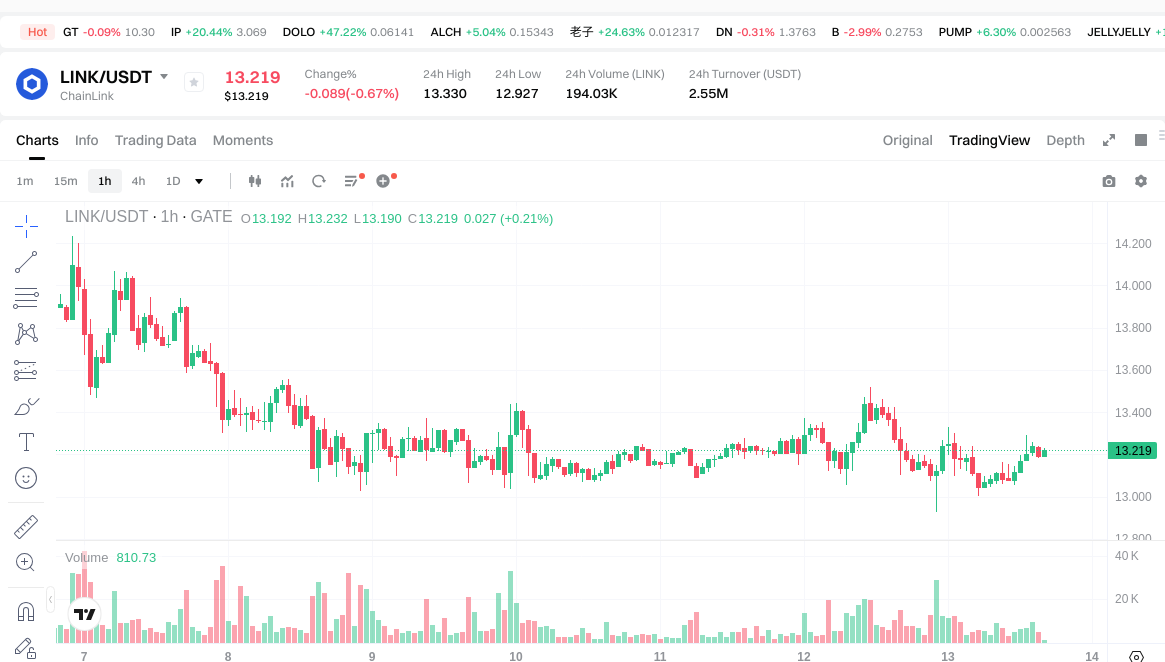
- Current LINK Price: $13.202 (as of January 13, 2026)
- 24-Hour Price Movement: -0.61% (decrease of $0.081)
- Recent Price Range: 1-hour change +0.12%, 7-day change -3.62%, 30-day change -3.56%
- 24-Hour Trading Volume: Approximately $2.56 billion
- Market Capitalization: $9.35 billion (circulating supply-based)
- Fully Diluted Market Cap: $13.20 billion
- Circulating Supply: 708.1 million LINK (70.81% of maximum supply)
- Whale Activity: Crypto whales accumulated over 680,000 LINK (approximately $8.5 million), indicating potential confidence in future price movements.
- Institutional Investment Products: Bitwise's Chainlink ETF has been approved for listing on NYSE Arca under ticker 'CLNK', while Grayscale's Chainlink ETF (GLNK) received $2.24 million in inflows recently.
- Exchange Listings: LINK is available on 72 exchanges, with active trading on major platforms.
Click to view real-time LINK market price
II. Core Factors Affecting Whether LINK is a Good Investment
Supply Mechanism and Scarcity (LINK Investment Scarcity)
- Fixed Maximum Supply → Influences Price and Investment Value
- LINK operates with a maximum supply of 1,000,000,000 tokens, with approximately 708,099,970 tokens currently in circulation (70.81% of total supply). This capped supply model creates a structural scarcity mechanism that may support long-term value appreciation as demand increases.
- Historical Pattern: LINK has experienced significant price fluctuations, with trading prices ranging from a low of $0.148183 to levels observed in recent periods. The circulating supply ratio continues to gradually increase as tokens are released into the market.
- Investment Significance: The fixed supply cap represents a fundamental constraint that differentiates LINK from inflationary assets, potentially serving as a key factor in long-term investment consideration.
Institutional Investment and Mainstream Adoption (Institutional Investment in LINK)
- Market Position Trend: LINK currently ranks #17 by market capitalization with approximately $9.35 billion in circulating market value and is listed on 72 exchanges globally. The token maintains a significant presence in the cryptocurrency market with a 0.40% market dominance.
- Ecosystem Adoption: As an ERC-20 standardized token on Ethereum, LINK serves as payment for Chainlink node operators who provide oracle services, including off-chain data retrieval, data formatting for blockchain compatibility, and off-chain computation. The network has attracted 120,837 token holders.
- Analyst Projections: Some market analysts project LINK could trade between $14.17 and $19.74 in 2025, with an average estimated price of $16.66. Various sources suggest potential price targets ranging from $19 to $22 by the end of 2025, while longer-term projections indicate possible growth toward higher levels by 2030.
Macroeconomic Environment's Impact on LINK Investment
- Market Volatility Context: LINK has demonstrated price sensitivity to broader market conditions, with recent performance showing a -0.61% change over 24 hours, -3.62% over 7 days, and -33.33% over the past year. These fluctuations reflect the token's responsiveness to changing market sentiment and economic conditions.
- Trading Activity: The token recorded a 24-hour trading volume of approximately $2.56 billion, indicating active market participation and liquidity.
- Geopolitical and Market Uncertainty: In the current market environment characterized by geopolitical risks, LINK has shown consolidation patterns as it establishes support levels. The token's role in connecting smart contracts with real-world data positions it within the broader trend of blockchain infrastructure development.
Technology and Ecosystem Development (Technology & Ecosystem for LINK Investment)
- Oracle Network Functionality: Chainlink operates as a decentralized oracle network that enables smart contracts on blockchain platforms to securely interact with real-world data, APIs, and traditional banking systems. This core functionality addresses a critical infrastructure need in the blockchain ecosystem.
- Network Security Model: LINK tokens function as part of the node operation framework, serving to prevent malicious actors and incentivize reliable oracle service provision. This token utility creates inherent demand tied to network usage.
- Ecosystem Applications: The Chainlink network supports various applications across DeFi, smart contracts, and data connectivity use cases. Some analysts highlight Chainlink's position in real-world asset (RWA) tokenization and its role as a leading oracle service provider in the blockchain space.
- Long-term Development Potential: Market observers note Chainlink's fundamental role in connecting smart contracts with external data sources, which may support sustained demand for oracle services as blockchain adoption expands across industries.
III. LINK Future Investment Prediction and Price Outlook (Is ChainLink(LINK) worth investing in 2026-2031)
Short-term Investment Prediction (2026, short-term LINK investment outlook)
- Conservative Forecast: $8.19 - $12.87
- Neutral Forecast: $13.22 - $13.55
- Optimistic Forecast: $13.87 - $15.22
Mid-term Investment Outlook (2027-2029, mid-term ChainLink(LINK) investment forecast)
- Market Stage Expectation: LINK may experience gradual growth as institutional adoption of blockchain oracle services expands and Chainlink's Cross-Chain Interoperability Protocol (CCIP) gains traction in Q1 2026.
- Investment Return Prediction:
- 2027: $12.87 - $18.70
- 2028: $10.96 - $19.35
- 2029: $15.96 - $20.22
- Key Catalysts: Launch of CCIP v1.5 on mainnet in Q1 2026, early access to Chainlink Confidential Compute enabling privacy-preserving smart contracts, accumulation of over $1 million in LINK by Chainlink Reserve since August 2025, approval of Bitwise Chainlink ETF (CLNK) on NYSE Arca, and Grayscale Chainlink ETF (GLNK) recording $2.24 million inflows.
Long-term Investment Outlook (Is LINK a good long-term investment?)
- Base Scenario: $12.71 - $22.96 (assuming steady development of oracle infrastructure and moderate DeFi sector growth through 2030)
- Optimistic Scenario: $20.97 - $23.00 (assuming widespread institutional adoption, successful implementation of CCIP across multiple blockchains, and favorable regulatory environment)
- Risk Scenario: $8.19 - $15.93 (under conditions of increased competition from alternative oracle providers, regulatory headwinds, or broader crypto market downturn)
Click to view LINK long-term investment and price prediction: Price Prediction
2026-2031 Long-term Outlook
- Base Scenario: $12.71 - $22.96 (corresponding to steady progress and gradual mainstream application enhancement)
- Optimistic Scenario: $20.97 - $23.00 (corresponding to large-scale adoption and favorable market conditions)
- Transformative Scenario: Above $23.00 (if ecosystem achieves breakthrough developments and mainstream popularization)
- 2031-12-31 Predicted High: $22.96 (based on optimistic development assumptions)
Disclaimer: Price predictions are speculative and based on historical data analysis and current market trends. Actual future prices may differ significantly due to numerous unpredictable factors including regulatory changes, technological developments, market sentiment, and macroeconomic conditions. This information should not be considered as investment advice.
| Year |
Predicted High Price |
Predicted Average Price |
Predicted Low Price |
Price Change |
| 2026 |
13.87785 |
13.217 |
8.19454 |
0 |
| 2027 |
18.6954465 |
13.547425 |
12.87005375 |
2 |
| 2028 |
19.3457229 |
16.12143575 |
10.96257631 |
22 |
| 2029 |
20.2162804305 |
17.733579325 |
15.9602213925 |
34 |
| 2030 |
22.9596651520775 |
18.97492987775 |
12.7132030180925 |
43 |
| 2031 |
22.64468131610685 |
20.96729751491375 |
15.93514611133445 |
58 |
IV. LINK Investment Strategy and Risk Management (How to invest in Chainlink)
Investment Strategy (LINK investment strategy)
-
Long-term Holding (HODL LINK): Suitable for conservative investors. With a historical low of $0.148183 and an all-time high of $52.7, LINK has demonstrated significant growth potential over time. Long-term holders may benefit from the token's role in supporting Chainlink node operators and its utility within the decentralized oracle network ecosystem.
-
Active Trading: Relies on technical analysis and swing trading strategies. LINK's 24-hour trading volume of approximately $2.56 billion indicates substantial liquidity, which can facilitate active trading opportunities. Investors may monitor price ranges (24h high: $13.33, 24h low: $12.927) and utilize technical indicators to identify entry and exit points.
Risk Management (Risk management for LINK investment)
V. LINK Investment Risks and Challenges (Risks of investing in Chainlink)
-
Market Risk:
- High volatility: LINK has experienced a 33.33% decline over the past year, demonstrating significant price fluctuations
- Price movements: 24-hour change of -0.61%, 7-day change of -3.62%, and 30-day change of -3.56% reflect ongoing market dynamics
- Trading volume fluctuations may impact liquidity during certain periods
-
Regulatory Risk:
- Uncertainty regarding cryptocurrency regulations across different jurisdictions
- Potential policy changes may affect token usage and trading accessibility
- ERC20 token classification may be subject to evolving regulatory frameworks
-
Technical Risk:
- Network security considerations related to Ethereum blockchain infrastructure
- Smart contract vulnerabilities that could potentially affect token operations
- Dependency on Chainlink network performance and node operator reliability
- Potential technical challenges during protocol upgrades or network maintenance
VI. Conclusion: Is Chainlink a Good Investment?
-
Investment Value Summary: LINK demonstrates notable long-term potential as an ERC20 token supporting Chainlink node operators in the decentralized oracle network. With a circulating supply of approximately 708 million tokens (70.81% of total supply) and a market capitalization of approximately $9.35 billion, LINK maintains its position as a significant player in the cryptocurrency market. However, price volatility remains a considerable factor, as evidenced by recent performance metrics.
-
Investor Recommendations:
✅ Beginners: Consider dollar-cost averaging (DCA) strategy combined with secure wallet storage. Start with small allocations and gradually build positions while learning about the Chainlink ecosystem.
✅ Experienced Investors: May implement swing trading strategies combined with portfolio diversification. Monitor technical indicators and market trends to optimize entry and exit points.
✅ Institutional Investors: Consider strategic long-term allocation as part of a diversified cryptocurrency portfolio, with proper risk assessment and compliance frameworks.
⚠️ Disclaimer: Cryptocurrency investments carry high risk due to market volatility and various factors discussed above. This content is for informational purposes only and does not constitute investment advice. Investors should conduct thorough research and consider their financial situation before making investment decisions.
VII. FAQ
Q1: Is ChainLink (LINK) a good investment for beginners in 2026?
LINK can be suitable for beginners who understand cryptocurrency risks and are willing to adopt a long-term perspective. As a decentralized oracle network token with a market capitalization of approximately $9.35 billion and listing on 72 exchanges, LINK offers reasonable liquidity and established market presence. Beginners should consider starting with a dollar-cost averaging (DCA) strategy, allocating only 5-10% of their crypto portfolio to LINK, and using secure storage solutions such as hardware wallets for long-term holdings. The token's role in connecting smart contracts with real-world data provides fundamental utility, though recent performance shows -33.33% decline over the past year, highlighting the importance of risk management and diversification.
Q2: What is the predicted price range for LINK in 2027?
Based on current market analysis and various forecasting models, LINK is predicted to trade between $12.87 and $18.70 in 2027, with potential for higher levels depending on market conditions. This forecast assumes continued development of Chainlink's oracle infrastructure, successful implementation of the Cross-Chain Interoperability Protocol (CCIP), and moderate growth in the DeFi sector. Key catalysts that may influence this outlook include institutional adoption, regulatory developments, and the broader cryptocurrency market environment. However, these predictions are speculative and subject to significant uncertainty due to market volatility, competitive dynamics, and technological developments.
Q3: How does LINK's fixed supply mechanism affect its investment value?
LINK operates with a maximum supply cap of 1 billion tokens, with approximately 708.1 million tokens currently in circulation (70.81% of total supply). This fixed supply model creates structural scarcity that may support long-term value appreciation as demand increases, distinguishing LINK from inflationary assets. The circulating supply ratio gradually increases as tokens are released into the market according to the project's distribution schedule. This scarcity mechanism, combined with LINK's utility as payment for Chainlink node operators providing oracle services, creates potential upward price pressure when network usage expands. However, investors should note that scarcity alone does not guarantee price appreciation and must be evaluated alongside adoption metrics, competitive positioning, and overall market conditions.
Q4: What are the main risks associated with investing in LINK?
LINK investment carries three primary risk categories: (1) Market Risk - high volatility demonstrated by a 33.33% decline over the past year and recent short-term fluctuations including -3.62% over 7 days; (2) Regulatory Risk - uncertainty regarding cryptocurrency regulations across jurisdictions and potential policy changes affecting token usage and trading accessibility; (3) Technical Risk - network security considerations related to Ethereum blockchain infrastructure, smart contract vulnerabilities, dependency on node operator reliability, and potential challenges during protocol upgrades. Additionally, LINK faces competitive pressure from alternative oracle providers and correlation with broader cryptocurrency market movements. Investors should implement proper risk management through diversified portfolios, appropriate position sizing, and secure storage practices.
Q5: How does institutional investment impact LINK's future prospects?
Institutional investment significantly influences LINK's market outlook and potential price appreciation. Recent developments include the approval of Bitwise's Chainlink ETF (CLNK) for listing on NYSE Arca and Grayscale's Chainlink ETF (GLNK) recording $2.24 million in inflows. Additionally, crypto whales accumulated over 680,000 LINK (approximately $8.5 million), indicating confidence in future price movements. These institutional activities provide enhanced legitimacy, improved liquidity, and broader market access for LINK. The Chainlink Reserve has accumulated over $1 million in LINK since August 2025, further demonstrating institutional-level commitment. Such developments typically correlate with reduced volatility, increased price stability, and potential for sustained growth, though they do not eliminate investment risks inherent in cryptocurrency markets.
Q6: What role does Chainlink's technology play in determining LINK's investment value?
Chainlink's core technology as a decentralized oracle network fundamentally underpins LINK's investment thesis. The network enables smart contracts on blockchain platforms to securely interact with real-world data, APIs, and traditional banking systems, addressing critical infrastructure needs in the blockchain ecosystem. LINK tokens serve as payment for node operators who provide oracle services including off-chain data retrieval, data formatting for blockchain compatibility, and off-chain computation. This utility creates inherent demand tied to network usage. The upcoming launch of CCIP v1.5 on mainnet in Q1 2026 and early access to Chainlink Confidential Compute for privacy-preserving smart contracts represent significant technological advancements. As blockchain adoption expands across industries, particularly in DeFi and real-world asset (RWA) tokenization, demand for reliable oracle services may increase, potentially supporting long-term LINK value appreciation.
Q7: Should investors buy LINK during the current market conditions in 2026?
Investment decisions depend on individual risk tolerance, investment horizon, and portfolio strategy. At the current price of $13.202 (as of January 13, 2026), LINK trades approximately 75% below its 2021 peak of $52.7, which may present a relative value opportunity for long-term investors who believe in the project's fundamental utility. However, recent performance shows negative momentum with -3.62% over 7 days and -33.33% over the past year, suggesting caution is warranted. Conservative investors may consider implementing a dollar-cost averaging approach to mitigate timing risk, while experienced traders might evaluate technical indicators and market sentiment before establishing positions. The 24-hour trading volume of approximately $2.56 billion indicates sufficient liquidity for entry and exit. Investors should assess whether LINK aligns with their investment objectives, conduct thorough research on Chainlink's technology and competitive positioning, and maintain appropriate risk management through diversification and position sizing.
Q8: What is the difference between LINK's circulating market cap and fully diluted market cap?
LINK's circulating market capitalization is approximately $9.35 billion, calculated based on the 708.1 million tokens currently in circulation (70.81% of maximum supply). The fully diluted market cap is $13.20 billion, representing the theoretical market value if all 1 billion maximum supply tokens were in circulation at the current price of $13.202. This difference of approximately $3.85 billion reflects future token releases according to Chainlink's distribution schedule. Investors should understand that as additional tokens enter circulation, potential dilution may occur, which could exert downward pressure on price absent corresponding demand increases. The gradual release of remaining 291.9 million tokens (29.19% of total supply) represents a factor to consider when evaluating long-term investment scenarios, as the circulating supply will continue expanding toward the maximum cap over time.
* The information is not intended to be and does not constitute financial advice or any other recommendation of any sort offered or endorsed by Gate.