This comprehensive analysis evaluates whether ChainOpera AI (COAI) represents a sound investment opportunity in the emerging AI-blockchain sector. The article examines COAI's tokenomics, market fundamentals, and price dynamics—currently trading at $0.4323 with a market cap of $84.94 million and 42,270 holders across 14 exchanges including Gate. Key investment considerations include substantial supply overhang (only 19.65% circulating), extreme historical volatility ranging from $0.349 to $47.98, and concentrated ownership among top holders. The analysis presents price forecasts for 2026-2031 across conservative, neutral, and optimistic scenarios while outlining diversified investment strategies for different investor profiles. Risk factors include market volatility, regulatory uncertainty, technical development challenges, and liquidity constraints. The conclusion positions COAI as a high-risk, early-stage opportunity requiring careful position sizing, risk management, and fundamental research before investme
Introduction: ChainOpera AI (COAI) Investment Position and Market Outlook
COAI is an emerging digital asset in the cryptocurrency sector, representing ChainOpera AI, a blockchain-based full-stack AI platform. As of January 18, 2026, COAI holds a market ranking of 401, with a market capitalization of approximately $84.94 million and a circulating supply of 196.48 million tokens. The current price stands at $0.4323, reflecting a 24-hour trading volume of $582,739.83. With approximately 42,270 holders and trading availability across 14 exchanges, COAI has been gaining attention within the decentralized AI infrastructure space. Positioned as a collaborative intelligence network co-created and co-owned by its community, the platform integrates AI applications for end users, a developer platform for agent creation, and a decentralized infrastructure layer for model and GPU resources. This article provides a comprehensive analysis of COAI's investment value, historical performance trends, future price projections, and associated investment risks to serve as a reference for investors evaluating "Is ChainOpera AI (COAI) a good investment?"
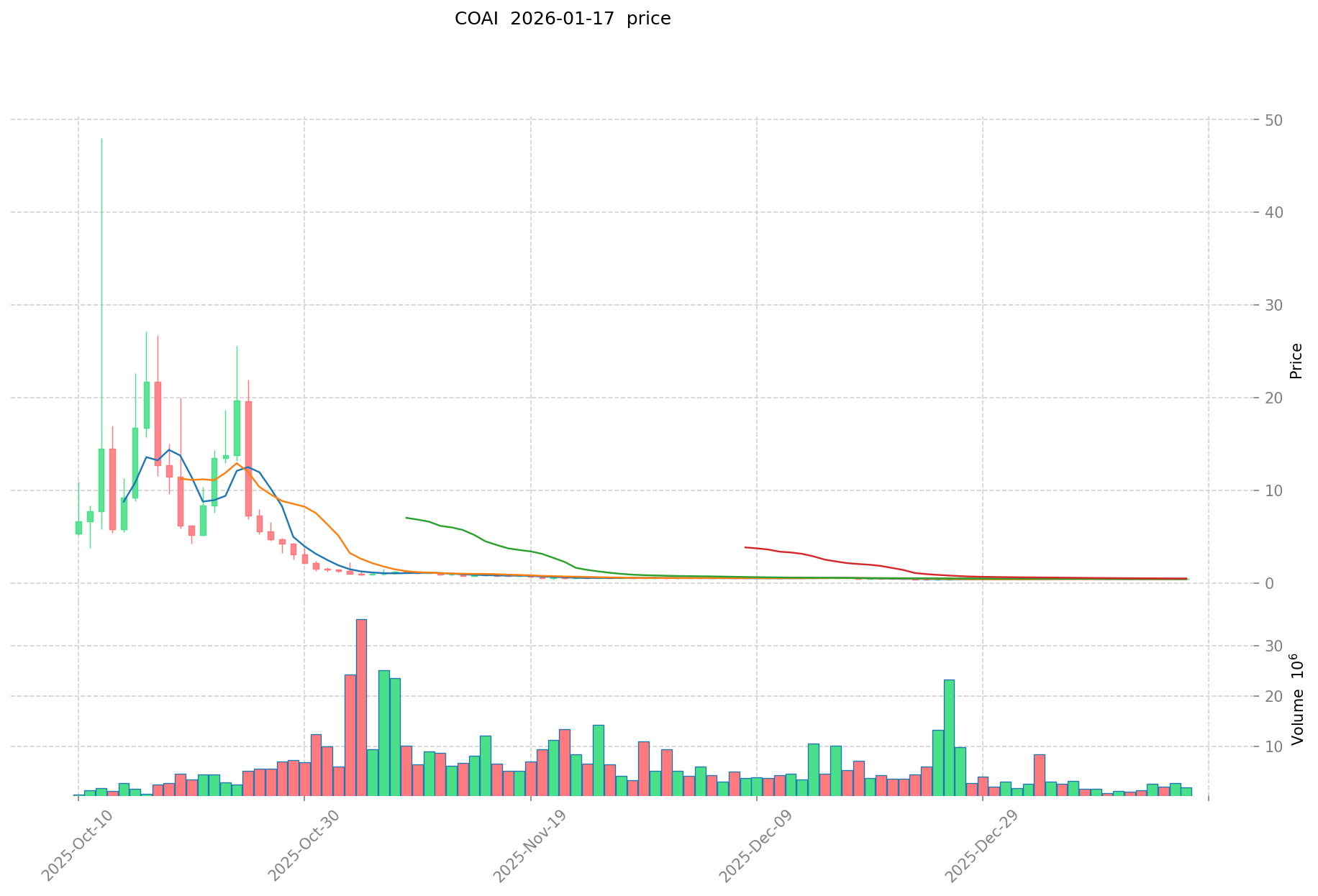
I. ChainOpera AI (COAI) Price History Review and Current Investment Value
- 2025: Token launch and initial trading phase → COAI was first published on January 25, 2025, with investors experiencing significant volatility during the early stage of market formation
- October 2025: Peak price event → COAI reached a notable price level of $47.978 on October 12, 2025, reflecting strong market interest during this period
- December 2025: Market correction phase → Price declined from higher levels to $0.349 on December 24, 2025, demonstrating typical market cycle fluctuations
Current COAI Investment Market Status (January 2026)
- COAI current price: $0.4323
- 24-hour trading volume: $582,739.82
- Market capitalization: $84,937,987
- Circulating supply: 196,479,267 COAI (19.65% of total supply)
- Current market ranking: #401
- Total supply: 1,000,000,000 COAI
- Contract standard: BEP-20
- Number of holders: 42,270
- Listed exchanges: 14
Click to view real-time COAI market price
II. Core Factors Influencing Whether COAI is a Good Investment
Supply Mechanism and Scarcity (COAI Investment Scarcity)
ChainOpera AI (COAI) has a total supply of 1,000,000,000 tokens with a maximum supply also capped at 1,000,000,000. As of January 18, 2026, the circulating supply stands at 196,479,267 tokens, representing approximately 19.65% of the total supply. This limited circulating percentage indicates that a substantial portion of tokens remains locked or unvested.
The concentration of supply presents both opportunities and risks. Over 96% of COAI tokens are reportedly held by the top 10 wallets, primarily due to team and investor lockups. This concentrated ownership structure creates potential scarcity in the immediate market but simultaneously introduces significant volatility risk, as large holders could influence price movements substantially once unlocking events occur.
Historical price data shows considerable fluctuation: COAI experienced a surge from approximately $0.14 to levels near $5.77 within a short period, before subsequently declining. The token reached a peak price of $47.978 on October 12, 2025, but fell to a low of $0.349 on December 24, 2025. Such dramatic price swings reflect the impact of supply dynamics and holder behavior on market valuation.
For long-term investment considerations, the scheduled release of locked tokens represents a critical factor. Major token unlock events could increase circulating supply substantially, potentially diluting scarcity value and creating downward price pressure. Investors should monitor roadmap milestones and vesting schedules closely, as these events may serve as inflection points for COAI's supply-demand balance.
Institutional Investment and Mainstream Adoption (Institutional Investment in COAI)
Available data indicates that COAI is listed on 14 exchanges and has attracted attention within the AI-blockchain sector. The token has accumulated 42,270 holders as of the latest data, suggesting a growing but still relatively modest retail investor base.
While specific institutional investment figures are not provided in the reference materials, the project's positioning as a "decentralized AI stack" and its presence on multiple trading platforms suggest some level of market validation. The platform's promise to enable users and developers to create, deploy, and monetize AI models on Binance Smart Chain positions it within a sector that has attracted both retail speculation and institutional interest.
However, the lack of detailed information regarding institutional holders, strategic partnerships, or enterprise adoption cases limits the ability to assess mainstream adoption trajectory. The current holder count and exchange listings indicate early-stage market penetration rather than established institutional backing.
Regulatory considerations also play a role in institutional participation. The reference materials note that regulatory uncertainty contributed to previous price instability. Clear regulatory frameworks and compliance measures would be necessary to attract more conservative institutional investors seeking exposure to AI-blockchain projects.
Macroeconomic Environment Impact on COAI Investment
The broader cryptocurrency market environment significantly influences COAI's investment profile. As a high-volatility asset within the AI-crypto sector, COAI's performance appears sensitive to overall market sentiment and risk appetite.
Monetary policy shifts and interest rate environments affect capital flows into speculative digital assets. During periods of tightening monetary policy or rising interest rates, risk assets like COAI may face reduced demand as investors rotate toward lower-risk alternatives. Conversely, accommodative monetary conditions could support renewed interest in growth-oriented crypto projects.
While some established cryptocurrencies are positioned as inflation hedges or "digital gold," COAI's current stage of development and high volatility make it more suitable for risk-seeking investors rather than those seeking stable value preservation. The token's dramatic price movements reflect speculative trading patterns rather than stable store-of-value characteristics.
Geopolitical uncertainty and macroeconomic instability can create both opportunities and risks for crypto investments. Increased uncertainty may drive interest in decentralized technologies, but it can also trigger broad market sell-offs that impact high-beta assets like COAI disproportionately.
Technology and Ecosystem Development (Technology & Ecosystem for COAI Investment)
ChainOpera AI positions itself as a full-stack AI platform integrating three core capabilities: an AI application for end users, a developer platform for agent creation, and a decentralized infrastructure layer for model and GPU resources. This comprehensive approach aims to establish a network of AI agents and models co-created and co-owned by the community.
The project's technical roadmap includes planned milestones such as testnet and mainnet launches, which could serve as catalysts for increased adoption and investment interest. Successful deployment of these infrastructure components would demonstrate technical viability and potentially attract developer activity to the ecosystem.
ChainOpera AI's integration with Binance Smart Chain provides access to an established blockchain infrastructure with lower transaction costs and faster processing compared to some alternative networks. The use of the BEP-20 token standard enables interoperability within the BSC ecosystem and facilitates integration with existing DeFi protocols and applications.
However, the practical utility and adoption metrics of the ChainOpera AI platform remain limited in the available data. The absence of detailed information regarding active users, deployed AI models, developer engagement, or real-world applications makes it challenging to assess the platform's progress in building a sustainable ecosystem.
For COAI to deliver long-term investment value, the project must demonstrate tangible progress in ecosystem development, including user acquisition, developer adoption, partnerships, and practical use cases that justify the platform's value proposition. Until such fundamentals are established and verifiable, investment considerations should acknowledge the speculative nature and high-risk profile of the asset.
III. COAI Future Investment Forecast and Price Outlook (Is ChainOpera AI(COAI) worth investing in 2026-2031)
Short-term Investment Outlook (2026, short-term COAI investment outlook)
Based on current market conditions and recent technical patterns, COAI presents several possible scenarios for 2026. The token currently trades around $0.43, showing modest volatility with 24-hour fluctuations between $0.4257 and $0.4453.
- Conservative forecast: $0.26 - $0.43
- Neutral forecast: $0.43 - $0.57
- Optimistic forecast: $0.50 - $0.88
The short-term outlook reflects ongoing market consolidation following the token's significant price correction from its October 2025 peak. Technical indicators suggest stabilization around current levels, though momentum indicators show mixed signals that warrant cautious positioning.
Mid-term Investment Outlook (2027-2029, mid-term ChainOpera AI(COAI) investment forecast)
-
Market Phase Expectations: The mid-term period may witness gradual ecosystem development as the project advances its decentralized AI infrastructure. Market sentiment could shift from recovery mode to growth orientation if key deliverables materialize.
-
Investment Return Projections:
- 2027: $0.23 - $0.61
- 2028: $0.40 - $0.66
- 2029: $0.35 - $0.89
-
Key Catalysts: Successful implementation of AI agent platforms, expansion of developer community, strategic partnerships with AI and blockchain enterprises, and broader market recovery in the AI-crypto convergence sector.
Long-term Investment Outlook (Is COAI a good long-term investment?)
- Base Scenario: $0.49 - $0.91 (assuming steady ecosystem development and moderate market conditions)
- Optimistic Scenario: $0.60 - $1.90 (assuming successful product delivery and favorable AI narrative)
- Risk Scenario: $0.10 - $0.50 (under conditions of continued selling pressure or prolonged market downturn)
Click to view COAI long-term investment and price forecast: Price Prediction
2026-2031 Long-term Outlook
- Base Scenario: $0.42 - $0.91 USD (corresponding to steady progress and gradual mainstream application advancement)
- Optimistic Scenario: $0.60 - $1.90 USD (corresponding to large-scale adoption and favorable market environment)
- Transformative Scenario: Above $3.00 USD (contingent on breakthrough ecosystem developments and mainstream penetration)
- Predicted High for 2031-12-31: $1.90 USD (based on optimistic development assumptions)
Disclaimer: Price predictions are speculative and subject to high uncertainty. Cryptocurrency investments carry substantial risk, including potential total loss of capital. The forecasts presented are derived from current market analysis and historical patterns but do not constitute financial advice or guaranteed outcomes. Investors should conduct independent research and consider their risk tolerance before making investment decisions.
| Year |
Predicted High Price |
Predicted Average Price |
Predicted Low Price |
Price Change |
| 2026 |
0.567885 |
0.4335 |
0.255765 |
0 |
| 2027 |
0.57078945 |
0.5006925 |
0.305422425 |
15 |
| 2028 |
0.664318809 |
0.535740975 |
0.3964483215 |
23 |
| 2029 |
0.88804424016 |
0.600029892 |
0.34801733736 |
38 |
| 2030 |
0.9970096685472 |
0.74403706608 |
0.6175507648464 |
72 |
| 2031 |
0.91404953567928 |
0.8705233673136 |
0.487493085695616 |
101 |
IV. COAI Investment Strategy and Risk Management (How to invest in ChainOpera AI)
Investment Strategy (COAI investment strategy)
Long-term Holding (HODL COAI)
Long-term holding represents a strategy suitable for conservative investors who believe in the fundamental value proposition of ChainOpera AI's blockchain-based AI platform. This approach involves acquiring COAI tokens and maintaining positions through market cycles, focusing on the project's development milestones rather than short-term price movements.
Given COAI's market capitalization of approximately $84.94 million and a circulation ratio of 19.65%, early-stage investors should consider the token's supply dynamics. With 196.48 million tokens currently in circulation out of a maximum supply of 1 billion, future token releases may impact price dynamics over extended holding periods.
Active Trading Strategy
Active trading strategies for COAI rely on technical analysis and momentum-based operations. Recent price data shows:
- 1-hour change: +0.35%
- 24-hour change: -2.03%
- 7-day change: +3.17%
- 30-day change: +3.84%
- 1-year change: +157.20%
The 24-hour trading range between $0.4257 and $0.4453 suggests moderate intraday volatility, which may present opportunities for traders employing swing trading or scalping strategies. The daily trading volume of approximately $582,740 indicates modest liquidity that traders should factor into position sizing decisions.
Risk Management (Risk management for COAI investment)
Asset Allocation Recommendations
Conservative Investors: Allocation to COAI should represent no more than 1-3% of total cryptocurrency portfolio, with the remainder distributed across established digital assets and traditional financial instruments.
Aggressive Investors: May consider allocating 5-10% of their cryptocurrency portfolio to COAI, recognizing the higher risk-reward profile associated with emerging AI-blockchain projects.
Professional Investors: Institutional or sophisticated investors might allocate 3-7% of digital asset holdings to COAI as part of a diversified AI-focused cryptocurrency strategy, with appropriate hedging mechanisms in place.
Risk Hedging Solutions
Multi-asset portfolio construction remains essential for COAI investors. Diversification across different blockchain sectors (DeFi, infrastructure, gaming) and traditional hedging instruments can help mitigate concentration risk. The token's presence on 14 exchanges provides multiple venues for position management and risk distribution.
Secure Storage Solutions
Cold Wallet Storage: For long-term holdings, hardware wallets supporting BEP-20 tokens provide optimal security. COAI's deployment on BSC (contract address: 0x0a8d6c86e1bce73fe4d0bd531e1a567306836ea5) requires compatible wallet infrastructure.
Hot Wallet Considerations: For active traders, exchange-based wallets offer convenience but require enhanced security measures including two-factor authentication and withdrawal whitelisting.
Hardware Wallet Recommendations: Devices supporting BSC-based tokens provide secure offline storage options, particularly important given the project's holder base of 42,270 addresses.
V. COAI Investment Risks and Challenges (Risks of investing in ChainOpera AI)
Market Risks
High Volatility: COAI has demonstrated significant price volatility, with historical prices ranging from an all-time high of $47.98 (October 12, 2025) to an all-time low of $0.349 (December 24, 2025). This represents extreme price swings that investors must be prepared to withstand.
Price Discovery Phase: With a market cap to fully diluted valuation ratio of 19.65%, the token remains in early circulation stages. Additional token releases from the remaining 80.35% of supply could create selling pressure as the project develops.
Market Manipulation Concerns: The relatively modest 24-hour trading volume of approximately $582,740 suggests that large transactions could significantly impact price stability, potentially exposing investors to manipulation risks in less liquid market conditions.
Regulatory Risks
Jurisdictional Uncertainty: AI-focused blockchain projects operate in a regulatory gray area across multiple jurisdictions. As governments worldwide develop frameworks for both artificial intelligence and cryptocurrency regulation, COAI could face compliance challenges that impact its operational capabilities and token valuation.
Policy Evolution: The intersection of decentralized AI infrastructure and cryptocurrency creates unique regulatory considerations. Changes in data privacy laws, AI governance standards, or cryptocurrency classification could affect the project's business model and token utility.
Technical Risks
Network Security: As a BEP-20 token on Binance Smart Chain, COAI inherits the underlying blockchain's security properties while introducing project-specific smart contract risks. Vulnerabilities in the token contract or associated platform infrastructure could compromise user funds or platform functionality.
Platform Development Challenges: The project's integration of AI applications, developer tools, and decentralized GPU infrastructure represents significant technical complexity. Development delays, integration failures, or competitive technological advances could impact the project's value proposition and token demand.
Scalability Concerns: As the platform scales its AI agent network and GPU resource allocation, technical bottlenecks or infrastructure limitations could affect user experience and adoption rates, potentially influencing long-term token value.
VI. Conclusion: Is ChainOpera AI a Good Investment?
Investment Value Summary
ChainOpera AI presents a high-risk, high-potential opportunity in the emerging AI-blockchain convergence sector. The token has demonstrated considerable price appreciation over the past year (+157.20%), though it currently trades significantly below its historical peak. With a market dominance of 0.012% and ranking at position 401, COAI represents an early-stage project with growth potential tied to successful execution of its full-stack AI platform vision.
The project's three-layer architecture—end-user applications, developer platform, and decentralized infrastructure—addresses real market needs in collaborative AI development. However, significant supply overhang (80.35% of tokens not yet circulating) and modest trading liquidity present near-term challenges.
Investor Recommendations
✅ Beginners: Consider dollar-cost averaging with small allocations (1-2% of cryptocurrency portfolio) and utilize hardware wallet storage for holdings. Focus on understanding the project fundamentals before increasing exposure. Given the project's early stage and volatility profile, new investors should prioritize education and risk management over position sizing.
✅ Experienced Investors: May employ swing trading strategies capitalizing on the token's volatility patterns while maintaining a core long-term position. Portfolio allocation of 3-5% could be appropriate for those with higher risk tolerance and understanding of AI-blockchain sector dynamics. Consider monitoring development milestones and community growth metrics (currently 42,270 holders) as indicators of project traction.
✅ Institutional Investors: Strategic long-term allocation of 2-4% within diversified AI-focused cryptocurrency portfolios may be suitable for institutions with appropriate risk management frameworks. The project's presence on 14 exchanges and BEP-20 standard compatibility facilitates institutional participation, though liquidity constraints should be factored into position building strategies.
⚠️ Disclaimer: Cryptocurrency investments carry substantial risk of capital loss. COAI's extreme historical volatility, early development stage, and evolving regulatory landscape create significant uncertainty. This analysis is provided for informational purposes only and does not constitute financial, investment, or legal advice. Prospective investors should conduct independent research, assess their risk tolerance, and consult qualified financial advisors before making investment decisions.
VII. FAQ
Q1: What is ChainOpera AI (COAI) and what makes it different from other AI crypto projects?
ChainOpera AI (COAI) is a full-stack AI platform built on Binance Smart Chain that integrates three core components: AI applications for end users, a developer platform for creating AI agents, and a decentralized infrastructure layer for model and GPU resources. Unlike single-purpose AI tokens, COAI aims to establish a comprehensive "collaborative intelligence network" that is co-created and co-owned by its community. The project's BEP-20 token standard enables interoperability within the BSC ecosystem, providing access to lower transaction costs and faster processing compared to some alternative blockchain networks. As of January 2026, COAI holds a market ranking of #401 with approximately 42,270 holders across 14 exchanges.
Q2: Is COAI a good short-term or long-term investment?
COAI presents different risk-reward profiles for short-term versus long-term investors. For short-term trading (2026), the token shows moderate volatility with forecasts ranging from $0.26 to $0.88 depending on market conditions, making it suitable for active traders who can manage high volatility. For long-term investment (2026-2031), COAI's value depends heavily on successful execution of its decentralized AI platform, with base scenario projections between $0.42 and $0.91, and optimistic scenarios reaching $1.90 by 2031. However, investors should note that 80.35% of tokens remain locked, which could create selling pressure upon release. The token's extreme historical volatility—ranging from $0.349 to $47.98—indicates substantial risk that requires appropriate position sizing and risk management regardless of investment horizon.
Q3: What are the main risks of investing in COAI?
COAI carries several significant risk factors that investors must consider. First, market risks include extreme price volatility, with the token experiencing swings from $47.98 to $0.349 within a short period, and relatively low liquidity with only $582,740 in 24-hour trading volume. Second, supply risks exist with only 19.65% of total tokens currently circulating; future unlocking events could substantially dilute value. Third, technical risks include smart contract vulnerabilities, platform development challenges, and scalability concerns for the AI infrastructure. Fourth, regulatory uncertainty affects both cryptocurrency and AI governance frameworks globally. Finally, the project's early-stage development means limited proven use cases and uncertain adoption metrics, making COAI a highly speculative investment suitable primarily for risk-tolerant investors.
Q4: How should I allocate COAI in my investment portfolio?
Portfolio allocation for COAI should be based on your risk tolerance and investment experience. Conservative investors should limit COAI exposure to 1-3% of their total cryptocurrency portfolio, with the remainder distributed across established digital assets and traditional financial instruments. Aggressive investors may consider 5-10% allocation within their crypto holdings, recognizing the higher risk-reward profile of emerging AI-blockchain projects. Professional or institutional investors might allocate 3-7% of digital asset portfolios to COAI as part of a diversified AI-focused cryptocurrency strategy with appropriate hedging mechanisms. Regardless of allocation level, investors should employ dollar-cost averaging to manage entry timing risk, utilize secure storage solutions (hardware wallets supporting BEP-20 tokens), and maintain diversification across multiple blockchain sectors to mitigate concentration risk.
Q5: What price predictions exist for COAI through 2031?
Price forecasts for COAI vary significantly based on market scenarios and adoption assumptions. For 2026, short-term projections range from conservative ($0.26-$0.43) to optimistic ($0.50-$0.88) scenarios. Mid-term forecasts (2027-2029) suggest potential ranges between $0.23-$0.89 depending on ecosystem development progress. Long-term predictions through 2031 show a base scenario of $0.49-$0.91, an optimistic scenario of $0.60-$1.90, and a transformative scenario exceeding $3.00 if breakthrough developments occur. The predicted high for December 31, 2031, stands at $1.90 based on optimistic development assumptions. However, these forecasts are highly speculative and subject to numerous variables including market conditions, regulatory developments, competitive dynamics, and the project's execution capabilities. Investors should view these predictions as reference points rather than guaranteed outcomes.
Q6: How does COAI's supply mechanism affect investment potential?
COAI's supply structure significantly impacts its investment dynamics. The token has a maximum supply of 1,000,000,000 with only 196,479,267 tokens (19.65%) currently in circulation as of January 2026. This limited circulating percentage creates immediate scarcity but introduces substantial risk from future token releases. Over 96% of COAI tokens are reportedly held by the top 10 wallets, primarily due to team and investor lockups, creating concentrated ownership that could drive significant price volatility once unlocking occurs. The scheduled release of locked tokens represents critical inflection points that investors must monitor closely, as major unlock events could increase circulating supply substantially and create downward price pressure. While current scarcity may support price levels, the potential for supply dilution makes understanding vesting schedules and roadmap milestones essential for assessing COAI's long-term investment viability.
Q7: What security measures should I take when investing in COAI?
Securing COAI investments requires implementing multiple protective measures. For long-term holdings, hardware wallets supporting BEP-20 tokens provide optimal security through offline storage solutions. COAI's deployment on Binance Smart Chain (contract address: 0x0a8d6c86e1bce73fe4d0bd531e1a567306836ea5) requires compatible wallet infrastructure such as Ledger or Trezor devices with BSC support. For active traders using exchange-based wallets, essential security practices include enabling two-factor authentication, implementing withdrawal whitelisting, and distributing holdings across multiple platforms to reduce concentration risk. Given COAI's presence on 14 exchanges, investors have multiple venues for risk distribution. Additionally, investors should verify contract addresses before transactions, avoid sharing private keys, maintain updated security software, and consider portfolio insurance options where available to protect against exchange failures or security breaches.
Q8: What factors could drive COAI's price higher in the future?
Several potential catalysts could positively influence COAI's price trajectory. Technology development milestones including successful testnet and mainnet launches would demonstrate technical viability and potentially attract developer adoption. Ecosystem growth measured by increasing active users, deployed AI models, and developer engagement would validate the platform's value proposition. Strategic partnerships with established AI and blockchain enterprises could provide credibility and accelerate adoption. Broader market trends favoring AI-blockchain convergence projects and accommodative monetary policy supporting risk assets could benefit COAI. Additionally, clear regulatory frameworks providing compliance pathways might attract institutional investment currently constrained by uncertainty. The project's integration with Binance Smart Chain provides infrastructure advantages, while growing mainstream recognition of decentralized AI applications could drive demand. However, realizing these catalysts depends on successful execution, competitive positioning, and favorable market conditions that remain uncertain.
* The information is not intended to be and does not constitute financial advice or any other recommendation of any sort offered or endorsed by Gate.