This comprehensive analysis examines CHEQD NETWORK (CHEQ) as an investment opportunity within the decentralized identity and trusted data economy sector. The article evaluates CHEQ's current market position with a $6.69 million market cap and $0.006873 price point, reviews its dramatic 99% decline from 2021 peaks, and explores institutional backing from Evernym. Key investment considerations include limited liquidity ($16,030 daily volume), high circulation ratio (97.31%), and Layer 1 technology built on Cosmos SDK. Price forecasts range from conservative 2026 estimates of $0.00535-$0.00892 to optimistic 2031 projections reaching $0.0193, contingent on ecosystem adoption and regulatory developments. The analysis addresses market risks, regulatory uncertainties, and technical challenges while providing tailored recommendations for beginners, experienced investors, and institutions. Suitable for investors researching identity-focused blockchain opportunities on Gate exchange.
Introduction: CHEQD NETWORK (CHEQ) Investment Position and Market Outlook
CHEQ is a notable asset in the cryptocurrency space, focusing on building a trusted data economy through verifiable credentials and decentralized identity solutions. As of January 28, 2026, CHEQ holds a market capitalization of approximately $6.69 million, with a circulating supply of about 973.10 million tokens and a current price around $0.006873. The project positions itself within the decentralized identity and data monetization sector, utilizing the Cosmos SDK to create a Layer 1 network with customizable governance structures. With a market dominance of 0.00021% and ranking at 1395, CHEQ has attracted attention from investors exploring opportunities in identity infrastructure and data economy solutions. This article provides a comprehensive analysis of CHEQ's investment characteristics, historical price trends, future price outlook, and associated risks to serve as a reference for investors evaluating the question "Is CHEQD NETWORK (CHEQ) a good investment?"
I. CHEQ Price History Review and Current Investment Value
- November 2021: Token reached a price of $0.71551 following market launch → Early investors experienced substantial gains during the initial trading period
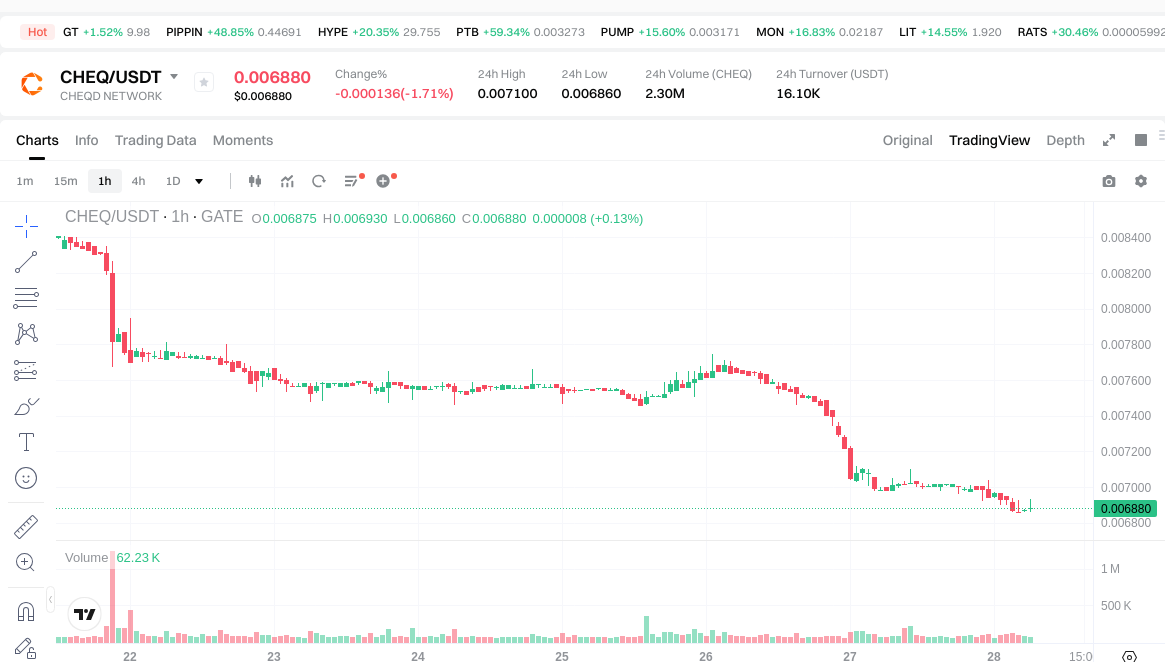
- January 2026: Price declined to $0.00686065 → CHEQ experienced a significant correction of over 99% from its earlier peak levels
- 2025-2026: Market cycle correction → Price decreased from higher levels to the current range near historical lower bounds
Current CHEQ Investment Market Status (January 2026)
- CHEQ current price: $0.006873
- Market sentiment (based on price momentum): Neutral to cautious, with a 24-hour decline of 1.77%
- 24-hour trading volume: $16,030.28
- Market capitalization: Approximately $6.69 million with a circulating supply of 973,095,905 CHEQ tokens
Click to view real-time CHEQ market price
II. Core Factors Influencing Whether CHEQ is a Good Investment
Supply Mechanism and Scarcity (CHEQ Investment Scarcity)
- Total supply capped at 1,000,000,000 tokens with a circulating supply of 973,095,905 tokens (97.31% of total supply) → impacts price dynamics and investment value
- The high circulation ratio suggests limited future dilution potential, which may contribute to supply-side stability
- Investment significance: Understanding token distribution and supply constraints remains relevant for evaluating long-term investment considerations
Institutional Investment and Mainstream Adoption (Institutional Investment in CHEQ)
- CHEQD Network is supported by Evernym, described as a leading provider in decentralized and self-sovereign identity solutions, and Outlier Ventures
- The network's infrastructure enables customizable business models and governance structures for verifiable credentials → potential institutional appeal in identity verification sectors
- Adoption by ecosystem participants seeking to monetize trusted data exchanges may influence investment outlook
Macroeconomic Environment's Impact on CHEQ Investment
- Broader cryptocurrency market conditions and monetary policy shifts → affect overall digital asset investment sentiment
- Market capitalization standing at approximately $6.69 million (as of January 28, 2026) reflects niche positioning within the broader crypto economy
- Geopolitical and regulatory developments in data privacy and digital identity sectors → may create demand dynamics for identity-focused blockchain solutions
Technology and Ecosystem Development (Technology & Ecosystem for CHEQ Investment)
- Built using Cosmos SDK as a dedicated Layer 1 network with native payment token functionality → supports verifiable credential exchanges
- Ecosystem focus on trusted data economy enables new business models for credential verification with enhanced security and cost efficiency
- Expanding applications in decentralized identity, data monetization, and potential integration with identity verification systems → may support long-term ecosystem value propositions
III. CHEQ Future Investment Forecast and Price Outlook (Is CHEQD NETWORK(CHEQ) worth investing in 2026-2031)
Short-term Investment Forecast (2026, short-term CHEQ investment outlook)
- Conservative forecast: $0.00535392 - $0.006864
- Neutral forecast: $0.006864 - $0.0089232
- Optimistic forecast: $0.0089232 or above
Mid-term Investment Outlook (2027-2029, mid-term CHEQD NETWORK(CHEQ) investment forecast)
- Market stage expectation: Based on reference data, CHEQ may experience gradual recovery and development from 2027 to 2029, with potential price increases ranging from approximately 14% to 70% compared to 2026 levels.
- Investment return forecast:
- 2027: $0.005367648 - $0.011761464
- 2028: $0.00874650348 - $0.01356199416
- 2029: $0.0094727580948 - $0.0170743540968
- Key catalysts: Market recovery momentum, expansion of verifiable credentials applications, and broader adoption of decentralized identity solutions.
Long-term Investment Outlook (Is CHEQ a good long-term investment?)
- Base scenario: $0.011651492456604 - $0.016973779134312 (assuming steady ecosystem development and moderate market conditions through 2030)
- Optimistic scenario: $0.015679168861356 - $0.019285377699467 (assuming enhanced adoption of identity verification technologies and favorable regulatory environment through 2031)
- Risk scenario: $0.008309959496518 or below (in case of prolonged market downturn or significant competitive pressures)
For more details on CHEQ long-term investment and price forecasts: Price Prediction
2026-01-28 to 2031 Long-term Outlook
- Base scenario: $0.00535392 - $0.0143845585884 (corresponding to steady progress and gradual mainstream application growth)
- Optimistic scenario: $0.015679168861356 - $0.019285377699467 (corresponding to large-scale adoption and favorable market environment)
- Transformative scenario: Above $0.019285377699467 (in case of breakthrough ecosystem developments and mainstream popularization)
- 2031-12-31 predicted high: $0.019285377699467 (based on optimistic development assumptions)
Disclaimer: The above price forecasts are based on reference materials and historical data analysis. Cryptocurrency markets are highly volatile and unpredictable. These forecasts do not constitute investment advice, and actual market performance may differ substantially from projections. Investors should conduct independent research and consider their own risk tolerance before making investment decisions.
| Year |
Predicted High Price |
Predicted Average Price |
Predicted Low Price |
Price Change |
| 2026 |
0.0089232 |
0.006864 |
0.00535392 |
0 |
| 2027 |
0.011761464 |
0.0078936 |
0.005367648 |
14 |
| 2028 |
0.01356199416 |
0.009827532 |
0.00874650348 |
42 |
| 2029 |
0.0170743540968 |
0.01169476308 |
0.0094727580948 |
70 |
| 2030 |
0.016973779134312 |
0.0143845585884 |
0.011651492456604 |
109 |
| 2031 |
0.019285377699467 |
0.015679168861356 |
0.008309959496518 |
128 |
IV. CHEQ Investment Strategy and Risk Management (How to invest in CHEQ)
Investment Methodology (CHEQ investment strategy)
Long-term Holding (HODL CHEQ): This approach is suitable for conservative investors who believe in the long-term vision of the cheqd network's trusted data economy. Given the current circulating supply of 973,095,905 CHEQ tokens (97.31% of total supply) and a market capitalization of approximately $6.69 million, investors adopting this strategy should focus on the project's fundamental development in decentralized identity and verifiable credentials rather than short-term price movements.
Active Trading: For traders relying on technical analysis and swing trading, CHEQ's recent price volatility presents opportunities. The token has shown a 0.27% increase over 1 hour but declined 1.77% over 24 hours, 19% over 7 days, and 22.32% over 30 days. The 24-hour trading range between $0.00686 and $0.0071 provides a narrow band for short-term operations, though the relatively low 24-hour trading volume of approximately $16,030 suggests limited liquidity that may impact execution.
Risk Management (Risk management for CHEQ investment)
Asset Allocation Ratio:
- Conservative investors: Consider allocating no more than 1-2% of crypto portfolio to CHEQ given its lower market ranking (1,395) and higher volatility
- Aggressive investors: May allocate 3-5% while maintaining strict stop-loss disciplines
- Professional investors: Could consider up to 5-8% allocation as part of a diversified DeFi and identity sector exposure
Risk Hedging Solutions: Implement a multi-asset portfolio approach that includes established cryptocurrencies alongside CHEQ exposure. Consider diversifying across different blockchain sectors rather than concentrating solely in identity-focused tokens. Given CHEQ's 82.23% decline over the past year, dollar-cost averaging rather than lump-sum investment may help mitigate timing risk.
Secure Storage: Due to the relatively lower market cap and exchange availability (listed on 4 exchanges), security becomes particularly important:
- Cold Wallet: Use hardware wallets such as Ledger or Trezor for long-term holdings
- Hot Wallet: Maintain only trading amounts on exchange platforms
- Backup Protocols: Ensure proper seed phrase storage and multi-signature options where available
V. CHEQ Investment Risks and Challenges (Risks of investing in CHEQ)
Market Risk: CHEQ demonstrates significant volatility characteristics, with the price currently at $0.006873, which is notably close to its all-time low of $0.00686065 (recorded on January 28, 2026). The token has declined from an all-time high of $0.71551 (November 26, 2021), representing a substantial drawdown. The low 24-hour trading volume of approximately $16,030 suggests limited liquidity, which can amplify price swings and potentially create challenges for executing larger trades without impacting market price.
Regulatory Risk: As a decentralized identity and verifiable credentials network built on Cosmos SDK, CHEQ operates in a regulatory landscape that varies significantly across jurisdictions. Different countries maintain varying approaches to digital identity solutions and blockchain-based credential systems. The evolving nature of data privacy regulations (such as GDPR in Europe or similar frameworks in other regions) may impact the adoption and operational framework of the cheqd network. Policy uncertainty surrounding blockchain-based identity solutions could affect the project's expansion plans and partnership development.
Technical Risk: The cheqd network operates as a Layer 1 blockchain with its own dedicated payment token, which introduces several technical considerations:
- Network Security: As a public permissionless network, the platform faces potential vulnerabilities related to consensus mechanisms and validator operations
- Upgrade Execution: Protocol upgrades and governance decisions must be implemented smoothly to maintain network stability and user confidence
- Integration Complexity: The success of customizable business models and governance structures depends on proper technical implementation and ecosystem developer adoption
- Dependency Risk: The project's backing by Evernym and integration with broader identity ecosystems creates interdependencies that could impact operations if partnerships change
VI. Conclusion: Is CHEQ a Good Investment?
Investment Value Summary: CHEQ presents an opportunity within the decentralized identity and trusted data economy sector, operating through a dedicated Layer 1 network built on Cosmos SDK. The project's focus on enabling verifiable credentials with customizable business models addresses emerging needs in data authenticity and identity verification. However, the token's performance shows notable challenges, with the current price near historical lows and a market cap of approximately $6.69 million, ranking 1,395 in the broader cryptocurrency market. The nearly complete circulation (97.31% of max supply) reduces future supply inflation concerns, while the modest trading volume and limited exchange availability (4 exchanges) indicate an early-stage market presence.
Investor Recommendations:
✅ Beginners: Consider a dollar-cost averaging approach with very small allocations (under 2% of crypto portfolio) if interested in the decentralized identity sector. Prioritize secure wallet storage using hardware wallets, and focus on understanding the project's fundamental technology and partnerships before investing. Given the token's proximity to all-time lows and limited liquidity, new investors should proceed with particular caution.
✅ Experienced Investors: May explore swing trading opportunities based on the token's volatility patterns, though the low trading volume requires careful position sizing. A diversified portfolio approach that includes CHEQ as a small allocation (2-5%) within a broader identity and data sector exposure may be appropriate. Monitor development progress, partnership announcements, and ecosystem adoption metrics as key indicators for position adjustments.
✅ Institutional Investors: Could consider CHEQ as part of a strategic sector allocation focusing on decentralized identity infrastructure and Web3 data solutions. The project's backing by established identity providers and its technical foundation on Cosmos SDK provide institutional-grade infrastructure considerations. However, the limited liquidity and lower market cap suggest position sizes should remain proportional to overall portfolio scale, with emphasis on long-term ecosystem development rather than short-term price performance.
⚠️ Disclaimer: Cryptocurrency investments carry significant risk, including the possibility of complete capital loss. This content is provided for informational purposes only and does not constitute financial, investment, or trading advice. Market conditions, project developments, and regulatory environments can change rapidly. Investors should conduct thorough independent research, consider their own risk tolerance and financial situation, and consult with qualified financial advisors before making investment decisions.
VII. FAQ
Q1: What is CHEQD Network (CHEQ) and how does it differ from other cryptocurrency investments?
CHEQ is a Layer 1 blockchain network built on Cosmos SDK that focuses on creating a trusted data economy through verifiable credentials and decentralized identity solutions. Unlike typical cryptocurrency investments focused on payment or smart contract platforms, CHEQ enables organizations to build customizable business models around identity verification and data monetization. The network operates as a public permissionless infrastructure with a native payment token used for credential exchanges, distinguishing itself through its specialized focus on decentralized identity rather than competing in the broader smart contract or DeFi sectors where most cryptocurrencies operate.
Q2: Is CHEQ a good investment for beginners in 2026?
For beginners, CHEQ presents a high-risk opportunity that requires careful consideration. The token currently trades near its all-time low at approximately $0.006873, with limited liquidity reflected in a 24-hour trading volume of only $16,030 and availability on just 4 exchanges. New investors should approach with extreme caution, allocating no more than 1-2% of their cryptocurrency portfolio if interested in the decentralized identity sector. Dollar-cost averaging is recommended over lump-sum investment given the 82% decline over the past year and the token's volatility. Beginners must prioritize secure storage using hardware wallets and thoroughly understand the project's technology and partnerships before committing capital.
Q3: What are the main risks of investing in CHEQ?
CHEQ faces three primary investment risks. Market risk is substantial, with the token showing extreme volatility (99% decline from all-time high) and very low liquidity that can amplify price movements and create challenges for trade execution. Regulatory risk stems from evolving data privacy laws and varying jurisdictional approaches to blockchain-based identity solutions, which could impact adoption and operational frameworks. Technical risk includes network security considerations as a Layer 1 blockchain, dependency on partner organizations like Evernym, and the complexity of implementing customizable governance structures that require successful ecosystem developer adoption. The combination of these factors makes CHEQ a speculative investment suitable only for those with high risk tolerance.
Q4: What is the price forecast for CHEQ through 2031?
Price forecasts for CHEQ vary significantly based on adoption scenarios. For 2026, conservative estimates range from $0.00535 to $0.00686, neutral forecasts suggest $0.00686 to $0.00892, and optimistic projections indicate above $0.00892. Mid-term outlook (2027-2029) anticipates potential recovery with prices ranging from $0.00537 to $0.0171 depending on market conditions. Long-term projections through 2031 present a base scenario of $0.0117 to $0.0170, an optimistic scenario of $0.0157 to $0.0193, and a risk scenario below $0.0083. The 2031 predicted high reaches $0.0193 under favorable conditions including mainstream adoption of decentralized identity solutions and positive regulatory developments. However, these forecasts should be viewed with caution given cryptocurrency market unpredictability.
Q5: How should institutional investors approach CHEQ investment?
Institutional investors should consider CHEQ as a strategic sector allocation within decentralized identity infrastructure and Web3 data solutions portfolios. The project's backing by established identity providers like Evernym and its technical foundation on Cosmos SDK provide institutional-grade infrastructure considerations that may align with long-term digital identity investment theses. However, position sizing must remain proportional to overall portfolio scale given CHEQ's limited liquidity (24-hour volume around $16,000) and relatively small market capitalization of approximately $6.69 million. Institutions should emphasize monitoring ecosystem development metrics, partnership expansions, and adoption rates of verifiable credential applications rather than focusing on short-term price movements. A diversified approach that includes CHEQ as part of broader identity sector exposure rather than a concentrated position is recommended.
Q6: What storage methods are recommended for CHEQ tokens?
Due to CHEQ's relatively lower market cap and limited exchange availability, secure storage practices are particularly important. For long-term holdings, cold storage solutions such as hardware wallets (Ledger or Trezor) are strongly recommended to minimize security risks. Hot wallets connected to the internet should only maintain amounts needed for active trading purposes and should be kept on reputable exchanges. Investors must implement proper backup protocols including secure seed phrase storage in multiple physical locations and should consider multi-signature options where available. Given the token's availability on only 4 exchanges, diversifying storage across multiple secure locations while maintaining proper private key management becomes essential for protecting CHEQ investments from potential exchange-related risks or security incidents.
Q7: How does CHEQ's circulating supply impact its investment potential?
CHEQ currently has 973,095,905 tokens in circulation, representing 97.31% of the maximum supply of 1,000,000,000 tokens. This high circulation ratio presents both opportunities and considerations for investors. On the positive side, the near-complete token distribution minimizes future dilution risk from additional supply releases, potentially providing supply-side stability that could support price appreciation if demand increases. This characteristic differs from projects with low circulation ratios where significant future token unlocks can create selling pressure. However, the already high circulation means that investment returns will depend primarily on actual adoption and ecosystem growth rather than supply scarcity dynamics. For long-term investors evaluating CHEQ's investment potential, this supply structure suggests that fundamental project development and real-world usage of verifiable credentials will be more important drivers of value than token economics alone.
Q8: What role does CHEQ's technology ecosystem play in its investment value?
CHEQ's technology ecosystem significantly influences its investment proposition through several key factors. Built on Cosmos SDK as a dedicated Layer 1 network, CHEQ provides native payment token functionality specifically designed for verifiable credential exchanges, creating potential utility value beyond speculative trading. The ecosystem's focus on enabling trusted data economy applications allows organizations to develop customizable business models for credential verification with enhanced security and potentially lower operational costs compared to traditional identity systems. Expanding applications in decentralized identity, data monetization, and potential integration with existing identity verification infrastructure may support long-term value creation. However, the success of these technological capabilities depends on actual adoption by ecosystem participants, successful implementation of governance structures, and the network's ability to compete with alternative identity solutions. Investors should monitor partnership announcements, integration milestones, and real-world usage metrics as indicators of whether the technology ecosystem is translating into tangible investment value.
* The information is not intended to be and does not constitute financial advice or any other recommendation of any sort offered or endorsed by Gate.