This comprehensive analysis examines whether Clearpool (CPOOL) represents a viable investment opportunity within the institutional DeFi lending sector. CPOOL, the utility and governance token of the Clearpool protocol, currently trades at $0.02712 with a market capitalization of $24.51 million, having experienced significant 92.54% year-over-year decline from its all-time high of $2.55. The article evaluates CPOOL's investment potential through multiple dimensions: price history review, core investment factors including supply mechanisms and institutional adoption, price forecasts spanning 2026-2031, and comprehensive risk assessment covering market volatility, regulatory uncertainty, and technical vulnerabilities. Investment strategies are tailored for different investor profiles—from conservative dollar-cost averaging for beginners to active trading for experienced investors and strategic allocation for institutions. While CPOOL offers potential opportunities through its governance functionality and staking
Introduction: Clearpool (CPOOL) Investment Position and Market Prospects
CPOOL is a notable asset in the cryptocurrency sector, serving as the utility and governance token for the Clearpool protocol since its launch in 2021. As of January 2026, CPOOL maintains a market capitalization of approximately $24.51 million, with a circulating supply of around 903.58 million tokens, and a current trading price hovering near $0.02712. The token operates within the decentralized capital markets ecosystem, where institutional borrowers can access uncollateralized liquidity through single borrower pools.
With its positioning in the DeFi lending and liquidity provision space, CPOOL has attracted attention from investors exploring "Is Clearpool (CPOOL) a good investment?" The token ranks 787th among cryptocurrencies by market capitalization, representing approximately 0.00085% of the total crypto market share. Liquidity providers can earn yields through the platform, with interest rates enhanced by CPOOL rewards, while token holders participate in protocol governance and staking mechanisms.
This article provides a comprehensive analysis of CPOOL's investment characteristics, historical price movements, future price projections, and associated risks to serve as a reference for potential investors navigating the evolving landscape of decentralized finance protocols.
I. CPOOL Price History Review and Investment Value Status
Clearpool's CPOOL token has experienced significant volatility since its launch in November 2021. The token debuted at a price of $0.3 and initially saw substantial growth during the broader crypto market bull run. However, the token's price trajectory has been largely downward over the past year, with a notable 92.54% decline year-over-year as of January 2026.
The token reached its peak price in November 2021 at approximately $2.55, coinciding with the broader cryptocurrency market's bullish momentum. However, following the market-wide correction in 2022 and subsequent bear market conditions, CPOOL experienced a substantial decline. By October 2023, the token touched its lowest recorded price at approximately $0.016.
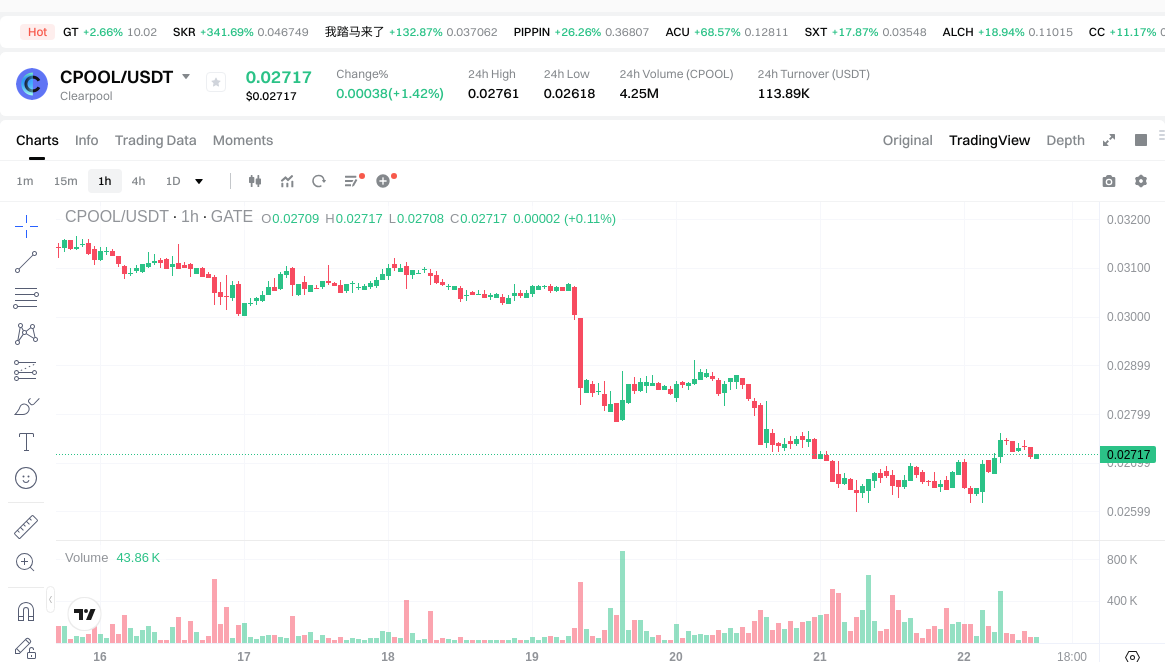
Recent months have shown mixed performance, with the token declining 7.43% over the past 30 days and 12.87% over the past week, indicating continued selling pressure in the near term.
Current CPOOL Investment Market Status (January 2026)
- CPOOL current price: $0.02712
- Market sentiment (Fear & Greed Index): Data unavailable
- 24-hour trading volume: $112,924.03
- Market capitalization: $24,505,097.23
- Circulating supply: 903,580,281.27 CPOOL (90.36% of total supply)
- Fully diluted market cap: $27,120,000
- Institutional investor holdings: Data unavailable
Click to view real-time CPOOL market price
The token currently ranks #787 in the cryptocurrency market by market capitalization, representing 0.00085% of the total crypto market share. CPOOL is listed on 19 exchanges and has approximately 22,629 holders. The market cap to fully diluted valuation ratio stands at 90.36%, suggesting that most of the token supply is already in circulation.
II. Core Factors Affecting Whether CPOOL is a Good Investment (Is Clearpool(CPOOL) a Good Investment)
Supply Mechanism and Scarcity (CPOOL investment scarcity)
- Fixed supply mechanism → impacts price and investment value
- Total supply: 1,000,000,000 CPOOL tokens with a maximum supply cap of 1,000,000,000 tokens
- Current circulating supply: 903,580,281 CPOOL (approximately 90.36% of total supply)
- Market cap to fully diluted valuation ratio stands at 90.36%, indicating relatively high token circulation
- Investment significance: the defined supply ceiling establishes potential scarcity characteristics that may support long-term valuation considerations
Institutional Investment and Mainstream Adoption (Institutional investment in CPOOL)
- Token holder base: approximately 22,629 holders as of January 22, 2026
- Exchange availability: listed on 19 cryptocurrency exchanges, including Gate.com
- Clearpool's protocol facilitates uncollateralized institutional borrowing through decentralized capital markets
- The platform connects institutional borrowers with DeFi liquidity providers, potentially attracting institutional participation
- Market positioning: focuses on bridging traditional institutional finance with decentralized finance infrastructure
Macroeconomic Environment's Impact on CPOOL Investment
- Monetary policy and interest rate changes → may alter investment attractiveness of yield-generating DeFi protocols
- Market capitalization: $24,505,097 with market dominance of 0.00085%
- 24-hour trading volume: $112,924, reflecting current market liquidity conditions
- Economic uncertainties may influence institutional demand for alternative credit markets and decentralized lending solutions
Technology and Ecosystem Development (Technology & Ecosystem for CPOOL investment)
- Decentralized Capital Markets Ecosystem: enables institutional borrowers to create single-borrower liquidity pools
- Uncollateralized lending model: differentiates from traditional DeFi overcollateralized protocols
- Liquidity provider incentives: pool interest rates enhanced by additional rewards paid in CPOOL tokens
- Governance functionality: CPOOL serves as both utility and governance token, allowing holders to stake, vote, and earn rewards
- DeFi integration: operates within the broader decentralized finance ecosystem, potentially benefiting from sector growth
- Smart contract deployment: primary contract address on Ethereum blockchain (0x66761fa41377003622aee3c7675fc7b5c1c2fac5)
III. CPOOL Future Investment Forecast and Price Outlook (Is Clearpool(CPOOL) worth investing in 2026-2031)
Short-term Investment Forecast (2026, short-term CPOOL investment outlook)
- Conservative forecast: $0.024417 - $0.02713
- Neutral forecast: $0.02713
- Optimistic forecast: $0.02713 - $0.0382533
Mid-term Investment Outlook (2027-2029, mid-term Clearpool(CPOOL) investment forecast)
-
Market phase expectation: The mid-term outlook suggests a gradual growth trajectory as the DeFi capital markets ecosystem continues to develop, with potential expansion in institutional borrower adoption and liquidity provider participation.
-
Investment return forecast:
- 2027: $0.026807153 - $0.038576147
- 2028: $0.03420854256 - $0.04846210196
- 2029: $0.0214444801173 - $0.0512985602806
-
Key catalysts: Protocol adoption rate among institutional borrowers, overall DeFi market growth, competitive positioning within decentralized capital markets, and regulatory developments affecting uncollateralized lending platforms.
Long-term Investment Outlook (Is CPOOL a good long-term investment?)
-
Base scenario: $0.031271097771051 - $0.067676256370185 (assuming steady protocol development and moderate market expansion through 2030)
-
Optimistic scenario: $0.042881076234556 - $0.064035740510271 (assuming accelerated institutional adoption and favorable DeFi market conditions through 2031)
-
Risk scenario: Below $0.024417 (under conditions of market downturn or reduced institutional interest in decentralized lending)
Click to view CPOOL long-term investment and price forecast: Price Prediction
2026-2031 Long-term Outlook
-
Base scenario: $0.024417 - $0.04846210196 (corresponding to steady progress and gradual mainstream application growth)
-
Optimistic scenario: $0.042881076234556 - $0.067676256370185 (corresponding to large-scale adoption and favorable market environment)
-
Transformational scenario: Above $0.067676256370185 (in case of breakthrough ecological development and mainstream popularization)
-
December 31, 2031 predicted high: $0.064035740510271 (based on optimistic development assumptions)
Disclaimer: Price predictions are based on historical data analysis and market modeling. Actual prices may vary significantly due to market volatility, regulatory changes, technological developments, and other unforeseen factors. This information does not constitute investment advice.
| Year |
Predicted High Price |
Predicted Average Price |
Predicted Low Price |
Price Change |
| 2026 |
0.0382533 |
0.02713 |
0.024417 |
0 |
| 2027 |
0.038576147 |
0.03269165 |
0.026807153 |
20 |
| 2028 |
0.04846210196 |
0.0356338985 |
0.03420854256 |
31 |
| 2029 |
0.0512985602806 |
0.04204800023 |
0.0214444801173 |
55 |
| 2030 |
0.067676256370185 |
0.0466732802553 |
0.031271097771051 |
72 |
| 2031 |
0.064035740510271 |
0.057174768312742 |
0.042881076234556 |
110 |
IV. Clearpool Investment Strategy and Risk Management (How to invest in Clearpool)
Investment Methodology (Clearpool investment strategy)
Long-term Holding (HODL CPOOL): Suitable for conservative investors
Long-term holding represents a passive investment approach where investors purchase CPOOL tokens and maintain their positions over extended periods, regardless of short-term price fluctuations. This strategy aligns with investors who believe in Clearpool's fundamental value proposition as a decentralized capital markets ecosystem. Given CPOOL's role as both a utility and governance token within the Clearpool protocol, long-term holders may benefit from staking rewards and governance participation rights. However, investors should note that CPOOL has experienced significant volatility, with the token trading at approximately $0.02712 as of January 22, 2026, representing a substantial decline from its all-time high of $2.55 recorded on November 17, 2021.
Active Trading: Relies on technical analysis and swing trading
Active trading involves utilizing technical analysis tools and market indicators to identify short-term trading opportunities. Given CPOOL's 24-hour price range between $0.02618 and $0.02761, active traders may capitalize on intraday price movements. This approach requires continuous market monitoring and a solid understanding of chart patterns, volume analysis, and market sentiment indicators. The token's 24-hour trading volume of approximately $112,924 suggests moderate liquidity levels, which active traders should consider when executing entry and exit strategies.
Risk Management (Risk management for Clearpool investment)
Asset Allocation Ratio: Conservative / Aggressive / Professional investors
- Conservative investors: May allocate 1-3% of their cryptocurrency portfolio to CPOOL, prioritizing established assets with lower volatility
- Aggressive investors: Could consider 5-10% allocation, accepting higher risk for potential returns
- Professional investors: May implement dynamic allocation strategies based on market conditions and institutional borrowing demand within the Clearpool ecosystem
Risk Hedging Solutions: Multi-asset portfolio + hedging instruments
Investors can implement portfolio diversification strategies by combining CPOOL holdings with other digital assets across different sectors, including established cryptocurrencies, stablecoins, and DeFi protocols. Risk mitigation may also involve setting predetermined stop-loss levels and utilizing dollar-cost averaging to reduce timing risk. Professional investors might explore derivative instruments where available to hedge against adverse price movements.
Secure Storage: Hot and cold wallets + hardware wallet recommendations
Given that CPOOL operates as an ERC-20 token on the Ethereum blockchain, investors should prioritize secure storage solutions. Hardware wallets such as Ledger and Trezor provide cold storage options with enhanced security features. For smaller amounts or frequent trading, reputable hot wallets with multi-signature capabilities may offer convenience while maintaining reasonable security standards. Investors should never store significant holdings on centralized exchanges for extended periods and should implement backup procedures for wallet recovery phrases.
V. Clearpool Investment Risks and Challenges (Risks of investing in Clearpool)
Market Risk: High volatility and price manipulation concerns
CPOOL demonstrates considerable price volatility, with the token declining approximately 92.54% over the past year. The 24-hour price change of 1.3% and 7-day decline of 12.87% illustrate the token's susceptibility to short-term market fluctuations. With a relatively modest market capitalization of approximately $24.5 million and a market dominance of 0.00085%, CPOOL may be more vulnerable to price manipulation compared to larger-cap assets. The token's historical price range, from an all-time low of $0.01599962 on October 17, 2023, to its all-time high of $2.55, underscores the substantial volatility investors may encounter.
Regulatory Risk: Policy uncertainty across different jurisdictions
As a decentralized lending protocol facilitating uncollateralized institutional borrowing, Clearpool operates within an evolving regulatory landscape. Different jurisdictions maintain varying approaches to DeFi protocols and lending platforms, creating uncertainty regarding future compliance requirements. Regulatory developments affecting institutional cryptocurrency borrowing, KYC/AML requirements for DeFi platforms, or changes in securities classification could materially impact Clearpool's operations and CPOOL token utility. Investors should monitor regulatory announcements in their respective jurisdictions and assess how policy changes might affect the protocol's accessibility and functionality.
Technical Risk: Network security vulnerabilities and upgrade failures
Operating on the Ethereum blockchain, CPOOL faces technical risks including smart contract vulnerabilities, potential bugs in protocol upgrades, and dependency on Ethereum network stability. Security incidents affecting either the Clearpool protocol or the underlying Ethereum infrastructure could result in loss of funds or diminished confidence in the platform. Additionally, failed protocol upgrades or governance decisions that negatively impact tokenomics could adversely affect CPOOL's value proposition. The protocol's reliance on institutional borrowers creates counterparty risk if borrowers default on uncollateralized loans, potentially affecting liquidity provider returns and overall platform credibility.
VI. Conclusion: Is Clearpool a Good Investment?
Investment Value Summary: CPOOL presents potential long-term opportunities within the institutional DeFi lending sector, though the token has experienced significant price volatility in recent periods.
Clearpool's positioning as a decentralized capital markets ecosystem facilitating institutional borrowing represents an innovative approach within DeFi. The CPOOL token's dual functionality as both a utility and governance token provides holders with staking opportunities and protocol participation rights. However, the token's substantial decline of over 92% from its all-time high, combined with its relatively small market capitalization and moderate trading volume, indicates considerable risk factors that investors must carefully evaluate.
Investor Recommendations:
✅ Beginners: Consider dollar-cost averaging strategies combined with secure wallet storage. Allocate only a small portion of overall portfolio to higher-risk assets like CPOOL.
✅ Experienced Investors: May employ swing trading strategies based on technical analysis while maintaining diversified portfolio exposure across multiple DeFi protocols.
✅ Institutional Investors: Could evaluate strategic long-term allocation as part of broader DeFi exposure, with particular attention to Clearpool's institutional borrower network and protocol development trajectory.
⚠️ Notice: Cryptocurrency investments carry substantial risk, including the possibility of complete capital loss. This analysis is provided for informational purposes only and does not constitute investment advice. Investors should conduct independent research and consult qualified financial advisors before making investment decisions.
VII. FAQ
Q1: What is CPOOL and how does it function within the Clearpool ecosystem?
CPOOL is the utility and governance token of the Clearpool protocol, serving multiple functions within the decentralized capital markets ecosystem. The token enables holders to participate in protocol governance through voting rights, earn rewards through staking mechanisms, and receive additional yield incentives when providing liquidity to institutional borrower pools. Launched in November 2021, CPOOL operates as an ERC-20 token on the Ethereum blockchain with a fixed maximum supply of 1 billion tokens. The protocol differentiates itself by facilitating uncollateralized lending to institutional borrowers through single-borrower liquidity pools, where liquidity providers can earn interest enhanced by CPOOL token rewards.
Q2: How has CPOOL's price performed since launch, and what is its current market position?
CPOOL has experienced substantial volatility since its November 2021 launch at $0.3. The token reached its all-time high of $2.55 on November 17, 2021, during the broader crypto market bull run, but subsequently declined significantly. As of January 22, 2026, CPOOL trades at approximately $0.02712, representing a 92.54% decline year-over-year. The token currently maintains a market capitalization of $24.51 million, ranking #787 among cryptocurrencies with a market dominance of 0.00085%. With approximately 903.58 million tokens in circulation (90.36% of total supply) and 22,629 holders, CPOOL demonstrates moderate distribution across 19 exchanges.
Q3: What are the primary risks associated with investing in CPOOL?
CPOOL presents three major risk categories: market risk, regulatory risk, and technical risk. Market risk stems from significant price volatility, with the token declining over 92% from its all-time high, combined with a relatively small market cap that may increase susceptibility to price manipulation. Regulatory risk arises from evolving DeFi regulations across jurisdictions, particularly concerning uncollateralized institutional lending and potential KYC/AML requirements. Technical risk includes smart contract vulnerabilities, dependency on Ethereum network stability, counterparty risk from institutional borrower defaults, and potential issues during protocol upgrades. The token's 24-hour trading volume of approximately $112,924 also suggests moderate liquidity conditions.
Q4: What are the price predictions for CPOOL from 2026 to 2031?
Price forecasts for CPOOL vary across different scenarios. For 2026, conservative estimates range from $0.024417 to $0.02713, while optimistic scenarios suggest potential highs of $0.0382533. Mid-term projections for 2027-2029 show gradual growth potential, with 2027 estimates between $0.026807153 and $0.038576147, 2028 between $0.03420854256 and $0.04846210196, and 2029 between $0.0214444801173 and $0.0512985602806. Long-term forecasts through 2031 present base scenarios of $0.031271097771051 to $0.067676256370185, with optimistic scenarios reaching $0.064035740510271 by December 31, 2031. These predictions assume continued protocol development, institutional adoption growth, and favorable DeFi market conditions, though actual prices may vary significantly.
Q5: How should different investor types approach CPOOL investment strategies?
Investment strategies should align with investor experience and risk tolerance. Beginners may consider long-term holding (HODL) strategies with conservative portfolio allocation of 1-3%, utilizing dollar-cost averaging to mitigate timing risk and secure hardware wallet storage. Experienced investors might employ active trading approaches based on technical analysis, potentially allocating 5-10% of their portfolio while implementing stop-loss mechanisms and diversification across multiple DeFi protocols. Institutional investors could evaluate strategic long-term positions with dynamic allocation strategies, focusing on Clearpool's institutional borrower network development and governance participation opportunities. All investor categories should prioritize secure storage solutions, maintain diversified portfolios, and avoid storing significant holdings on centralized exchanges for extended periods.
Q6: What factors could drive CPOOL's future value and adoption?
Several factors may influence CPOOL's future performance: protocol adoption rate among institutional borrowers seeking uncollateralized liquidity, overall growth in the DeFi capital markets sector, competitive positioning against traditional and decentralized lending platforms, and favorable regulatory developments for institutional DeFi participation. Technical catalysts include successful protocol upgrades, enhanced smart contract security, and expanded integration within the broader DeFi ecosystem. Additionally, the token's utility functions—staking rewards, governance rights, and liquidity provider incentives—combined with its defined supply ceiling of 1 billion tokens, may support long-term value considerations. However, these potential catalysts must be weighed against market volatility, regulatory uncertainties, and technical risks inherent in the DeFi lending sector.
* The information is not intended to be and does not constitute financial advice or any other recommendation of any sort offered or endorsed by Gate.