This comprehensive guide evaluates Clearpool (CPOOL) as an investment opportunity within the decentralized lending sector. The article examines CPOOL's historical price performance, current market metrics (trading at $0.02735 with $24.71M market cap), and core utility as a governance and staking token for the Clearpool protocol. It provides detailed analysis of factors affecting investment value, including institutional adoption potential, supply mechanics, and technology development. The guide presents price projections through 2031 across conservative, neutral, and optimistic scenarios, along with short-term and mid-term outlooks. Risk management strategies address market volatility, regulatory uncertainty, and technical vulnerabilities specific to DeFi lending platforms. Available on Gate and other major exchanges, CPOOL suits experienced investors using dollar-cost averaging or swing trading strategies, though all investors should prioritize secure storage and portfolio diversification while acknowledging
Introduction: Clearpool (CPOOL) Investment Position and Market Outlook
CPOOL is a significant asset in the cryptocurrency sector, serving as the utility and governance token for the Clearpool protocol since its launch in 2021. As of January 2026, CPOOL has a market capitalization of approximately $24.71 million, with a circulating supply of around 903.58 million tokens, and a current trading price of approximately $0.02735. Positioned as a decentralized capital markets ecosystem token, CPOOL enables institutional borrowers to access uncollateralized liquidity while allowing liquidity providers to earn yields enhanced by CPOOL rewards. With these characteristics, CPOOL has become a focal point for investors considering "Is Clearpool (CPOOL) a good investment?" This article provides a comprehensive analysis of CPOOL's investment value, historical price trends, future price projections, and associated investment risks to serve as a reference for investors.
I. CPOOL Price History Review and Current Investment Value
Clearpool (CPOOL) was launched on November 3, 2021, with an initial offering price of $0.3. The token experienced significant price volatility during its early trading period, reaching a notable peak of $2.55 on November 17, 2021, shortly after launch. This represented a substantial gain from its initial price level within the first two weeks of trading.
Following the broader cryptocurrency market downturn in 2022-2023, CPOOL experienced considerable price decline. The token recorded a low point of approximately $0.016 on October 17, 2023, reflecting the challenging market conditions faced by DeFi protocols during this period.
Over the past year, CPOOL has shown a decline of approximately 92.47% from comparable price levels, indicating substantial downward pressure. The 30-day trend shows a decrease of around 8.42%, while the 7-day performance indicates a decline of approximately 13.19%.
Current CPOOL Investment Market Status (January 2026)
- Current CPOOL price: $0.02735
- 24-hour price change: +1.82%
- 24-hour trading volume: $114,505.56
- Market capitalization: $24,712,920.69
- Circulating supply: 903,580,281 CPOOL (90.36% of total supply)
- Fully diluted market cap: $27,350,000
- Market dominance: 0.00085%
- Number of token holders: 22,629
- Listed on 19 exchanges
Click to view real-time CPOOL market price
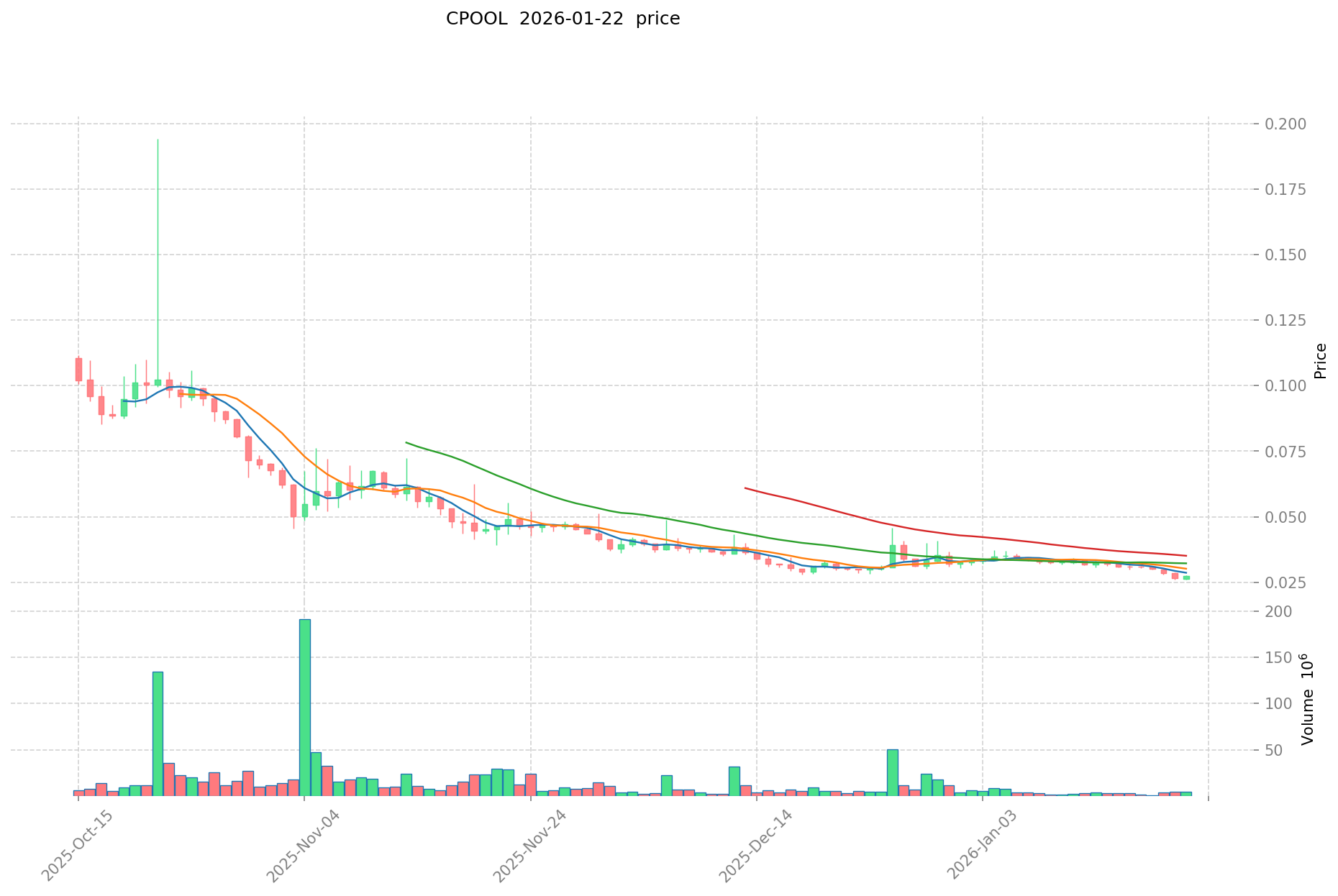
II. Core Factors Affecting Whether CPOOL is a Good Investment (Is Clearpool(CPOOL) a Good Investment)
Supply Mechanism and Scarcity (CPOOL investment scarcity)
- Fixed maximum supply of 1,000,000,000 CPOOL tokens → impacts price dynamics and investment value
- Current circulating supply stands at approximately 903,580,281 tokens, representing 90.36% of the total supply
- Investment significance: the high circulation ratio indicates limited additional supply pressure, which may support price stability over time
Institutional Investment and Mainstream Adoption (Institutional investment in CPOOL)
- Token holder base has expanded to 22,629 addresses, reflecting growing participant interest
- Clearpool's institutional borrower model allows qualified entities to access uncollateralized liquidity, potentially attracting traditional finance participants to the DeFi space
- The protocol's focus on institutional capital markets may position CPOOL as a bridge between conventional finance and decentralized ecosystems
Macroeconomic Environment's Impact on CPOOL Investment
- Monetary policy shifts and interest rate changes → may alter investor appetite for DeFi yield-generating assets like CPOOL
- In periods of economic uncertainty, demand for decentralized lending protocols could fluctuate based on risk sentiment and alternative yield opportunities
- Regulatory developments in digital asset markets may influence institutional participation in Clearpool's ecosystem
Technology and Ecosystem Development (Technology & Ecosystem for CPOOL investment)
- CPOOL serves dual utility as both governance and staking token, enabling holders to participate in protocol decisions and earn rewards
- Liquidity providers can earn yields enhanced by CPOOL rewards, creating economic incentives for ecosystem participation
- The protocol's single-borrower pool model represents a differentiated approach in DeFi lending, potentially supporting long-term value through specialized institutional use cases
- Integration with broader DeFi infrastructure and expansion of borrower partnerships may drive sustained adoption and utility
III. CPOOL Future Investment Prediction and Price Outlook (Is Clearpool(CPOOL) worth investing in 2026-2031)
Short-term Investment Prediction (2026, short-term CPOOL investment outlook)
- Conservative prediction: $0.019152 - $0.02736
- Neutral prediction: $0.02736
- Optimistic prediction: $0.02736 - $0.0295488
Mid-term Investment Outlook (2027-2029, mid-term Clearpool(CPOOL) investment forecast)
-
Market stage expectation: Based on historical price analysis, CPOOL may experience moderate volatility with gradual recovery potential from its historical low of $0.01599962. The token's utility and governance functions within the Clearpool protocol could support price stability.
-
Investment return prediction:
- 2027: $0.021056256 - $0.029592576
- 2028: $0.02118714624 - $0.03569889024
- 2029: $0.0200639372544 - $0.0404514864
-
Key catalysts: Protocol adoption rate, institutional borrower activity, liquidity provider participation, and overall DeFi market sentiment.
Long-term Investment Outlook (Is CPOOL a good long-term investment?)
- Base scenario: $0.0192953590128 - $0.0433235419344 (assuming steady protocol development and maintained market position)
- Optimistic scenario: $0.029101406088456 - $0.0433235419344 (assuming increased institutional adoption and expanded borrowing pool activity)
- Risk scenario: Below $0.0192953590128 (under adverse market conditions or reduced protocol utilization)
Click to view CPOOL long-term investment and price prediction: Price Prediction
2026-01-22 - 2031 Long-term Outlook
- Base scenario: $0.03236118912 - $0.0398649398472 (corresponding to steady progress and gradual mainstream application improvement)
- Optimistic scenario: $0.0398649398472 - $0.04185818683956 (corresponding to large-scale adoption and favorable market environment)
- Transformative scenario: Above $0.04185818683956 (if ecosystem achieves breakthrough progress and mainstream popularization)
- 2031-12-31 predicted high: $0.04185818683956 (based on optimistic development assumptions)
Disclaimer: This prediction is based on historical data and market analysis and does not constitute investment advice. Cryptocurrency markets are highly volatile and subject to multiple risk factors. Investors should conduct independent research and consider their risk tolerance before making investment decisions.
| Year |
Predicted High Price |
Predicted Average Price |
Predicted Low Price |
Price Change |
| 2026 |
0.0295488 |
0.02736 |
0.019152 |
0 |
| 2027 |
0.029592576 |
0.0284544 |
0.021056256 |
4 |
| 2028 |
0.03569889024 |
0.029023488 |
0.02118714624 |
6 |
| 2029 |
0.0404514864 |
0.03236118912 |
0.0200639372544 |
18 |
| 2030 |
0.0433235419344 |
0.03640633776 |
0.0192953590128 |
33 |
| 2031 |
0.04185818683956 |
0.0398649398472 |
0.029101406088456 |
45 |
IV. Clearpool Investment Strategy and Risk Management (How to invest in Clearpool)
Investment Methodology (Clearpool investment strategy)
Long-term Holding (HODL CPOOL): Suitable for Conservative Investors
For investors seeking steady exposure to decentralized capital markets infrastructure, a long-term holding strategy may be appropriate. This approach involves acquiring CPOOL tokens and maintaining positions through market cycles, potentially benefiting from the protocol's ecosystem development and utility expansion. Investors adopting this strategy should consider the token's governance and staking features, which may provide additional yield opportunities beyond price appreciation.
Active Trading: Technical Analysis and Swing Trading
Active traders may capitalize on CPOOL's price movements through technical analysis and swing trading strategies. With 24-hour trading volume of approximately $114,506 and recent price fluctuations ranging from $0.02618 to $0.02761, short-term trading opportunities may emerge. However, traders should note the token's significant volatility, as evidenced by the 13.19% decline over seven days and 8.42% decrease over 30 days. Technical indicators, volume patterns, and broader DeFi market sentiment should inform trading decisions.
Risk Management (Risk management for Clearpool investment)
Asset Allocation Ratios: Conservative / Aggressive / Professional Investors
- Conservative Investors: May consider allocating 1-3% of their cryptocurrency portfolio to CPOOL, limiting exposure to emerging DeFi lending protocols while maintaining diversification across established assets.
- Aggressive Investors: Could allocate 5-10% to CPOOL, accepting higher risk in pursuit of potential returns from DeFi infrastructure growth.
- Professional Investors: May incorporate CPOOL into broader DeFi lending sector allocations, potentially 3-7% of specialized portfolios, with active monitoring of protocol metrics and market conditions.
Risk Hedging Strategies: Multi-asset Portfolio + Hedging Instruments
Investors should consider diversifying across multiple cryptocurrency categories rather than concentrating solely in DeFi lending tokens. Combining CPOOL with established cryptocurrencies, stablecoins, and other DeFi sectors can help mitigate protocol-specific risks. Some investors may employ derivative instruments or maintain stablecoin reserves to hedge against adverse price movements.
Secure Storage: Hot/Cold Wallets + Hardware Wallet Recommendations
Given that CPOOL operates as an ERC-20 token on the Ethereum network (contract address: 0x66761fa41377003622aee3c7675fc7b5c1c2fac5), investors should prioritize secure storage solutions:
- Hardware Wallets: Physical devices offering offline private key storage provide enhanced security for long-term holdings.
- Cold Wallets: Software wallets maintained offline reduce exposure to online threats while requiring careful backup procedures.
- Hot Wallets: Exchange or mobile wallets offer convenience for active trading but carry increased security risks and should hold only trading amounts.
Investors should verify contract addresses through official sources before transactions and consider multi-signature solutions for larger holdings.
V. Clearpool Investment Risks and Challenges (Risks of investing in Clearpool)
Market Risk: High Volatility and Price Dynamics
CPOOL demonstrates substantial price volatility characteristic of mid-cap cryptocurrency assets. The token has experienced an annual decline of 92.47% from its historical high of $2.55 (reached on November 17, 2021) to its current price of approximately $0.02735. Recent performance shows mixed signals, with a 1.82% increase over 24 hours contrasted against a 13.19% decline over seven days. This volatility reflects both broader market conditions and factors specific to DeFi lending protocols.
With a market capitalization of approximately $24.71 million and ranking around #784, CPOOL maintains relatively limited liquidity compared to major cryptocurrencies. Lower liquidity can amplify price swings and may result in wider bid-ask spreads during periods of market stress. The token's 24-hour trading volume of $114,506 suggests moderate trading activity across 19 exchanges.
Regulatory Risk: Policy Uncertainty Across Jurisdictions
Decentralized lending protocols face evolving regulatory frameworks across different jurisdictions. Authorities in various countries continue developing policies regarding DeFi platforms, uncollateralized lending, and cryptocurrency governance tokens. Regulatory actions or restrictive policies could impact Clearpool's operational model, particularly regarding institutional borrower participation and cross-border lending activities.
Investors should monitor regulatory developments in major markets, as policy changes could affect protocol usage, token utility, and market access. The classification of governance tokens, securities regulations, and lending platform oversight remain areas of regulatory focus that could influence CPOOL's value proposition.
Technical Risk: Network Security and Protocol Vulnerabilities
As a DeFi protocol facilitating uncollateralized lending, Clearpool faces technical risks inherent to smart contract platforms. Potential vulnerabilities in protocol code, integration risks with other DeFi systems, and dependencies on Ethereum network security represent ongoing considerations. While the project has been operational since October 2021, the DeFi sector has experienced numerous security incidents affecting various protocols.
Investors should consider that protocol upgrades, changes to lending mechanisms, or technical issues could impact token utility and value. The governance function of CPOOL tokens means that protocol modifications may occur through community voting, introducing uncertainty regarding future technical direction.
VI. Conclusion: Is Clearpool a Good Investment?
Investment Value Summary
Clearpool represents an infrastructure project within the decentralized lending sector, offering exposure to institutional borrowing mechanisms in DeFi. The token's utility encompasses governance rights, staking opportunities, and rewards distribution within the protocol ecosystem. With approximately 90.36% of maximum supply already circulating (903.58 million of 1 billion tokens) and 22,629 holders, the project demonstrates established community participation.
However, significant price depreciation from historical highs and recent negative medium-term trends indicate challenges facing the project. The token's current valuation reflects substantial revaluation from earlier periods, suggesting that market expectations have adjusted considerably. Potential investors should carefully evaluate the protocol's competitive position within DeFi lending, adoption trends among institutional borrowers, and the broader trajectory of decentralized capital markets.
Investor Recommendations
✅ Beginners: Consider dollar-cost averaging (DCA) strategies to mitigate timing risk, combined with secure hardware wallet storage for any holdings. New investors should allocate only amounts they can afford to lose entirely and should thoroughly research DeFi lending mechanics before investing.
✅ Experienced Investors: May employ swing trading strategies based on technical analysis while maintaining diversified exposure across multiple DeFi sectors. Portfolio allocation should reflect risk tolerance and conviction regarding decentralized lending adoption.
✅ Institutional Investors: Could evaluate CPOOL as part of specialized DeFi infrastructure allocations, conducting thorough due diligence on protocol security, competitive positioning, and regulatory exposure before establishing positions.
⚠️ Disclaimer: Cryptocurrency investments carry substantial risk, including the possibility of total loss. This content serves informational purposes only and does not constitute investment advice. Investors should conduct independent research and consult qualified financial advisors before making investment decisions.
VII. FAQ
Q1: What is CPOOL's current market position and how does it compare to its historical performance?
CPOOL currently trades at approximately $0.02735 with a market capitalization of $24.71 million, ranking around #784 in the cryptocurrency market. The token has experienced significant decline from its all-time high of $2.55 reached on November 17, 2021, representing a decline of approximately 92.47% from peak levels. With 903.58 million tokens in circulation (90.36% of maximum supply) and 22,629 holders across 19 exchanges, CPOOL demonstrates established community participation despite substantial price depreciation from historical highs.
Q2: What are the primary use cases and utility functions of CPOOL tokens?
CPOOL serves three primary functions within the Clearpool protocol ecosystem. First, it functions as a governance token, allowing holders to participate in protocol decision-making and vote on proposed changes. Second, CPOOL can be staked to earn rewards, providing yield-generating opportunities for token holders. Third, the token serves as an incentive mechanism for liquidity providers, who receive CPOOL rewards in addition to base yields when supplying capital to institutional borrower pools. This multi-functional utility structure aims to align stakeholder interests within the decentralized capital markets ecosystem.
Q3: What are the key risks investors should consider before investing in CPOOL?
CPOOL investors face three primary risk categories. Market risk manifests through high volatility, with recent performance showing a 13.19% decline over seven days and 92.47% decline over one year, alongside relatively limited liquidity evidenced by $114,506 in 24-hour trading volume. Regulatory risk stems from evolving policies regarding DeFi lending platforms, uncollateralized credit, and governance tokens across different jurisdictions. Technical risk includes potential smart contract vulnerabilities, protocol upgrade uncertainties, and dependencies on Ethereum network security. These factors collectively contribute to CPOOL's risk profile as a mid-cap DeFi infrastructure token.
Q4: What price predictions exist for CPOOL from 2026 to 2031?
Short-term predictions for 2026 range from $0.019152 (conservative) to $0.0295488 (optimistic), with a neutral prediction at $0.02736. Mid-term forecasts suggest 2027 prices between $0.021056256 and $0.029592576, while 2028 estimates range from $0.02118714624 to $0.03569889024. Long-term predictions for 2031 span from $0.029101406088456 (risk scenario) to $0.04185818683956 (optimistic scenario). These predictions assume various levels of protocol adoption, institutional borrower participation, and favorable DeFi market conditions. However, investors should note that cryptocurrency price predictions carry substantial uncertainty and do not guarantee future performance.
Q5: How should different investor types approach CPOOL allocation and risk management?
Conservative investors may consider allocating 1-3% of their cryptocurrency portfolio to CPOOL, focusing on long-term holding strategies while maintaining diversification across established assets. Aggressive investors could allocate 5-10% to CPOOL, accepting higher risk in pursuit of potential returns from DeFi infrastructure growth. Professional investors might incorporate CPOOL into specialized DeFi lending sector allocations of 3-7%, with active monitoring of protocol metrics and market conditions. All investor types should prioritize secure storage through hardware or cold wallets, verify contract addresses (0x66761fa41377003622aee3c7675fc7b5c1c2fac5), and employ risk hedging strategies through multi-asset portfolio diversification.
Q6: What factors could drive CPOOL's future value appreciation or decline?
Several key factors may influence CPOOL's trajectory. Positive catalysts include increased institutional borrower adoption, expansion of lending pool activity, growth in liquidity provider participation, and broader DeFi market momentum. The token's fixed maximum supply of 1 billion tokens with 90.36% already circulating suggests limited additional supply pressure. However, negative factors include continued regulatory uncertainty affecting DeFi lending platforms, competitive pressure from alternative institutional credit protocols, potential technical vulnerabilities, and adverse macroeconomic conditions affecting risk appetite for DeFi yield-generating assets. The protocol's ability to differentiate its single-borrower pool model and expand borrower partnerships will likely influence long-term value.
Q7: Is CPOOL suitable for beginners, and what precautions should new investors take?
CPOOL presents significant challenges for beginner investors due to its high volatility, substantial historical price decline, and complex DeFi lending mechanics. Newcomers considering CPOOL should first thoroughly research decentralized lending protocols, understand the uncollateralized borrowing model, and recognize the substantial risk of total loss. Recommended precautions include starting with dollar-cost averaging (DCA) strategies to mitigate timing risk, allocating only amounts they can afford to lose entirely, using secure hardware wallet storage, and verifying contract addresses through official sources before transactions. Beginners should also consider gaining experience with more established cryptocurrencies before investing in mid-cap DeFi infrastructure tokens like CPOOL.
Q8: What distinguishes Clearpool's lending model from other DeFi lending protocols?
Clearpool employs a single-borrower pool model that differentiates it from traditional multi-borrower DeFi lending platforms. This approach allows qualified institutional borrowers to access uncollateralized liquidity through dedicated pools, contrasting with overcollateralized lending common in DeFi. The protocol targets institutional capital markets participants, potentially bridging traditional finance and decentralized ecosystems. Liquidity providers can earn yields enhanced by CPOOL rewards while accepting credit risk from specific institutional borrowers. This specialized model positions Clearpool as an infrastructure for institutional DeFi participation rather than retail-focused lending, though this specialization also concentrates risk and may limit addressable market compared to broader lending protocols.
* The information is not intended to be and does not constitute financial advice or any other recommendation of any sort offered or endorsed by Gate.