Clore.ai (CLORE) is a decentralized GPU computing marketplace enabling users to share and lease computational resources for AI training, rendering, and mining tasks. As of February 2026, CLORE trades at $0.002949 with a market cap of $1.86 million and 632.2 million circulating tokens (48.63% of max supply). This comprehensive analysis examines CLORE's investment potential through multiple lenses: historical performance showing a 94.99% decline from its $0.45 peak, fundamental tokenomics with controlled scarcity mechanisms, and 2026-2031 price projections ranging from $0.00202 to $0.00574 across conservative to optimistic scenarios. The article addresses critical investment considerations including market risks from high volatility and liquidity constraints, regulatory uncertainties for decentralized computing platforms, and technical vulnerabilities. Targeted recommendations provide allocation strategies for conservative (1-2% portfolio), aggressive (5-10% crypto), and institutional investors, while security
Introduction: Clore.ai (CLORE)'s Investment Position and Market Outlook
Clore.ai (CLORE) represents an emerging asset in the cryptocurrency space, having launched in December 2022. The project operates as a decentralized marketplace for GPU computing power, enabling users to share and lease resources for AI training, rendering, and mining tasks. As of February 1, 2026, CLORE maintains a market capitalization of approximately $1.86 million with a circulating supply of around 632.22 million tokens, currently trading at $0.002949. With its positioning in the GPU rental and computational resource sector, CLORE has become a subject of discussion among investors exploring "Is Clore.ai (CLORE) a good investment?" This article provides a comprehensive analysis of CLORE's investment value, historical performance, future price outlook, and associated risks to offer reference for market participants.
The token shows a circulating supply ratio of 48.63%, with a maximum supply cap of 1.3 billion tokens. Trading activity remains modest with 24-hour volume at approximately $46,286 across 6 exchanges. The project's community-driven approach and additional incentive mechanisms aim to expand accessibility to advanced computational resources while streamlining operational efficiency. As the digital asset market continues to evolve, understanding CLORE's market dynamics, technical fundamentals, and risk factors becomes essential for informed decision-making.
I. Clore.ai (CLORE) Price History and Current Investment Status
- 2022: Project launch in December 2022 → Token deployment marked the beginning of CLORE's market presence
- 2024: Peak valuation period in March 2024 → CLORE experienced significant price appreciation during this timeframe
- 2025-2026: Market correction phase → Price declined substantially from elevated levels to lower trading ranges
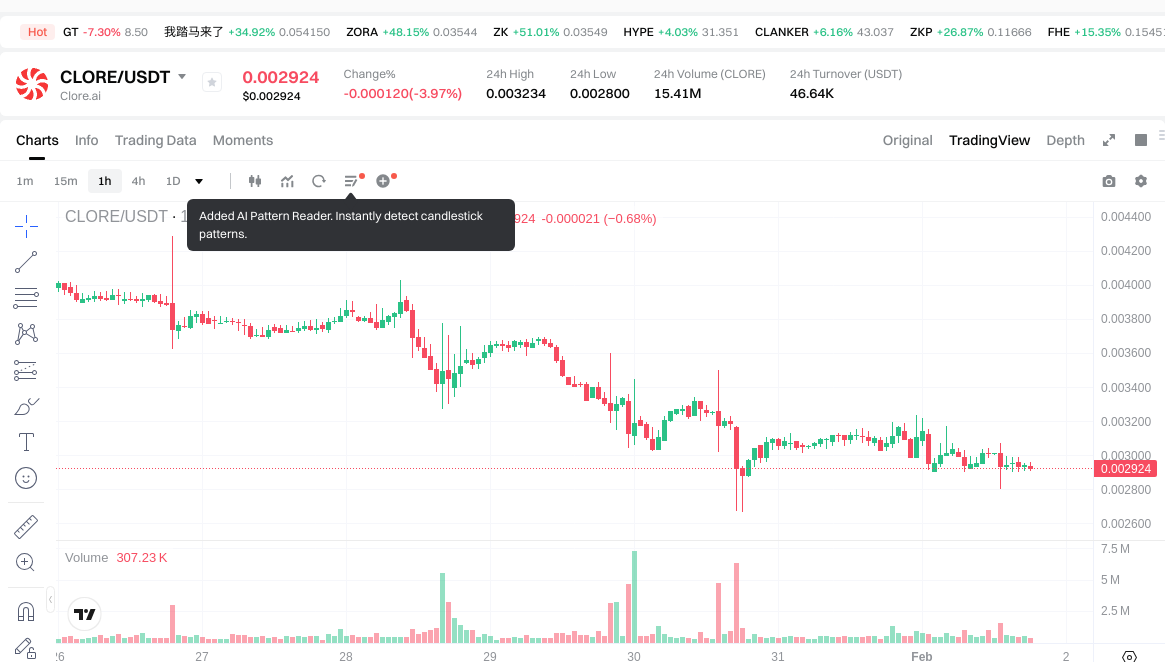
Current CLORE Investment Market Status (February 2026)
- CLORE current price: $0.002949
- Market sentiment: Neutral to cautious, reflecting broader market conditions
- 24-hour trading volume: $46,286.07
- Market capitalization: $1.86 million
- Circulating supply: 632.22 million CLORE (48.63% of maximum supply)
- Exchange listings: Available on 6 trading platforms
Click to view real-time CLORE market price
II. Core Factors Influencing Whether CLORE is a Good Investment (Is Clore.ai(CLORE) a Good Investment)
Supply Mechanism and Scarcity (CLORE investment scarcity)
- Supply structure influences price and investment value → Clore.ai has a maximum supply of 1,300,000,000 CLORE tokens, with a current circulating supply of approximately 632,222,341 tokens (representing about 48.63% of the maximum supply). The controlled supply mechanism suggests potential scarcity dynamics as circulation increases over time.
- Historical patterns → The token experienced notable price fluctuations, with historical data showing significant volatility. The current circulating ratio indicates that approximately half of the total planned supply remains to be released, which may influence future scarcity perceptions.
- Investment significance → The defined maximum supply cap creates a framework for potential scarcity-driven value, though the substantial unreleased portion of tokens represents a consideration for long-term investment analysis.
Institutional Investment and Mainstream Adoption (Institutional investment in CLORE)
- Market presence → Clore.ai is currently listed on 6 exchanges with a holder base of approximately 1,532 addresses, reflecting a relatively limited but existing user community.
- Platform adoption → The project operates as a marketplace enabling GPU computing power sharing and leasing, serving users engaged in AI training, rendering, and mining activities. The platform offers managed services through data centers to support high-performance computing needs.
- Community-driven approach → The project incorporates incentive mechanisms such as Clore Mining to encourage participation, though broader institutional adoption metrics were not extensively documented in available materials.
Macroeconomic Environment Impact on CLORE Investment
- Market positioning → As a utility-focused token within the GPU computing marketplace sector, CLORE's investment attractiveness may be influenced by broader trends in decentralized computing demand and AI infrastructure development.
- Economic sensitivity → General cryptocurrency market conditions, including liquidity trends and risk appetite in digital asset markets, can affect trading volumes and price stability for assets like CLORE.
- Sector-specific factors → Growth in AI and machine learning applications may create demand for decentralized GPU computing resources, potentially supporting the platform's value proposition and investment considerations.
Technology and Ecosystem Development (Technology & Ecosystem for CLORE investment)
- Platform functionality → Clore.ai provides a marketplace infrastructure that facilitates GPU resource sharing, enabling users to monetize idle computing capacity while others access affordable computational power for various applications.
- Service reliability → The platform emphasizes secure, managed services through data centers to enhance reliability for users with high-performance computing requirements.
- Ecosystem expansion → The project aims to streamline profitability for GPU providers while expanding accessibility to advanced computational resources through its community-driven model and incentive structures, though specific technical upgrade roadmaps were not detailed in available materials.
III. CLORE Future Investment Prediction and Price Outlook (Is Clore.ai(CLORE) worth investing in 2026-2031)
Short-term Investment Prediction (2026, short-term CLORE investment outlook)
- Conservative estimate: $0.00202 - $0.00293
- Neutral estimate: $0.00293 - $0.00357
- Optimistic estimate: $0.00357 and above
Mid-term Investment Outlook (2027-2029, mid-term Clore.ai(CLORE) investment forecast)
-
Market stage expectation: The project may experience gradual adoption growth in the GPU computing marketplace, with potential expansion in AI training and rendering use cases. Community-driven development and incentive mechanisms could support moderate price appreciation.
-
Investment return prediction:
- 2027: $0.00198 - $0.00452
- 2028: $0.00206 - $0.00427
- 2029: $0.00281 - $0.00453
-
Key catalysts: Expansion of GPU marketplace adoption, growth in AI and computational resource demand, development of data center infrastructure, and community engagement initiatives.
Long-term Investment Outlook (Is CLORE a good long-term investment?)
- Base scenario: $0.00284 - $0.00568 (assuming steady ecosystem development and moderate market conditions)
- Optimistic scenario: $0.00499 - $0.00574 (assuming increased adoption of decentralized computing resources and favorable market sentiment)
- Risk scenario: Below $0.00202 (under adverse market conditions or reduced demand for GPU computing services)
Click to view CLORE long-term investment and price prediction: Price Prediction
2026-02-01 to 2031 Long-term Outlook
- Base scenario: $0.00284 - $0.00430 USD (corresponding to steady progress and gradual mainstream application growth)
- Optimistic scenario: $0.00499 - $0.00574 USD (corresponding to large-scale adoption and favorable market environment)
- Transformative scenario: Above $0.00574 USD (if ecosystem achieves breakthrough development and mainstream popularity)
- 2031-12-31 predicted high: $0.00574 USD (based on optimistic development assumptions)
Disclaimer: Price predictions are based on historical data and current market analysis. Cryptocurrency investments carry substantial risk, and past performance does not guarantee future results. Investors should conduct independent research and consider their risk tolerance before making investment decisions.
| Year |
Predicted High Price |
Predicted Average Price |
Predicted Low Price |
Price Change |
| 2026 |
0.00357094 |
0.002927 |
0.00201963 |
0 |
| 2027 |
0.0045160683 |
0.00324897 |
0.0019818717 |
10 |
| 2028 |
0.004270771065 |
0.00388251915 |
0.0020577351495 |
31 |
| 2029 |
0.004525076069325 |
0.0040766451075 |
0.002812885124175 |
38 |
| 2030 |
0.005677135976704 |
0.004300860588412 |
0.002838567988352 |
45 |
| 2031 |
0.005737348024942 |
0.004988998282558 |
0.002943508986709 |
69 |
IV. Clore.ai Investment Strategy and Risk Management (How to invest in GPU computing marketplace tokens)
Investment Methodology (Clore.ai investment strategy)
Long-term Holding (HODL CLORE)
For conservative investors considering CLORE tokens, a long-term holding strategy may align with the growing demand for decentralized GPU computing resources. This approach involves:
- Accumulating tokens during price corrections and holding through market cycles
- Focusing on the fundamental value proposition of GPU sharing and rental marketplace
- Monitoring adoption metrics such as the number of GPU providers and renters on the platform
- Tracking integration with AI training, rendering, and mining use cases
Given the project's community-driven approach and additional incentive mechanisms like Clore Mining, patient investors may benefit from potential ecosystem growth over time.
Active Trading
For traders comfortable with higher risk, active trading strategies based on technical analysis and market momentum may be considered:
- Technical Analysis: Monitoring support and resistance levels, with recent data showing 24-hour trading ranges between $0.0028 and $0.003234
- Volatility Trading: Capitalizing on price fluctuations, as evidenced by the -3.69% 24-hour change and -25.59% weekly movement
- Trend Following: Analyzing longer-term trends, noting the -55.45% monthly decline and -94.99% annual decrease from peak levels
- Volume Analysis: Observing daily trading volume of approximately $46,286 to gauge market liquidity and sentiment
Traders should note the token's historical price range, from an all-time high of $0.45 (March 2024) to an all-time low of $0.002667 (January 2026), indicating substantial volatility.
Risk Management (Risk management for CLORE investment)
Asset Allocation Ratios
Conservative Investors:
- Allocate no more than 1-2% of total portfolio to CLORE
- Prioritize established cryptocurrencies and traditional assets
- Focus on capital preservation over aggressive growth
Aggressive Investors:
- May allocate 5-10% of crypto portfolio to infrastructure and utility tokens like CLORE
- Accept higher volatility in exchange for potential growth opportunities
- Maintain diversification across multiple blockchain sectors
Professional Investors:
- Conduct thorough due diligence on platform metrics, GPU utilization rates, and competitive positioning
- Implement position sizing based on risk-adjusted return expectations
- Monitor regulatory developments affecting decentralized computing platforms
Risk Hedging Strategies
- Multi-Asset Portfolio: Combine CLORE with established cryptocurrencies, stablecoins, and traditional assets to reduce correlation risk
- Defensive Tools: Consider using stop-loss orders during volatile periods, given the token's demonstrated price swings
- Diversification: Balance exposure across different blockchain infrastructure projects and computing resource platforms
- Liquidity Management: Maintain sufficient reserves in more liquid assets, noting CLORE's presence on 6 exchanges with moderate daily volume
Secure Storage Solutions
Cold Wallet Storage:
- Hardware wallets (such as Ledger or Trezor) for long-term holdings
- Offline storage significantly reduces exposure to hacking risks
- Recommended for amounts exceeding short-term trading needs
Hot Wallet Management:
- Use reputable software wallets for active trading amounts only
- Enable two-factor authentication and strong password protocols
- Regularly update wallet software to address security vulnerabilities
Platform Security:
- CLORE operates with contract address 0xe60201989b8628f43dc0605f585a72bcf1f1e977 on Ethereum
- Verify contract addresses through official sources before transactions
- Be cautious of phishing attempts and unofficial platforms
Hardware Wallet Recommendations:
- Ledger Nano X/S: Supports ERC-20 tokens including CLORE
- Trezor Model T/One: Compatible with Ethereum-based assets
- Cold Card: For users prioritizing maximum security features
V. Clore.ai Investment Risks and Challenges (Risks of investing in GPU computing marketplace tokens)
Market Risks
High Volatility:
- CLORE has demonstrated significant price fluctuations, with a 94.99% decline from its historical peak
- Short-term movements show continued instability, including a 25.59% weekly decrease and 55.45% monthly decline
- The token's price history ranges from $0.45 (all-time high in March 2024) to $0.002667 (all-time low in January 2026)
- Current market capitalization of approximately $1.86 million represents a relatively small market presence, potentially amplifying price swings
Price Manipulation Concerns:
- With a circulating supply of 632.2 million tokens (48.63% of max supply) and moderate daily trading volume around $46,286, the market may be susceptible to larger trades influencing price
- Limited exchange listings (6 exchanges) could concentrate liquidity and increase manipulation vulnerability
- Holders numbering 1,532 suggest a relatively concentrated ownership structure
Liquidity Constraints:
- Daily trading volume relative to market capitalization indicates moderate liquidity conditions
- Market depth may impact the ability to execute large orders without significant price impact
Regulatory Risks
Policy Uncertainty Across Jurisdictions:
- Decentralized GPU computing platforms may face varying regulatory treatment depending on jurisdiction
- Classification of utility tokens versus securities differs by country, affecting legal compliance requirements
- Tax treatment of mining rewards and rental income from GPU sharing remains unclear in many regions
Compliance Challenges:
- Platforms facilitating peer-to-peer GPU rental may encounter evolving regulations regarding:
- Data privacy and processing standards
- Cross-border service provision
- Anti-money laundering (AML) and know-your-customer (KYC) requirements for marketplace participants
- Intellectual property considerations for AI training and rendering activities
Potential Regulatory Actions:
- Changes in cryptocurrency taxation policies could affect token holder returns
- Restrictions on decentralized computing services in certain markets may limit platform growth
- Regulatory clarity remains limited for blockchain-based infrastructure projects
Technical Risks
Network Security Vulnerabilities:
- Smart contract risks associated with the Ethereum-based token (contract address: 0xe60201989b8628f43dc0605f585a72bcf1f1e977)
- Potential for exploits in GPU rental marketplace mechanisms
- Security of user data and computing resources on the platform
- Dependence on underlying blockchain infrastructure (Ethereum) for transaction security
Upgrade and Development Risks:
- Platform development roadmap execution uncertainty
- Technical challenges in scaling GPU sharing infrastructure
- Competition from established cloud computing providers and emerging decentralized alternatives
- Integration complexities with various GPU hardware and software configurations
Operational Risks:
- Reliance on community participation for GPU supply and demand balance
- Quality assurance challenges for rented computing resources
- Potential for service disruptions affecting platform reliability
- Data center security and managed service delivery consistency
VI. Conclusion: Is GPU computing marketplace tokens a Good Investment?
Investment Value Assessment
Clore.ai presents a value proposition centered on decentralized GPU computing resource sharing, addressing growing demand for AI training, rendering, and computational tasks. The platform's community-driven approach and incentive mechanisms like Clore Mining aim to create a sustainable ecosystem for GPU providers and renters.
However, the investment profile reflects significant volatility. The token has experienced substantial price declines, with a 94.99% decrease from its all-time high and ongoing negative momentum across multiple timeframes. With a current price around $0.002949 and a relatively modest market capitalization of approximately $1.86 million, the asset demonstrates characteristics typical of smaller-cap cryptocurrency projects.
Long-term potential depends on factors including:
- Adoption rates among GPU owners and computing resource consumers
- Competitive positioning against centralized cloud providers and alternative decentralized platforms
- Technological development and platform reliability improvements
- Market conditions in the broader cryptocurrency and AI infrastructure sectors
Short-term price movements remain highly uncertain, influenced by overall crypto market sentiment, project-specific developments, and liquidity dynamics.
Investor Recommendations
✅ Beginners
- Dollar-Cost Averaging (DCA): Consider small, regular purchases rather than lump-sum investments to mitigate timing risk
- Secure Storage Priority: Use hardware wallets (Ledger, Trezor) for storing CLORE tokens
- Limited Allocation: Limit exposure to 1-2% of total investment portfolio
- Educational Focus: Research GPU computing market fundamentals and blockchain infrastructure trends before investing
- Caution with Volatility: Prepare for significant price fluctuations and avoid investing funds needed in the near term
✅ Experienced Investors
- Strategic Position Management: Implement swing trading strategies during periods of high volatility, using technical analysis tools
- Portfolio Integration: Position CLORE within a diversified crypto portfolio alongside infrastructure and utility tokens
- Risk-Adjusted Sizing: Base position size on risk tolerance and portfolio construction principles
- Active Monitoring: Track platform adoption metrics, GPU utilization rates, and competitive developments
- Hedging Strategies: Consider correlation with broader crypto markets and implement appropriate hedging
✅ Institutional Investors
- Thematic Exposure: Evaluate CLORE as part of decentralized infrastructure and AI-related blockchain investment themes
- Due Diligence Depth: Conduct comprehensive analysis of:
- Platform economics and tokenomics sustainability
- Competitive landscape in decentralized computing
- Regulatory compliance and legal structure
- Team capabilities and development progress
- Long-term Strategic Allocation: If including in portfolio, position as a small-cap, high-risk allocation within crypto infrastructure segment
- Liquidity Considerations: Account for limited daily trading volume when planning entry and exit strategies
⚠️ Important Disclaimer
Cryptocurrency investments carry substantial risk, including the potential for complete loss of capital. Price volatility, regulatory uncertainty, and technical risks are inherent to digital assets. The information provided in this analysis is for educational and informational purposes only and does not constitute investment advice, financial guidance, or a recommendation to buy, sell, or hold any cryptocurrency.
Prospective investors should:
- Conduct independent research and due diligence
- Consult qualified financial advisors before making investment decisions
- Only invest amounts they can afford to lose entirely
- Consider their individual financial situation, risk tolerance, and investment objectives
Past performance does not indicate future results. Market conditions can change rapidly and unpredictably.
VII. FAQ
Q1: What is Clore.ai (CLORE) and what problem does it solve?
Clore.ai is a decentralized marketplace for GPU computing power that enables users to share and lease computational resources for AI training, rendering, and mining tasks. The platform addresses the growing demand for affordable, accessible high-performance computing by connecting GPU owners who have idle resources with users who need computational power. It operates through a community-driven model with incentive mechanisms like Clore Mining, offering managed services through data centers to ensure reliability. The CLORE token, launched in December 2022 with a maximum supply of 1.3 billion tokens, serves as the utility token for transactions within this ecosystem.
Q2: Is CLORE currently a good short-term investment in 2026?
Short-term investment in CLORE presents significant risks and uncertainty. The token is currently trading at $0.002949 (as of February 1, 2026) with conservative short-term estimates ranging from $0.00202 to $0.00357. Recent performance shows concerning trends including a -25.59% weekly decline, -55.45% monthly decrease, and a dramatic -94.99% drop from its all-time high of $0.45 in March 2024. With limited liquidity (approximately $46,286 in daily trading volume), modest market capitalization ($1.86 million), and only 6 exchange listings, the token exhibits high volatility. Short-term traders should employ strict risk management, use technical analysis tools, and only allocate capital they can afford to lose entirely.
Q3: What are the main risks of investing in CLORE tokens?
Investing in CLORE involves multiple risk categories: Market risks include extreme price volatility (94.99% decline from peak), potential price manipulation due to concentrated ownership (only 1,532 holders), and liquidity constraints with moderate daily trading volume. Regulatory risks encompass policy uncertainty regarding decentralized computing platforms, varying classification of utility tokens across jurisdictions, and unclear tax treatment of GPU rental income and mining rewards. Technical risks involve smart contract vulnerabilities on Ethereum, platform development execution uncertainty, competition from established cloud providers, and operational challenges in maintaining service quality. The combination of these factors creates a high-risk investment profile suitable only for investors with appropriate risk tolerance.
Q4: How should I allocate CLORE in my cryptocurrency portfolio?
Portfolio allocation for CLORE should be based on investor experience and risk tolerance. Conservative investors should limit CLORE exposure to 1-2% of their total portfolio, prioritizing capital preservation and established assets. Aggressive investors comfortable with higher risk may allocate 5-10% of their cryptocurrency portfolio to infrastructure tokens like CLORE, accepting volatility for potential growth opportunities while maintaining diversification across blockchain sectors. Professional investors should implement risk-adjusted position sizing, conduct thorough due diligence on platform metrics and competitive positioning, and monitor regulatory developments. All investors should maintain sufficient reserves in more liquid assets and use secure storage solutions—hardware wallets like Ledger or Trezor for long-term holdings, and reputable software wallets with two-factor authentication for active trading amounts only.
Q5: What is CLORE's long-term investment outlook through 2031?
Long-term projections for CLORE through 2031 present multiple scenarios based on ecosystem development and market conditions. Base scenario estimates range from $0.00284 to $0.00430, assuming steady progress and gradual adoption growth in the GPU computing marketplace. Optimistic scenario predicts $0.00499 to $0.00574 by December 2031, contingent on large-scale adoption of decentralized computing resources and favorable market sentiment. The transformative scenario envisions prices above $0.00574 if the ecosystem achieves breakthrough development. Key factors influencing these outcomes include expansion of GPU marketplace adoption, growth in AI and computational resource demand, development of data center infrastructure, and sustained community engagement. However, investors must recognize that these predictions carry significant uncertainty, and a risk scenario of below $0.00202 remains possible under adverse market conditions.
Q6: What factors could drive CLORE's price appreciation?
Several fundamental and market factors could support CLORE price appreciation: Demand-side drivers include increased adoption of AI training and machine learning applications requiring GPU resources, growth in rendering and computational tasks, and expansion of the platform's user base beyond the current 1,532 holders. Supply-side dynamics involve the controlled release of the remaining 51.37% of maximum supply (approximately 667.78 million tokens still unreleased), which could create scarcity effects if demand grows. Ecosystem developments such as successful data center expansion, improved platform reliability, enhanced incentive mechanisms, and strategic partnerships with AI infrastructure projects could strengthen the value proposition. Market sentiment factors including positive trends in decentralized infrastructure investments, favorable regulatory clarity for computing platforms, and broader cryptocurrency market recovery could provide tailwind support.
Q7: How does CLORE compare to traditional cloud computing providers?
CLORE differentiates itself from traditional centralized cloud providers through its decentralized marketplace model, which theoretically offers cost advantages by enabling GPU owners to monetize idle computing capacity. While established providers like AWS, Google Cloud, and Azure offer enterprise-grade reliability, standardized service levels, and comprehensive support, Clore.ai targets users seeking more affordable computational resources and those who value decentralization principles. However, the platform faces significant competitive challenges including establishing trust in service quality, achieving comparable reliability and uptime, building comprehensive documentation and developer tools, and scaling infrastructure to meet enterprise demands. The platform's community-driven approach and blockchain-based incentive structures represent potential advantages in creating a more distributed computing economy, but mainstream adoption requires demonstrating consistent performance and overcoming the established market positions of traditional providers.
Q8: What security measures should I implement when investing in CLORE?
Implementing robust security measures is essential for CLORE token holders. Storage security requires using hardware wallets (Ledger Nano X/S or Trezor Model T/One) for long-term holdings to minimize exposure to hacking risks, while keeping only active trading amounts in hot wallets with two-factor authentication enabled. Transaction security involves verifying the official contract address (0xe60201989b8628f43dc0605f585a72bcf1f1e977 on Ethereum) before any transactions, using only reputable exchanges from the 6 platforms where CLORE is listed, and being vigilant against phishing attempts and unofficial platforms. Operational security includes regularly updating wallet software, maintaining strong unique passwords, avoiding sharing private keys or seed phrases, and conducting test transactions with small amounts before larger transfers. Risk management should incorporate position sizing appropriate to risk tolerance, implementing stop-loss orders during volatile periods, and maintaining emergency funds separate from cryptocurrency investments.
* The information is not intended to be and does not constitute financial advice or any other recommendation of any sort offered or endorsed by Gate.