Codexfield (CODEX) is a decentralized infrastructure protocol enabling code and digital knowledge assetization on BNB Chain, currently trading at $31.16 with a $226.22 million market cap. This comprehensive analysis examines whether CODEX represents a sound investment opportunity by evaluating its price trajectory, market fundamentals, and risk-return profile. The token shows mixed short-term performance with 7-day gains of 11.32% offset by liquidity constraints—trading on only 4 exchanges including Gate with a $1.03 million daily volume. Price predictions through 2031 range from conservative scenarios of $44.64-$55.04 to optimistic projections exceeding $61.52, contingent on developer adoption and Web3 infrastructure maturation. Key investment considerations include the low 6.05% circulating supply ratio, concentration risk with 38 holders, and dependence on mainstream adoption. The analysis provides tailored recommendations for beginners, experienced traders, and institutional investors, emphasizing risk ma
Introduction: Codexfield (CODEX) Investment Position and Market Outlook
Codexfield (CODEX) represents a decentralized infrastructure protocol in the cryptocurrency space, designed to enable the storage, sharing, and assetization of code and structured digital knowledge. Built on BNB Greenfield and BNB Smart Chain, CODEX allows developers to publish code, algorithms, models, and technical content as on-chain assets with verifiable ownership, usage rights, and reputation. As of January 16, 2026, CODEX holds a market ranking of 223, with a market capitalization of approximately $226.22 million and a circulating supply of 7.26 million tokens. The current price stands at around $31.16, with a 24-hour trading volume of $1.03 million. With its focus on transforming software and knowledge from consumable resources into programmable, tradable assets, CODEX has attracted attention from investors exploring opportunities in the Web3 infrastructure sector. The token operates on a BEP-20 standard and is traded on 4 exchanges, with a fully diluted market cap of $3.74 billion based on a total supply of 120 million tokens. Recent price movements show a 7-day increase of 11.32%, though experiencing a 30-day decline of 2.56%. This article provides a comprehensive analysis of CODEX's investment value, historical performance, future price predictions, and associated risks to assist investors in their decision-making process.
I. Codexfield (CODEX) Price History Review and Investment Value Status
-
January 2026: CODEX experienced notable price volatility shortly after its market debut on January 2, 2026. The token reached a peak value of $50 within the first two weeks of trading, representing initial investor interest in the decentralized code assetization protocol.
-
Early January 2026: Following the initial price surge, CODEX underwent a correction phase, with the price declining from $50 to lower levels as early market dynamics stabilized and trading patterns normalized.
-
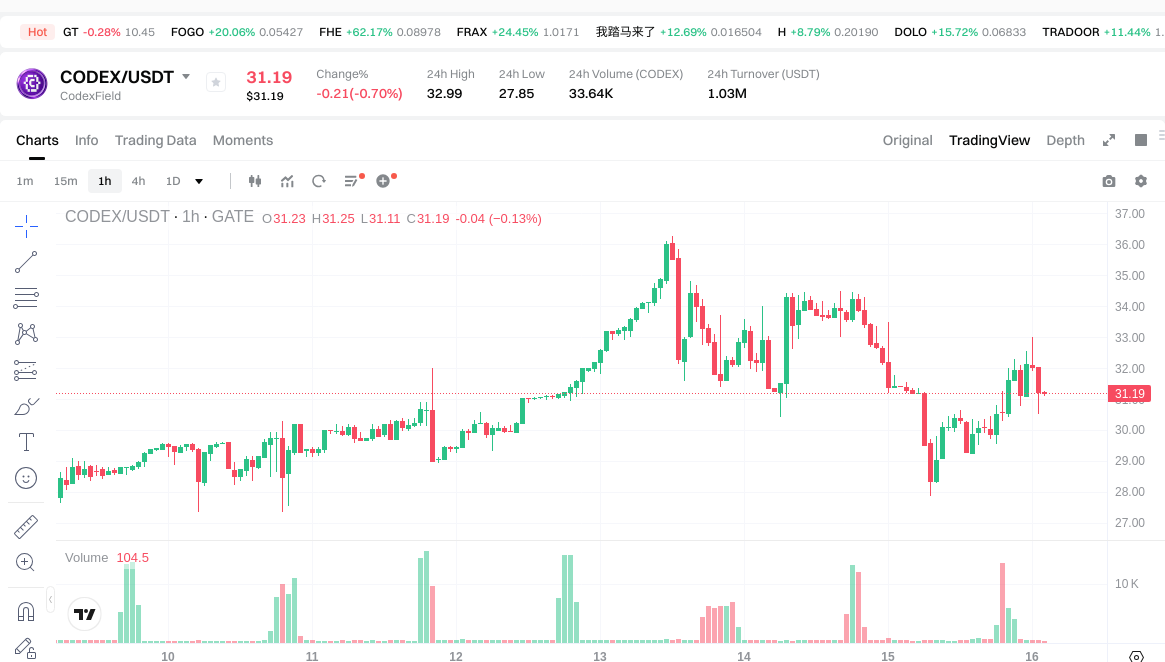
Mid-January 2026: As of January 16, 2026, CODEX has shown mixed short-term performance with a 24-hour decline of 0.73% and a 1-hour decrease of 1.73%, while demonstrating stronger 7-day growth of 11.32%, suggesting evolving market sentiment and trading activity.
Current CODEX Investment Market Status (January 2026)
- CODEX current price: $31.16
- Market sentiment (Fear & Greed Index): Data indicates cautious market positioning, with CODEX experiencing moderate trading activity
- 24-hour trading volume: $1,030,612.389
- Token circulation metrics: 7,260,000 CODEX tokens currently in circulation (6.05% of total supply), with a circulating market cap of $226,221,600 and fully diluted valuation of $3,739,200,000
Click to view real-time CODEX market price
II. Core Factors Influencing Whether CODEX Is a Good Investment (Is Codexfield(CODEX) a Good Investment)
Supply Mechanism and Scarcity (CODEX investment scarcity)
- Supply mechanism → influences price and investment value
- CodexField has a maximum supply of 120,000,000 CODEX tokens, with a current circulating supply of 7,260,000 tokens, representing a circulating ratio of approximately 6.05%
- The relatively low circulating supply compared to total supply suggests a controlled token release strategy, which may support price stability as demand grows
- Investment significance: the scarcity factor, with only 6.05% of total supply currently circulating, could serve as a foundation for long-term investment consideration, though this depends on future token unlock schedules and market dynamics
Institutional Investment and Mainstream Adoption (Institutional investment in CODEX)
- The token currently trades on 4 exchanges and has 38 holders, indicating early-stage adoption
- CodexField's infrastructure is built on BNB Greenfield and BNB Smart Chain, which may provide technical credibility and integration opportunities within the BNB ecosystem
- The platform aims to transform how developers monetize code, algorithms, and technical content by converting them into on-chain assets with verifiable ownership, potentially attracting developer communities and content creators
- Mainstream adoption factors: the platform's value proposition addresses inefficiencies in traditional platforms where developers create value but platforms extract rent, positioning CodexField as an alternative to centralized code repositories
Technology and Ecosystem Development (Technology & Ecosystem for CODEX investment)
- Git-compatible tools integration: CodexField integrates Git-compatible tools with decentralized storage, enabling developers to publish code and technical content as programmable, tradable assets
- On-chain reputation and incentive system: the platform incorporates on-chain reputation mechanisms and incentive structures designed to reward content creators and knowledge contributors
- Content assetization infrastructure: the protocol enables the storage, sharing, and assetization of code and structured digital knowledge, creating a framework for monetizing technical contributions
- Decentralized storage foundation: built on BNB Greenfield's decentralized storage infrastructure, the platform provides an alternative to centralized code hosting platforms
- Ecosystem value: the token's economic model is designed so that increased ecosystem activity strengthens the token's utility and potential value within the platform's content and model financialization framework
- Long-term perspective: according to available analyses, CodexField's potential value may grow alongside the expansion of AI content production capacity, as the platform positions itself to serve content creators and developers in the Web3 era
III. CODEX Future Investment Predictions and Price Outlook (Is Codexfield (CODEX) worth investing in 2026-2031)
Short-term Investment Outlook (2026, short-term CODEX investment outlook)
Based on current market data, Codexfield (CODEX) shows mixed near-term signals. As of January 16, 2026, the token trades at approximately $31.16, with 24-hour performance showing a decline of 0.73%. However, the 7-day trend indicates upward momentum with an 11.32% increase, suggesting potential short-term volatility.
- Conservative scenario: $27.85 - $30.50 (reflecting recent 24-hour low and moderate recovery)
- Neutral scenario: $30.50 - $35.00 (accounting for current price stability and weekly trend)
- Optimistic scenario: $35.00 - $42.11 (assuming sustained 7-day momentum and market sentiment improvement)
The short-term outlook is influenced by the token's relatively recent market entry (launched January 2, 2026) and limited exchange availability (4 exchanges). Price predictions from analytical tools suggest potential modest growth scenarios, though market participants should note the token's low circulation ratio of 6.05% (7.26 million circulating vs. 120 million total supply).
Mid-term Investment Outlook (2027-2028, mid-term Codexfield (CODEX) investment forecast)
- Market stage expectation: Early expansion phase as CodexField's infrastructure protocol gains traction within the BNB Chain ecosystem and developer adoption increases
- Investment return projections:
- 2027: $36.65 - $40.31 (reflecting potential ecosystem development and increased circulation)
- 2028: $38.48 - $50.79 (accounting for broader adoption of decentralized code storage solutions)
- Key catalysts: Integration with Git-compatible tools, expansion of on-chain reputation systems, growth in decentralized storage demand, and potential listings on additional major exchanges
The mid-term forecast considers CodexField's positioning within the Web3 infrastructure sector, where demand for verifiable ownership and code assetization may grow as the ecosystem matures. However, the success trajectory depends on developer adoption rates and the platform's ability to differentiate from traditional code repositories.
Long-term Investment Outlook (Is CODEX a good long-term investment?)
- Base scenario: $44.64 - $55.04 (2029-2030, assuming steady ecosystem growth and sustained developer engagement)
- Optimistic scenario: $50.84 - $61.52 (2031, corresponding to widespread adoption of code assetization models and Web3 infrastructure maturation)
- Risk scenario: Below $25.00 (under conditions of severe market downturn, limited platform adoption, or competitive displacement)
For detailed CODEX long-term investment and price predictions: Price Prediction
2026-2031 Long-term Outlook
- Base scenario: $31.00 - $50.00 (corresponding to moderate progress in mainstream application and steady ecosystem development)
- Optimistic scenario: $50.00 - $61.52 (corresponding to large-scale adoption and favorable market conditions)
- Transformative scenario: Above $65.00 (contingent on breakthrough developments in the ecosystem and mainstream integration)
- Predicted high for December 31, 2031: $61.52 (based on optimistic development assumptions)
Disclaimer: Price predictions are derived from analytical models incorporating supply dynamics, market sentiment indicators, regulatory trends, institutional adoption patterns, and macroeconomic factors. These projections are inherently speculative and should not be construed as investment advice. Past performance does not guarantee future results. Cryptocurrency investments carry substantial risk, including potential loss of principal. Market participants should conduct independent research, consider their financial situation and risk tolerance, and consult qualified financial advisors before making investment decisions. The information presented reflects conditions as of January 16, 2026, and is subject to change based on evolving market dynamics.
| Year |
Predicted High Price |
Predicted Average Price |
Predicted Low Price |
Price Change |
| 2026 |
42.1065 |
31.19 |
21.833 |
0 |
| 2027 |
40.313075 |
36.64825 |
24.5543275 |
17 |
| 2028 |
50.7944745 |
38.4806625 |
24.627624 |
23 |
| 2029 |
48.654949665 |
44.6375685 |
24.10428699 |
43 |
| 2030 |
55.04258571735 |
46.6462590825 |
27.9877554495 |
49 |
| 2031 |
61.52175110390925 |
50.844422399925 |
34.574207231949 |
63 |
IV. Codexfield Investment Strategy and Risk Management (How to invest in Codexfield)
Investment Methodology (Codexfield investment strategy)
Long-term Holding (HODL Codexfield)
For conservative investors seeking to participate in the decentralized code and digital knowledge infrastructure space, a long-term holding strategy may be appropriate. This approach involves acquiring CODEX tokens and maintaining positions through market cycles, based on conviction in the protocol's fundamental value proposition of transforming software and knowledge into programmable, tradable on-chain assets.
Key considerations for long-term holders include:
- Monitoring the development progress of CodexField's Git-compatible tools and decentralized storage integration
- Tracking adoption metrics among developers publishing code, algorithms, and technical content on the platform
- Evaluating the growth of the on-chain reputation and incentive ecosystem
- Assessing the expansion of use cases for code assetization within the Web3 ecosystem
Active Trading
For investors with higher risk tolerance and technical analysis capabilities, active trading strategies may be employed. CODEX has demonstrated notable price volatility, with 24-hour fluctuations ranging from $27.85 to $32.99 as of January 16, 2026. The token has shown a 7-day price increase of approximately 11.32%, while experiencing shorter-term declines of 1.73% over 1 hour and 0.73% over 24 hours.
Active trading approaches may include:
- Technical analysis based on price action, volume patterns, and momentum indicators
- Swing trading to capitalize on medium-term price movements
- Monitoring daily trading volume (approximately $1.03 million as of January 16, 2026) for liquidity assessment
- Setting predetermined entry and exit points based on risk-reward ratios
Risk Management (Risk management for Codexfield investment)
Asset Allocation Ratios
Conservative Investors: May consider allocating 1-3% of their cryptocurrency portfolio to CODEX, recognizing its relatively early stage and limited circulation (6.05% of total supply in circulation as of January 16, 2026).
Moderate Investors: Could allocate 3-7% of their cryptocurrency holdings to CODEX, balancing exposure to emerging infrastructure protocols with established digital assets.
Aggressive/Professional Investors: May allocate 7-15% or more to CODEX, based on thorough due diligence of the protocol's technical architecture, team capabilities, and market positioning within the BNB Chain ecosystem.
Risk Hedging Solutions
- Diversified Portfolio Construction: Balance CODEX exposure with established cryptocurrencies, stablecoins, and assets from different sectors (DeFi, Layer 1/Layer 2 protocols, infrastructure tokens)
- Position Sizing: Limit individual position sizes to amounts that align with personal risk tolerance and overall portfolio strategy
- Rebalancing Mechanisms: Establish periodic portfolio reviews to maintain desired allocation percentages as asset values fluctuate
- Stablecoin Reserves: Maintain liquidity reserves in stablecoins for opportunistic purchases during market corrections
Secure Storage Solutions
Cold Wallet Storage: For long-term holdings, consider transferring CODEX tokens to cold storage solutions that support BEP-20 tokens on BSC (BNB Smart Chain). This approach minimizes exposure to online threats.
Hot Wallet Management: For active trading positions, use reputable hot wallets with strong security features, while keeping only necessary amounts for trading purposes.
Hardware Wallet Recommendations: Leading hardware wallet solutions supporting BEP-20 tokens provide enhanced security through offline private key storage. Ensure regular firmware updates and secure backup of recovery phrases.
Multi-Signature Wallets: For larger holdings or institutional investors, multi-signature wallet solutions add additional security layers by requiring multiple approvals for transactions.
V. Codexfield Investment Risks and Challenges (Risks of investing in Codexfield)
Market Risks
High Volatility: CODEX has demonstrated considerable price fluctuations, with historical price ranges from $1 to $50 recorded on January 2, 2026. The current price of $31.16 (as of January 16, 2026) reflects ongoing volatility characteristic of emerging cryptocurrency assets.
Liquidity Considerations: With a 24-hour trading volume of approximately $1.03 million and listing on 4 exchanges, CODEX may experience liquidity constraints compared to more established cryptocurrencies. Limited liquidity can result in wider bid-ask spreads and potential price slippage during larger transactions.
Concentration Risk: With only 38 holders reported and a circulating supply of 7.26 million tokens (6.05% of total supply), token concentration may present risks related to potential large-scale selling pressure or market manipulation vulnerabilities.
Regulatory Risks
Jurisdictional Uncertainty: The regulatory landscape for decentralized infrastructure protocols and tokenized code assets remains evolving across different jurisdictions. Changes in regulatory approaches toward cryptocurrencies, decentralized storage solutions, or on-chain intellectual property rights could impact CodexField's operations and token value.
Compliance Requirements: As regulatory frameworks develop, CodexField may face compliance obligations that could affect its protocol design, token economics, or operational costs.
Cross-Border Considerations: Investors should be aware of their local jurisdiction's regulations regarding cryptocurrency ownership, trading, and taxation, particularly for tokens representing intellectual property rights or code ownership.
Technical Risks
Smart Contract Vulnerabilities: As a protocol built on BNB Greenfield and BNB Smart Chain, CodexField relies on smart contract functionality. Potential vulnerabilities in contract code could expose users to security risks, including loss of funds or unauthorized access.
Network Dependency: CodexField's functionality depends on the continued operation and security of the BNB Chain infrastructure. Any technical issues, network congestion, or security compromises affecting the underlying blockchain could impact the protocol's performance.
Integration Complexity: The protocol's integration of Git-compatible tools, decentralized storage, and on-chain reputation systems involves multiple technical components. Challenges in maintaining interoperability or implementing upgrades could affect user experience and adoption.
Adoption Risk: The success of CodexField depends on widespread adoption by developers and technical content creators. Competition from alternative code sharing platforms, centralized or decentralized, may limit user acquisition and network effects.
VI. Conclusion: Is Codexfield a Good Investment?
Investment Value Summary
CodexField presents a novel approach to code and digital knowledge assetization within the Web3 ecosystem. By enabling developers to publish code, algorithms, and technical content as verifiable on-chain assets with programmable ownership and usage rights, the protocol addresses emerging needs in decentralized infrastructure.
The platform's integration with BNB Greenfield and BNB Smart Chain positions it within an established blockchain ecosystem, while its focus on transforming software and knowledge into tradable assets represents an innovative value proposition. However, investors should note the project's early stage, reflected in its limited circulation (6.05% of total supply), relatively small holder base (38 holders), and concentrated market capitalization.
Price performance has shown mixed signals, with recent 7-day gains offset by shorter-term declines and a 30-day decrease of approximately 2.56%. Market volatility remains substantial, as evidenced by the significant historical price range.
Investor Recommendations
✅ Beginners: Consider a cautious approach with small position sizes. Employ dollar-cost averaging (DCA) strategies to mitigate timing risk and volatility. Prioritize secure storage using reputable wallets supporting BEP-20 tokens. Conduct thorough research on the protocol's fundamentals, team background, and development roadmap before committing capital.
✅ Experienced Investors: May explore tactical trading opportunities based on technical analysis and market momentum indicators. Consider position sizing within a diversified cryptocurrency portfolio, maintaining exposure to multiple sectors and risk profiles. Monitor protocol development milestones, adoption metrics, and competitive positioning within the decentralized infrastructure landscape.
✅ Institutional Investors: Conduct comprehensive due diligence including technical audits, tokenomics analysis, and team assessment. Evaluate CodexField's potential role within broader Web3 infrastructure portfolios. Consider staged entry strategies aligned with development milestones and adoption indicators. Implement institutional-grade custody solutions and compliance frameworks.
⚠️ Disclaimer: Cryptocurrency investments carry substantial risks, including the potential loss of principal. Market volatility, regulatory uncertainty, technical vulnerabilities, and liquidity constraints may significantly impact investment outcomes. This analysis is provided for informational purposes only and does not constitute financial advice, investment recommendations, or solicitation to buy or sell any securities or digital assets. Investors should conduct independent research, consult qualified financial advisors, and only invest amounts they can afford to lose. Past performance does not guarantee future results.
VII. FAQ
Q1: What makes Codexfield (CODEX) different from traditional code repositories like GitHub?
Codexfield transforms code from a consumable resource into a programmable, tradable on-chain asset with verifiable ownership. Unlike centralized platforms where developers create value but platforms extract rent, CODEX enables developers to publish code, algorithms, and technical content as blockchain-based assets with built-in usage rights and monetization mechanisms. The protocol integrates Git-compatible tools with decentralized storage on BNB Greenfield, creating an on-chain reputation system that directly rewards content creators rather than platform intermediaries.
Q2: Why is only 6.05% of CODEX tokens currently circulating, and how does this affect investment decisions?
As of January 16, 2026, only 7.26 million of the 120 million total CODEX tokens are in circulation. This controlled release strategy may support price stability by limiting immediate supply, but it also presents risks related to future token unlocks. Investors should monitor the project's vesting schedule and token distribution timeline, as large-scale releases could create downward price pressure. The low circulation ratio means the current market cap of $226.22 million significantly differs from the fully diluted valuation of $3.74 billion, indicating substantial future supply expansion.
Q3: Is CODEX suitable for short-term trading or long-term holding?
CODEX exhibits characteristics suitable for both strategies, depending on investor profiles. Short-term traders may capitalize on significant volatility, evidenced by 24-hour price ranges from $27.85 to $32.99 and a 7-day gain of 11.32%. However, relatively low trading volume ($1.03 million daily) and listing on only 4 exchanges may create liquidity challenges. Long-term holders betting on Web3 infrastructure adoption might view the current early stage (38 holders, recent January 2, 2026 launch) as an opportunity, though this requires conviction in the protocol's ability to attract developer communities and compete with established code-sharing platforms.
Q4: What are the primary risks investors should consider before purchasing CODEX?
Key risks include: (1) Concentration risk - with only 38 holders and limited circulation, large holders could significantly impact price; (2) Liquidity constraints - trading on just 4 exchanges with moderate volume may cause price slippage; (3) Technical dependencies - reliance on BNB Chain infrastructure means network issues could affect functionality; (4) Adoption uncertainty - success depends on developers choosing CODEX over established alternatives; (5) Regulatory ambiguity - evolving regulations regarding tokenized intellectual property and decentralized storage remain unclear across jurisdictions.
Q5: How should investors allocate CODEX within their cryptocurrency portfolio?
Conservative investors might limit CODEX to 1-3% of their crypto holdings, recognizing the project's early stage and limited track record. Moderate investors could allocate 3-7%, balancing exposure to emerging infrastructure with established assets. Aggressive investors with higher risk tolerance might commit 7-15% or more, based on thorough analysis of the protocol's technical merit and market positioning. All investors should diversify across multiple crypto sectors (DeFi, Layer 1/2, infrastructure) and maintain stablecoin reserves for opportunistic purchases during corrections.
Q6: What price predictions exist for CODEX through 2031?
Analytical models project varied scenarios: Short-term (2026): conservative $27.85-$30.50, neutral $30.50-$35.00, optimistic $35.00-$42.11; Mid-term (2027-2028): $36.65-$50.79 assuming ecosystem development; Long-term (2029-2031): base scenario $44.64-$61.52. These predictions factor in potential developer adoption, Web3 infrastructure maturation, and increased token circulation. However, predictions carry substantial uncertainty given the project's nascency, market volatility, and dependence on unproven adoption rates. Investors should treat forecasts as speculative scenarios rather than guaranteed outcomes.
Q7: What security measures should CODEX holders implement?
For long-term holdings, transfer tokens to cold storage hardware wallets supporting BEP-20 tokens on BNB Smart Chain, ensuring offline private key storage and secure backup of recovery phrases with regular firmware updates. Active traders should use reputable hot wallets with strong security features while keeping only necessary trading amounts online. Larger holders or institutional investors should consider multi-signature wallet solutions requiring multiple approvals for transactions. Never share private keys, verify wallet addresses carefully before transactions, and enable all available security features including two-factor authentication.
Q8: How can investors monitor CODEX development progress to inform investment decisions?
Track key indicators including: (1) Developer adoption metrics - growth in developers publishing code and content on the platform; (2) Ecosystem expansion - integration progress with Git-compatible tools and decentralized storage; (3) On-chain activity - transaction volume, active addresses, and reputation system engagement; (4) Token distribution - changes in holder numbers and circulation supply; (5) Exchange listings - expansion beyond current 4 exchanges to improve liquidity; (6) Competitive positioning - comparison with alternative decentralized code repositories; (7) Partnership announcements - collaborations within the BNB Chain ecosystem or broader Web3 space.
* The information is not intended to be and does not constitute financial advice or any other recommendation of any sort offered or endorsed by Gate.