This comprehensive analysis examines whether Compound (COMP) represents a viable investment opportunity in 2026 and beyond. COMP serves as the governance token for the Compound DeFi lending protocol with a current market cap of $260.65 million and price of approximately $26.96 as of January 2026. The article evaluates COMP's investment potential through multiple lenses: historical price performance from its $909.09 peak in May 2021 to current levels, core investment factors including fixed supply mechanics and institutional adoption, and detailed price forecasts spanning 2026-2031. It provides actionable investment strategies differentiated for beginners through institutional investors, while comprehensively addressing market, regulatory, and technical risks inherent in DeFi governance token investments. The analysis concludes that COMP offers governance participation in an established protocol but requires careful risk management given significant volatility and competitive DeFi landscape dynamics, with real
Introduction: Compound (COMP) Investment Status and Market Outlook
COMP represents a significant asset within the cryptocurrency sector, serving as the governance token for the Compound protocol since its launch in 2020. As of January 2026, Compound maintains a market capitalization of approximately $260.65 million, with a circulating supply of around 9.67 million tokens, and a current price hovering near $26.96. Positioned as a decentralized money market protocol built on the Ethereum blockchain, COMP has established itself as a notable player in the decentralized finance (DeFi) landscape. With a ranking of 203 in the broader cryptocurrency market and a market dominance of 0.0078%, the token continues to attract attention from market participants evaluating "Is Compound (COMP) a good investment?" This analysis examines COMP's investment characteristics, historical price movements, future price trajectories, and associated investment risks to provide reference points for potential investors.
I. Compound (COMP) Price History Review and Current Investment Value Status
- 2021: DeFi boom peak → COMP reached $909.09 on May 12, 2021, during the height of decentralized finance enthusiasm when Compound's "lending-as-mining" model attracted significant market attention
- 2025: Market correction phase → Price declined from previous elevated levels to $23.47 in October 2025, reflecting broader crypto market adjustments
- 2020-2021: Initial growth cycle → Following its June 2020 launch at $244.50, COMP experienced substantial price appreciation during the DeFi summer period
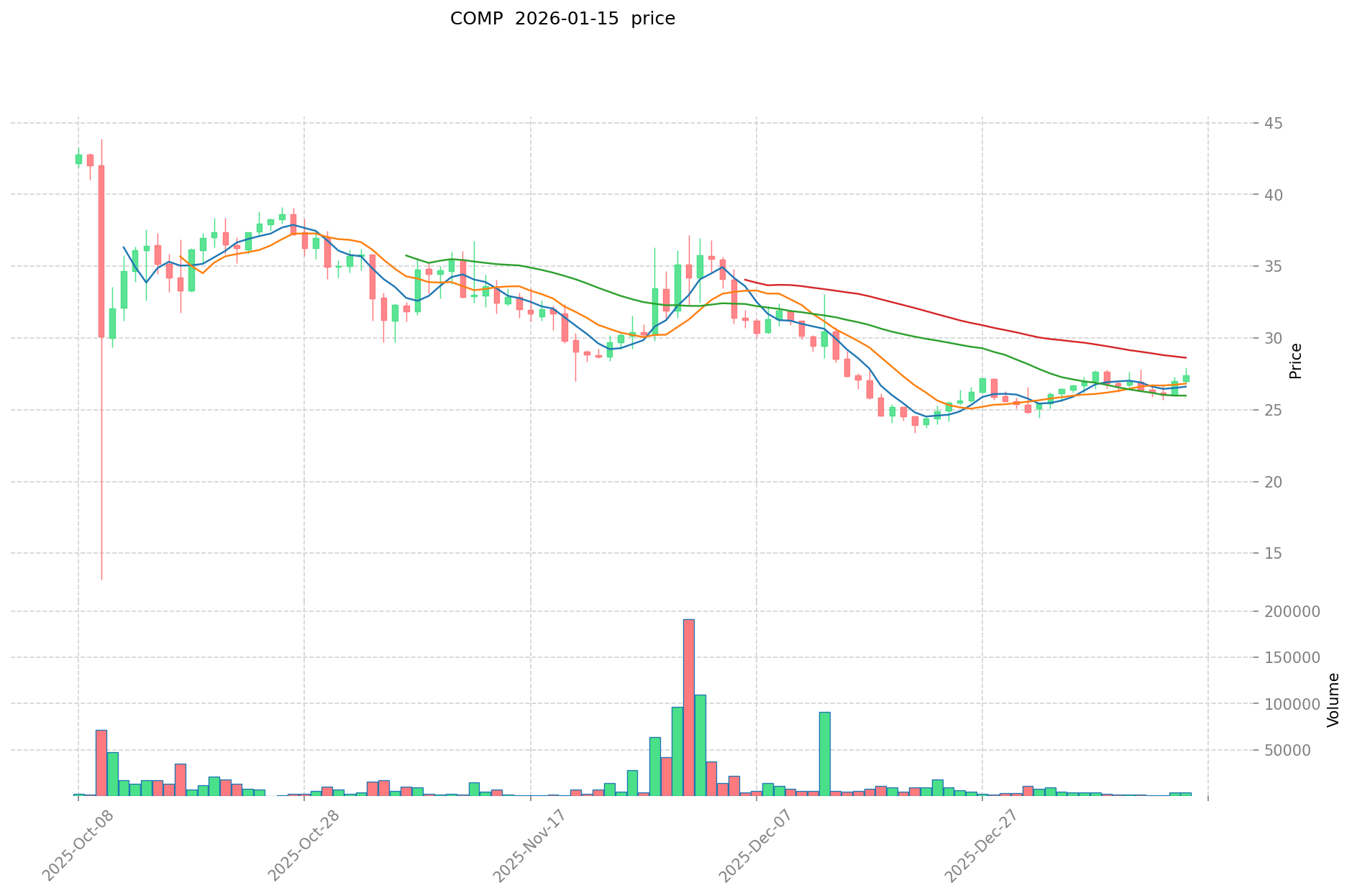
Current COMP Investment Market Status (January 2026)
- COMP current price: $26.96
- 24-hour trading volume: $104,323,612.70
- Market capitalization: $260,654,382.94
- Circulating supply: 9,668,189.28 COMP (96.68% of total supply)
Click to view real-time COMP market price
II. Core Factors Affecting Whether COMP is a Good Investment
Supply Mechanism and Scarcity (COMP Investment Scarcity)
- Fixed Maximum Supply Design → Influences Price and Investment Value
- COMP has a maximum supply of 10,000,000 tokens, with a current circulating supply of approximately 9,668,189 tokens (96.68% of total supply). This relatively high circulation ratio indicates that the majority of tokens are already in the market, reducing potential dilution risks for investors.
- Historical Context: COMP reached a notable price level of $910.54 in May 2021, though it has experienced significant volatility since then, trading at $26.96 as of January 15, 2026. The token's price movements have been influenced by broader market conditions and protocol adoption rates.
- Investment Significance: The fixed supply cap and high circulation percentage create a defined scarcity model, which may support long-term investment considerations, though market dynamics and protocol utility remain primary value drivers.
Institutional Investment and Mainstream Adoption (Institutional Investment in COMP)
- Market Presence: COMP is listed on 60 exchanges and has attracted 219,458 holders, indicating a broad distribution across the cryptocurrency ecosystem.
- Protocol Position: As a decentralized money market protocol built on the Ethereum blockchain, Compound has established itself within the DeFi sector, with COMP serving as the governance token for protocol decisions.
- Market Capitalization: With a market cap of approximately $260.65 million and a market dominance of 0.0078%, COMP maintains a presence in the broader cryptocurrency landscape, though its relative market share reflects the competitive nature of the DeFi lending sector.
Macroeconomic Environment's Impact on COMP Investment
- Market Performance Context: COMP has experienced varied performance across different timeframes, with a 1.09% increase over 7 days but a -0.70% change over 30 days, and a -64.42% decline over one year as of January 15, 2026. These fluctuations reflect sensitivity to broader cryptocurrency market conditions.
- DeFi Market Dynamics: As a lending protocol token, COMP's investment appeal may be influenced by interest rate environments and demand for decentralized financial services. Changes in traditional financial market conditions could impact user adoption of DeFi lending platforms.
- Market Volatility Considerations: The significant gap between COMP's historical price range (from $22.89 to $910.54) demonstrates substantial volatility, which investors should consider when evaluating risk-adjusted investment potential.
Technology and Ecosystem Development (Technology & Ecosystem for COMP Investment)
- Protocol Foundation: Compound operates as a decentralized money market protocol on the Ethereum blockchain, with its smart contracts available for review on GitHub. The protocol's technical infrastructure supports lending and borrowing activities within the DeFi ecosystem.
- DeFi Integration: The Compound protocol has established connections within the broader DeFi landscape, contributing to its utility as a governance token. The token's value may be influenced by the protocol's adoption rates and the overall growth of decentralized lending markets.
- Governance Function: COMP serves as the governance token for the Compound protocol, allowing holders to participate in protocol decision-making. This governance utility may provide additional considerations for long-term investment evaluation beyond pure price speculation.
III. COMP Future Investment Forecast and Price Outlook (Is Compound (COMP) worth investing in 2026-2030)
Short-term COMP Investment Outlook (2026)
- Conservative forecast: $16.45 - $26.97
- Neutral forecast: $26.97 - $29.53
- Optimistic forecast: $29.53 - $32.09
Mid-term Compound (COMP) Investment Forecast (2027-2028)
-
Market stage expectation: Compound may experience gradual growth as the DeFi lending protocol continues to attract users seeking yield opportunities. The project's established position in decentralized finance could support steady development during this period.
-
Investment return forecast:
- 2027: $25.10 - $33.08
- 2028: $17.84 - $37.56
-
Key catalysts: Enhanced protocol features, broader integration with DeFi ecosystems, and potential increases in total value locked (TVL) may influence price movements. Market conditions and competitive dynamics within the lending sector will likely play significant roles.
Long-term Investment Outlook (Is COMP a good long-term investment?)
- Base scenario: $20.62 - $44.36 by 2030 (assuming continued protocol adoption and stable market conditions)
- Optimistic scenario: $41.63 - $53.71 by 2031 (assuming favorable regulatory environment and increased DeFi adoption)
- Risk scenario: $16.45 - $18.25 (in case of heightened competition, regulatory challenges, or adverse market conditions)
Click to view COMP long-term investment and price forecast: Price Prediction
2026-2031 Long-term Outlook
- Base scenario: $16.45 - $44.36 (corresponding to steady progress and gradual mainstream adoption)
- Optimistic scenario: $41.63 - $53.71 (corresponding to large-scale adoption and favorable market environment)
- Transformative scenario: Above $53.71 (subject to breakthrough developments in the ecosystem and mainstream popularization)
- December 31, 2031 predicted high: $53.71 (based on optimistic development assumptions)
Disclaimer: Price forecasts are based on historical data and market analysis models. Cryptocurrency markets are highly volatile and subject to numerous unpredictable factors. These predictions should not be considered as investment advice. Investors should conduct independent research and consider their risk tolerance before making investment decisions.
| Year |
Predicted High Price |
Predicted Average Price |
Predicted Low Price |
Price Change |
| 2026 |
32.0943 |
26.97 |
16.4517 |
0 |
| 2027 |
33.076008 |
29.53215 |
25.1023275 |
9 |
| 2028 |
37.5648948 |
31.304079 |
17.84332503 |
16 |
| 2029 |
43.387453494 |
34.4344869 |
18.250278057 |
27 |
| 2030 |
44.35850602458 |
38.910970197 |
20.62281420441 |
44 |
| 2031 |
53.7088121629191 |
41.63473811079 |
27.0625797720135 |
54 |
IV. COMP Investment Strategy and Risk Management (How to invest in DeFi Governance Tokens)
Investment Methodology (COMP investment strategy)
-
Long-term Holding (HODL COMP): Suitable for conservative investors who believe in the long-term development of decentralized finance protocols and governance models. This approach requires patience to weather market volatility and focus on the fundamental value proposition of protocol governance rights.
-
Active Trading: Relies on technical analysis and swing trading strategies. Traders may utilize price trends, support and resistance levels, and trading volume indicators to identify entry and exit points. Given COMP's historical volatility, this approach demands careful risk management and market monitoring.
Risk Management (Risk management for COMP investment)
-
Asset Allocation Ratios:
- Conservative investors: Allocate 1-3% of crypto portfolio to governance tokens like COMP
- Aggressive investors: May allocate 5-10% depending on risk tolerance and market outlook
- Professional investors: Consider dynamic allocation based on protocol developments and DeFi market cycles
-
Risk Hedging Solutions: Diversify across multiple DeFi protocols and asset classes. Consider combining COMP exposure with blue-chip cryptocurrencies and stablecoins. Some investors may use derivatives or options for hedging purposes where available.
-
Secure Storage: Utilize cold wallets for long-term holdings and hardware wallets such as Ledger or Trezor for enhanced security. Hot wallets should only hold amounts needed for active trading. Always verify contract addresses (0xc00e94Cb662C3520282E6f5717214004A7f26888 for Ethereum) before transactions.
V. COMP Investment Risks and Challenges (Risks of investing in DeFi Governance Tokens)
-
Market Risk: COMP exhibits significant price volatility, with historical price ranging from $22.89 to $910.54. The token has experienced a notable decline of 64.42% over the past year. Price movements can be influenced by broader crypto market sentiment, DeFi sector trends, and protocol-specific developments.
-
Regulatory Risk: Decentralized finance protocols face evolving regulatory frameworks across different jurisdictions. Policy changes regarding DeFi governance, securities classification, and lending protocols could impact COMP's utility and market dynamics. Regulatory uncertainty varies significantly by country and region.
-
Technical Risk: Smart contract vulnerabilities, protocol upgrades, and network security issues pose potential risks. As a governance token for a lending protocol, technical failures or exploits in the Compound protocol could negatively affect COMP's value. Changes in the Ethereum network may also impact token functionality and transaction costs.
VI. Conclusion: Is DeFi Governance Token a Good Investment?
-
Investment Value Summary: COMP represents governance rights in an established DeFi protocol with potential for long-term value creation, though the token has experienced substantial price fluctuations. With a circulating supply of approximately 9.67 million tokens out of a maximum 10 million, the token demonstrates high circulation ratio of 96.68%.
-
Investor Recommendations:
✅ Beginners: Consider dollar-cost averaging (DCA) strategy combined with secure wallet storage. Start with small allocations to understand DeFi governance mechanics and market dynamics.
✅ Experienced Investors: May explore swing trading opportunities while maintaining core positions. Diversify across multiple DeFi protocols and monitor protocol developments, governance proposals, and market trends.
✅ Institutional Investors: Evaluate strategic long-term allocation as part of broader DeFi exposure. Consider governance participation opportunities and protocol fundamentals in investment decisions.
⚠️ Disclaimer: Cryptocurrency investments carry substantial risk. This content is for informational purposes only and does not constitute investment advice. Conduct thorough research and consider your financial situation before making investment decisions.
VII. FAQ
Q1: Is Compound (COMP) a good investment for beginners in 2026?
COMP may be suitable for beginners who understand DeFi protocols and can tolerate high volatility, but it requires careful consideration. As a governance token for an established lending protocol, COMP offers exposure to the DeFi sector. However, the token has experienced significant price volatility, declining 64.42% over the past year and trading far below its May 2021 peak of $910.54. Beginners should start with small allocations (1-3% of crypto portfolio), use dollar-cost averaging strategies, and prioritize secure storage methods. Understanding the token's governance function and the Compound protocol's mechanics is essential before investing.
Q2: What is the realistic price prediction for COMP by 2030?
Based on current market analysis, COMP's predicted price range for 2030 spans from $20.62 to $44.36 under base scenario assumptions. The conservative forecast suggests a low of $20.62, while the optimistic scenario projects a high of $44.36, with an average predicted price of $38.91. These projections assume continued protocol adoption, stable market conditions, and favorable DeFi sector growth. However, actual prices may vary significantly due to market volatility, regulatory changes, competitive dynamics, and broader cryptocurrency market conditions. Investors should view these predictions as reference points rather than guaranteed outcomes.
Q3: What are the main risks associated with investing in COMP?
COMP investment carries three primary risk categories: market risk, regulatory risk, and technical risk. Market risk stems from significant price volatility, with historical prices ranging from $22.89 to $910.54 and current 2026 prices around $26.96. Regulatory risk involves evolving DeFi regulations that could impact governance tokens and lending protocols across different jurisdictions. Technical risk includes potential smart contract vulnerabilities, protocol exploits, and changes to the Ethereum network that may affect transaction costs and functionality. Additionally, with 96.68% of tokens already in circulation, market dynamics are heavily influenced by existing holder behavior and broader DeFi sector trends.
Q4: How does COMP's tokenomics affect its investment potential?
COMP's tokenomics feature a fixed maximum supply of 10,000,000 tokens with approximately 9,668,189 tokens currently circulating (96.68% of total supply). This high circulation ratio indicates minimal dilution risk from new token releases, but also means that price appreciation depends primarily on demand growth rather than supply constraints. The fixed supply cap creates a defined scarcity model that may support long-term value considerations. However, the token's investment potential is primarily driven by protocol adoption, governance utility, and the overall growth of decentralized lending markets rather than tokenomics alone.
Q5: What investment strategies work best for COMP in 2026?
Two primary strategies suit different investor profiles: long-term holding (HODL) and active trading. Long-term holding is appropriate for conservative investors who believe in DeFi protocol development and governance models, requiring patience through market volatility while focusing on fundamental value. Active trading suits those with technical analysis skills who can identify entry and exit points using price trends, support/resistance levels, and volume indicators. Risk management is crucial for both approaches: conservative investors should allocate 1-3% of their crypto portfolio to COMP, while aggressive investors may allocate 5-10%. Diversification across multiple DeFi protocols and asset classes is recommended regardless of strategy.
Q6: How does COMP compare to other DeFi governance tokens as an investment?
COMP holds a market capitalization of approximately $260.65 million with a market dominance of 0.0078%, ranking 203rd in the broader cryptocurrency market as of January 2026. As an established DeFi lending protocol governance token, COMP competes within a sector that includes multiple lending and borrowing platforms. The token's investment characteristics include governance rights in protocol decisions, exposure to DeFi lending market growth, and integration within the broader Ethereum ecosystem. However, the token has experienced significant price decline from historical peaks, reflecting both market corrections and competitive pressures. Investors should evaluate COMP's position relative to protocol TVL (total value locked), user adoption rates, and technical developments when comparing against alternative DeFi governance tokens.
Q7: What factors could drive COMP price appreciation in the coming years?
Several catalysts may influence COMP's price trajectory through 2031. Enhanced protocol features and improved user experience could attract more participants to the Compound platform, increasing demand for governance participation. Broader integration with other DeFi ecosystems and increased total value locked (TVL) may boost token utility and value perception. Favorable regulatory frameworks that provide clarity for DeFi protocols could reduce uncertainty and attract institutional participation. Additionally, general cryptocurrency market conditions, Ethereum network upgrades, and overall DeFi sector adoption rates will likely play significant roles. The optimistic scenario projecting prices between $41.63 and $53.71 by 2031 assumes multiple positive developments align, while the base scenario of $20.62 to $44.36 reflects more moderate growth assumptions.
Q8: Should I buy COMP now or wait for a better entry point?
The decision depends on your investment strategy, risk tolerance, and market outlook. Current price levels around $26.96 represent a significant discount from historical peaks but have shown mixed short-term performance (+1.09% over 7 days, -0.70% over 30 days). For long-term investors employing dollar-cost averaging, current levels may represent a reasonable entry point for gradual accumulation. Active traders may prefer waiting for technical confirmation of trend reversals or support level tests. Consider that the token has high circulation (96.68%), meaning price movements depend heavily on demand dynamics rather than supply restrictions. Conservative forecasts suggest potential ranges of $16.45 to $32.09 for 2026, indicating both downside risks and upside opportunities. Ultimately, timing decisions should align with your overall investment plan and should not be based solely on short-term price predictions.
* The information is not intended to be and does not constitute financial advice or any other recommendation of any sort offered or endorsed by Gate.