This comprehensive analysis examines whether Constellation (DAG) represents a viable investment opportunity within the cryptocurrency sector. The article evaluates DAG's core technology—a hypergraph network architecture with two-tier consensus mechanism supporting 120 mainnet nodes—and its enterprise-focused ecosystem connecting over 70 companies. Current market fundamentals show DAG trading at 0.01184 USD with a 44.99 million USD market capitalization, though the token experienced an 83.03% decline over the past year. The analysis addresses critical investment considerations including unlimited token supply, regulatory uncertainties, technical risks, and limited liquidity of approximately 29,316 USD daily trading volume on Gate. Price forecasts across multiple scenarios range from 0.0084-0.0345 USD through 2031, with recommendations tailored for conservative, aggressive, and professional investors. The article concludes that DAG may suit risk-tolerant investors seeking Layer 0 protocol exposure through dolla
Introduction: Constellation (DAG)'s Investment Position and Market Outlook
Constellation (DAG) represents a notable asset within the cryptocurrency sector, having launched in June 2018. The project has developed infrastructure focused on distributed systems architecture and Web3 applications. As of January 20, 2026, DAG maintains a market capitalization of approximately 44.99 million USD, with a circulating supply of around 3.80 billion tokens. The current price stands at approximately 0.01184 USD. With its positioning as a blockchain infrastructure provider utilizing a hypergraph network and two-tier consensus mechanism, Constellation has attracted attention from those examining "Is Constellation (DAG) a good investment?" This article provides a comprehensive analysis of DAG's investment characteristics, historical price movements, future price considerations, and associated risks to serve as reference material for investors.
I. Constellation (DAG) Price History Review and Current Investment Value
- 2019: Network launch phase → Early participants experienced limited trading activity as the project established its mainnet infrastructure
- 2021: Market expansion period → DAG price movements reflected broader crypto market dynamics, with notable volatility throughout the year
- 2022-2024: Market adjustment cycle → Price levels experienced considerable fluctuation as the cryptocurrency sector underwent various transitions
Current DAG Investment Market Status (January 2026)
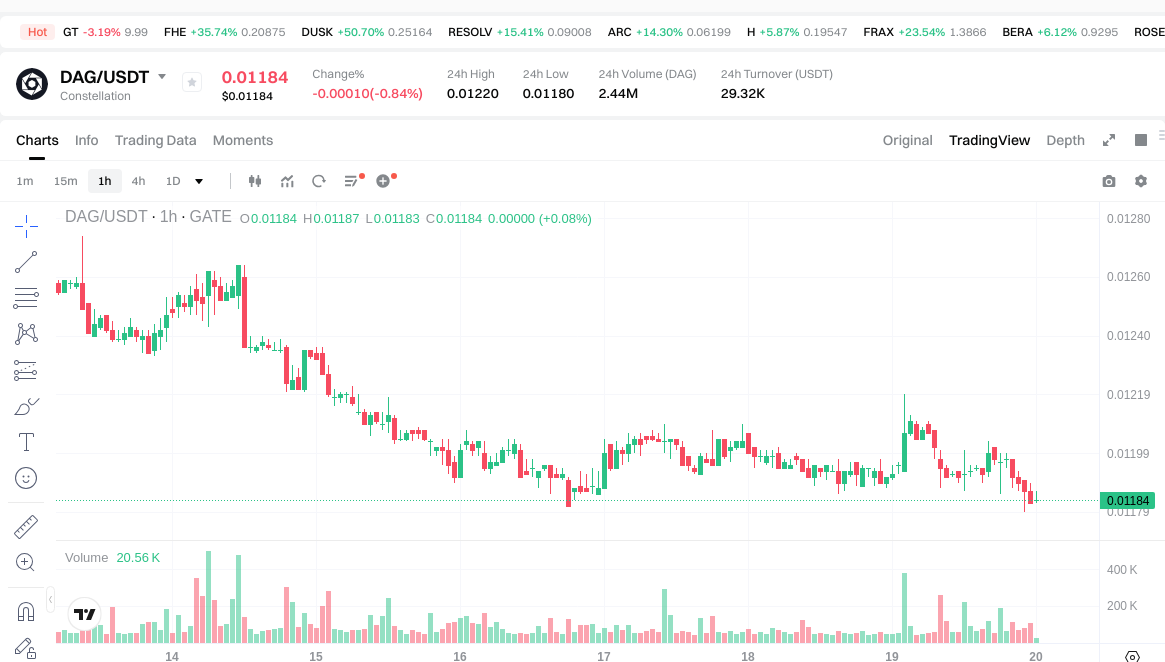
- DAG current price: 0.01184 USD
- Market capitalization: Approximately 44.996 million USD
- 24-hour trading volume: 29,315.90 USD
- Circulating supply: 3.80 billion DAG (representing 95.01% of total supply)
- Market ranking: 563
- Market share: 0.0013%
Click to view real-time DAG market price
II. Core Factors Influencing Whether DAG is a Good Investment (Is Constellation(DAG) a Good Investment)
Supply Mechanism and Scarcity (DAG investment scarcity)
- Unlimited maximum supply design → affects long-term price support and investment value assessment
- Historical pattern: DAG reached a notable price level of $0.451761 in August 2021, while the circulating supply ratio currently stands at approximately 95.01%, indicating a relatively mature supply distribution stage
- Investment significance: the unlimited supply model may pose challenges to long-term scarcity-driven value appreciation compared to assets with capped supply mechanisms
Institutional Investment and Mainstream Adoption (Institutional investment in DAG)
- Enterprise connections: Constellation has connected over 70 companies through its accelerator program, including partnerships with entities such as Alkimi and GeoJam, which contribute to ecosystem development
- Application deployment: the network serves as infrastructure for Web3 applications, potentially enhancing practical utility and investment relevance
- Network operations: supported by 120 mainnet nodes that maintain network state and earn DAGX cryptocurrency, reflecting decentralized infrastructure participation
Macroeconomic Environment Impact on DAG Investment
- Market capitalization positioning: with a market cap of approximately $44.996 million and market dominance of 0.0013%, DAG represents a smaller-cap digital asset that may exhibit higher sensitivity to broader market conditions
- Price performance: the 1-year price change of approximately -83.03% suggests vulnerability to unfavorable market cycles and macroeconomic headwinds
- Trading activity: 24-hour trading volume of approximately $29,315.90 indicates relatively limited liquidity compared to major cryptocurrencies, which may affect investment accessibility during market volatility
Technology and Ecosystem Development (Technology & Ecosystem for DAG investment)
- Consensus architecture: utilizes asynchronous Extended Trust Chain and Proof-of-Meme consensus model, combined with a two-tier consensus structure (L0 and L1) designed to support speed and scalability
- Technical infrastructure: positions mobile clients as full nodes, forming a distributed operating system with fault resistance and horizontal scalability capabilities
- Smart contract implementation: employs composable microservices compatible with JVM (Java Virtual Machine), representing consensus security through modern serverless architecture
- Network protocol: operates as a layer-0 protocol (Hypergraph Network) that aims to enable enterprises and individuals to participate in the stakeholder economy and data entrepreneurship
III. DAG Future Investment Forecast and Price Outlook (Is Constellation(DAG) worth investing in 2026-2031)
Short-term DAG Investment Outlook (2026)
- Conservative Forecast: $0.0084 - $0.0118
- Neutral Forecast: $0.0118 - $0.0145
- Optimistic Forecast: $0.0145 - $0.0173
Mid-term Constellation(DAG) Investment Forecast (2027-2028)
- Market Stage Expectation: The mid-term outlook suggests a period of gradual price stabilization and potential modest growth as the network continues development.
- Investment Return Forecast:
- 2027: $0.0122 - $0.0162
- 2028: $0.0129 - $0.0224
- Key Catalysts: Network infrastructure development, enterprise adoption progress, and overall cryptocurrency market conditions.
Long-term Investment Outlook (Is DAG a good long-term investment?)
- Base Scenario: $0.0115 - $0.0270 (assuming steady network growth and moderate market conditions)
- Optimistic Scenario: $0.0198 - $0.0345 (assuming accelerated adoption and favorable market environment)
- Risk Scenario: Below $0.0084 (under adverse market conditions or development challenges)
View DAG long-term investment and price forecast: Price Prediction
2026-01-20 - 2031 Long-term Outlook
- Base Scenario: $0.0084 - $0.0212 USD (corresponding to steady progress and gradual mainstream application growth)
- Optimistic Scenario: $0.0170 - $0.0345 USD (corresponding to large-scale adoption and favorable market environment)
- Transformative Scenario: Above $0.0345 USD (if ecosystem achieves breakthrough developments and mainstream adoption)
- 2031-12-31 Predicted High: $0.0345 USD (based on optimistic development assumptions)
Disclaimer: These forecasts are based on historical data and market analysis patterns. Cryptocurrency investments carry substantial risks, and actual prices may vary significantly from predictions due to market volatility, regulatory changes, technological developments, and other unforeseen factors. This information should not be construed as investment advice.
| Year |
Predicted High Price |
Predicted Average Price |
Predicted Low Price |
Price Change |
| 2026 |
0.0172718 |
0.01183 |
0.0083993 |
0 |
| 2027 |
0.016151499 |
0.0145509 |
0.012222756 |
22 |
| 2028 |
0.02241275127 |
0.0153511995 |
0.01289500758 |
29 |
| 2029 |
0.02360246923125 |
0.018881975385 |
0.01151800498485 |
59 |
| 2030 |
0.026977622331318 |
0.021242222308125 |
0.0169937778465 |
79 |
| 2031 |
0.034477188917202 |
0.024109922319721 |
0.019770136302171 |
103 |
IV. Constellation (DAG) Investment Strategy and Risk Management (How to invest in Layer 0 protocols)
Investment Methodology (Constellation investment strategy)
Long-term Holding (HODL DAG): Suitable for conservative investors
Long-term holding may be appropriate for investors who believe in the fundamental technology and ecosystem development of Constellation Network. This approach typically involves purchasing DAG tokens and holding them through market cycles, focusing on the project's long-term adoption by enterprise partners and network expansion rather than short-term price movements.
Active Trading: Relies on technical analysis and swing trading
Active traders may utilize technical indicators and chart patterns to identify potential entry and exit points. Given DAG's historical price volatility, with 24-hour changes around -0.92% and 7-day fluctuations of -6.99%, swing trading strategies could be employed during periods of market movement. Traders should monitor key support levels near $0.0118 and resistance around $0.0122 based on recent 24-hour price ranges.
Risk Management (Risk management for Constellation investment)
Asset Allocation Ratios: Conservative / Aggressive / Professional investors
- Conservative investors: May consider allocating 1-3% of their cryptocurrency portfolio to DAG, maintaining larger positions in established cryptocurrencies
- Aggressive investors: Could allocate 5-10% of their portfolio, accepting higher volatility for potential growth opportunities
- Professional investors: May employ dynamic allocation strategies based on market conditions and technical indicators
Risk Hedging Solutions: Multi-asset portfolio + hedging instruments
Investors can manage DAG exposure through diversification across different cryptocurrency categories, including established Layer 1 protocols and stablecoins. Portfolio construction should consider DAG's market correlation with broader crypto markets and its relatively small market capitalization of approximately $44.99 million.
Secure Storage: Hot/cold wallets + hardware wallet recommendations
DAG tokens should be stored using appropriate security measures. For long-term holdings, hardware wallets provide enhanced security through offline private key storage. For active trading purposes, reputable exchange wallets with two-factor authentication may be utilized, though holding large amounts on exchanges carries counterparty risk.
V. Constellation (DAG) Investment Risks and Challenges (Risks of investing in Layer 0 protocols)
Market Risk: High volatility and price manipulation concerns
DAG has experienced significant price volatility, with a 1-year decline of -83.03% from previous levels. The token's 24-hour trading volume of approximately $29,316 suggests relatively limited liquidity compared to major cryptocurrencies, which may result in wider bid-ask spreads and increased susceptibility to larger price swings from individual trades. The current price of $0.01184 represents a substantial decrease from its all-time high of $0.451761 recorded on August 26, 2021.
Regulatory Risk: Policy uncertainty across different jurisdictions
As with all cryptocurrency investments, DAG faces regulatory uncertainty across various jurisdictions. Changes in cryptocurrency regulations, tax treatment, or legal classification could impact the token's accessibility, trading venues, and overall market sentiment. Investors should monitor regulatory developments in their respective countries and assess how potential policy changes might affect their holdings.
Technical Risk: Network security vulnerabilities and upgrade failures
Constellation Network utilizes a two-tier consensus mechanism (L0 and L1) supported by approximately 120 mainnet nodes. Technical risks include potential network vulnerabilities, consensus mechanism failures, or issues during protocol upgrades. The project's architecture, including its asynchronous ExtendedTrustChain and proof-of-stake consensus model, requires ongoing maintenance and development. Any technical failures or security breaches could negatively impact token value and network functionality.
VI. Conclusion: Is Layer 0 protocol a Good Investment?
Investment Value Summary: Constellation (DAG) presents long-term investment potential based on its enterprise-focused approach and hypergraph network technology, though the token has experienced significant short-term price volatility.
The project's infrastructure serves over 70 companies through its accelerator program and maintains an operational mainnet with 120 nodes. However, investors should note the substantial 83.03% decline over the past year and the token's current market capitalization rank of 563, indicating it remains a smaller project within the cryptocurrency ecosystem.
Investor Recommendations:
✅ Beginners: Consider dollar-cost averaging with small, regular purchases + secure wallet storage. Limit DAG exposure to a small percentage of overall cryptocurrency allocation.
✅ Experienced Investors: May employ swing trading strategies during volatility periods + maintain diversified portfolio allocation across multiple blockchain protocols.
✅ Institutional Investors: Could evaluate strategic long-term positioning based on enterprise adoption metrics and network growth indicators.
⚠️ Notice: Cryptocurrency investment carries high risk. This article is for informational purposes only and does not constitute investment advice. Investors should conduct their own research and consult with qualified financial advisors before making investment decisions.
VII. FAQ
Q1: Is Constellation (DAG) a good investment for beginners in 2026?
DAG may be suitable for beginners willing to accept high risk as part of a diversified cryptocurrency portfolio, though it should represent only a small allocation (1-3%). The project offers exposure to Layer 0 protocol infrastructure with enterprise partnerships involving over 70 companies, but the token has experienced an 83.03% decline over the past year and maintains relatively limited trading volume of approximately $29,316 daily. Beginners should employ dollar-cost averaging strategies, use secure wallet storage, and understand that DAG's current market capitalization of $44.99 million and ranking of 563 indicates it remains a smaller, more volatile asset compared to established cryptocurrencies.
Q2: What are the main risks associated with investing in Constellation (DAG)?
The primary risks include significant price volatility, limited liquidity, regulatory uncertainty, and technical vulnerabilities. DAG's current price of $0.01184 represents a substantial decrease from its all-time high of $0.451761 in August 2021, demonstrating considerable downside risk. The relatively low 24-hour trading volume suggests potential challenges in executing large orders without price impact. Additionally, regulatory changes across jurisdictions could affect token accessibility, while technical risks related to the two-tier consensus mechanism and network security require ongoing monitoring. Investors should be prepared for potential losses and avoid allocating funds they cannot afford to lose.
Q3: How does Constellation's unlimited supply affect its long-term investment value?
The unlimited maximum supply design presents challenges to long-term scarcity-driven value appreciation compared to cryptocurrencies with capped supplies like Bitcoin. With approximately 95.01% of tokens already in circulation (3.80 billion DAG), the supply distribution has reached a relatively mature stage, but the absence of a supply cap means additional tokens could be introduced over time. This factor may limit price appreciation potential based on scarcity alone, making adoption rates, network utility, and enterprise partnerships more critical determinants of long-term investment value. Investors should evaluate DAG based on its fundamental utility and ecosystem growth rather than relying on supply-driven price dynamics.
Q4: What is the price forecast for Constellation (DAG) through 2031?
Price forecasts suggest gradual growth under favorable conditions, with predicted ranges of $0.0084-$0.0173 for 2026, expanding to $0.0198-$0.0345 by 2031 in optimistic scenarios. Conservative estimates place the 2031 price between $0.0084-$0.0212, while transformative scenarios envision prices above $0.0345 if the ecosystem achieves breakthrough adoption. These projections assume steady network development, increasing enterprise partnerships, and supportive cryptocurrency market conditions. However, actual prices may vary significantly due to market volatility, regulatory changes, technological developments, and competitive dynamics within the Layer 0 protocol space. These forecasts should not be considered guaranteed outcomes or investment advice.
Q5: How does Constellation's technology differentiate it from other blockchain investments?
Constellation utilizes a hypergraph network architecture with a two-tier consensus mechanism (L0 and L1) that differs from traditional blockchain structures, positioning mobile clients as full nodes within a distributed operating system. The network employs asynchronous ExtendedTrustChain and Proof-of-Meme consensus models designed to support scalability and speed. Smart contracts are implemented through composable microservices compatible with JVM, representing consensus security through modern serverless architecture. As a Layer 0 protocol, Constellation aims to enable enterprises and individuals to participate in the stakeholder economy, supporting approximately 120 mainnet nodes that maintain network state and earn DAGX cryptocurrency. This technical approach targets enterprise adoption rather than consumer applications, distinguishing it from many Layer 1 blockchain investments.
Q6: What investment strategy is most appropriate for DAG tokens?
The optimal strategy depends on investor risk tolerance and experience level. Long-term holding (HODL) may suit conservative investors who believe in Constellation's enterprise-focused technology and are willing to weather short-term volatility, typically allocating 1-3% of their cryptocurrency portfolio to DAG. Active traders with technical analysis skills might employ swing trading strategies to capitalize on price movements, given DAG's historical volatility and 24-hour fluctuations around -0.92%. Professional investors could implement dynamic allocation strategies based on network growth metrics and market conditions. All approaches should incorporate proper risk management, including diversification across multiple cryptocurrencies, secure storage using hardware wallets for long-term holdings, and position sizing appropriate to individual financial circumstances and risk tolerance.
Q7: What indicators suggest Constellation might be undervalued or overvalued?
Valuation assessment should consider multiple factors including market capitalization relative to enterprise partnerships, network activity metrics, and comparison to similar Layer 0 protocols. With a market cap of approximately $44.99 million serving over 70 enterprise connections and 120 mainnet nodes, DAG's infrastructure deployment suggests potential for growth if adoption accelerates. However, the 83.03% decline over the past year and 24-hour trading volume of only $29,316 indicate limited current market interest. The current price of $0.01184 sits significantly below the August 2021 high of $0.451761, potentially representing a discounted entry point or reflecting fundamental challenges. Investors should evaluate whether the network's technical capabilities and enterprise partnerships justify higher valuations compared to competitors, considering that DAG represents only 0.0013% of total cryptocurrency market share.
Q8: How liquid is the DAG token market for investors?
DAG exhibits relatively limited liquidity compared to major cryptocurrencies, with 24-hour trading volume of approximately $29,315.90 and a market capitalization of $44.99 million. This liquidity profile suggests that larger investment positions may experience slippage when entering or exiting positions, particularly during periods of low market activity. The relatively low trading volume means wider bid-ask spreads may occur, potentially increasing transaction costs for active traders. Investors planning substantial DAG allocations should consider executing orders gradually to minimize market impact and should expect that liquidating larger positions quickly might require accepting less favorable prices. Long-term holders less concerned with immediate liquidity may find this less concerning than active traders who require efficient entry and exit capabilities.
* The information is not intended to be and does not constitute financial advice or any other recommendation of any sort offered or endorsed by Gate.