This comprehensive analysis evaluates whether Contentos (COS) represents a viable investment opportunity within the decentralized content ecosystem sector. As of January 2026, COS trades at $0.001283 with a market capitalization of $6.64 million, ranking approximately #1400 in the cryptocurrency market. The article examines COS tokenomics featuring unlimited maximum supply with 52.19% circulating ratio, analyzes historical price volatility spanning from $0.08469 (July 2019 peak) to current levels, and explores market potential driven by blockchain-based content rights management and transparent creator monetization. Short-to-long-term price forecasts range from $0.00065 to $0.00245 across conservative, neutral, and optimistic scenarios through 2031. Critical investment considerations include substantial market risks from limited liquidity ($12,251 daily volume), regulatory uncertainties in decentralized content platforms, and competitive pressures in the sector. The article provides tailored investment strate
Introduction: Contentos (COS) Investment Position and Market Outlook
COS is a digital asset in the cryptocurrency field that has been operational since 2019. As of January 28, 2026, Contentos has a market capitalization of approximately $6.64 million, with a circulating supply of around 5.18 billion tokens, and the current price stands at approximately $0.001283. The project positions itself as a decentralized content ecosystem focused on transparent value distribution to users through blockchain technology for digital content rights confirmation, storage, trading, and distribution. With a market cap ranking of 1400 and a market dominance of 0.00040%, Contentos has attracted attention from market participants examining "Is Contentos (COS) a good investment?" This article provides a comprehensive analysis of COS's investment characteristics, historical price movements, future price considerations, and associated investment risks to serve as a reference for market participants.
I. COS Price History Review and Current Investment Value Status
COS Historical Price Performance and Investment Returns (Contentos(COS) investment performance)
- 2019: Initial token launch (June 2019) at $0.020659 → Early investors experienced significant price appreciation as the token reached near $0.084685 by July 2019
- 2019-2025: Extended market cycle → Price declined from peak levels near $0.084685 to lower ranges around $0.00114031
- 2025-2026: Recent market conditions → COS trading around $0.001283 as of January 28, 2026, showing moderate short-term fluctuations
Current COS Investment Market Status (January 2026)
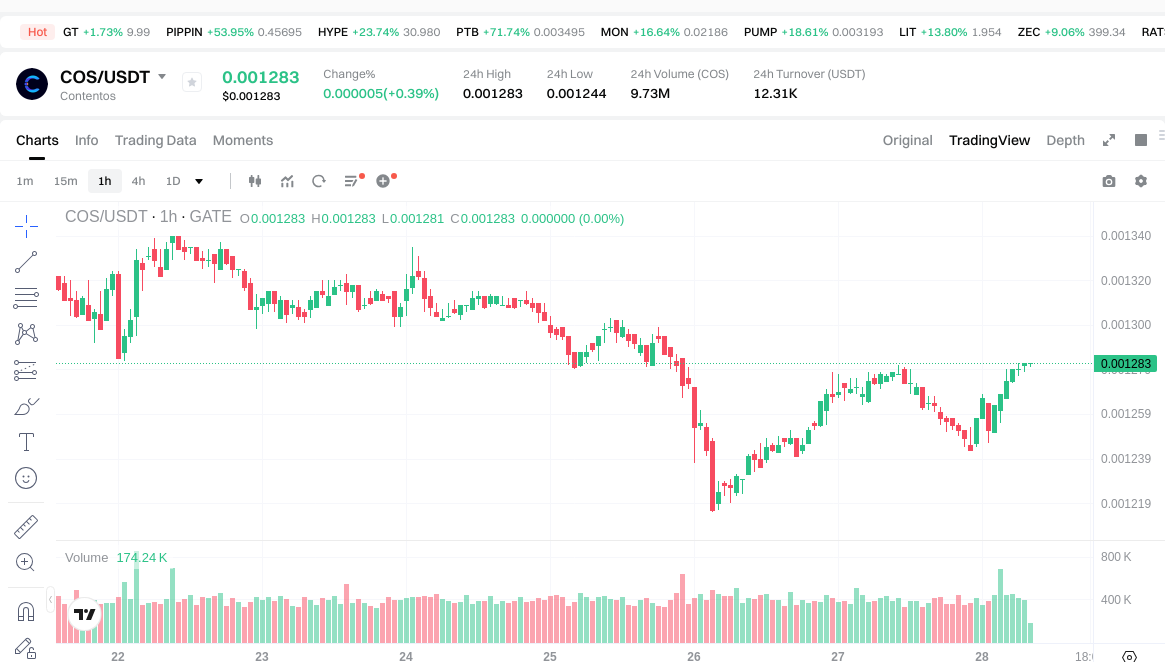
- COS current price: $0.001283
- 24-hour trading volume: $12,251.04
- Market capitalization: $6,641,396.61
- Circulating supply: 5,176,458,774 COS (52.19% of total supply)
- Market dominance: 0.00040%
- Price trends: +0.08% (1H), +0.23% (24H), -1.39% (7D), +3.39% (30D), -79.97% (1Y)
Click to view real-time COS market price
II. Core Factors Influencing Whether COS is a Good Investment
Supply Mechanism and Scarcity (COS Investment Scarcity)
- Unlimited maximum supply → potential dilution impact on price and investment value
- Total supply of 9.9 billion COS with circulating supply of 5.18 billion (52.19% circulation ratio)
- Historical context: COS experienced substantial price volatility, with price movements from $0.00114 to $0.08469 observed during its trading history
- Investment significance: The unlimited supply model may affect long-term scarcity considerations for investment decisions
Macro-Economic Environment Impact on COS Investment
- Monetary policy and interest rate changes → alter investment attractiveness across crypto assets
- Inflation environment considerations → digital asset positioning in portfolio diversification
- Geopolitical uncertainty factors → may influence demand patterns in decentralized content platforms
Technology and Ecosystem Development (Technology & Ecosystem for COS Investment)
- Blockchain-based content rights management: enables content verification, storage, transaction, and distribution capabilities
- Decentralized revenue distribution model: transparent pricing and value structures designed to benefit users directly
- Community-driven ecosystem: incentive mechanisms for content sharing and promotion through ecological rewards
- Tamper-proof reputation system: long-term reflection of interactive behavior credibility in user reputation values
- BSC deployment: contract address 0x96dd399f9c3afda1f194182f71600f1b65946501 provides network accessibility
III. COS Future Investment Forecast and Price Outlook (Is Contentos(COS) worth investing in 2026-2031)
Short-term COS Investment Outlook (2026, short-term COS investment outlook)
Based on available market data, short-term predictions for COS in 2026 present varied scenarios:
- Conservative forecast: $0.00065433 - $0.00114475
- Neutral forecast: $0.001283 - $0.001379225
- Optimistic forecast: $0.00147545 - $0.00164127775
The short-term outlook suggests modest price movements, with the neutral scenario indicating potential stability around current levels. Market participants should consider the limited liquidity (24-hour trading volume of $12,251.04) and the token's circulation ratio of approximately 52.19% when evaluating near-term positions.
Mid-term Contentos(COS) Investment Forecast (2027-2029, mid-term Contentos(COS) investment forecast)
-
Market stage expectation: The mid-term period may witness gradual ecosystem development as the project continues its content distribution infrastructure expansion. Price action could reflect broader market sentiment toward decentralized content platforms.
-
Investment return forecast:
- 2027: $0.00114475675 - $0.00164127775
- 2028: $0.00146494383375 - $0.00176699410875
- 2029: $0.001212580828987 - $0.002064664654762
-
Key catalysts: Potential factors include expansion of the content creator base, integration with major social media platforms, development of monetization features, and broader adoption of blockchain-based content distribution models.
Long-term Investment Outlook (Is Contentos a good long-term investment?)
- Baseline scenario: $0.001185051966924 - $0.002445650996739 (assuming steady development of decentralized content infrastructure and sustained community engagement)
- Optimistic scenario: $0.001925709446251 - $0.002445650996739 (assuming significant platform adoption, successful partnerships with content creators, and favorable regulatory environment for blockchain content platforms)
- Risk scenario: Below $0.00114031 (representing historical low levels, contingent upon adverse market conditions, competitive pressure from established content platforms, or execution challenges)
For detailed COS long-term investment analysis and price predictions: Price Forecast
2026-01-28 to 2031 Long-term Outlook
- Baseline scenario: $0.001185051966924 - $0.001925709446251 (corresponding to steady progress and gradual mainstream application growth)
- Optimistic scenario: $0.001925709446251 - $0.002445650996739 (corresponding to large-scale adoption and favorable market conditions)
- Transformative scenario: Above $0.002445650996739 (contingent upon breakthrough ecosystem developments and mainstream popularization)
- 2031-12-31 predicted high: $0.002445650996739 (based on optimistic development assumptions)
Disclaimer: These projections are derived from historical data patterns and market analysis models. Cryptocurrency markets remain highly volatile and subject to numerous unpredictable factors. Past performance does not guarantee future results. The information provided should not be construed as financial advice. Investors should conduct thorough independent research and consider their risk tolerance before making investment decisions. The actual performance of COS may differ materially from these forecasts due to market dynamics, regulatory changes, technological developments, competitive landscape shifts, and macroeconomic factors.
| Year |
Predicted High Price |
Predicted Average Price |
Predicted Low Price |
Price Change |
| 2026 |
0.00147545 |
0.001283 |
0.00065433 |
0 |
| 2027 |
0.00164127775 |
0.001379225 |
0.00114475675 |
7 |
| 2028 |
0.00176699410875 |
0.001510251375 |
0.00146494383375 |
17 |
| 2029 |
0.002064664654762 |
0.001638622741875 |
0.001212580828987 |
27 |
| 2030 |
0.001999775194184 |
0.001851643698318 |
0.001185051966924 |
44 |
| 2031 |
0.002445650996739 |
0.001925709446251 |
0.001636853029313 |
50 |
IV. Contentos (COS) Investment Strategy and Risk Management (How to invest in Contentos)
Investment Methodology (Contentos investment strategy)
Long-term Holding (HODL COS): Suitable for Conservative Investors
Long-term holding represents a passive investment approach focusing on the fundamental value proposition of Contentos' decentralized content ecosystem. This strategy involves accumulating COS tokens during market corrections and maintaining positions through market cycles. Given the project's focus on content creator monetization and blockchain-based digital rights management, investors adopting this approach typically evaluate the platform's user growth metrics, content transaction volume, and ecosystem development progress rather than short-term price movements.
Active Trading: Relying on Technical Analysis and Swing Operations
Active trading strategies for COS involve leveraging technical indicators and market sentiment analysis to capture short-to-medium term price movements. With a 24-hour trading volume of approximately $12,251 and price fluctuations ranging between $0.001244 and $0.001283, swing traders may identify entry and exit points based on support and resistance levels. The token's 1-hour change of +0.08% and 24-hour change of +0.23% suggest modest intraday volatility, while the 7-day decline of -1.39% indicates potential consolidation phases that experienced traders might exploit.
Risk Management (Risk management for COS investment)
Asset Allocation Ratios: Conservative / Aggressive / Professional Investors
-
Conservative Allocation: Position sizing of 1-3% of total portfolio value, appropriate for investors with limited risk tolerance. Given COS's market cap of approximately $6.64 million and ranking around #1400, conservative investors should treat this as a high-risk, small-cap allocation.
-
Aggressive Allocation: Position sizing of 5-10% of crypto portfolio allocation for investors comfortable with higher volatility and smaller market cap projects. This approach assumes active monitoring and willingness to adjust positions based on ecosystem developments.
-
Professional Allocation: Institutional or experienced investors might allocate based on risk-adjusted return models, incorporating correlation analysis with broader crypto markets and sector-specific developments in decentralized content platforms.
Diversification across multiple blockchain ecosystems can mitigate concentration risk associated with Contentos' specific market position. Since COS operates within the content creation and distribution sector, pairing this investment with established large-cap cryptocurrencies or stablecoins can provide portfolio stability. Given the token's circulating supply of approximately 5.18 billion COS (52.19% of total supply), investors should monitor potential dilution risks from the remaining token distribution.
Secure Storage: Hot/Cold Wallets + Hardware Wallet Recommendations
Secure storage practices are essential for COS token holders. The token's contract address on BSC (0x96dd399f9c3afda1f194182f71600f1b65946501) indicates compatibility with BEP-20 wallet infrastructure. Recommended storage solutions include:
- Cold Storage: Hardware wallets supporting BSC network for long-term holdings
- Hot Wallets: Reputable software wallets with BSC integration for active trading positions
- Multi-signature Solutions: For larger holdings exceeding personal risk thresholds
With approximately 10,965 holders, the token maintains a modest but established user base, suggesting reasonable liquidity for smaller position adjustments.
V. Contentos (COS) Investment Risks and Challenges (Risks of investing in Contentos)
Market Risk: High Volatility and Price Manipulation
COS exhibits characteristics common to small-cap cryptocurrencies, including significant price volatility. The token's annual performance shows a decline of -79.97%, indicating substantial downside risk during adverse market conditions. The current price of $0.001283 represents a significant distance from its all-time high of $0.084685 (recorded on July 8, 2019), demonstrating the potential for extreme price fluctuations in both directions.
With a relatively modest 24-hour trading volume compared to market cap, liquidity constraints may amplify price movements, creating conditions where larger orders could disproportionately impact market prices. The token's presence on 13 exchanges provides some liquidity distribution, though investors should remain cautious about slippage when executing larger trades.
Regulatory Risk: Policy Uncertainty Across Different Countries
Decentralized content platforms face evolving regulatory frameworks regarding digital rights management, content monetization, and token economics. Different jurisdictions maintain varying approaches to classifying utility tokens versus securities, creating uncertainty for cross-border operations. Investors should monitor regulatory developments in key markets where Contentos operates, as changes in digital asset regulations could impact platform adoption and token utility.
The project's focus on content creator monetization and transparent value distribution places it at the intersection of blockchain technology and digital media regulations, both of which remain subject to ongoing policy discussions in major markets.
Technical Risk: Network Security Vulnerabilities and Upgrade Failures
As with any blockchain project, technical risks include potential smart contract vulnerabilities, network security threats, and implementation challenges during protocol upgrades. The project's GitHub repository (https://github.com/coschain/contentos-go) provides transparency into development activity, which investors should monitor for code quality and maintenance frequency.
The token's deployment on BSC introduces dependencies on that chain's security and performance characteristics. Any significant issues affecting BSC infrastructure could indirectly impact COS token functionality and market confidence.
VI. Conclusion: Is Contentos a Good Investment?
Investment Value Summary
Contentos (COS) presents a high-risk, high-reward investment opportunity within the decentralized content creation sector. The project's vision of transparent content monetization and blockchain-based digital rights management addresses genuine market needs, though execution risks and competitive pressures remain significant considerations. With a market cap of approximately $6.64 million and ranking around #1400, COS operates in a highly competitive environment where project differentiation and user adoption become critical success factors.
The token's price performance, including a one-year decline of -79.97%, reflects broader challenges facing smaller-cap blockchain projects and underscores the importance of rigorous risk assessment. While short-term price movements show modest volatility (+0.23% over 24 hours), the substantial distance from all-time highs indicates considerable uncertainty regarding value recovery trajectories.
Investor Recommendations
✅ Beginners: Consider dollar-cost averaging with minimal position sizes (1-2% of total investment capital) paired with secure wallet storage solutions. New investors should prioritize understanding the project's fundamental value proposition and ecosystem development before committing capital. Given the token's volatility profile, beginners should treat this as a speculative position within a broader, diversified portfolio.
✅ Experienced Investors: Active portfolio management combining swing trading opportunities with strategic position adjustments based on ecosystem developments may be appropriate. Monitor key metrics including holder growth, trading volume trends, and platform adoption indicators. Experienced investors might implement partial position strategies, maintaining core holdings while trading around volatility.
✅ Institutional Investors: Strategic allocation decisions should incorporate thorough due diligence on competitive positioning within the decentralized content sector, token economics analysis, and team execution capabilities. Institutional approaches might involve tiered entry strategies with clearly defined exit criteria based on predetermined performance benchmarks.
⚠️ Disclaimer: Cryptocurrency investments carry substantial risk, including potential complete loss of capital. This analysis provides informational content only and does not constitute investment advice. Investors should conduct independent research, assess personal risk tolerance, and consider consulting financial advisors before making investment decisions. Past performance does not guarantee future results, and market conditions can change rapidly.
VII. FAQ
Q1: Is Contentos (COS) a good investment for beginners in 2026?
Contentos (COS) represents a high-risk investment opportunity that may not be suitable for most beginners. As of January 28, 2026, COS trades at $0.001283 with a market cap of only $6.64 million, ranking around #1400, which classifies it as a small-cap cryptocurrency with significant volatility risks. The token has experienced a -79.97% decline over the past year, demonstrating substantial downside potential during adverse market conditions. For beginners, it's recommended to allocate no more than 1-2% of total investment capital using a dollar-cost averaging strategy, paired with secure wallet storage solutions. New investors should prioritize understanding the project's decentralized content ecosystem fundamentals and treat this position as highly speculative within a diversified portfolio.
Q2: What is the price prediction for Contentos (COS) in 2027-2031?
Based on market analysis models, COS price forecasts show varying scenarios across different timeframes. For 2027, predictions range from $0.00114 to $0.00164 (representing approximately 7% growth from current levels). Mid-term forecasts for 2028-2029 suggest a range of $0.00146 to $0.00206, assuming steady ecosystem development. Long-term projections for 2030-2031 present a baseline scenario of $0.00118 to $0.00193 and an optimistic scenario reaching $0.00244 by end of 2031 (approximately 50% cumulative growth). However, these projections are subject to significant uncertainty due to market volatility, competitive pressures in the decentralized content sector, regulatory developments, and the project's ability to achieve meaningful platform adoption. Investors should note that cryptocurrency markets remain highly unpredictable, and actual performance may differ materially from these forecasts.
Q3: What are the main risks of investing in Contentos (COS)?
Contentos investment carries three primary risk categories. First, market risk stems from high volatility and limited liquidity—with only $12,251 in 24-hour trading volume, larger orders may experience significant slippage, and the token's -79.97% annual decline demonstrates extreme price fluctuation potential. Second, regulatory risk arises from evolving global frameworks governing decentralized content platforms, digital rights management, and token classifications, which vary significantly across jurisdictions. Third, technical risk includes potential smart contract vulnerabilities, network security threats, and dependency on BSC infrastructure performance. The token's unlimited maximum supply also presents potential dilution concerns, as only 52.19% of the total supply currently circulates. Additionally, with approximately 10,965 holders and ranking #1400 by market cap, COS faces intense competition from both established content platforms and other blockchain projects in the sector.
Q4: How does Contentos differ from other blockchain content platforms?
Contentos distinguishes itself through several core features within the decentralized content ecosystem. The platform implements blockchain-based content rights management enabling verification, storage, transaction, and distribution capabilities for digital content creators. Its decentralized revenue distribution model aims to provide transparent pricing and value structures that benefit users directly, contrasting with traditional centralized platforms. The project incorporates community-driven incentive mechanisms for content sharing and promotion through ecological rewards, combined with a tamper-proof reputation system that reflects long-term user interaction credibility. Deployed on BSC (contract address: 0x96dd399f9c3afda1f194182f71600f1b65946501), the platform provides network accessibility while maintaining focus on creator monetization and transparent value distribution. However, investors should evaluate whether these differentiating features translate into sustainable competitive advantages against established content platforms and emerging blockchain alternatives.
Q5: What investment strategy is most appropriate for Contentos (COS)?
The appropriate Contentos investment strategy depends on individual risk tolerance and investment objectives. Conservative investors should implement a long-term holding (HODL) approach with 1-3% portfolio allocation, focusing on fundamental value proposition rather than short-term price movements, while monitoring user growth metrics, content transaction volume, and ecosystem development progress. Aggressive investors might allocate 5-10% of their crypto portfolio, combining swing trading opportunities based on technical analysis with strategic position adjustments—given the token's modest intraday volatility (+0.23% over 24 hours) and -1.39% weekly decline, experienced traders may identify consolidation patterns for entry points. Professional investors should employ risk-adjusted return models incorporating correlation analysis with broader crypto markets and sector-specific developments. Regardless of strategy, implementing secure storage practices (hardware wallets for cold storage, reputable BSC-compatible software wallets for active trading) and diversification across multiple blockchain ecosystems remains essential for mitigating concentration risk associated with Contentos' small-cap market position.
Q6: What factors could drive Contentos (COS) price growth?
Several potential catalysts could influence Contentos price appreciation in future periods. Platform adoption metrics represent a primary driver—expansion of the content creator base, successful integration with major social media platforms, and development of enhanced monetization features could increase token utility and demand. Broader market acceptance of blockchain-based content distribution models and decentralized digital rights management would benefit the sector generally. Macro-economic factors including monetary policy shifts, inflation dynamics, and geopolitical uncertainty may redirect investment flows toward alternative digital assets. Technical developments such as protocol upgrades, enhanced security features, and improved user experience could strengthen competitive positioning. However, investors should recognize that with a current market cap of only $6.64 million and 52.19% circulating supply, significant token releases from the remaining supply could create downward price pressure, offsetting positive catalysts. The unlimited maximum supply structure requires careful monitoring for potential dilution impacts on long-term investment value.
Q7: How does Contentos token supply affect investment value?
Contentos employs an unlimited maximum supply model that significantly impacts investment considerations. Currently, 5.18 billion COS tokens circulate (representing 52.19% of the 9.9 billion total supply), meaning approximately 4.72 billion tokens remain for potential future distribution. This supply structure contrasts with fixed-supply cryptocurrencies where scarcity creates inherent upward price pressure. The unlimited supply model introduces ongoing dilution risk, as additional token releases could increase circulating supply without corresponding demand growth, potentially suppressing price appreciation. Historical price movements from $0.08469 (July 2019 peak) to current levels around $0.001283 reflect both market cycle dynamics and supply-demand imbalances. Investors evaluating long-term positions should assess the project's token distribution schedule, vesting mechanisms for team and advisor allocations, and ecosystem incentive programs that might require additional token circulation. The supply dynamics become particularly relevant when comparing investment returns against fixed-supply alternatives, as COS requires sustained demand growth to offset potential dilution effects and achieve meaningful price appreciation over extended timeframes.
Q8: What portfolio allocation is recommended for Contentos investment?
Portfolio allocation for Contentos should reflect individual risk profiles and investment objectives across three investor categories. Conservative investors seeking capital preservation should limit COS allocation to 1-3% of total portfolio value, treating this as a high-risk, small-cap position within a broader diversified strategy that includes established cryptocurrencies and traditional assets. Given the token's -79.97% annual decline and market cap of approximately $6.64 million, conservative allocation minimizes exposure to extreme volatility while maintaining potential upside participation. Aggressive investors comfortable with higher volatility and smaller market cap projects might allocate 5-10% of their cryptocurrency portfolio specifically, assuming active monitoring and willingness to adjust positions based on ecosystem developments and technical indicators. Professional or institutional investors should implement risk-adjusted allocation models incorporating correlation analysis with broader crypto markets, sector-specific developments in decentralized content platforms, and quantitative metrics such as holder growth rates, trading volume trends, and platform adoption indicators. Regardless of allocation strategy, implementing multi-asset portfolio diversification and secure storage practices (separating cold storage holdings from active trading positions) remains essential for managing concentration risk associated with COS's market position.
* The information is not intended to be and does not constitute financial advice or any other recommendation of any sort offered or endorsed by Gate.