This comprehensive analysis examines whether Corn (CORN) represents a viable investment opportunity for cryptocurrency investors. Trading at $0.07049 with a $37 million market cap, Corn operates as an ERC-20 token designed to enhance Bitcoin utility through optimized earning mechanisms. The project has secured $16.5 million in funding from leading venture capital firms including Polychain Capital and Framework. The article evaluates critical investment factors including tokenomics with unlimited supply, institutional backing from 1,000+ ICO participants, and early-stage ecosystem development. Short-term price outlooks range from $0.0663 to $0.0750, while long-term scenarios through 2031 project potential ranges between $0.0664 and $0.1629. The analysis addresses market risks including extreme price volatility (historical range $0.05271-$13.986), regulatory uncertainties, and technical dependencies on Ethereum infrastructure, while providing tailored investment strategies for beginner, experienced, and institu
Introduction: Corn (CORN) Investment Position and Market Prospects
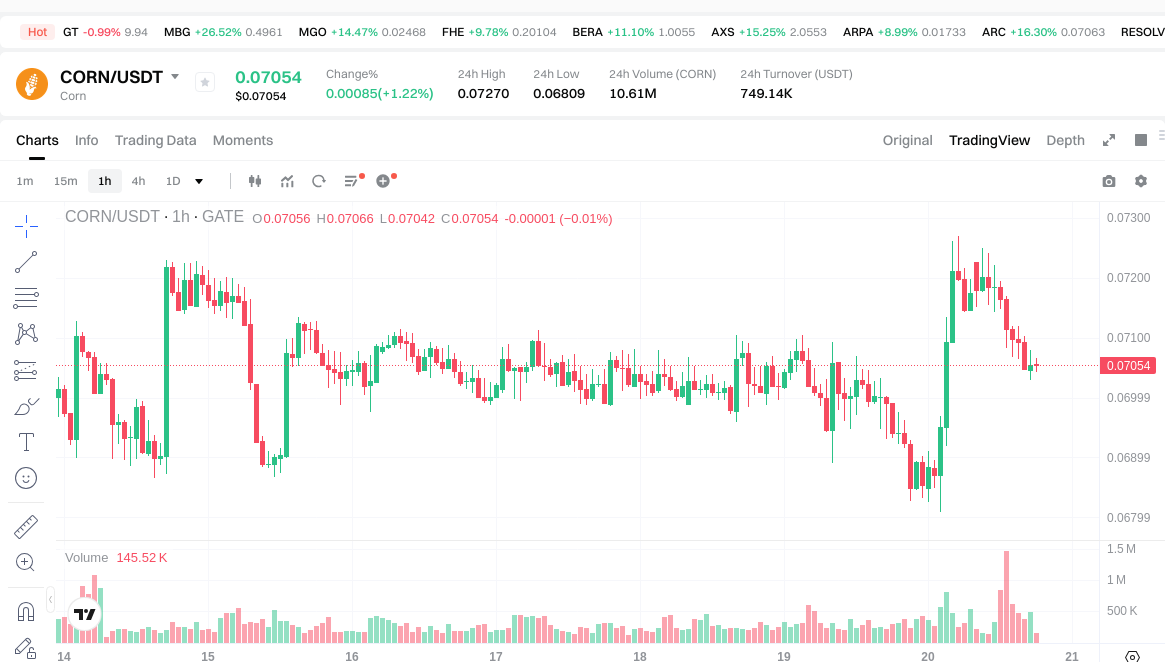
Corn (CORN) represents a notable asset in the cryptocurrency sector, designed to enhance Bitcoin utility through its protocol stack. As of January 20, 2026, Corn maintains a market capitalization of approximately $37.01 million, with a circulating supply of 525 million tokens and a current trading price around $0.07049. The project has secured $16.5 million in funding from venture capital firms including Polychain Capital, Framework, and Tribe Capital, alongside over 1,000 ICO participants. With a market ranking of 631 and a 24-hour trading volume of $746,342, Corn positions itself as a facilitator for Bitcoin-based earning opportunities. Over the past year, the token has shown a price increase of 21.72%, though it has experienced fluctuations across shorter timeframes. This analysis examines Corn's investment characteristics, historical performance patterns, future price considerations, and associated risks to provide investors with informational context regarding the question "Is Corn (CORN) a good investment?"
I. Corn (CORN) Price History Review and Investment Value Status
- 2025: Token Launch and Initial Trading → CORN experienced significant price volatility during its early trading phase
- February 2025: Price Peak Period → CORN reached a notable price level of $13.986
- November 2025: Market Correction → Price declined to $0.05271
Current CORN Investment Market Status (January 2026)
- CORN current price: $0.07049
- 24-hour trading volume: $746,342.27
- Market capitalization: $37,007,250
- Circulating supply: 525,000,000 CORN (25% of total supply)
- Market cap to fully diluted valuation ratio: 25%
- Number of holders: 714
Click to view real-time CORN market price
II. Core Factors Affecting Whether CORN is a Good Investment
Supply Mechanism and Scarcity (CORN investment scarcity)
- Total Supply & Circulation → Impact on Price and Investment Value
- CORN has a total supply of 2,100,000,000 tokens with no maximum supply cap (∞), indicating an inflationary supply model
- Current circulating supply stands at 525,000,000 tokens, representing 25% of total supply
- The relatively low circulation ratio suggests potential for future token releases, which may affect scarcity dynamics
- Historical Price Performance
- CORN has experienced significant price volatility, with historical price ranging from $0.05271 to $13.986
- The 1-year price change shows a positive trend of 21.72%, indicating potential recovery momentum
- Investment Implications: The unlimited supply mechanism may dilute scarcity value compared to fixed-supply assets, requiring careful consideration of tokenomics in long-term investment decisions
Institutional Investment and Mainstream Adoption (Institutional investment in CORN)
- Institutional Backing
- CORN secured $16.5 million in funding from major venture capital firms including Polychain Capital, Framework, and Tribe Capital
- Over 1,000 ICO participants contributed to the project's initial funding round
- The project launched on January 26, 2025, and is currently listed on 6 exchanges with Gate.com trading support
- Holder Base and Market Presence
- Current holder count stands at 714 addresses
- Market capitalization of approximately $37 million with a market dominance of 0.0045%
- The relatively small holder base and market presence suggest early-stage adoption status
Technology and Ecosystem Development (Technology & Ecosystem for CORN investment)
- Protocol Infrastructure
- CORN operates as an ERC-20 token on the Ethereum blockchain
- The protocol stack is designed to unlock Bitcoin's utility and provide optimized earning opportunities for BTC holders
- Contract address: 0x44f49ff0da2498bcb1d3dc7c0f999578f67fd8c6
- Ecosystem Positioning
- CORN positions itself as "a better way to use Bitcoin," focusing on accessible earning opportunities
- The CORN token serves to fuel the growing ecosystem and brand development
- Documentation available at docs.usecorn.com provides technical resources for users
- Community and Development Activity
- Active community presence on Discord and Twitter/X platforms
- The project maintains official channels for user engagement and ecosystem updates
- Investment implications: Technology and ecosystem development remain in early stages, with long-term value dependent on successful execution of protocol utility and ecosystem expansion
III. CORN Future Investment Forecast and Price Outlook (Is Corn(CORN) worth investing in 2026-2031)
Short-term Investment Forecast (2026, short-term CORN investment outlook)
- Conservative forecast: $0.0663 - $0.0705
- Neutral forecast: $0.0705 - $0.0741
- Optimistic forecast: $0.0741 - $0.0750
Mid-term Investment Outlook (2027-2029, mid-term Corn(CORN) investment forecast)
-
Market stage expectation: During 2027-2029, CORN may experience gradual price fluctuations as the protocol stack continues to develop and expand Bitcoin utility applications. The token's ecosystem development and community growth could influence its performance.
-
Investment return forecast:
- 2027: $0.0477 - $0.0948
- 2028: $0.0610 - $0.0944
- 2029: $0.0667 - $0.1272
-
Key catalysts: Protocol stack adoption rate, Bitcoin ecosystem expansion, partnership developments, and overall cryptocurrency market sentiment.
Long-term Investment Outlook (Is CORN a good long-term investment?)
- Baseline scenario: $0.0692 - $0.1081 (assuming steady protocol development and moderate ecosystem expansion)
- Optimistic scenario: $0.1108 - $0.1629 (assuming accelerated adoption and favorable market conditions)
- Risk scenario: $0.0477 - $0.0667 (considering potential market headwinds or slower-than-expected growth)
Click to view CORN long-term investment and price forecast: Price Prediction
2026-01-20 - 2031 Long-term Outlook
- Base scenario: $0.0664 - $0.1081 USD (corresponding to steady progress and mainstream application advancement)
- Optimistic scenario: $0.1108 - $0.1629 USD (corresponding to large-scale adoption and favorable market environment)
- Transformative scenario: Above $0.1629 USD (such as breakthrough ecosystem progress and mainstream adoption)
- 2031-12-31 Predicted high: $0.1629 USD (based on optimistic development assumptions)
Disclaimer: The above forecasts are based on current market data and analysis models. Cryptocurrency markets involve uncertainty and risk. This information does not constitute investment advice. Investors should conduct independent research and consider their risk tolerance before making investment decisions.
| Year |
Predicted High Price |
Predicted Average Price |
Predicted Low Price |
Price Change |
| 2026 |
0.0740985 |
0.07057 |
0.0663358 |
0 |
| 2027 |
0.0947578675 |
0.07233425 |
0.047740605 |
2 |
| 2028 |
0.0944070463875 |
0.08354605875 |
0.0609886228875 |
18 |
| 2029 |
0.127236470173312 |
0.08897655256875 |
0.066732414426562 |
26 |
| 2030 |
0.113511836939582 |
0.108106511371031 |
0.06918816727746 |
53 |
| 2031 |
0.162889486008301 |
0.110809174155307 |
0.093079706290457 |
57 |
IV. Corn Investment Strategy and Risk Management (How to invest in Corn)
Investment Methodology (Corn investment strategy)
Long-term Holding (HODL Corn): Suitable for Conservative Investors
Long-term holding represents a passive investment approach that focuses on the fundamental value proposition of Corn's protocol. This strategy is based on the premise that Corn's Bitcoin utility infrastructure may appreciate over extended periods as the ecosystem matures and adoption increases. Investors adopting this approach typically maintain positions through market cycles, reducing the impact of short-term volatility. This method requires patience and conviction in the project's long-term vision of optimizing Bitcoin's earning opportunities.
Active Trading: Relying on Technical Analysis and Swing Operations
Active trading strategies involve capitalizing on Corn's price movements through technical analysis and market timing. Given Corn's 24-hour price change of 1.67% and observable volatility between $0.06809 and $0.0727, swing traders may identify entry and exit points based on support and resistance levels. This approach demands continuous market monitoring, understanding of chart patterns, and disciplined execution. Traders should consider Corn's relatively lower liquidity with a 24-hour trading volume of approximately $746,342, which may impact execution and spread costs.
Risk Management (Risk management for Corn investment)
Asset Allocation Ratios: Conservative / Aggressive / Professional Investors
- Conservative Investors: May allocate 1-3% of their cryptocurrency portfolio to Corn, given its emerging status and concentration risk. This limited exposure allows participation in potential upside while maintaining overall portfolio stability.
- Aggressive Investors: Could consider 5-10% allocation for higher risk tolerance portfolios, acknowledging the project's backing by established firms like Polychain Capital, Framework, and Tribe Capital, along with its $16.5 million funding.
- Professional Investors: May implement dynamic allocation strategies ranging from 3-15% based on market conditions, technical indicators, and fundamental developments within Corn's ecosystem.
Risk Hedging Solutions: Multi-asset Portfolio + Hedging Instruments
Diversification remains essential when investing in Corn. Investors should consider:
- Maintaining exposure to established cryptocurrencies (Bitcoin, Ethereum) alongside Corn positions
- Balancing portfolio with stablecoins to provide liquidity during market downturns
- Considering correlation analysis with Bitcoin, given Corn's direct relationship to BTC utility
- Implementing stop-loss orders to limit downside exposure, particularly relevant given Corn's historical low of $0.05271
Secure Storage: Hot and Cold Wallets + Hardware Wallet Recommendations
Given that Corn operates as an ERC-20 token on the Ethereum network (contract address: 0x44f49ff0da2498bcb1d3dc7c0f999578f67fd8c6), investors should implement appropriate security measures:
- Cold Storage: Hardware wallets such as Ledger or Trezor provide optimal security for long-term holdings, protecting against online threats
- Hot Wallets: MetaMask or other Ethereum-compatible wallets offer convenience for active trading, though with increased security considerations
- Multi-signature Solutions: For larger holdings, multi-signature wallets add additional security layers
- Best Practices: Regular backup of recovery phrases, verification of contract addresses before transactions, and avoiding storage on exchange platforms for extended periods
V. Corn Investment Risks and Challenges (Risks of investing in Corn)
Market Risk: High Volatility and Price Manipulation
Corn exhibits significant price volatility, characteristic of emerging cryptocurrency projects. The token's price range from an all-time low of $0.05271 (November 4, 2025) to an all-time high of $13.986 (February 25, 2025) demonstrates substantial fluctuation potential. With a current circulating supply of 525 million tokens (25% of total supply) and approximately 714 holders, the token may be susceptible to concentrated selling pressure or market manipulation. The relatively modest 24-hour trading volume compared to market capitalization suggests potential liquidity constraints that could amplify price movements during periods of high buying or selling activity.
Regulatory Risk: Policy Uncertainty Across Different Countries
As a token linked to Bitcoin utility and earning mechanisms, Corn operates within an evolving regulatory landscape. Different jurisdictions maintain varying stances on cryptocurrency derivatives, yield-generating products, and Bitcoin-related instruments. Regulatory developments affecting Bitcoin itself, DeFi protocols, or token classification could materially impact Corn's operations and value proposition. Investors should monitor regulatory announcements from major markets and consider how changes in cryptocurrency oversight might affect Corn's protocol stack and ecosystem development.
Technical Risk: Network Security Vulnerabilities and Upgrade Failures
Corn's reliance on the Ethereum network as an ERC-20 token introduces dependency on Ethereum's infrastructure and security. Potential risks include:
- Smart contract vulnerabilities within Corn's protocol stack that could be exploited
- Ethereum network congestion affecting transaction execution and costs
- Protocol upgrade risks as Corn's ecosystem evolves
- Integration risks with Bitcoin-related infrastructure
- Dependency on third-party services and bridges for Bitcoin utility functions
The project's technical roadmap execution and ability to maintain security standards will significantly influence long-term viability.
VI. Conclusion: Is Corn a Good Investment?
Investment Value Summary
Corn presents an investment opportunity centered on enhancing Bitcoin's utility through optimized earning mechanisms. The project has secured notable backing from established venture capital firms including Polychain Capital, Framework, and Tribe Capital, along with participation from over 1,000 ICO contributors in a $16.5 million raise. The token currently trades at $0.07049 with a market capitalization of approximately $37 million and a fully diluted valuation of $148 million.
The investment case involves exposure to Bitcoin ecosystem innovation, though with considerations for the project's early stage, limited circulation (25% of total supply), and observed price volatility. The token's performance shows a 1-year increase of 21.72%, though recent periods indicate mixed momentum with slight negative movement over 7 days.
Investor Recommendations
✅ Beginners: Consider dollar-cost averaging strategies with small, regular purchases to mitigate timing risk. Prioritize secure storage solutions using hardware wallets compatible with ERC-20 tokens. Limit initial exposure to amounts you can afford to lose entirely given the high-risk nature of emerging cryptocurrency projects.
✅ Experienced Investors: May explore swing trading opportunities based on technical analysis of Corn's price patterns, while maintaining a core long-term position. Implement proper risk management through position sizing and stop-loss strategies. Monitor developments in Corn's ecosystem, partnership announcements, and protocol updates that may influence value.
✅ Institutional Investors: Could consider strategic long-term allocation as part of a diversified cryptocurrency portfolio, particularly if thesis aligns with Bitcoin ecosystem expansion. Conduct thorough due diligence on protocol mechanics, team background, and competitive positioning within the Bitcoin DeFi landscape.
⚠️ Disclaimer: Cryptocurrency investments carry substantial risk including potential total loss of capital. Corn's price volatility, regulatory uncertainties, and early-stage status present significant considerations. This content provides informational analysis only and does not constitute investment advice. Individuals should conduct independent research and consider their financial situation and risk tolerance before making investment decisions.
VII. FAQ
Q1: What is Corn (CORN) and how does it relate to Bitcoin?
Corn (CORN) is an ERC-20 token operating on the Ethereum blockchain that aims to enhance Bitcoin's utility through its protocol stack. The project positions itself as "a better way to use Bitcoin," providing optimized earning opportunities for BTC holders. With a total supply of 2.1 billion tokens and current circulation of 525 million (25%), Corn has secured $16.5 million in funding from major venture capital firms including Polychain Capital, Framework, and Tribe Capital. The protocol is designed to unlock Bitcoin's earning potential while maintaining accessibility for users seeking Bitcoin-based yield opportunities.
Q2: What has been Corn's historical price performance since launch?
Corn launched in January 2025 and has experienced significant price volatility. The token reached an all-time high of $13.986 in February 2025, followed by a market correction to an all-time low of $0.05271 in November 2025. As of January 20, 2026, CORN trades at approximately $0.07049 with a market capitalization of $37.01 million. Over the past year, the token has shown a price increase of 21.72%, though shorter timeframes reflect mixed performance. The substantial price range demonstrates the high volatility characteristic of emerging cryptocurrency projects.
Q3: What are the main risks associated with investing in Corn?
Investing in Corn involves several significant risks. Market risk includes high price volatility, demonstrated by its historical range from $0.05271 to $13.986, and potential liquidity constraints with only 714 current holders and $746,342 in 24-hour trading volume. Regulatory risk stems from evolving cryptocurrency policies affecting Bitcoin-related products and DeFi protocols across different jurisdictions. Technical risk involves smart contract vulnerabilities, dependency on Ethereum infrastructure, and execution risks in protocol development. Additionally, the unlimited maximum supply (∞) introduces inflationary pressure that may affect long-term scarcity value.
Q4: What is the price forecast for Corn through 2031?
Based on current analysis, Corn's price outlook varies by scenario. For 2026, short-term forecasts range from $0.0663 (conservative) to $0.0750 (optimistic). Mid-term projections for 2027-2029 estimate ranges of $0.0477-$0.1272 depending on protocol adoption and market conditions. Long-term forecasts through 2031 suggest a base scenario of $0.0664-$0.1081, an optimistic scenario of $0.1108-$0.1629, and a transformative scenario exceeding $0.1629. The 2031 predicted high stands at $0.1629, representing potential 131% growth from current levels. However, these forecasts involve significant uncertainty and depend on ecosystem development, market conditions, and adoption rates.
Q5: How should different types of investors approach Corn?
Investment approach should vary by investor profile. Conservative investors may allocate 1-3% of their cryptocurrency portfolio to Corn, employing long-term holding (HODL) strategies while using hardware wallets for secure storage. Aggressive investors could consider 5-10% allocation with active trading strategies based on technical analysis, though should implement strict risk management including stop-loss orders. Professional investors may deploy dynamic allocation ranging from 3-15% based on market conditions, utilizing multi-asset portfolio diversification and hedging instruments. All investors should prioritize secure storage using hardware wallets compatible with ERC-20 tokens and maintain realistic expectations about the high-risk nature of emerging cryptocurrency projects.
Q6: What factors could influence Corn's future investment value?
Several key factors may impact Corn's investment value. Protocol development and successful execution of Bitcoin utility features remain critical for long-term viability. Ecosystem expansion, including partnership developments and integration with Bitcoin infrastructure, could drive adoption. Market sentiment toward Bitcoin and DeFi protocols will influence demand for Corn's earning mechanisms. The token's supply dynamics, with only 25% currently circulating, present both opportunity and risk as additional tokens enter circulation. Institutional backing from firms like Polychain Capital provides credibility, though early-stage status means execution risk remains substantial. Regulatory developments affecting cryptocurrency derivatives and Bitcoin-related products could materially impact operations.
Q7: Is Corn suitable for beginners in cryptocurrency investing?
Corn presents significant challenges for beginners due to its high volatility, early-stage status, and complex risk profile. The token's price range from $0.05271 to $13.986 demonstrates extreme fluctuation potential that may be difficult for inexperienced investors to navigate psychologically. However, beginners interested in Corn exposure should employ dollar-cost averaging strategies with small, regular purchases to mitigate timing risk. Priority should be given to understanding secure storage solutions, particularly hardware wallets for ERC-20 tokens. Beginners must limit exposure to amounts they can afford to lose entirely and invest time in understanding Corn's protocol mechanics, Bitcoin relationship, and broader cryptocurrency market dynamics before committing capital.
Q8: How does Corn's tokenomics affect its investment potential?
Corn's tokenomics present both opportunities and considerations for investors. The total supply of 2.1 billion tokens with an unlimited maximum supply (∞) indicates an inflationary model that may dilute scarcity value over time compared to fixed-supply assets like Bitcoin. Currently, only 525 million tokens (25%) are in circulation, suggesting potential for future releases that could create selling pressure. The relatively low holder count of 714 addresses indicates concentrated ownership that may amplify price volatility. However, the $16.5 million funding from established venture capital firms and structured token distribution could provide stability during ecosystem development. Investors should carefully evaluate how additional token releases might impact price dynamics and whether the protocol's utility can offset inflationary supply pressures.
* The information is not intended to be and does not constitute financial advice or any other recommendation of any sort offered or endorsed by Gate.