This comprehensive guide evaluates whether Cosmos (ATOM) represents a sound investment in the blockchain interoperability sector. Trading at $2.652 with a $1.29 billion market cap as of January 2026, ATOM enables cross-chain communication through its Tendermint consensus and IBC protocol. The analysis examines ATOM's price history spanning from $1.16 (2020 low) to $44.45 (2022 peak), identifying current consolidation dynamics. Short-term 2026 projections range from $1.96-$2.73, while long-term 2031 forecasts suggest $2.00-$3.87 depending on ecosystem adoption scenarios. The guide addresses key investment considerations including supply mechanisms, institutional adoption trends, and technology developments, alongside actionable investment strategies for conservative, moderate, and aggressive investors. Critical risk assessments cover market volatility, regulatory uncertainties, and technical challenges. Practical recommendations include dollar-cost averaging for beginners, diversified portfolio allocation of 1
Introduction: Cosmos (ATOM)'s Investment Position and Market Prospects
ATOM is a notable asset in the cryptocurrency sector, having been launched in March 2019. It has gained recognition in the blockchain interoperability and cross-chain communication space. As of January 2026, Cosmos holds a market capitalization of approximately $1.29 billion with a circulating supply of around 487.97 million tokens, and the current price is trading near $2.65. With its positioning in enabling blockchain interoperability through the Tendermint consensus mechanism and Inter-Blockchain Communication (IBC) protocol, ATOM has become a focal point when investors discuss "Is Cosmos (ATOM) a good investment?" This article provides a comprehensive analysis of ATOM's investment value, historical price movements, future price projections, and associated investment risks to offer insights for potential investors.
I. Cosmos (ATOM) Price History Review and Investment Value Status
- 2020: Institutional accumulation phase → Early holders experienced significant portfolio growth as major institutions began building positions during market recovery
- 2022: All-time high milestone → ATOM reached approximately $44.45 in January 2022, representing a substantial appreciation from earlier price levels
- 2020-2024: Market cycle volatility → Price fluctuated between $1.16 and levels near previous peaks, reflecting broader cryptocurrency market dynamics
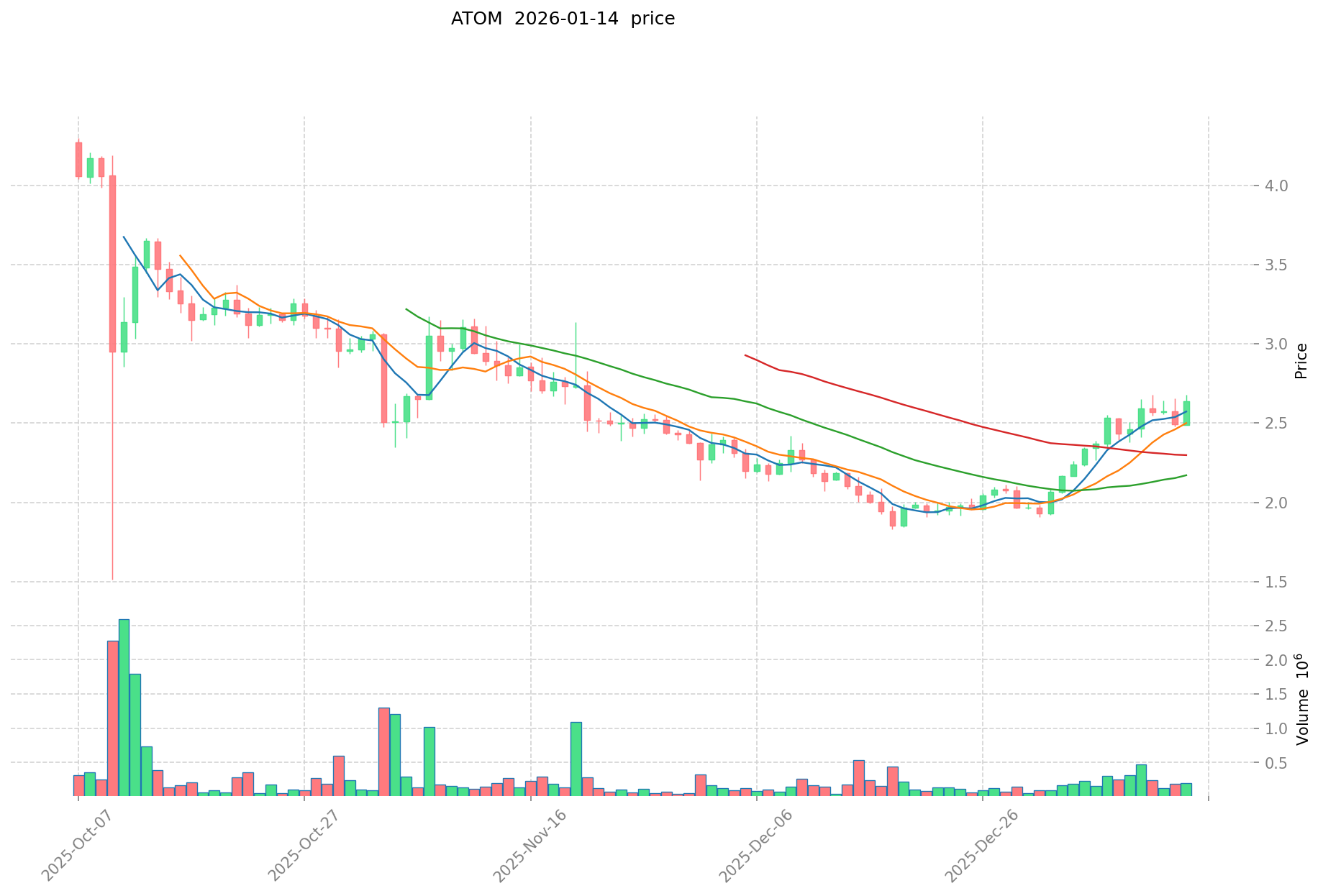
- Recent Period: Consolidation phase → As of January 2026, ATOM trades around $2.652, showing recovery momentum with 24-hour gains of approximately 6.59%
Current ATOM Investment Market Status (January 2026)
- Current ATOM price: $2.652
- 24-hour price change: +6.59% (indicating positive short-term momentum)
- 24-hour trading volume: Approximately $522.08 million
- Market capitalization: $1.29 billion (ranked 72nd globally)
- Circulating supply: 487.97 million ATOM
- Market share: 0.037% of total cryptocurrency market
- Price performance trends:
- 1-hour: -0.22%
- 7-day: +4.74%
- 30-day: +26.01%
- 1-year: -57.84%
Click to view real-time ATOM market price
II. Core Factors Influencing Whether ATOM is a Good Investment
Supply Mechanism and Scarcity (ATOM Investment Scarcity)
- Supply dynamics → Impact on price and investment value
- Historical patterns: Supply changes have influenced ATOM price movements in the past
- Investment significance: Scarcity characteristics serve as a key consideration for long-term investment assessment
As of January 14, 2026, ATOM has a circulating supply of approximately 487.97 million tokens, with a total supply matching this figure. The circulating supply ratio stands at 124.82%, indicating that the current circulating supply exceeds the maximum supply of 390.93 million tokens. This supply structure differs from traditional fixed-supply cryptocurrencies and may influence investor perceptions of scarcity.
Institutional Investment and Mainstream Adoption (Institutional Investment in ATOM)
- Institutional engagement trends: The Cosmos ecosystem has attracted attention from notable projects, including dYdX's announcement in June 2022 to build a standalone blockchain on Cosmos
- Enterprise adoption → Enhanced investment profile through ecosystem expansion
- Policy environment considerations remain relevant for investment outlook assessment
The migration of projects to the Cosmos ecosystem, particularly dYdX's decision to establish infrastructure on the platform, has contributed to shifts in investor sentiment. Such developments may indicate growing institutional interest in the interoperability solutions offered by the Cosmos network.
Macroeconomic Environment Impact on ATOM Investment
- Monetary policy and interest rate changes → Influence on investment attractiveness
- Inflation environment considerations → Potential role in portfolio diversification
- Geopolitical uncertainty factors → May affect demand patterns for digital assets
Broader economic conditions, including regulatory developments and market competition, continue to influence the cryptocurrency sector. These factors present both opportunities and challenges for ATOM investment considerations.
Technology and Ecosystem Development (Technology & Ecosystem for ATOM Investment)
- Tendermint consensus mechanism: Provides network security and performance characteristics that support developer activity
- IBC protocol implementation: Enables cross-chain communication, expanding potential use cases and ecosystem connectivity
- DeFi, NFT, and payment applications: Ongoing development within the Cosmos ecosystem may contribute to long-term value considerations
The Cosmos network's focus on interoperability through the IBC protocol and its modular architecture using Tendermint BFT consensus has positioned it as infrastructure for cross-chain applications. Progress in features such as Gravity DEX, Gravity Bridge, and interchain accounts during 2021-2022 supported ecosystem development. As of January 2026, the network continues to evolve with focus areas including institutional applications, fintech integration, and government use cases.
The network's ability to process transactions efficiently while maintaining security through its consensus mechanism remains a technical foundation for ecosystem growth. However, investment decisions should account for market competition, regulatory uncertainties, and the speculative nature of price predictions in the cryptocurrency sector.
III. ATOM Future Investment Forecast and Price Outlook (Is Cosmos(ATOM) worth investing in 2026-2031)
Short-term Investment Forecast (2026, short-term ATOM investment outlook)
Based on available market analysis, short-term price projections for ATOM in 2026 show varied scenarios:
- Conservative forecast: $1.96 - $2.40
- Neutral forecast: $2.40 - $2.65
- Optimistic forecast: $2.65 - $2.73
The short-term outlook reflects the current market positioning, with ATOM trading around $2.65 as of January 2026. Technical indicators suggest potential for moderate volatility within this range, influenced by broader cryptocurrency market sentiment and ecosystem developments.
Mid-term Investment Outlook (2027-2029, mid-term Cosmos(ATOM) investment forecast)
The mid-term perspective for ATOM suggests a period of gradual evolution:
- Market stage expectation: Consolidation phase with potential for selective growth driven by ecosystem expansion and interoperability advances
- Investment return forecast:
- 2027: $2.02 - $2.93
- 2028: $2.39 - $3.03
- 2029: $2.02 - $3.04
- Key catalysts: Cross-chain protocol adoption, validator network expansion, and integration with emerging blockchain applications
The mid-term trajectory indicates moderate growth potential, with annual variations reflecting typical cryptocurrency market cycles. The price ranges suggest relatively stable development rather than dramatic appreciation.
Long-term Investment Outlook (Is ATOM a good long-term investment?)
Long-term projections for ATOM through 2031 present multiple scenarios based on different development paths:
- Baseline scenario: $2.00 - $3.20 (assumes steady ecosystem growth and maintained market position)
- Optimistic scenario: $3.20 - $3.87 (assumes accelerated adoption of Cosmos SDK and successful implementation of interoperability solutions)
- Risk scenario: $1.96 - $2.40 (reflects potential challenges from competitive layer-0 protocols or broader market contractions)
For detailed ATOM long-term investment analysis and price forecasts: Price Prediction
2026-2031 Long-term Outlook
- Base scenario: $2.00 - $3.17 (corresponding to steady progress and gradual mainstream application enhancement)
- Optimistic scenario: $3.17 - $3.87 (corresponding to large-scale adoption and favorable market conditions)
- Transformational scenario: Above $3.87 (contingent upon breakthrough ecosystem developments and mainstream popularization)
- 2031-12-31 projected high: $3.87 (based on optimistic development assumptions)
Disclaimer: These projections are derived from historical data analysis and current market trends. Cryptocurrency investments carry substantial risk due to market volatility, regulatory uncertainties, and technological factors. Price forecasts should not be construed as financial advice or guaranteed outcomes. Past performance does not indicate future results. Investors should conduct independent research and consider their risk tolerance before making investment decisions.
| Year |
Predicted High Price |
Predicted Average Price |
Predicted Low Price |
Price Change |
| 2026 |
2.72847 |
2.649 |
1.96026 |
0 |
| 2027 |
2.93072115 |
2.688735 |
2.01655125 |
1 |
| 2028 |
3.034506321 |
2.809728075 |
2.38826886375 |
5 |
| 2029 |
3.03900188592 |
2.922117198 |
2.01626086662 |
10 |
| 2030 |
3.3680322824148 |
2.98055954196 |
1.9969748931132 |
12 |
| 2031 |
3.872641012868628 |
3.1742959121874 |
2.412464893262424 |
19 |
IV. Cosmos (ATOM) Investment Strategy and Risk Management (How to invest in ATOM)
Investment Methodology (ATOM investment strategy)
Long-term Holding (HODL ATOM): This approach suits conservative investors who believe in the long-term potential of the Cosmos ecosystem. Given ATOM's role in the interchain infrastructure, long-term holders may benefit from the network's growth and adoption of Inter-Blockchain Communication (IBC) protocol. However, investors should note that ATOM has experienced significant price volatility, with historical data showing a decline of approximately 57.84% over the past year as of January 14, 2026.
Active Trading: This strategy relies on technical analysis and swing trading opportunities. Traders may capitalize on ATOM's price movements, which have shown recent volatility with a 24-hour change of 6.59% and a 7-day change of 4.74%. Active traders should monitor key support and resistance levels, with recent data indicating a 24-hour range between $2.486 and $2.677.
Risk Management (Risk management for ATOM investment)
Asset Allocation Ratios:
- Conservative investors: Consider allocating 1-3% of portfolio to ATOM
- Moderate investors: May allocate 3-7% based on risk tolerance
- Aggressive investors: Could consider 7-15% allocation with careful monitoring
Risk Hedging Solutions: Investors may consider diversifying across multiple blockchain assets and maintaining exposure to both established and emerging crypto assets. Portfolio diversification beyond single-chain exposure can help mitigate project-specific risks.
Secure Storage:
- Cold storage solutions recommended for long-term holdings
- Hardware wallets provide enhanced security for private key management
- Hot wallets suitable only for active trading amounts
- Regular security audits of storage methods advised
V. ATOM Investment Risks and Challenges (Risks of investing in ATOM)
Market Risks: ATOM demonstrates considerable price volatility, with a historical high of $44.45 recorded on January 17, 2022, and a historical low of $1.16 on March 13, 2020. The current price of $2.652 (as of January 14, 2026) represents substantial fluctuation potential. The relatively modest market cap of approximately $1.29 billion and a market dominance of 0.037% indicate exposure to broader market movements.
Regulatory Risks: Cryptocurrency regulatory frameworks vary significantly across jurisdictions and continue to evolve. Policy uncertainty in major markets could impact ATOM's trading accessibility and adoption. Investors should stay informed about regulatory developments in their respective regions.
Technical Risks: As with any blockchain project, Cosmos faces potential technical challenges including:
- Network security vulnerabilities that could affect the Tendermint consensus mechanism
- Risks associated with protocol upgrades and governance decisions
- Interoperability challenges as the IBC protocol continues to develop
- Competition from other interoperability solutions in the blockchain space
VI. Conclusion: Is ATOM a Good Investment?
Investment Value Summary: Cosmos (ATOM) presents a unique value proposition in the blockchain interoperability space, with its Tendermint consensus mechanism and IBC protocol offering technical advantages. However, the asset has experienced significant price volatility, including a notable decline over the past year. The project's long-term potential depends on the continued adoption of its interchain technology and the growth of its ecosystem.
Investor Recommendations:
✅ Beginners: Consider dollar-cost averaging (DCA) strategy combined with secure wallet storage. Start with small allocations to understand market dynamics and project fundamentals.
✅ Experienced Investors: May employ swing trading strategies while maintaining a diversified portfolio. Monitor technical indicators and ecosystem developments for informed decision-making.
✅ Institutional Investors: Could consider strategic long-term allocation as part of a broader blockchain infrastructure investment thesis, with appropriate risk assessment and portfolio weighting.
⚠️ Disclaimer: Cryptocurrency investments carry substantial risk, including the potential for total loss of capital. This content is for informational purposes only and does not constitute investment advice. Conduct thorough research and consult with financial professionals before making investment decisions.
VII. FAQ
Q1: What is the minimum investment amount recommended for ATOM?
There is no universal minimum, but conservative investors may start with $100-500 to gain exposure while limiting risk. The recommended portfolio allocation varies by investor profile: conservative investors typically allocate 1-3%, moderate investors 3-7%, and aggressive investors 7-15% of their total portfolio to ATOM. Dollar-cost averaging (DCA) is particularly suitable for beginners, allowing gradual position building regardless of the initial investment amount. Consider transaction fees and storage costs when determining your minimum viable investment.
Q2: How does ATOM generate returns for investors?
ATOM generates returns primarily through two mechanisms: price appreciation and staking rewards. Price appreciation occurs when market demand increases relative to supply, though historical data shows significant volatility with ATOM ranging from $1.16 (March 2020) to $44.45 (January 2022). Staking rewards are earned by delegating ATOM tokens to validators securing the Cosmos network, typically providing annual percentage yields (APY) that vary based on network participation rates. Additionally, holders may benefit from airdrops distributed to ATOM stakers by projects launching on the Cosmos ecosystem.
Q3: What makes Cosmos (ATOM) different from other blockchain interoperability projects?
Cosmos distinguishes itself through its Inter-Blockchain Communication (IBC) protocol and modular architecture powered by the Tendermint BFT consensus mechanism. Unlike bridge-based solutions that create connection points between specific chains, IBC enables direct chain-to-chain communication within the Cosmos ecosystem. The Cosmos SDK allows developers to build application-specific blockchains (app chains) with sovereignty over their governance and tokenomics while maintaining interoperability. This differs from shared-security models where all applications compete for the same blockspace and resources.
Q4: Is ATOM a better short-term or long-term investment?
ATOM exhibits characteristics that favor long-term holding over short-term speculation. Short-term price forecasts for 2026 range from $1.96 to $2.73, indicating modest near-term volatility. Long-term projections through 2031 suggest potential appreciation to $3.17-$3.87 under optimistic scenarios, representing gradual growth rather than explosive returns. The asset's 57.84% decline over the past year (as of January 2026) demonstrates significant short-term risk. Long-term holders may benefit from ecosystem maturation, increased IBC adoption, and the network's growing role in blockchain interoperability infrastructure, though this requires tolerance for volatility and patient capital allocation.
Q5: What are the main risks of investing in ATOM that investors should monitor?
Key risks include market volatility (evidenced by historical fluctuations between $1.16 and $44.45), regulatory uncertainty affecting cryptocurrency trading and adoption, technological competition from alternative interoperability solutions, and protocol-specific risks related to network security and governance decisions. ATOM's relatively modest market capitalization of $1.29 billion and 0.037% market dominance indicate susceptibility to broader market movements. Additionally, the tokenomics structure with a circulating supply ratio of 124.82% (exceeding maximum supply) presents unique considerations. Investors should monitor validator network health, IBC adoption metrics, competing layer-0 protocols, and regulatory developments in major markets.
Q6: How should investors securely store their ATOM tokens?
Security requirements vary by investment strategy and holding period. Long-term holders should prioritize cold storage solutions, particularly hardware wallets (such as Ledger or Trezor), which keep private keys offline and protected from online threats. For active traders requiring frequent access, reputable exchange wallets or software wallets may be appropriate for trading amounts only, with the majority stored in cold storage. Regardless of method, investors should implement best practices including backup seed phrase storage in multiple secure physical locations, two-factor authentication for all accounts, regular security audits of storage methods, and avoiding disclosure of holdings publicly to minimize targeted attack risks.
Q7: What factors could drive ATOM price appreciation in 2026-2027?
Several catalysts may influence ATOM price performance: increased IBC protocol adoption by new blockchain projects, expansion of the validator network enhancing security and decentralization, migration of established projects (similar to dYdX's 2022 announcement), development of Cosmos-native DeFi applications and infrastructure, favorable regulatory clarity in major markets, broader cryptocurrency market recovery, and successful implementation of protocol upgrades. The current technical indicators showing 26.01% growth over 30 days and positive 7-day momentum of 4.74% suggest potential near-term strength. However, these factors must overcome competitive pressure from alternative interoperability solutions and broader market uncertainties affecting the cryptocurrency sector.
Q8: What research should investors conduct before purchasing ATOM?
Comprehensive due diligence should include: analysis of Cosmos network metrics (validator count, IBC transaction volume, active zones), evaluation of ecosystem projects and their traction, assessment of competitive positioning against Polkadot, Avalanche, and other interoperability protocols, review of governance proposals and community sentiment, technical analysis of price trends and support/resistance levels, and understanding of tokenomics including inflation rate and staking participation. Investors should also examine their own risk tolerance, investment timeline, and portfolio diversification strategy. Consulting the official Cosmos documentation, following development updates through official channels, and reviewing independent analysis from multiple sources provides a balanced perspective for informed decision-making.
* The information is not intended to be and does not constitute financial advice or any other recommendation of any sort offered or endorsed by Gate.