This comprehensive analysis examines Creditcoin (CTC) as an investment opportunity, providing investors with essential insights into blockchain-based credit infrastructure. The article evaluates CTC's current market position at $0.2784 with $142.13 million market capitalization, historical performance showing a 96.8% decline from its $8.67 all-time high, and detailed price forecasts through 2031 across conservative, neutral, and optimistic scenarios. Key investment factors include its cross-chain lending functionality, presence on 25 exchanges, supply mechanism with 600 million token cap, and ecosystem development focusing on real-world asset integration. The analysis presents multiple investment strategies for different investor profiles—from dollar-cost averaging for beginners to technical analysis approaches for experienced traders—alongside comprehensive risk management frameworks covering market volatility, regulatory uncertainty, and technical vulnerabilities. Suitable for investors seeking informed dec
Introduction: Creditcoin (CTC) Investment Position and Market Prospects
Creditcoin (CTC) represents a notable asset in the cryptocurrency sector, having launched in 2020 as a global credit network platform. The project aims to connect blockchain assets through protocols to facilitate inter-blockchain lending markets. As of January 16, 2026, Creditcoin maintains a market capitalization of approximately $142.13 million with a circulating supply of around 510.51 million tokens, and the current price stands at approximately $0.2784. With its positioning as a cross-chain lending infrastructure, CTC has gradually become a focal point for investors considering "Is Creditcoin (CTC) a good investment?" The token is currently ranked #294 by market capitalization, representing 0.0045% of the total cryptocurrency market dominance. This article provides a comprehensive analysis of Creditcoin's investment characteristics, historical price movements, future price projections, and associated investment risks to serve as a reference for potential investors.
I. Creditcoin (CTC) Historical Price Review and Current Investment Value
- 2019-2020: Following its launch, CTC showed limited price movement, remaining below $1.00, reflecting early-stage market adoption with modest investor returns.
- March 2021: CTC experienced a notable price surge, reaching approximately $8.71, which represented a significant milestone in its market development. This period reflected broader market momentum.
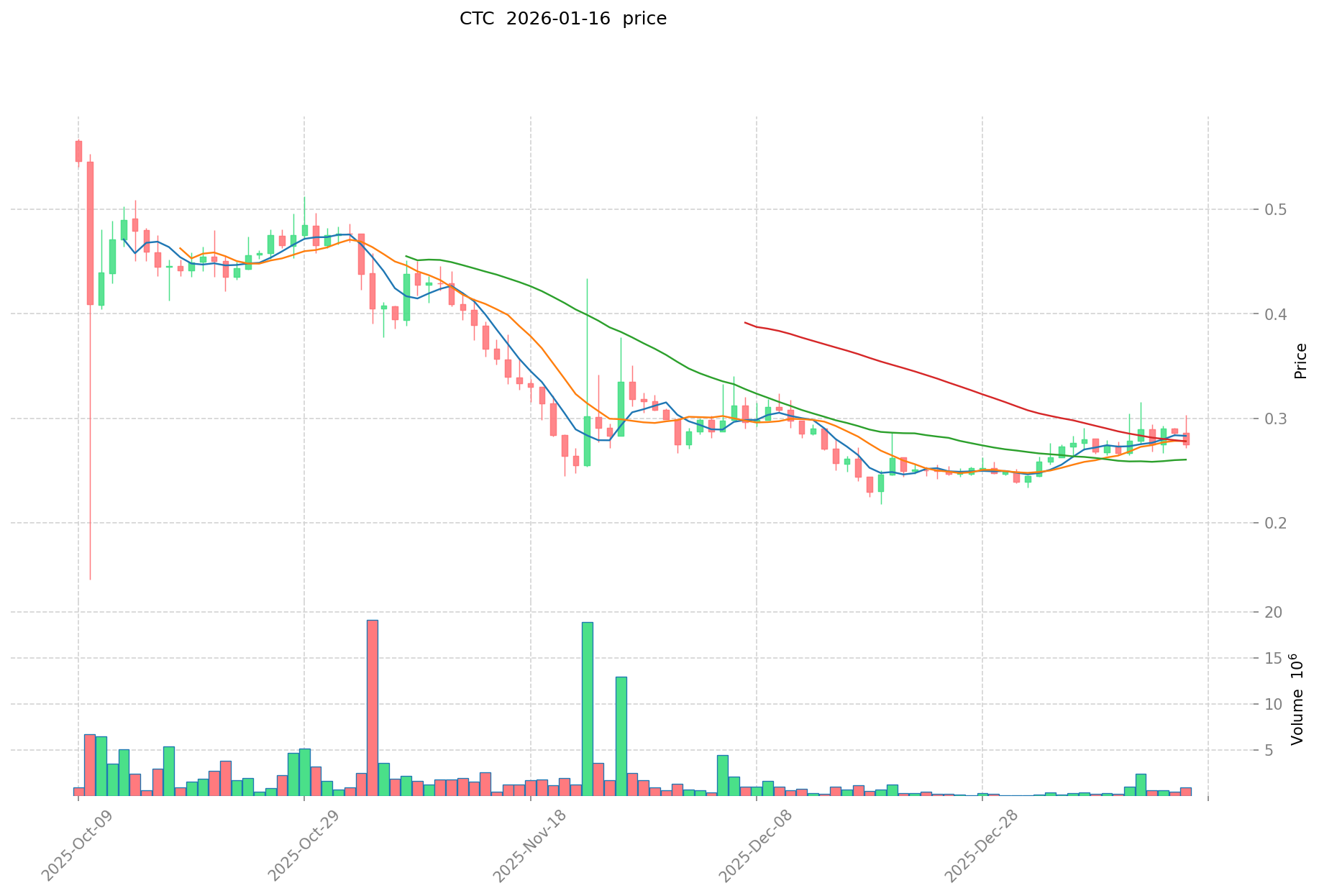
- 2021-2026: Following the peak in early 2021, CTC entered a corrective phase. As of January 16, 2026, the token trades at $0.2784, reflecting market adjustments and changing investment conditions.
Current CTC Investment Market Status (January 2026)
- CTC current price: $0.2784
- 24-hour trading volume: $161,862.33
- Market capitalization: $142,125,380.15
- Circulating supply: 510,507,831 CTC tokens
Click to view real-time CTC market price
II. Core Factors Affecting Whether CTC is a Good Investment
Supply Mechanism and Scarcity (CTC investment scarcity)
- Maximum supply capped at 600,000,000 CTC → creates scarcity framework that may influence long-term value dynamics
- Current circulating supply of 510,507,831 CTC represents approximately 85.08% of total supply → indicates substantial token circulation in the market
- Total supply of 549,916,158 CTC with remaining allocation → supply expansion trajectory may impact price sensitivity
- Investment consideration: The defined supply cap provides a measurable scarcity parameter, though market adoption and utility remain critical determinants of investment value
Institutional Investment and Mainstream Adoption (Institutional investment in CTC)
- Trading presence across 25 exchanges → indicates multi-platform accessibility for investors
- Holder base of 851,327 addresses → demonstrates distributed ownership across the network
- Market capitalization of $142,125,380 with 0.0045% market dominance → reflects positioning within the broader cryptocurrency landscape
- Investment perspective: Exchange availability and holder distribution suggest established market presence, though institutional adoption patterns require ongoing monitoring
Macroeconomic Environment Impact on CTC Investment
- Current price of $0.2784 represents approximately 96.79% decline from all-time high of $8.67 recorded in March 2021 → reflects significant market cycle impact
- 24-hour trading volume of $161,862 → indicates active market participation under current conditions
- Investment context: Price performance demonstrates sensitivity to broader cryptocurrency market cycles and macroeconomic conditions
Technology and Ecosystem Development (Technology & Ecosystem for CTC investment)
- Platform positioning as global credit network infrastructure → aims to connect blockchain assets for inter-blockchain lending markets
- Integration with Ethereum network (contract address: 0xa3ee21c306a700e682abcdfe9baa6a08f3820419) → provides technical foundation for platform operations
- Strategic focus on cryptocurrency lending market development → targets creation of transparent marketplace connecting fundraisers and lenders
- Recent partnerships in trustless authentication sector → positions CTC within identity verification and AI deepfake mitigation narratives
- Investment relevance: Ecosystem development in real-world asset (RWA) sector and lending infrastructure may influence long-term value proposition, though technical adoption metrics require continuous evaluation
III. CTC Future Investment Forecast and Price Outlook (Is Creditcoin(CTC) worth investing in 2026-2031)
Short-term Investment Forecast (2026, short-term CTC investment outlook)
- Conservative forecast: $0.1699 - $0.2200
- Neutral forecast: $0.2400 - $0.2785
- Optimistic forecast: $0.2800 - $0.2896
Mid-term Investment Outlook (2027-2028, mid-term Creditcoin(CTC) investment forecast)
- Market stage expectation: CTC may enter a moderate growth phase during 2027-2028, with price fluctuations potentially reflecting broader market conditions and adoption trends in the blockchain lending sector.
- Investment return forecast:
- 2027: $0.2670 - $0.3750
- 2028: $0.2043 - $0.4646
- Key catalysts: Expansion of the blockchain lending market, increased adoption of Creditcoin's cross-chain infrastructure, and overall cryptocurrency market sentiment may influence price movements.
Long-term Investment Outlook (Is CTC a good long-term investment?)
- Base scenario: $0.2187 - $0.5711 (assuming steady development of platform functionality and moderate market conditions)
- Optimistic scenario: $0.4000 - $0.7272 (assuming enhanced adoption, favorable regulatory environment, and successful ecosystem expansion)
- Risk scenario: Below $0.2000 (under conditions of prolonged market downturn or significant competitive pressures)
Click to view CTC long-term investment and price forecast: Price Prediction
2026-01-16 - 2031 Long-term Outlook
- Base scenario: $0.2187 - $0.4050 (corresponding to steady progress and gradual mainstream application enhancement)
- Optimistic scenario: $0.4880 - $0.7272 (corresponding to large-scale adoption and favorable market environment)
- Transformative scenario: Above $0.7272 (if ecosystem achieves breakthrough progress and mainstream popularization)
- 2031-12-31 forecast high: $0.7272 (based on optimistic development assumptions)
Disclaimer: The forecasts presented are based on historical data and market analysis models. Cryptocurrency markets are highly volatile and unpredictable. These projections should not be construed as financial advice, and actual prices may differ significantly from estimates. Investors should conduct thorough research and consider their risk tolerance before making investment decisions.
| Year |
Predicted High Price |
Predicted Average Price |
Predicted Low Price |
Price Change |
| 2026 |
0.28964 |
0.2785 |
0.169885 |
0 |
| 2027 |
0.3749724 |
0.28407 |
0.2670258 |
2 |
| 2028 |
0.464624892 |
0.3295212 |
0.204303144 |
18 |
| 2029 |
0.41295596784 |
0.397073046 |
0.21044871438 |
42 |
| 2030 |
0.5710704547572 |
0.40501450692 |
0.2187078337368 |
45 |
| 2031 |
0.727183296449514 |
0.4880424808386 |
0.297705913311546 |
75 |
IV. Creditcoin Investment Strategy and Risk Management (How to invest in CTC)
Investment Methodology (Creditcoin investment strategy)
Long-term Holding (HODL CTC)
For conservative investors seeking stable exposure to blockchain-based credit infrastructure, a long-term holding strategy may be considered. This approach involves:
- Strategic Allocation: Maintaining CTC positions as part of a diversified cryptocurrency portfolio
- Dollar-Cost Averaging: Implementing regular purchase intervals to mitigate entry price volatility
- Rebalancing Protocol: Periodic portfolio adjustments based on predetermined allocation targets
Given CTC's 1-year performance showing a decline of 75.44%, long-term holders should evaluate the project's fundamental development trajectory rather than short-term price movements.
Active Trading Approach
For investors with technical analysis capabilities, active trading strategies may include:
- Technical Analysis: Monitoring support levels around $0.2718 (24-hour low) and resistance near $0.2885 (24-hour high)
- Volume Analysis: Current 24-hour trading volume of approximately $161,862 provides insight into market liquidity
- Trend Following: Observing the 7-day positive momentum (+3.030%) versus broader downward trends
Risk Management (Risk management for Creditcoin investment)
Asset Allocation Framework
Conservative Investors
- Allocation: 1-3% of cryptocurrency portfolio
- Focus: Core blockchain infrastructure exposure with minimal single-asset concentration
Moderate Investors
- Allocation: 3-7% of cryptocurrency portfolio
- Approach: Balanced exposure with periodic rebalancing based on market conditions
Aggressive/Professional Investors
- Allocation: Up to 10% of cryptocurrency portfolio
- Strategy: Active position management with technical analysis integration
Risk Hedging Solutions
- Multi-Asset Portfolio Construction: Combining CTC with established cryptocurrencies and stablecoins
- Correlation Analysis: Monitoring CTC's relationship with broader market movements
- Stop-Loss Implementation: Establishing predetermined exit thresholds for position management
Secure Storage Recommendations
Cold Wallet Solutions
- Hardware wallets compatible with Ethereum-based tokens (given CTC's ERC-20 contract at 0xa3ee21c306a700e682abcdfe9baa6a08f3820419)
- Multi-signature wallet configurations for larger holdings
Hot Wallet Management
- Exchange-based storage for active trading positions only
- Two-factor authentication and withdrawal whitelist activation
- Regular security audit of connected applications
V. Creditcoin Investment Risks and Challenges (Risks of investing in CTC)
Market Risk Factors
Price Volatility
Creditcoin demonstrates significant price fluctuation characteristics:
- Historical price range: $0.128298 (October 19, 2023) to $8.67 (March 14, 2021)
- Current price distance from all-time high: approximately 96.8% below peak
- Recent volatility indicators: 2.38% decline over 24 hours with intraday range of approximately 6.1%
Liquidity Considerations
- Trading volume of $161,862 over 24 hours may present liquidity constraints for larger positions
- Market depth analysis should precede significant transaction execution
- Available on 25 exchanges, providing multiple trading venues
Regulatory Risk Landscape
Jurisdictional Variability
- Cryptocurrency lending platforms face evolving regulatory frameworks across different jurisdictions
- Compliance requirements for blockchain-based credit networks continue to develop
- Cross-border transaction regulations may impact platform utility
Policy Uncertainty
- Regulatory approaches to decentralized lending infrastructure remain subject to change
- Securities classification considerations for lending platform tokens
- Potential impact of financial services regulations on blockchain credit markets
Technical Risk Assessment
Network Security Considerations
- Smart contract vulnerabilities inherent to blockchain-based lending protocols
- Dependency on Ethereum network security for ERC-20 token operations
- Third-party integration risks within the credit network ecosystem
Development Execution Risks
- Platform upgrade implementation challenges
- Scalability limitations affecting user experience
- Competitive pressure from alternative blockchain lending solutions
Operational Risks
- Credit assessment mechanism reliability
- Cross-chain integration complexity
- Market adoption challenges for blockchain-based lending infrastructure
VI. Conclusion: Is CTC a Good Investment?
Investment Value Assessment
Creditcoin operates within the blockchain-based credit infrastructure sector, representing an innovative approach to decentralized lending markets. The token's performance metrics present a mixed picture:
Positive Indicators:
- Recent 30-day momentum showing 11.26% gain
- Circulating supply ratio of 85.08% suggests limited additional supply pressure
- Presence on 25 exchanges provides accessibility
- Holder count of 851,327 indicates community engagement
Challenge Factors:
- Significant distance from historical peak pricing
- 1-year performance decline of 75.44%
- Relatively modest daily trading volume
- Market capitalization of approximately $142 million positions it as a mid-tier project
Investor Recommendations
For Beginners:
✅ Dollar-Cost Averaging: Implement systematic investment approach to mitigate timing risk
✅ Secure Storage Priority: Utilize hardware wallet solutions for token custody
✅ Education First: Understand blockchain lending mechanics before position establishment
✅ Position Sizing: Limit exposure to amount comfortable with potential loss
For Experienced Investors:
✅ Technical Analysis Integration: Monitor support/resistance levels and volume patterns
✅ Portfolio Diversification: Maintain CTC as part of broader cryptocurrency allocation strategy
✅ Risk-Adjusted Positioning: Scale exposure based on technical and fundamental analysis
✅ Active Management: Implement rebalancing protocols aligned with market conditions
For Institutional Investors:
✅ Due Diligence Framework: Comprehensive evaluation of platform mechanics, development team, and competitive positioning
✅ Strategic Allocation: Consider blockchain credit infrastructure exposure as part of thematic investment approach
✅ Risk Management Infrastructure: Implement institutional-grade custody solutions and compliance frameworks
✅ Long-term Perspective: Evaluate sector growth potential rather than short-term price movements
⚠️ Important Disclosure: Cryptocurrency investments carry substantial risk, including potential complete loss of capital. Market conditions can change rapidly, and past performance does not indicate future results. This analysis is provided for informational purposes only and does not constitute financial, investment, or trading advice. Individuals should conduct independent research and consult with qualified financial advisors before making investment decisions. Regulatory frameworks for cryptocurrency assets continue to evolve and may significantly impact project viability and token value.
VII. FAQ
Q1: What is Creditcoin (CTC) and what makes it different from other cryptocurrency lending platforms?
Creditcoin (CTC) is a blockchain-based credit network infrastructure launched in 2020 that facilitates inter-blockchain lending markets by connecting blockchain assets through cross-chain protocols. Unlike traditional cryptocurrency lending platforms that operate within single blockchain ecosystems, Creditcoin's distinguishing feature is its cross-chain functionality, enabling credit transactions across multiple blockchain networks. The platform aims to create a transparent marketplace connecting fundraisers and lenders globally, with a focus on establishing verifiable credit histories on-chain. As of January 16, 2026, CTC operates as an ERC-20 token on the Ethereum network with a market capitalization of approximately $142 million and is accessible across 25 exchanges.
Q2: Has Creditcoin (CTC) been a profitable investment historically?
Creditcoin's investment performance has been highly variable throughout its history. The token reached its all-time high of approximately $8.67 in March 2021 during the broader cryptocurrency market bull run, delivering significant returns to early investors. However, as of January 16, 2026, CTC trades at $0.2784, representing approximately 96.8% decline from its peak price. The 1-year performance shows a decline of 75.44%, while recent shorter-term metrics indicate some recovery momentum with a 30-day gain of 11.26% and a 7-day increase of 3.03%. Historical profitability has largely depended on entry and exit timing, with early 2021 participants experiencing substantial gains while investors entering near peak prices facing significant unrealized losses.
Q3: What factors should I consider when determining my CTC investment allocation?
Investment allocation for CTC should be determined based on several key factors aligned with your investor profile. Conservative investors should limit exposure to 1-3% of their cryptocurrency portfolio, focusing on long-term infrastructure positioning. Moderate investors may allocate 3-7% with periodic rebalancing based on market conditions and project development milestones. Aggressive or professional investors comfortable with higher volatility might consider up to 10% allocation, implementing active management strategies. Critical considerations include your overall risk tolerance, investment timeframe, portfolio diversification across asset classes, understanding of blockchain lending mechanics, and ability to withstand potential complete loss of capital. The token's current liquidity profile with approximately $161,862 in daily trading volume should also inform position sizing decisions.
Q4: What are the primary risks associated with investing in Creditcoin?
Creditcoin investment carries multiple risk categories that require careful evaluation. Market risk is evidenced by significant price volatility, with historical fluctuations ranging from $0.128 to $8.67 and current distance of 96.8% below all-time high. Liquidity risk exists due to relatively modest daily trading volume of approximately $161,862, which may impact execution of larger positions. Regulatory risk stems from evolving legal frameworks governing cryptocurrency lending platforms across different jurisdictions, with potential compliance requirements affecting platform operations. Technical risks include smart contract vulnerabilities inherent to blockchain-based lending protocols, dependency on Ethereum network security, and operational challenges in credit assessment mechanisms and cross-chain integration. Additionally, competitive pressure from alternative blockchain lending solutions and market adoption challenges for decentralized credit infrastructure represent business model risks that may impact long-term value proposition.
Q5: What is the projected price outlook for Creditcoin through 2031?
Price projections for Creditcoin through 2031 vary significantly based on market conditions and adoption scenarios. For 2026, forecasts range from conservative estimates of $0.1699-$0.2200 to optimistic projections of $0.2800-$0.2896. Mid-term outlook for 2027-2028 suggests potential price ranges of $0.2670-$0.3750 (2027) and $0.2043-$0.4646 (2028), contingent upon blockchain lending market expansion and platform adoption. Long-term projections through 2031 present a base scenario range of $0.2187-$0.5711 assuming steady development, with optimistic scenarios reaching $0.4880-$0.7272 under favorable market conditions and enhanced adoption. The 2031 year-end forecast high stands at $0.7272 based on optimistic development assumptions. However, these projections carry substantial uncertainty and should not be construed as guaranteed outcomes, as cryptocurrency markets demonstrate high volatility and unpredictability influenced by numerous external factors.
Q6: How should I securely store my CTC tokens?
Secure storage of CTC tokens requires implementation of appropriate custody solutions based on your holdings size and usage pattern. For long-term holdings, cold storage through hardware wallets compatible with Ethereum-based ERC-20 tokens represents the most secure option, as CTC operates on the Ethereum network (contract address: 0xa3ee21c306a700e682abcdfe9baa6a08f3820419). Hardware wallets such as Ledger or Trezor provide offline private key storage, significantly reducing exposure to online threats. For larger holdings, multi-signature wallet configurations add an additional security layer requiring multiple approvals for transactions. Hot wallet storage through exchange accounts should be limited to only active trading positions, with security measures including two-factor authentication, withdrawal address whitelisting, and regular security audits of connected applications. Regardless of storage method, maintaining secure backup of recovery phrases in physically separate locations is essential for asset protection.
Q7: Is Creditcoin suitable for dollar-cost averaging (DCA) investment strategy?
Dollar-cost averaging represents a potentially suitable strategy for CTC investment, particularly for investors seeking to mitigate timing risk in a volatile market environment. CTC's significant price volatility, evidenced by its 96.8% decline from all-time high and substantial historical price fluctuations, makes lump-sum investment timing challenging. A DCA approach involves making regular, predetermined purchases regardless of price movements, which can reduce the impact of short-term volatility and eliminate emotional decision-making. Given CTC's current accessibility across 25 exchanges and its established market presence with 851,327 holders, systematic purchase implementation is operationally feasible. For beginners or conservative investors allocating modest portfolio percentages (1-3%), DCA provides a disciplined framework for gradual position building while maintaining risk management discipline. However, investors should ensure their selected purchase intervals align with their overall investment timeframe and that total planned allocation remains within appropriate risk parameters.
Q8: What role does Creditcoin's tokenomics play in its investment potential?
Creditcoin's tokenomics structure significantly influences its investment characteristics and long-term value proposition. The maximum supply cap of 600,000,000 CTC establishes a definitive scarcity framework, with current circulating supply of 510,507,831 CTC representing approximately 85.08% of total supply. This relatively high circulation ratio suggests limited additional supply pressure from token unlocks compared to projects with lower circulation percentages. The total supply of 549,916,158 CTC indicates approximately 38.4 million tokens remain for future allocation, representing about 7% of maximum supply. This supply structure creates measurable scarcity parameters that may influence long-term price dynamics, particularly if platform adoption increases demand. However, tokenomics alone do not determine investment success—utility adoption, network growth, competitive positioning, and overall market conditions remain critical determinants of value. The defined supply cap provides transparency for supply-side analysis, though demand-side factors through actual platform usage and lending market development ultimately drive sustainable value creation.
* The information is not intended to be and does not constitute financial advice or any other recommendation of any sort offered or endorsed by Gate.