This comprehensive analysis examines whether CrossFi (XFI) represents a viable investment opportunity in 2026 and beyond. The article evaluates XFI's market position, currently trading at $0.06137 with a market capitalization of $2.59 million, following a significant 94.5% decline from its November 2024 peak of $1.12. Through detailed examination of XFI's price history, supply mechanics, and technology fundamentals—including its non-custodial payment bridge between fiat and cryptocurrency—the analysis provides short, medium, and long-term price forecasts on Gate exchange. The content addresses critical investment considerations for different investor profiles, from conservative dollar-cost averaging strategies to active trading approaches, while highlighting substantial market volatility, limited liquidity, and early-stage execution risks. By presenting multiple scenarios from conservative to transformative outcomes through 2031, combined with comprehensive risk management frameworks and security protocols, t
Introduction: CrossFi (XFI) Investment Position and Market Outlook
XFI is a notable asset in the cryptocurrency sector, launched in September 2024 as the native token of CrossFi Chain. The project aims to bridge fiat and cryptocurrency through its non-custodial payment technology. As of January 31, 2026, XFI holds a market capitalization of approximately $2.59 million, with a circulating supply of around 42.25 million tokens, and trades at $0.06137. The token currently ranks 1915 in the crypto market with a market dominance of 0.00079%. With its positioning as a blockchain solution focused on financial inclusivity and seamless fiat-crypto integration, XFI has attracted attention from investors examining "Is CrossFi (XFI) a good investment?" This article provides a comprehensive analysis of XFI's investment characteristics, historical price performance, future price projections, and associated risks to assist investors in their research.
I. XFI Price History Review and Current Investment Value Status
- 2024: XFI reached a notable price level of $1.12 on November 21, 2024, representing a significant valuation point in its early trading history.
- 2025: The token experienced substantial price volatility, declining to $0.04944 by August 31, 2025, reflecting broader market adjustment patterns.
- Recent Period: From late 2024 through early 2026, XFI demonstrated considerable price fluctuation, with the token trading within a range that reflected ongoing market dynamics and evolving investor sentiment.
Current XFI Investment Market Status (January 2026)
- XFI current price: $0.06137
- Market sentiment (Fear & Greed Index): Not available in provided materials
- 24-hour trading volume: $27,414.71
- Institutional investor holdings: Not available in provided materials
Click to view real-time XFI market price
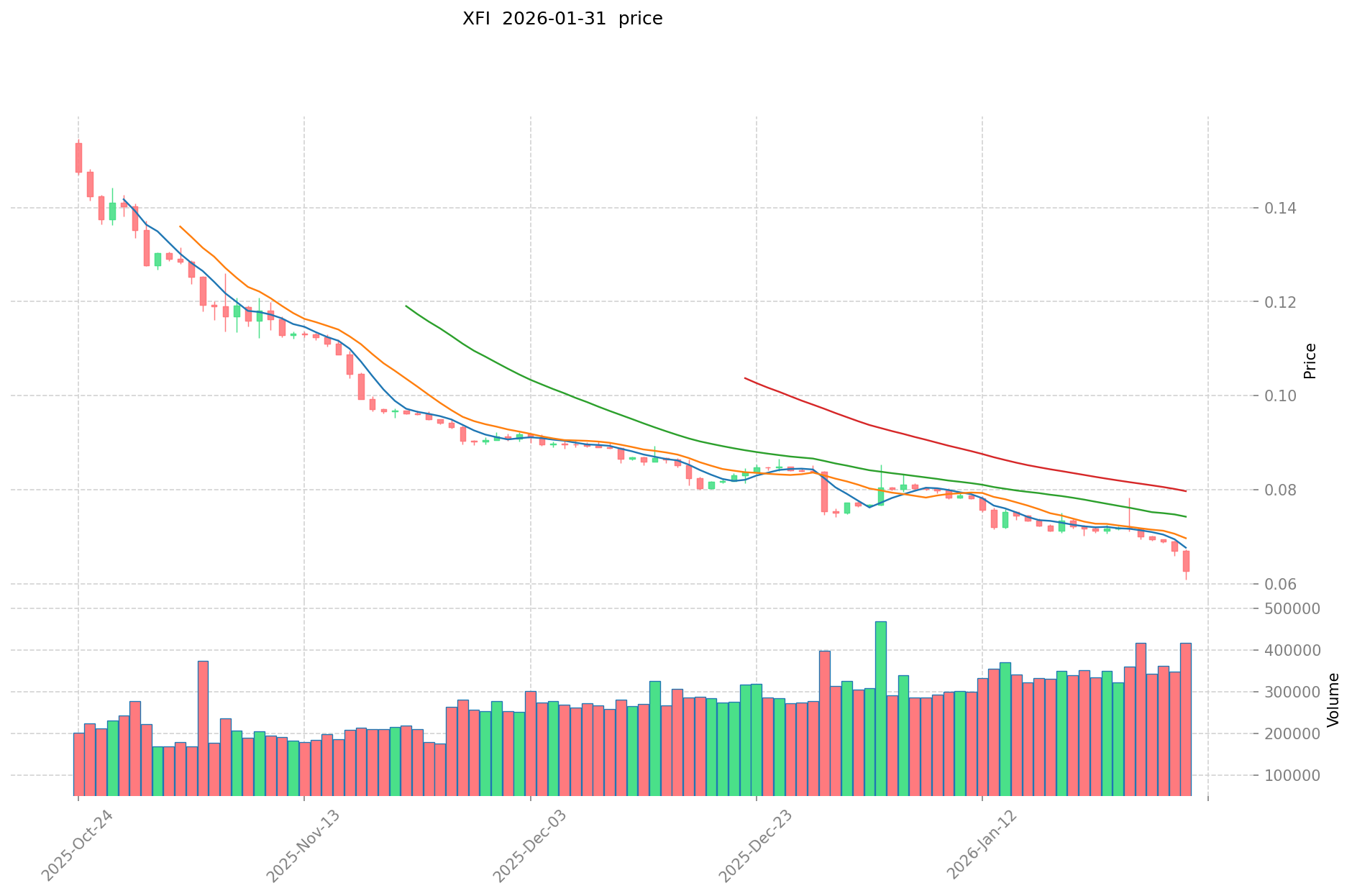
II. Core Factors Influencing Whether XFI is a Good Investment (Is CrossFi(XFI) a Good Investment)
Supply Mechanism and Scarcity (XFI investment scarcity)
- Supply mechanism → influences price and investment value
- Historical pattern: supply changes have previously driven XFI price movements
- Investment significance: scarcity serves as a key support for long-term investment considerations
According to available data, XFI has a maximum supply of 378,432,000 tokens, with a current circulating supply of 42,253,610 tokens, representing approximately 11.17% of the total supply. This relatively low circulation ratio may contribute to potential scarcity dynamics in the market.
Institutional Investment and Mainstream Adoption (Institutional investment in XFI)
- XFI is currently listed on 5 exchanges
- The project positions itself as a bridge between fiat currency and cryptocurrency, featuring non-custodial payment technology that allows users to maintain full control of their funds
- CrossFi Chain aims to provide an inclusive, next-generation solution for financial freedom and accessibility
Macroeconomic Environment's Impact on XFI Investment
- Monetary policy and interest rate changes → alter investment attractiveness
- Hedging role in inflationary environments → potential positioning consideration
- Geopolitical uncertainty → may influence demand for crypto assets
Technology and Ecosystem Development (Technology & Ecosystem for XFI investment)
- Non-custodial payment technology: enhances user control and security → potential investment appeal factor
- Fiat-crypto bridge solution: expands practical applications → long-term value consideration
- The project emphasizes transparency, convenience, and accessibility in financial services
CrossFi Chain presents itself as a solution aimed at providing seamless integration between traditional and digital financial systems, which may contribute to its ecosystem development and long-term positioning in the market.
III. XFI Future Investment Forecast and Price Outlook (Is CrossFi(XFI) worth investing in 2026-2031)
Short-term Investment Forecast (2026, short-term XFI investment outlook)
- Conservative forecast: $0.0549753 - $0.06177
- Neutral forecast: $0.06177
- Optimistic forecast: $0.06177 - $0.0908019
Mid-term Investment Outlook (2027-2029, mid-term CrossFi(XFI) investment forecast)
- Market phase expectation: XFI may enter a gradual recovery phase during this period, with price predictions showing moderate growth potential across the mid-term horizon.
- Investment return forecast:
- 2027: $0.057977322 - $0.1029860325
- 2028: $0.0743978727375 - $0.0994959502875
- 2029: $0.057685242168937 - $0.130501039660875
- Key catalysts: Market adoption rates, ecosystem development progress, and broader cryptocurrency market conditions may serve as primary factors influencing XFI's mid-term performance.
Long-term Investment Outlook (Is CrossFi a good long-term investment?)
- Base scenario: $0.068172797459133 - $0.131101533575256 (assuming steady ecosystem development and maintained market presence)
- Optimistic scenario: $0.112533505214812 - $0.1496695619357 (contingent upon enhanced adoption and favorable market dynamics)
- Risk scenario: Below $0.057685242168937 (under adverse market conditions or reduced ecosystem traction)
View XFI long-term investment and price forecast: Price Prediction
2026-01-31 - 2031 Long-term Outlook
- Base scenario: $0.068172797459133 - $0.112533505214812 (corresponding to steady progress and gradual mainstream application enhancement)
- Optimistic scenario: $0.112533505214812 - $0.1496695619357 (corresponding to large-scale adoption and favorable market environment)
- Transformative scenario: Above $0.1496695619357 (contingent upon breakthrough ecosystem progress and mainstream proliferation)
- 2031-12-31 forecast high: $0.137656610254019 (based on optimistic development assumptions)
Disclaimer: The above forecasts are based on analytical models and available data. Cryptocurrency investments carry substantial risk, and actual market performance may differ materially from predictions. This analysis does not constitute investment advice, and investors should conduct independent research and assessment before making investment decisions.
| Year |
Predicted High Price |
Predicted Average Price |
Predicted Low Price |
Price Change |
| 2026 |
0.0908019 |
0.06177 |
0.0549753 |
0 |
| 2027 |
0.1029860325 |
0.07628595 |
0.057977322 |
24 |
| 2028 |
0.0994959502875 |
0.08963599125 |
0.0743978727375 |
46 |
| 2029 |
0.130501039660875 |
0.09456597076875 |
0.057685242168937 |
54 |
| 2030 |
0.1496695619357 |
0.112533505214812 |
0.07764811859822 |
83 |
| 2031 |
0.137656610254019 |
0.131101533575256 |
0.068172797459133 |
113 |
IV. CrossFi Investment Strategy and Risk Management (How to invest in CrossFi)
Investment Methodology (CrossFi investment strategy)
Long-term Holding (HODL CrossFi)
For conservative investors seeking long-term exposure to blockchain payment infrastructure, a buy-and-hold strategy may be considered. This approach involves acquiring XFI tokens and maintaining positions through market cycles, focusing on the fundamental development of the CrossFi ecosystem rather than short-term price movements. Investors adopting this strategy typically establish predetermined allocation limits and maintain disciplined position management regardless of market volatility.
Active Trading
Active traders may utilize technical analysis and momentum-based strategies when engaging with XFI markets. Given the token's price fluctuations, as evidenced by the 24-hour range between $0.06066 and $0.0665, opportunities for swing trading may emerge. This approach requires continuous market monitoring, technical indicator analysis, and defined entry/exit parameters. Risk tolerance and trading experience should inform the selection of timeframes and position sizing.
Risk Management (Risk management for CrossFi investment)
Asset Allocation Ratios
- Conservative investors: Limit XFI exposure to 1-3% of total portfolio value, prioritizing capital preservation
- Moderate investors: Consider allocation of 3-7% within a diversified crypto portfolio
- Aggressive investors: May allocate 7-15% while maintaining awareness of concentration risk
Risk Hedging Approaches
Implementing a multi-asset portfolio strategy can help mitigate single-token exposure. Investors may consider:
- Diversification across multiple blockchain ecosystems and asset classes
- Maintaining stablecoin reserves for opportunistic rebalancing
- Setting predefined stop-loss levels to limit downside exposure
- Regular portfolio rebalancing based on predetermined thresholds
Secure Storage Solutions
Given CrossFi's non-custodial payment technology emphasis, proper asset custody is essential:
- Hot wallets: Suitable for active trading and frequent transactions, but maintain only necessary amounts
- Cold storage: Hardware wallets or air-gapped solutions recommended for long-term holdings
- Multi-signature wallets: Consider for larger allocations requiring enhanced security
- Regular security audits: Verify wallet integrity and backup recovery phrases securely
V. CrossFi Investment Risks and Challenges (Risks of investing in CrossFi)
Market Risks
CrossFi demonstrates significant price volatility, with recent performance showing a 7.72% decline over 24 hours and 14.35% decrease over 7 days. The token's relatively low market capitalization of approximately $2.59 million and limited circulating supply of 42.25 million tokens (representing 11.17% of total supply) may contribute to price sensitivity and liquidity constraints. The current trading volume of $27,414.71 suggests limited market depth, which could amplify price movements during periods of increased buying or selling pressure.
Regulatory Risks
As a blockchain project bridging fiat and cryptocurrency, CrossFi operates within an evolving regulatory landscape. Jurisdictional differences in payment technology oversight, securities classification, and cross-border transaction regulations may impact the project's operational capacity and market accessibility. Changes in regulatory frameworks across different regions could affect token utility, exchange availability, and adoption trajectory.
Technical Risks
Blockchain infrastructure projects face inherent technical challenges, including:
- Network security vulnerabilities that could compromise user funds or system integrity
- Smart contract risks associated with payment processing functions
- Interoperability challenges when bridging multiple payment systems
- Potential technical complications during protocol upgrades or feature implementations
- Dependencies on external infrastructure and third-party integrations
The relatively early stage of the project (token launch in September 2024) means the network's resilience and security measures continue to undergo real-world testing.
VI. Conclusion: Is CrossFi a Good Investment?
Investment Value Summary
CrossFi presents a value proposition centered on bridging traditional finance and cryptocurrency through non-custodial payment technology. The project's fundamental approach to financial inclusivity and user-controlled funds addresses specific market needs within the blockchain payments sector. However, the token has experienced substantial price decline since its all-time high of $1.12 in November 2024, currently trading at $0.06137, representing an approximate 94.5% decrease. The limited circulating supply and relatively small market capitalization indicate early-stage project characteristics with associated growth potential and execution risks.
Investor Recommendations
✅ Newcomers: Consider dollar-cost averaging with small, regular purchases rather than lump-sum investments. Prioritize secure wallet setup and practice proper key management. Limit initial exposure while gaining familiarity with the project's development and market dynamics.
✅ Experienced Investors: May explore tactical trading opportunities based on technical analysis and market cycles. Consider position sizing relative to overall portfolio risk tolerance and maintain predefined risk parameters. Monitor project milestones and ecosystem development metrics.
✅ Institutional Investors: Conduct comprehensive due diligence on project fundamentals, team credentials, and technology infrastructure. Evaluate strategic fit within broader portfolio objectives and regulatory compliance requirements. Consider phased entry strategies aligned with project development stages.
⚠️ Disclaimer: Cryptocurrency investments carry substantial risk, including the potential loss of principal. Market conditions can change rapidly, and past performance does not indicate future results. This content provides educational information only and does not constitute financial, investment, or legal advice. Investors should conduct independent research and consult qualified professionals before making investment decisions.
VII. FAQ
Q1: What is the current market position of CrossFi (XFI) and its key features?
CrossFi (XFI) currently ranks 1915 in the cryptocurrency market with a market capitalization of approximately $2.59 million and a circulating supply of 42.25 million tokens (11.17% of total supply). Launched in September 2024, XFI serves as the native token of CrossFi Chain, a blockchain platform designed to bridge fiat currency and cryptocurrency through non-custodial payment technology. The project emphasizes user control of funds, financial inclusivity, and seamless integration between traditional and digital financial systems. As of January 31, 2026, XFI trades at $0.06137 with a 24-hour trading volume of $27,414.71 and is listed on 5 exchanges.
Q2: How has XFI's price performed historically and what caused its significant decline?
XFI experienced substantial volatility since its launch, reaching an all-time high of $1.12 on November 21, 2024. Subsequently, the token declined sharply to $0.04944 by August 31, 2025, and currently trades at $0.06137, representing approximately 94.5% decrease from its peak. This significant price movement reflects broader market adjustment patterns, limited liquidity due to small market capitalization, and the early-stage nature of the project. Recent performance shows continued volatility with a 7.72% decline over 24 hours and 14.35% decrease over 7 days, indicating ongoing market uncertainty and adjustment pressures.
Q3: What are the price predictions for XFI in the short, medium, and long term?
Short-term forecast for 2026 suggests XFI may trade between $0.0549753 (conservative low) and $0.0908019 (optimistic high), with a neutral average of $0.06177. Mid-term projections indicate gradual recovery potential, with 2027 ranging from $0.057977322 to $0.1029860325, 2028 between $0.0743978727375 and $0.0994959502875, and 2029 from $0.057685242168937 to $0.130501039660875. Long-term outlook through 2031 presents a base scenario of $0.068172797459133 to $0.131101533575256, with optimistic scenarios reaching up to $0.1496695619357, contingent upon successful ecosystem development and favorable market conditions. The 2031 predicted high stands at $0.137656610254019, representing a potential 124% increase from current levels.
Q4: What investment strategies are suitable for different types of XFI investors?
Conservative investors should consider limiting XFI exposure to 1-3% of total portfolio value and adopting a long-term holding (HODL) strategy focused on fundamental ecosystem development rather than short-term price movements. Moderate investors may allocate 3-7% within a diversified crypto portfolio, potentially employing dollar-cost averaging to mitigate volatility impacts. Aggressive investors could consider 7-15% allocation while implementing active trading strategies based on technical analysis, given the token's price fluctuations evidenced by the 24-hour range between $0.06066 and $0.0665. All investors should implement proper risk management through diversification, predefined stop-loss levels, regular portfolio rebalancing, and secure storage solutions including hardware wallets for long-term holdings.
Q5: What are the primary risks associated with investing in CrossFi (XFI)?
Market risks include significant price volatility, limited liquidity due to low market capitalization ($2.59 million), and restricted trading volume ($27,414.71), which may amplify price movements during buying or selling pressure. Regulatory risks stem from CrossFi's operation within evolving payment technology and cross-border transaction frameworks, with potential jurisdictional complications affecting token utility and exchange availability. Technical risks involve network security vulnerabilities, smart contract complications in payment processing, interoperability challenges when bridging multiple payment systems, and dependencies on external infrastructure. The project's early stage (launched September 2024) means its network resilience and security measures continue undergoing real-world testing, presenting execution risks alongside growth potential.
Q6: How does CrossFi's supply mechanism and tokenomics affect its investment value?
CrossFi has a maximum supply of 378,432,000 tokens with only 42,253,610 tokens currently in circulation, representing approximately 11.17% of total supply. This relatively low circulation ratio may contribute to potential scarcity dynamics and price sensitivity in the market. The limited circulating supply combined with small market capitalization creates conditions where price movements can be amplified by trading activity. As additional tokens enter circulation over time, understanding the token release schedule and its impact on supply-demand dynamics becomes crucial for long-term investment considerations. This supply structure serves as both a potential support mechanism through scarcity and a risk factor through potential future dilution.
Q7: What role does institutional adoption play in CrossFi's investment outlook?
Currently, specific institutional investor holdings data for XFI is not publicly available, indicating potentially limited institutional participation at this early stage. The project's positioning as a bridge between fiat currency and cryptocurrency through non-custodial payment technology targets a market segment that could attract institutional interest in financial infrastructure. CrossFi Chain's emphasis on transparency, convenience, and accessibility in financial services aligns with enterprise requirements, though actual institutional adoption remains to be demonstrated. The token's listing on 5 exchanges provides basic market access, but expanded institutional custody solutions, regulatory clarity, and demonstrated network security would likely be prerequisites for significant institutional capital allocation.
Q8: Is CrossFi suitable as a long-term investment and what factors should influence this decision?
CrossFi's suitability as a long-term investment depends on individual risk tolerance, portfolio objectives, and assessment of the project's fundamental value proposition. Positive considerations include the project's focus on addressing real payment infrastructure needs, non-custodial technology emphasis, and early-stage positioning with growth potential. However, significant caution factors include the 94.5% price decline from all-time highs, limited market liquidity, early-stage execution risks, and uncertain regulatory environment. Long-term investors should evaluate the team's ability to deliver on technical roadmap milestones, achieve meaningful ecosystem adoption, and navigate competitive pressures from established payment solutions. Given these factors, XFI may be considered as a high-risk, speculative allocation within a diversified portfolio rather than a core holding, with position sizing reflecting the substantial execution and market risks inherent in early-stage blockchain projects.
* The information is not intended to be and does not constitute financial advice or any other recommendation of any sort offered or endorsed by Gate.