This comprehensive analysis examines whether Crypto Asset Governance Alliance (CAGA) represents a viable investment opportunity in 2026. The article evaluates CAGA's market fundamentals, including its $1.73 million market capitalization, 63.45 billion circulating tokens, and community-driven DAO governance model with 6,504 active holders. It provides detailed price history review, ranging from $0.0023 in December 2023 to current trading at $0.00002724, alongside price predictions for 2026-2031 across conservative, neutral, and optimistic scenarios. The analysis addresses critical factors affecting investment value including supply mechanisms, trading activity on Gate, and macro market conditions. Additionally, it outlines actionable investment strategies for different investor profiles—beginners, experienced traders, and institutional investors—while thoroughly examining market risks, regulatory uncertainties, and technical vulnerabilities. The guide concludes with practical recommendations and risk managemen
Introduction: Crypto Asset Governance Alliance (CAGA) Investment Position and Market Outlook
Crypto Asset Governance Alliance (CAGA) operates as a community-driven decentralized autonomous organization (DAO) in the cryptocurrency sector. Launched in November 2023, CAGA focuses on profitability and collaboration among crypto participants through anonymous decision-making mechanisms. As of February 2, 2026, CAGA holds a market capitalization of approximately $1.73 million, with a circulating supply of about 63.45 billion tokens and a current price around $0.00002724. The token ranks #2136 in the cryptocurrency market with a market dominance of 0.000099%. With 6,504 holders and governance features that empower token holders to direct project development, CAGA has attracted attention from investors exploring "Is Crypto Asset Governance Alliance (CAGA) a good investment?" This article provides a comprehensive analysis of CAGA's investment value, historical price trends, future price projections, and associated risks to serve as a reference for potential investors.
I. Crypto Asset Governance Alliance (CAGA) Price History Review and Investment Value Status
- 2023: CAGA reached a notable price level of $0.0023 on December 5, 2023 → The token experienced substantial volatility during its early trading phase
- 2025: Market correction phase → Price declined from previous levels to $0.00002517 in October 2025
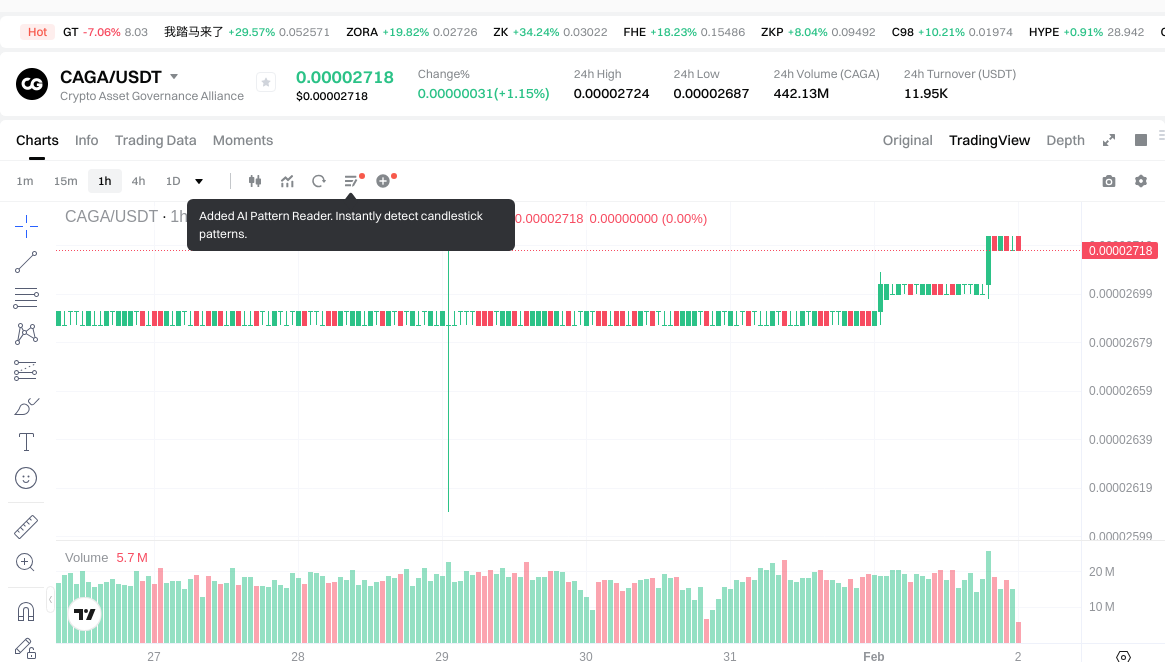
- Current Period (February 2026): Trading at $0.00002724 → The token shows a 24-hour increase of 0.92% and a 7-day gain of 0.92%
Current CAGA Investment Market Status (February 2026)
- CAGA Current Price: $0.00002724
- Market Sentiment (Fear & Greed Index): Data not available in provided materials
- 24-Hour Trading Volume: $11,988.54
- Institutional Investor Holdings: The token has 6,504 holders according to available data
- Market Capitalization: $1,728,352.48 (Circulating)
- Fully Diluted Valuation: $2,724,000.00
- Market Cap to FDV Ratio: 63.45%
Click to view real-time CAGA market price
II. Core Factors Affecting Whether CAGA is a Good Investment (Is Crypto Asset Governance Alliance(CAGA) a Good Investment)
Supply Mechanism and Scarcity (CAGA investment scarcity)
- Total supply of 100 billion tokens with approximately 63.45% in circulation → influences price dynamics and investment value
- The token has experienced price fluctuations, with a recorded price of $0.0023 in December 2023 and $0.00002517 in October 2025
- Investment significance: scarcity remains a key consideration for long-term investment evaluation
- CAGA operates as a Decentralized Autonomous Organization (DAO) governed by token holders
- Anonymous decision-making principle enables community participation in project direction
- Community-driven approach with 6,504 holders may influence investment considerations through collective governance
- 24-hour trading volume of $11,988.54 with a market capitalization of approximately $1.73 million
- Market cap to fully diluted valuation ratio of 63.45% indicates current circulation relative to total supply
- Trading activity on one exchange platform may affect liquidity considerations for investors
Macro Market Environment Impact on CAGA Investment
- Market sentiment indicators show positive trends in recent periods
- Price predictions for 2026 vary across sources, with some forecasts suggesting potential ranges between $0.0000096 and $0.00005942
- Market volatility and broader cryptocurrency market conditions may influence CAGA's investment outlook
III. CAGA Future Investment Prediction and Price Outlook (Is Crypto Asset Governance Alliance(CAGA) worth investing in 2026-2031)
Short-term Investment Prediction (2026, short-term CAGA investment outlook)
- Conservative forecast: $0.000019026 - $0.00002718
- Neutral forecast: $0.00002718 - $0.000035
- Optimistic forecast: $0.000035 - $0.0000404982
Mid-term Investment Outlook (2027-2029, mid-term Crypto Asset Governance Alliance(CAGA) investment forecast)
- Market stage expectation: Based on available data, CAGA may experience gradual development with potential price fluctuations reflecting broader market dynamics and community-driven initiatives.
- Investment return prediction:
- 2027: $0.000026732889 - $0.000038238183
- 2028: $0.00002955168603 - $0.000042885983385
- 2029: $0.000022493518092 - $0.000056825729917
- Key catalysts: Community governance decisions, DAO participation levels, and potential collaborations within the crypto ecosystem.
Long-term Investment Outlook (Is CAGA a good long-term investment?)
- Base scenario: $0.000038996657155 - $0.00006980883071 (assuming steady community engagement and moderate market conditions through 2030)
- Optimistic scenario: $0.000052489019091 - $0.000071951239653 (assuming enhanced community adoption and favorable market environment through 2031)
- Risk scenario: Below $0.000022493518092 (under adverse market conditions or reduced community participation)
Click to view CAGA long-term investment and price prediction: Price Prediction
2026-02-02 - 2031 Long-term Outlook
- Base scenario: $0.000019026 - $0.00006980883071 (corresponding to steady progress and gradual mainstream application improvement)
- Optimistic scenario: $0.000038996657155 - $0.000071951239653 (corresponding to large-scale adoption and favorable market environment)
- Transformative scenario: Above $0.000071951239653 (if the ecosystem achieves breakthrough developments and mainstream penetration)
- 2031-12-31 predicted high: $0.000071951239653 (based on optimistic development assumptions)
Disclaimer: The above predictions are based on historical data and market analysis. Cryptocurrency investments carry substantial risks, and past performance does not guarantee future results. Investors should conduct thorough research and consider their risk tolerance before making investment decisions.
| Year |
Predicted High Price |
Predicted Average Price |
Predicted Low Price |
Price Change |
| 2026 |
0.0000404982 |
0.00002718 |
0.000019026 |
0 |
| 2027 |
0.000038238183 |
0.0000338391 |
0.000026732889 |
24 |
| 2028 |
0.000042885983385 |
0.0000360386415 |
0.00002955168603 |
32 |
| 2029 |
0.000056825729917 |
0.000039462312442 |
0.000022493518092 |
44 |
| 2030 |
0.00006980883071 |
0.000048144021179 |
0.000038996657155 |
76 |
| 2031 |
0.000071951239653 |
0.000058976425945 |
0.000052489019091 |
116 |
IV. CAGA Investment Strategy and Risk Management (How to invest in CAGA)
Investment Methodology (CAGA investment strategy)
-
Long-term Holding (HODL CAGA): Suitable for conservative investors
Long-term holding strategies focus on accumulating CAGA tokens over extended periods, allowing investors to potentially benefit from the project's growth as a community-driven DAO. This approach requires patience and belief in the project's long-term vision of fostering collaboration in the crypto sphere.
-
Active Trading: Relying on technical analysis and swing trading
Active traders may leverage CAGA's price movements for short-term gains. Given the token's trading activity on exchanges, technical analysis tools can help identify entry and exit points. Traders should monitor the token's 24-hour volume and price trends to capitalize on market fluctuations.
Risk Management (Risk management for CAGA investment)
-
Asset Allocation Ratio: Conservative / Aggressive / Professional investors
Conservative investors might allocate a small percentage (1-3%) of their crypto portfolio to CAGA, given its relatively lower market capitalization and ranking. Aggressive investors with higher risk tolerance could increase this to 5-10%, while professional investors might adjust allocations based on comprehensive market analysis and portfolio diversification needs.
-
Risk Hedging Solutions: Multi-asset portfolio + hedging tools
Investors should consider diversifying their holdings across multiple cryptocurrencies and traditional assets to mitigate concentration risk. Hedging strategies may include setting stop-loss orders and maintaining positions in stablecoins or established cryptocurrencies alongside CAGA holdings.
-
Secure Storage: Hot/cold wallets + hardware wallet recommendations
Given that CAGA operates as an ERC-20 token on the Ethereum network, investors should utilize secure storage solutions. Hardware wallets such as Ledger or Trezor offer enhanced security for long-term holdings, while reputable software wallets can be used for smaller amounts needed for trading. Always verify contract addresses (0xbddc20ed7978b7d59ef190962f441cd18c14e19f) before transactions.
V. CAGA Investment Risks and Challenges (Risks of investing in CAGA)
-
Market Risk: High volatility, price manipulation
CAGA has experienced considerable price fluctuations, with a 1-year change of -61.91%. The token's 24-hour trading volume is relatively modest, which may contribute to increased volatility and potential susceptibility to price manipulation. Investors should be prepared for sudden price movements and maintain appropriate risk management practices.
-
Regulatory Risk: Policy uncertainty across different countries
As a decentralized autonomous organization (DAO) with anonymous decision-making principles, CAGA may face evolving regulatory scrutiny in various jurisdictions. Changes in cryptocurrency regulations, particularly regarding DAO governance structures, could impact the project's operations and token value.
-
Technical Risk: Network security vulnerabilities, upgrade failures
As an ERC-20 token, CAGA is subject to risks associated with the Ethereum network, including potential smart contract vulnerabilities, network congestion, and gas fee fluctuations. Additionally, the project's reliance on community governance through its DAO structure introduces risks related to decision-making processes and potential governance disputes.
VI. Conclusion: Is CAGA a Good Investment?
-
Investment Value Summary: CAGA presents itself as a community-driven DAO project with a focus on collaborative decision-making in the cryptocurrency space. While the token has shown recent short-term stability (0.92% change over 7 days), its significant 1-year decline of -61.91% reflects the challenges faced by newer projects in the competitive crypto market. The token's circulating supply represents approximately 63.45% of its maximum supply, with over 6,500 holders participating in the community.
-
Investor Recommendations:
✅ Beginners: Consider dollar-cost averaging (DCA) with small amounts + secure wallet storage using verified contract addresses
✅ Experienced Investors: Employ swing trading strategies combined with portfolio diversification, monitoring the token's relatively low trading volume for liquidity considerations
✅ Institutional Investors: Conduct thorough due diligence on the project's DAO governance structure and community engagement before considering strategic allocation
⚠️ Disclaimer: Cryptocurrency investments carry high risk. This content is for informational purposes only and does not constitute investment advice. Investors should conduct their own research and consider their risk tolerance before making investment decisions.
VII. FAQ
Q1: Is CAGA a good investment for beginners in 2026?
CAGA may be suitable for beginners with high risk tolerance who are willing to invest small amounts. As a relatively new DAO project with a market capitalization of approximately $1.73 million and ranking #2136, CAGA carries significant volatility risk, evidenced by its 1-year decline of -61.91%. Beginners should consider dollar-cost averaging (DCA) strategies, allocating only 1-3% of their crypto portfolio, and using secure hardware wallets to store tokens. The project's community-driven governance model with 6,504 holders offers an opportunity to participate in decentralized decision-making, but the modest 24-hour trading volume of $11,988.54 suggests limited liquidity that beginners should carefully consider.
Q2: What is the realistic price prediction for CAGA by the end of 2026?
Based on current market analysis, CAGA's price predictions for 2026 range from conservative to optimistic scenarios. The conservative forecast suggests a range of $0.000019026 to $0.00002718, while the neutral forecast estimates $0.00002718 to $0.000035. The optimistic scenario projects prices reaching $0.000035 to $0.0000404982 by year-end. These predictions are influenced by factors including the token's current circulation rate (63.45% of maximum supply), community governance decisions, and broader cryptocurrency market conditions. However, investors should note that CAGA's historical volatility and relatively low trading volume may lead to significant price fluctuations.
Q3: How does CAGA's governance model affect its investment value?
CAGA's decentralized autonomous organization (DAO) structure directly influences its investment value through community-driven decision-making mechanisms. Token holders participate in anonymous governance processes that determine project development direction, potentially creating more democratic and transparent operations compared to traditional centralized projects. With 6,504 holders currently engaged in the ecosystem, the governance model distributes decision-making power across the community. This structure can enhance long-term sustainability through collective wisdom, but also introduces risks related to governance disputes, slower decision-making processes, and potential conflicts among community members that could impact the token's market performance.
Q4: What are the main risks associated with investing in CAGA?
CAGA investment carries three primary risk categories. First, market risk includes high volatility demonstrated by the -61.91% decline over one year and potential price manipulation due to relatively low trading volume. Second, regulatory risk stems from evolving policies regarding DAO structures and decentralized governance, which may vary significantly across different jurisdictions. Third, technical risk involves Ethereum network vulnerabilities as CAGA operates as an ERC-20 token, including smart contract security concerns, network congestion, and gas fee fluctuations. Additionally, the project's reliance on community governance introduces operational risks related to decision-making effectiveness and potential organizational conflicts.
Q5: How does CAGA compare to other DAO projects in terms of investment potential?
CAGA distinguishes itself through its focus on profitability and collaboration within the crypto community, operating with an anonymous decision-making principle. However, with a market cap of $1.73 million and ranking #2136, CAGA is significantly smaller than established DAO projects. The token's market dominance of 0.000099% indicates limited market presence compared to major governance tokens. While CAGA's 63.45% circulating supply ratio suggests reasonable token distribution, its 24-hour trading volume of approximately $12,000 is modest compared to larger DAO projects. Investors should consider that CAGA's relatively recent launch in November 2023 means it lacks the track record and ecosystem development of more mature DAO projects.
Q6: What storage methods are recommended for CAGA tokens?
CAGA tokens should be stored using verified secure storage solutions appropriate to individual investment strategies. For long-term holdings, hardware wallets such as Ledger or Trezor offer optimal security as CAGA operates as an ERC-20 token on the Ethereum network. These cold storage solutions protect against online threats and unauthorized access. For active traders requiring frequent access, reputable software wallets can be utilized for smaller amounts, though investors must always verify the correct contract address (0xbddc20ed7978b7d59ef190962f441cd18c14e19f) before executing transactions. Diversifying storage methods between hot wallets for trading purposes and cold wallets for long-term holdings provides a balanced approach to security and accessibility.
Q7: Is CAGA suitable for long-term investment strategies?
CAGA's suitability for long-term investment depends on individual risk tolerance and belief in the project's governance model evolution. The base scenario projects prices ranging from $0.000038996657155 to $0.00006980883071 by 2030, while the optimistic scenario suggests $0.000052489019091 to $0.000071951239653 by 2031, representing potential growth from current levels. Long-term holders (HODLers) should focus on the project's community development, DAO participation rates, and governance effectiveness as key value drivers. However, the token's historical volatility, relatively small market presence, and evolving regulatory environment for DAO structures present significant uncertainties. Conservative long-term investors should limit CAGA allocation to 1-3% of their total crypto portfolio and maintain realistic expectations about the project's development timeline.
Q8: What catalysts could drive CAGA's price growth in the medium term?
Several factors could potentially influence CAGA's price trajectory through 2027-2029. Key catalysts include increased community governance participation beyond the current 6,504 holders, successful implementation of community-driven initiatives that demonstrate the DAO's effectiveness, and potential strategic collaborations within the broader cryptocurrency ecosystem. Enhanced liquidity through additional exchange listings could improve trading volume beyond the current $11,988.54 daily average. Additionally, broader market conditions favoring DAO projects and decentralized governance models could positively impact CAGA's valuation. The project's ability to differentiate itself in the competitive DAO landscape through unique value propositions and practical implementations of its profitability-focused approach will be critical for sustained growth. However, these catalysts remain speculative, and investors should monitor actual development progress and community engagement metrics.
* The information is not intended to be and does not constitute financial advice or any other recommendation of any sort offered or endorsed by Gate.