CUDIS is a health-tech blockchain project positioned as a longevity protocol combining AI-powered analytics and wearable technology. Trading at $0.02747 with a $6.8 million market cap and ranking #1389, CUDIS offers investors exposure to the emerging health-tech cryptocurrency sector. This comprehensive analysis examines CUDIS's market performance, including historical price volatility ranging from $0.31204 (November 2025) to current levels, alongside detailed price forecasts through 2030 across conservative, neutral, and optimistic scenarios. The article evaluates core investment factors including supply mechanisms, ecosystem development through CUDIS Ring and Longevity Hub, and multi-chain deployment on Gate exchange and other platforms. Critical risk factors including market volatility, regulatory uncertainty, and technical integration challenges are thoroughly addressed. Recommended investment strategies accommodate different investor profiles from beginners employing dollar-cost averaging to institutiona
Introduction: CUDIS's Investment Position and Market Outlook
CUDIS is a notable digital asset in the cryptocurrency sector, positioning itself as a rewarding longevity protocol aimed at extending healthspan through blockchain technology and AI-powered health tracking. As of January 28, 2026, CUDIS holds a market ranking of 1389, with a market capitalization of approximately $6.8 million and a circulating supply of 247.5 million tokens. The current trading price stands at around $0.02747, with a 24-hour trading volume of $21,144.58. With approximately 19,035 holders and availability on 18 exchanges, CUDIS has been gaining attention in the health and wellness sector of the blockchain ecosystem. Through the integration of the CUDIS Ring, an AI-powered Longevity Hub, and a blockchain-driven Super App, the project aims to provide users with ownership of their health data, real-time longevity insights, and economic incentives. This article comprehensively analyzes CUDIS's investment characteristics, historical price trends, future price outlook, and associated investment risks to provide reference for potential investors.
I. CUDIS Price History Review and Current Investment Value Status
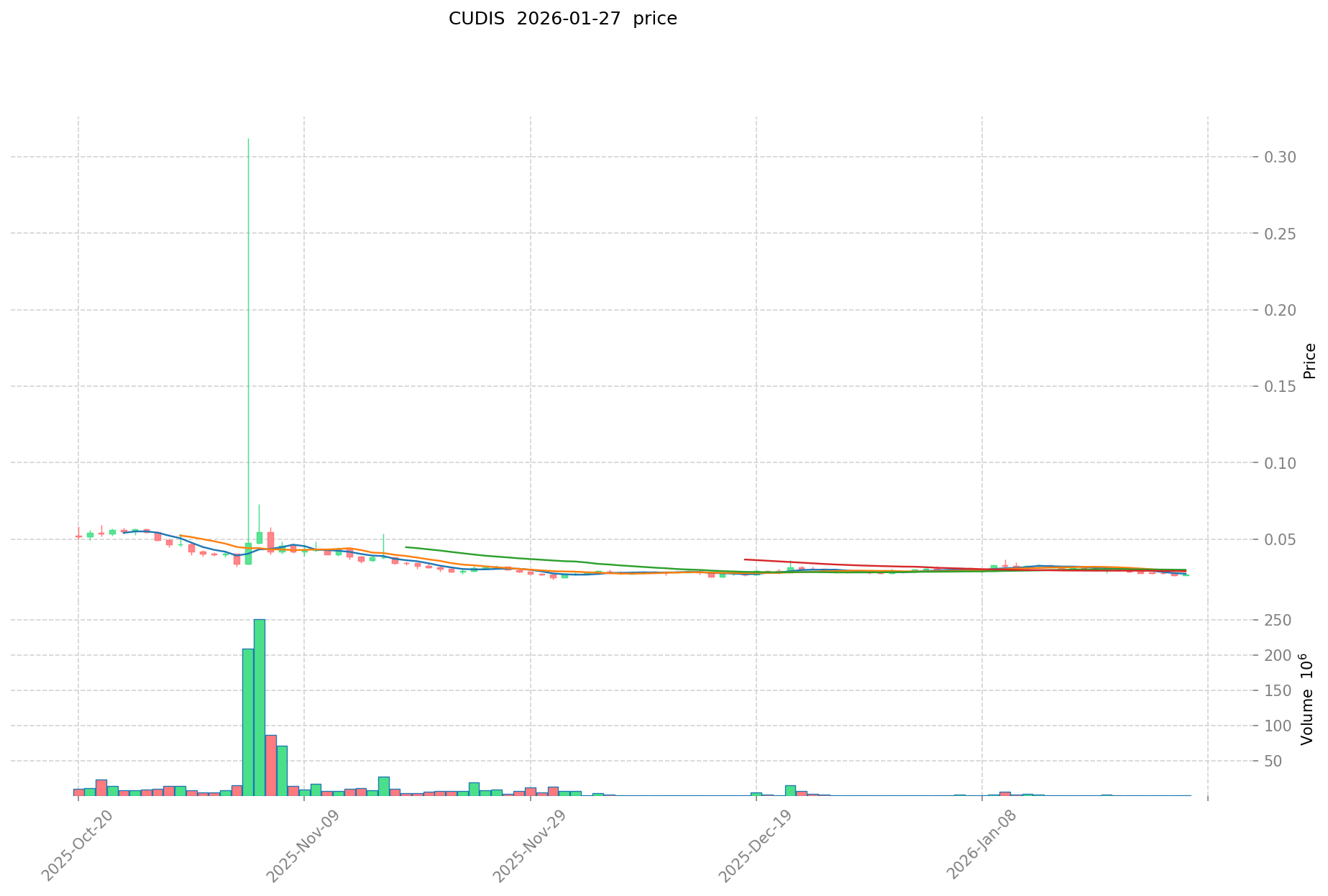
- 2025: CUDIS experienced significant price volatility during its early trading period. The token reached a notable price level of $0.31204 in November 2025, followed by a substantial decline to $0.02352 by December 2025.
- 2026: As of January 28, 2026, CUDIS is trading at $0.02747, showing a recovery of approximately 2.61% over the past 24 hours from recent lows.
Current CUDIS Investment Market Status (January 2026)
- CUDIS current price: $0.02747
- Market sentiment (Fear & Greed Index): Data indicates a neutral sentiment in the broader market
- 24-hour trading volume: $21,144.58
- Market capitalization: $6.80 million with 247.5 million tokens in circulation (24.75% of total supply)
- The token has experienced a -11.52% price change over the past 7 days and -4.06% over the past 30 days
Click to view real-time CUDIS market price
II. Core Factors Influencing Whether CUDIS is a Good Investment
Supply Mechanism and Scarcity
- Total supply capped at 1,000,000,000 tokens with current circulation of 247,500,000 (24.75%) → influences price dynamics and investment valuation
- Market cap to fully diluted valuation ratio of 24.75% indicates substantial unreleased supply that may affect future price movement
- Investment significance: the gradual release of tokens from the total supply pool represents a key consideration for long-term holders evaluating scarcity dynamics
Institutional Investment and Mainstream Adoption
- CUDIS holds approximately 0.00086% market share in the cryptocurrency sector as of January 2026
- The token is listed on 18 exchanges with approximately 19,035 holders, indicating expanding accessibility and adoption pathways
- Deployment across BSC and Solana blockchains provides multi-chain exposure and potential institutional access points
Macroeconomic Environment Impact on CUDIS Investment
- As a health-technology focused cryptocurrency, CUDIS may exhibit different correlation patterns compared to traditional digital assets during macroeconomic shifts
- The longevity and wellness sector positioning could attract specific investor segments seeking exposure to health-tech innovation
- Broader cryptocurrency market conditions continue to influence CUDIS trading volumes and price movements
Technology and Ecosystem Development
- Integration of CUDIS Ring hardware with AI-powered Longevity Hub creates a distinctive product ecosystem supporting token utility
- Blockchain-driven Super App architecture aims to provide users with health data ownership and economic incentives for wellness optimization
- Multi-chain deployment (BSC and Solana) enhances accessibility and operational flexibility across different blockchain ecosystems
- Partnership development for longevity-focused products and services represents ongoing ecosystem expansion efforts
III. CUDIS Future Investment Outlook and Price Forecast (Is CUDIS worth investing in 2026-2030)
Short-term Investment Outlook (2026, short-term CUDIS investment outlook)
- Conservative forecast: $0.0159 - $0.0181
- Neutral forecast: $0.02011 - $0.02637
- Optimistic forecast: $0.02752 - $0.0375
Mid-term Investment Outlook (2027-2028, mid-term CUDIS investment forecast)
- Market stage expectation: The token may experience gradual growth as the longevity protocol ecosystem develops and partnerships expand
- Investment return forecast:
- 2027: $0.0269 - $0.0374
- 2028: $0.0318 - $0.0454
- Key catalysts: Ecosystem expansion, adoption of CUDIS Ring and AI-powered Longevity Hub, partnership developments
Long-term Investment Outlook (Is CUDIS a good long-term investment?)
- Base scenario: $0.0336 - $0.0610 (assuming steady ecosystem development and moderate user adoption)
- Optimistic scenario: $0.0507 - $0.1054 (assuming accelerated adoption and favorable market conditions)
- Risk scenario: Below $0.0236 (under adverse market conditions or ecosystem setbacks)
Click to view CUDIS long-term investment and price forecast: Price Prediction
2026-2030 Long-term Outlook
- Base scenario: $0.0336 - $0.0610 (corresponding to steady progress and mainstream application gradual improvement)
- Optimistic scenario: $0.0507 - $0.1054 (corresponding to large-scale adoption and favorable market environment)
- Transformative scenario: Above $0.1054 (if ecosystem achieves breakthrough progress and mainstream adoption)
- 2030-12-31 forecast high: $0.0610 (based on optimistic development assumptions)
Disclaimer: Price predictions are based on historical patterns and market analysis models. Cryptocurrency markets are highly volatile and subject to various uncertainties. The forecasts presented here are for reference purposes only and should not be considered as investment advice. Past performance does not guarantee future results.
| Year |
Predicted High Price |
Predicted Average Price |
Predicted Low Price |
Price Change |
| 2026 |
0.0375791 |
0.02743 |
0.0159094 |
0 |
| 2027 |
0.0373802325 |
0.03250455 |
0.0269787765 |
18 |
| 2028 |
0.045425108625 |
0.03494239125 |
0.0317975760375 |
27 |
| 2029 |
0.055855412413125 |
0.0401837499375 |
0.038978237439375 |
46 |
| 2030 |
0.060984868092646 |
0.048019581175312 |
0.033613706822718 |
74 |
| 2031 |
0.076303114487571 |
0.054502224633979 |
0.050687068909601 |
98 |
IV. CUDIS Investment Strategy and Risk Management (How to invest in CUDIS)
Investment Methodology (CUDIS investment strategy)
Long-term Holding (HODL CUDIS)
Long-term holding may be suitable for conservative investors who believe in CUDIS's longevity protocol vision. The project aims to extend health-span to 140 years through its integrated ecosystem of CUDIS Ring, AI-powered Longevity Hub, and blockchain-driven Super App. However, investors should note that CUDIS has experienced notable price fluctuations since its launch in October 2024, with changes of -11.52% over 7 days and -75.11% over 1 year as of January 28, 2026.
Active Trading
Active traders may leverage technical analysis and swing trading approaches based on CUDIS's price movements. Recent data shows 24-hour volatility with a high of $0.02752 and low of $0.02657. The token's trading volume of approximately $21,144 across 18 exchanges provides liquidity for short-term trading strategies.
Risk Management (Risk management for CUDIS investment)
Asset Allocation Ratios
- Conservative investors: Consider limiting CUDIS exposure to a small percentage of the overall crypto portfolio, given its market cap rank of 1389 and market dominance of 0.00086%
- Aggressive investors: May allocate a moderate portion while maintaining diversification across other digital assets
- Professional investors: Could incorporate CUDIS as part of a specialized health-tech or longevity-focused crypto strategy
Risk Hedging Approaches
Investors should consider multi-asset portfolio construction combined with risk mitigation tools. Diversification across different crypto categories and traditional assets can help manage exposure to CUDIS's price volatility.
Secure Storage
CUDIS tokens exist on multiple blockchains, including BSC (contract address: 0xc1353d3ee02fdbd4f65f92eee543cfd709049cb1) and Solana (contract address: CudisfkgWvMKnZ3TWf6iCuHm8pN2ikXhDcWytwz6f6RN). Investors should utilize:
- Cold wallets: For long-term storage of substantial holdings
- Hot wallets: For active trading with limited amounts
- Hardware wallets: Recommended for enhanced security of private keys
V. CUDIS Investment Risks and Challenges (Risks of investing in CUDIS)
Market Risks
CUDIS exhibits considerable price volatility, with changes ranging from 0.11% (1-hour) to -75.11% (1-year). The token's relatively low market capitalization of approximately $6.8 million and circulating supply of 247.5 million tokens (24.75% of max supply) may contribute to price sensitivity. The fully diluted market cap stands at $27.47 million, indicating potential dilution as more tokens enter circulation from the 1 billion maximum supply.
Regulatory Risks
As a health-data and longevity-focused blockchain project operating across multiple jurisdictions, CUDIS may face evolving regulatory frameworks regarding:
- Health data privacy and ownership regulations
- Crypto asset classification and compliance requirements
- Cross-border health technology and blockchain integration policies
Different countries maintain varying approaches to crypto regulation, creating uncertainty for projects like CUDIS that combine blockchain technology with health applications.
Technical Risks
The CUDIS ecosystem integrates multiple components—physical devices (CUDIS Ring), AI systems (Longevity Hub), and blockchain infrastructure (Super App). Potential technical challenges include:
- Network security vulnerabilities across multi-chain deployments (BSC and Solana)
- Integration risks between hardware, AI, and blockchain components
- Smart contract risks associated with the BEP-20 standard implementation
- Platform upgrade dependencies and potential compatibility issues
VI. Conclusion: Is CUDIS a Good Investment?
Investment Value Summary
CUDIS represents an emerging project at the intersection of longevity technology and blockchain infrastructure. The token's circulating supply of 247.5 million represents 24.75% of the maximum supply, with a holder base of 19,035 participants. Price performance shows significant fluctuations, with a current price of $0.02747 compared to its previous high of $0.31204 (November 4, 2025) and low of $0.02352 (December 1, 2025).
Investor Recommendations
✅ Beginners
- Consider dollar-cost averaging strategies to manage entry points
- Prioritize secure wallet storage using cold or hardware wallets
- Start with modest allocations given the token's volatility and relatively early stage
✅ Experienced Investors
- Evaluate swing trading opportunities based on technical analysis
- Incorporate CUDIS within a diversified crypto portfolio
- Monitor development progress of the CUDIS Ring, Longevity Hub, and Super App components
✅ Institutional Investors
- Assess strategic positioning within health-tech and longevity-focused investment themes
- Evaluate partnership developments and ecosystem expansion
- Consider allocation as part of specialized crypto sector exposure
⚠️ Notice
Cryptocurrency investments carry substantial risks. The information provided in this article is for reference purposes only and does not constitute investment advice. Investors should conduct thorough due diligence and consider their risk tolerance before making any investment decisions regarding CUDIS or other digital assets.
VII. FAQ
Q1: What is the current market position of CUDIS and is it a viable investment option in 2026?
CUDIS currently ranks #1389 in the cryptocurrency market with a market cap of approximately $6.8 million and trades at $0.02747 as of January 28, 2026. The token maintains a circulating supply of 247.5 million tokens (24.75% of maximum supply) and is held by approximately 19,035 investors across 18 exchanges. While CUDIS presents an innovative approach to health-tech and longevity through its blockchain ecosystem, potential investors should note its significant price volatility, with a -75.11% change over the past year and recent short-term fluctuations. The project's viability as an investment depends on individual risk tolerance, belief in the longevity protocol vision, and understanding of the early-stage nature of the ecosystem.
Q2: How does CUDIS differentiate itself from other cryptocurrency projects?
CUDIS distinguishes itself by positioning as a rewarding longevity protocol that combines physical hardware (CUDIS Ring), AI-powered analytics (Longevity Hub), and blockchain infrastructure (Super App). Unlike traditional cryptocurrencies, CUDIS focuses on health-span extension and aims to help users reach 140 years of health-span through data ownership, real-time longevity insights, and economic incentives for wellness optimization. The multi-chain deployment across BSC and Solana blockchains provides operational flexibility, while the integration of wearable technology with blockchain creates a unique value proposition in the health-tech sector. This combination of hardware, AI, and blockchain elements targets a specific niche within the broader cryptocurrency ecosystem.
Q3: What are the primary risks associated with investing in CUDIS?
CUDIS investment carries multiple risk categories: Market Risk - significant price volatility with changes ranging from 0.11% (1-hour) to -75.11% (1-year), relatively low market cap of $6.8 million creating price sensitivity, and substantial unreleased supply (75.25% of maximum supply). Regulatory Risk - evolving health data privacy regulations, varying crypto asset compliance requirements across jurisdictions, and uncertainty regarding cross-border health technology policies. Technical Risk - integration complexities between hardware devices, AI systems, and blockchain infrastructure, multi-chain deployment security considerations across BSC and Solana, and smart contract vulnerabilities. The token's early-stage development and limited market dominance of 0.00086% add additional risk considerations for potential investors.
Q4: What is the projected price outlook for CUDIS through 2030?
Price forecasts indicate varying scenarios based on market conditions and ecosystem development. Short-term (2026): Conservative range $0.0159-$0.0181, neutral range $0.02011-$0.02637, optimistic range $0.02752-$0.0375. Mid-term (2027-2028): Projected range of $0.0269-$0.0374 (2027) and $0.0318-$0.0454 (2028) assuming steady ecosystem growth. Long-term (2030): Base scenario $0.0336-$0.0610, optimistic scenario $0.0507-$0.1054, with predicted high of $0.0610 by December 31, 2030. These projections assume factors including partnership developments, adoption rates of CUDIS Ring and Longevity Hub, and favorable market conditions. However, cryptocurrency markets remain highly volatile, and past performance does not guarantee future results.
Q5: What investment strategies are recommended for CUDIS?
Investment approaches vary by investor profile: Conservative investors should limit CUDIS exposure to a small percentage of overall crypto portfolio given its market rank of 1389 and employ dollar-cost averaging strategies to manage entry points. Aggressive investors may allocate moderate portions while maintaining diversification and leveraging swing trading based on technical analysis, utilizing the 24-hour volatility range between $0.02657-$0.02752. Institutional investors could incorporate CUDIS as specialized health-tech or longevity-focused crypto exposure, monitoring partnership developments and ecosystem expansion. All investors should prioritize secure storage through cold wallets for long-term holdings and hardware wallets for enhanced private key security, considering the token's multi-chain nature across BSC and Solana.
Q6: How does CUDIS's supply mechanism impact investment value?
CUDIS operates with a maximum supply of 1 billion tokens, of which only 247.5 million (24.75%) currently circulate in the market. This creates a market cap to fully diluted valuation ratio of 24.75%, indicating substantial unreleased supply that may affect future price movements through potential dilution. The gradual release of tokens from the total supply pool represents a key consideration for long-term holders evaluating scarcity dynamics. The current market capitalization of $6.8 million compared to the fully diluted market cap of $27.47 million suggests approximately 752.5 million tokens remain to be released. This supply structure influences price discovery, trading dynamics, and long-term valuation potential, requiring investors to monitor token release schedules and their impact on market equilibrium.
Q7: What role does the CUDIS ecosystem play in determining investment value?
The CUDIS ecosystem comprises three integrated components that collectively determine the token's utility and investment proposition. The CUDIS Ring serves as a physical wearable device for health data collection, the AI-powered Longevity Hub provides real-time analytics and longevity insights, and the blockchain-driven Super App enables data ownership and economic incentives. This multi-layered architecture creates token demand through user participation in health optimization activities. The ecosystem's success depends on adoption rates of hardware devices, effectiveness of AI analytics, user engagement with the Super App, and the development of partnership networks for longevity-focused products. Multi-chain deployment across BSC and Solana enhances accessibility but introduces technical complexity. Investors should monitor metrics including Ring adoption rates, active users on the Longevity Hub, and transaction volumes through the Super App as indicators of ecosystem health.
Q8: What factors should beginners consider before investing in CUDIS?
Beginners evaluating CUDIS should prioritize several foundational considerations: Market Understanding - recognize CUDIS's ranking of #1389 with limited market dominance of 0.00086%, indicating early-stage status compared to established cryptocurrencies. Volatility Awareness - acknowledge significant price fluctuations from a high of $0.31204 (November 2025) to current levels of $0.02747, representing substantial downside risk. Security Practices - implement secure storage solutions including cold wallets or hardware wallets, particularly given multi-chain deployment across BSC and Solana requiring management of different wallet addresses. Investment Strategy - employ dollar-cost averaging to mitigate timing risks, start with modest allocations proportionate to risk tolerance, and avoid allocating capital needed for essential expenses. Due Diligence - research the longevity protocol vision, monitor ecosystem development milestones, understand tokenomics including the 75.25% unreleased supply, and stay informed about regulatory developments affecting health-tech blockchain projects.
* The information is not intended to be and does not constitute financial advice or any other recommendation of any sort offered or endorsed by Gate.