CUDIS is a blockchain-based longevity protocol operating at the intersection of health technology and cryptocurrency, aiming to extend health-span to 140 years through integrated CUDIS Ring hardware, AI-powered Longevity Hub, and blockchain-driven Super App. As of January 2026, CUDIS trades at approximately $0.01988 with a market capitalization of $4.92 million across 19 exchanges including Gate, demonstrating significant price volatility while attracting 19,033 token holders. The article provides comprehensive analysis of CUDIS investment characteristics, examining price history from $0.31204 peak in November 2025 to current levels, evaluating core investment factors including tokenomics with 24.75% circulating supply, ecosystem partnerships, and multi-chain deployment on BSC and Solana networks. Price forecasts range from conservative $0.0145-$0.0198 short-term to optimistic $0.0310-$0.0396 long-term scenarios through 2031. Investment strategies address diverse investor profiles with risk management approac
Introduction: CUDIS's Investment Position and Market Outlook
CUDIS is a digital asset in the cryptocurrency sector that has established itself in the health and longevity technology space. As of January 29, 2026, CUDIS maintains a market capitalization of approximately $4.92 million, with a circulating supply of 247.5 million tokens and a current price around $0.01988. Positioned as a "Rewarding Longevity Protocol," CUDIS has been designed to integrate health data management with blockchain-driven incentive mechanisms through products including the CUDIS Ring, an AI-powered Longevity Hub, and a blockchain-based Super App. The project holds a market ranking of 1541 and is traded across 19 exchanges, with a holder base of approximately 19,033 addresses. This article provides an analysis of CUDIS's investment characteristics, historical price movements, future price considerations, and associated investment risks for reference purposes.
I. CUDIS (CUDIS) Price History Review and Current Investment Status
- 2025: Token launch in early 2025 → Initial market entry period with price discovery phase
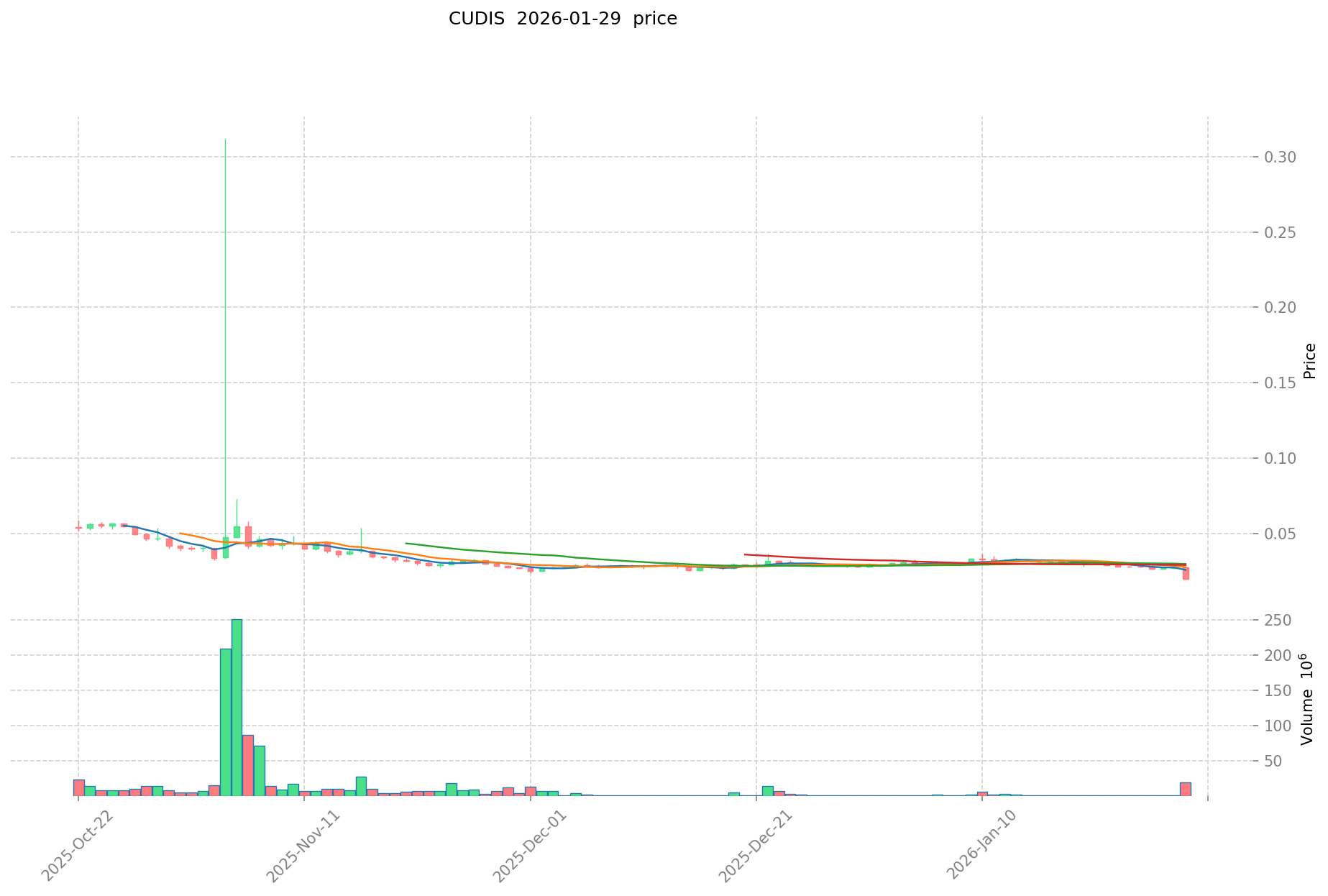
- November 2025: Price reached $0.31204 → Market showed early momentum during initial trading phase
- January 2026: Price declined to around $0.01921 → Experienced significant volatility in early trading months
Current CUDIS Investment Market Status (January 2026)
- CUDIS current price: $0.01988
- Market sentiment (Fear & Greed Index): Data not available in provided materials
- 24-hour trading volume: $421,810.08
- Institutional investor holdings: Approximately 19,033 holders recorded
Click to view real-time CUDIS market price
II. Core Factors Influencing Whether CUDIS is a Good Investment
Supply Mechanism and Scarcity (CUDIS investment scarcity)
- Supply structure: Total supply of 1,000,000,000 CUDIS with circulating supply of 247,500,000 tokens (24.75% of total) → impacts price dynamics and investment valuation
- Market capitalization-to-fully diluted valuation ratio stands at 24.75%, indicating significant token unlock potential that may affect future price movements
- Investment significance: The controlled circulating supply relative to maximum supply represents a fundamental factor in assessing long-term scarcity dynamics
Institutional Investment and Mainstream Adoption (Institutional investment in CUDIS)
- Holder distribution: The project has attracted 19,033 token holders, reflecting growing community participation
- Multi-chain deployment strategy: CUDIS maintains contract presence on both BSC (BEP-20 standard) and Solana networks, expanding accessibility across different blockchain ecosystems
- Partnership-driven ecosystem: CUDIS is collaborating with global partners to build a longevity ecosystem through products, programs, and services, which may influence adoption trajectory
Macroeconomic Environment's Impact on CUDIS Investment
- Market positioning: CUDIS operates within the health and wellness sector of the crypto market, with 0.00062% market dominance, positioning it as an emerging asset in a specialized niche
- Trading availability: Listed on 19 exchanges with 24-hour trading volume of $421,810.08, providing liquidity considerations for investment decisions
- Price volatility context: Recent performance shows -27.59% change over 24 hours and -31.33% over 7 days, reflecting sensitivity to broader market conditions and sector-specific dynamics
Technology and Ecosystem Development (Technology & Ecosystem for CUDIS investment)
- Product integration: The protocol combines CUDIS Ring hardware, AI-powered Longevity Hub, and blockchain-driven Super App to create a comprehensive health data management system
- User value proposition: The ecosystem provides users with data ownership, real-time longevity insights, and economic incentives for health optimization activities
- Long-term vision: The project's goal of extending health-span to 140 years represents an ambitious framework that may influence long-term value perception and ecosystem development potential
III. CUDIS Future Investment Forecast and Price Outlook (Is CUDIS Worth Investing in 2026-2031)
Short-term Investment Outlook (2026, short-term CUDIS investment outlook)
- Conservative forecast: $0.0145 - $0.0198
- Neutral forecast: $0.0198 - $0.0260
- Optimistic forecast: $0.0260 - $0.0312
Mid-term Investment Outlook (2027-2028, mid-term CUDIS investment forecast)
-
Market phase expectation: CUDIS may experience moderate fluctuations as the longevity protocol gains traction and partnerships expand. The integration of CUDIS Ring, AI-powered Longevity Hub, and blockchain-driven Super App could gradually attract more users seeking health data ownership and economic incentives.
-
Investment return forecast:
- 2027: $0.0218 - $0.0338
- 2028: $0.0227 - $0.0339
-
Key catalysts: Expansion of ecosystem partnerships, user adoption of CUDIS Ring and related health tracking products, regulatory clarity in blockchain-based health data management, and broader recognition of longevity-focused protocols.
Long-term Investment Outlook (Is CUDIS a good long-term investment?)
- Baseline scenario: $0.0239 - $0.0332 (assuming steady ecosystem development and moderate user base growth)
- Optimistic scenario: $0.0310 - $0.0396 (assuming accelerated adoption of longevity products, successful AI-driven health insights, and favorable market conditions)
- Risk scenario: $0.0171 - $0.0270 (considering potential market downturns, slower-than-expected adoption, or regulatory challenges)
Click to view CUDIS long-term investment and price forecast: Price Prediction
2026-01-29 - 2031 Long-term Outlook
- Baseline scenario: $0.0239 - $0.0332 (corresponding to steady progress and gradual mainstream application enhancement)
- Optimistic scenario: $0.0310 - $0.0396 (corresponding to large-scale adoption and favorable market environment)
- Transformative scenario: Above $0.0396 (if the ecosystem achieves breakthrough progress and mainstream popularization)
- 2031-12-31 forecast high: $0.0396 (based on optimistic development assumptions)
Disclaimer: The above forecasts are based on historical data, market analysis, and predictive models. Cryptocurrency markets are highly volatile, and actual prices may differ significantly from projections. Investors should conduct independent research and consider their own risk tolerance before making investment decisions. This content does not constitute investment advice.
| Year |
Predicted High Price |
Predicted Average Price |
Predicted Low Price |
Price Change |
| 2026 |
0.0260035 |
0.01985 |
0.0144905 |
0 |
| 2027 |
0.02476089 |
0.02292675 |
0.0217804125 |
15 |
| 2028 |
0.0338582244 |
0.02384382 |
0.022651629 |
19 |
| 2029 |
0.03317867553 |
0.0288510222 |
0.023946348426 |
45 |
| 2030 |
0.0365975216607 |
0.031014848865 |
0.01705816687575 |
56 |
| 2031 |
0.039553236757534 |
0.03380618526285 |
0.02704494821028 |
70 |
IV. CUDIS Investment Strategy and Risk Management (How to invest in CUDIS)
Investment Methodology (CUDIS investment strategy)
Long-term Holding (HODL CUDIS)
Long-term holding may be suitable for conservative investors who believe in CUDIS's longevity protocol vision. This approach involves purchasing CUDIS tokens and maintaining positions through market fluctuations, focusing on the project's long-term development rather than short-term price movements. Given CUDIS's goal of building a longevity ecosystem with AI-powered health tracking and blockchain integration, investors adopting this strategy would align with the project's extended timeline for ecosystem development.
Active Trading
Active trading strategies rely on technical analysis and swing trading opportunities. With CUDIS showing notable price volatility (24-hour change of -27.59%, 7-day change of -31.33%), traders may identify entry and exit points based on technical indicators and market patterns. The token's trading activity across 19 exchanges provides liquidity for active trading approaches, though investors should note the significant price fluctuations between the high and low points.
Risk Management (Risk management for CUDIS investment)
Asset Allocation Ratios
- Conservative investors: May consider allocating a small percentage (1-3%) of their crypto portfolio to CUDIS, given the project's early stage and price volatility
- Aggressive investors: Could potentially allocate a moderate portion (5-10%) of their crypto holdings, accepting higher risk for potential returns
- Professional investors: May conduct thorough due diligence and adjust allocation based on comprehensive risk assessment and portfolio strategy
Risk Hedging Solutions
Investors might consider implementing multi-asset portfolio strategies, combining CUDIS with other digital assets to diversify exposure. Portfolio construction could include established cryptocurrencies alongside emerging tokens to balance risk profiles. Additionally, investors may consider hedging tools available in crypto markets, though specific instruments should be evaluated based on individual risk tolerance and investment objectives.
Secure Storage
Cold and Hot Wallet Solutions: CUDIS tokens are deployed on BSC (contract: 0xc1353d3ee02fdbd4f65f92eee543cfd709049cb1) and Solana (contract: CudisfkgWvMKnZ3TWf6iCuHm8pN2ikXhDcWytwz6f6RN) networks. Investors should consider:
- Hot wallets: For active trading and frequent transactions, compatible wallets supporting BSC and Solana networks
- Cold wallets: For long-term storage, hardware wallet solutions that support BEP-20 and Solana tokens
- Hardware wallet recommendations: Devices compatible with BSC and Solana blockchains, providing offline storage for enhanced security
V. CUDIS Investment Risks and Challenges (Risks of investing in CUDIS)
Market Risks
High Volatility: CUDIS has demonstrated significant price fluctuations, with recent data showing a 24-hour decline of 27.59% and 7-day decline of 31.33%. The token's price has experienced substantial movement since its publication in February 2025, with current trading at $0.01988 compared to a historical high of $0.31204 in November 2025. Such volatility presents both opportunities and risks for investors.
Price Manipulation Concerns: With a relatively modest market capitalization of approximately $4.92 million and circulating supply of 247.5 million tokens (24.75% of total supply), the token may be susceptible to price movements from large holders or concentrated trading activity. The holder count of 19,033 indicates a developing user base that may evolve as the ecosystem expands.
Regulatory Risks
Policy Uncertainty Across Jurisdictions: As a blockchain-based health and longevity protocol, CUDIS operates at the intersection of cryptocurrency, health data, and personal wellness sectors. Different countries maintain varying regulatory frameworks for cryptocurrencies, health data management, and blockchain applications. Investors should consider that regulatory developments in any of these areas could impact the project's operations and token utility.
Technical Risks
Network Security Vulnerabilities: CUDIS operates on both BSC and Solana networks, inheriting the security characteristics and potential vulnerabilities of these blockchain platforms. Smart contract risks, network congestion, or security incidents on either chain could affect token functionality and user confidence.
Technology Integration Challenges: The project's vision involves integrating CUDIS Ring hardware, AI-powered Longevity Hub, and blockchain-driven Super App. The successful execution of this multi-component ecosystem involves technical complexity, including hardware manufacturing, AI algorithm development, data privacy implementation, and blockchain integration. Delays or complications in any component could impact the overall project development.
VI. Conclusion: Is CUDIS a Good Investment?
Investment Value Summary
CUDIS presents a unique proposition in the intersection of blockchain technology and longevity science, aiming to create a protocol for health-span extension to 140 years. The project's approach to combining wearable technology, AI-powered insights, and blockchain-based incentives addresses an emerging sector at the convergence of health technology and decentralized systems. However, the token has experienced significant price volatility, with current trading levels considerably below previous highs, and the project remains in its developmental phase with 24.75% of total supply currently circulating.
Investor Recommendations
✅ Beginners: Consider dollar-cost averaging approach with small, regular investments rather than lump-sum purchases, combined with secure wallet storage using hardware solutions compatible with BSC and Solana networks. Focus on understanding the project fundamentals and blockchain basics before committing significant capital.
✅ Experienced Investors: May explore swing trading opportunities given the token's volatility patterns, while maintaining a diversified portfolio that includes CUDIS as part of a broader crypto allocation. Active monitoring of project developments, partnership announcements, and ecosystem growth metrics could inform trading decisions.
✅ Institutional Investors: Could consider strategic evaluation of CUDIS within the context of emerging health technology and blockchain convergence sectors, conducting comprehensive due diligence on the team, technology roadmap, and competitive positioning before potential long-term allocation.
⚠️ Disclaimer: Cryptocurrency investments involve substantial risk, including the potential loss of principal. Price volatility, regulatory uncertainty, and project execution risks are particularly relevant for early-stage tokens. This content is provided for informational purposes only and does not constitute investment advice. Investors should conduct independent research and consult with qualified financial advisors before making investment decisions.
VII. FAQ
Q1: What is CUDIS and how does it combine blockchain with longevity science?
CUDIS is a blockchain-based protocol that rewards users for health optimization activities and aims to extend human health-span to 140 years. The project integrates three core components: the CUDIS Ring (wearable hardware for health tracking), an AI-powered Longevity Hub (providing real-time health insights), and a blockchain-driven Super App (facilitating data ownership and economic incentives). By leveraging blockchain technology on both BSC and Solana networks, CUDIS creates a decentralized ecosystem where users maintain control over their health data while earning rewards for engaging in longevity-focused behaviors. The protocol's architecture allows individuals to track health metrics, receive AI-driven recommendations, and participate in an economic system designed to incentivize wellness activities.
Q2: How has CUDIS performed since its launch in early 2025?
CUDIS experienced significant price volatility since its publication in February 2025, reaching a peak of $0.31204 in November 2025 before declining to approximately $0.01988 as of January 29, 2026. The token has demonstrated notable fluctuations, with recent data showing a 24-hour decline of 27.59% and a 7-day decline of 31.33%. This volatility reflects the token's early-stage market dynamics, with a current market capitalization of approximately $4.92 million and a circulating supply of 247.5 million tokens (24.75% of total supply). The token maintains trading activity across 19 exchanges with a 24-hour trading volume of $421,810.08 and has attracted approximately 19,033 holders since launch.
Q3: What are the main investment risks associated with CUDIS?
CUDIS presents several key risk factors for investors. Market risks include high price volatility, as evidenced by recent significant price declines and the token trading substantially below its November 2025 high. With a relatively modest market capitalization of $4.92 million, the token may be susceptible to price manipulation from large holders or concentrated trading activity. Regulatory risks stem from the project's position at the intersection of cryptocurrency, health data, and wellness sectors, where policy frameworks vary significantly across jurisdictions. Technical risks involve the complexity of integrating hardware devices, AI algorithms, and blockchain infrastructure across BSC and Solana networks. Additionally, with only 24.75% of tokens currently in circulation, future token unlocks could create selling pressure that impacts price dynamics.
Q4: What investment strategies are suitable for different types of CUDIS investors?
Investment approaches vary based on investor experience and risk tolerance. Beginners should consider a dollar-cost averaging strategy with small, regular purchases rather than lump-sum investments, focusing on understanding project fundamentals before committing significant capital. Hardware wallet storage compatible with BSC and Solana networks is essential for security. Experienced investors may explore active trading opportunities given the token's volatility patterns, with allocation recommendations ranging from 1-3% for conservative portfolios to 5-10% for aggressive strategies. Swing trading based on technical indicators could be suitable given the price fluctuations across 19 exchanges. Institutional investors should conduct comprehensive due diligence on team credentials, technology roadmap, and competitive positioning within the health technology and blockchain convergence sector before considering strategic allocation.
Q5: How does CUDIS's tokenomics and supply structure impact its investment potential?
CUDIS maintains a total supply of 1,000,000,000 tokens with 247,500,000 currently circulating (24.75% of maximum supply). This supply structure presents both opportunities and considerations for investors. The controlled circulating supply relative to maximum supply creates a fundamental scarcity dynamic, though the significant percentage of tokens yet to enter circulation (75.25%) represents potential selling pressure in future unlock events. The market capitalization-to-fully diluted valuation ratio of 24.75% indicates substantial token unlock potential that may affect price movements. The distribution across 19,033 holders reflects growing community participation but also suggests concentration risks. Investors should monitor token release schedules and vesting timelines, as these supply dynamics will influence price behavior as the project matures.
Q6: What factors could drive CUDIS adoption and price appreciation in the mid to long term?
Several catalysts could influence CUDIS's trajectory through 2026-2031. Ecosystem expansion through global partnerships to build longevity-focused products, programs, and services represents a key driver for adoption. Successful integration and market acceptance of CUDIS Ring hardware and related health tracking products could expand the user base beyond current holder counts. Regulatory clarity in blockchain-based health data management across major jurisdictions would reduce uncertainty and potentially facilitate broader adoption. Advances in AI-driven health insights and demonstrated value proposition for users seeking data ownership and health optimization incentives could strengthen network effects. Additionally, favorable macroeconomic conditions in cryptocurrency markets and growing recognition of longevity-focused protocols within the broader health technology sector may support long-term price appreciation.
Q7: Where can investors trade CUDIS and what are the liquidity considerations?
CUDIS is available for trading across 19 cryptocurrency exchanges, providing multiple access points for investors. The token operates on two blockchain networks with specific contract addresses: BSC (BEP-20 standard: 0xc1353d3ee02fdbd4f65f92eee543cfd709049cb1) and Solana (contract: CudisfkgWvMKnZ3TWf6iCuHm8pN2ikXhDcWytwz6f6RN). As of January 29, 2026, the 24-hour trading volume stands at $421,810.08, which investors should evaluate relative to their position sizes to assess liquidity adequacy. The multi-chain deployment expands accessibility across different blockchain ecosystems, though investors should consider gas fees and network characteristics when choosing which chain to use for trading or holding. For long-term storage, hardware wallets compatible with both BSC and Solana networks provide enhanced security compared to exchange custody.
Q8: What distinguishes CUDIS from other health and wellness blockchain projects?
CUDIS differentiates itself through its comprehensive integration of hardware, AI, and blockchain components focused specifically on longevity science. Unlike many blockchain projects that focus solely on data management or token incentives, CUDIS combines the CUDIS Ring wearable device for direct health data collection with an AI-powered Longevity Hub that provides real-time insights and a blockchain-driven Super App for data ownership and economic participation. The project's ambitious goal of extending health-span to 140 years represents a long-term vision that extends beyond typical wellness applications. The dual-chain strategy on BSC and Solana networks provides technical flexibility and broader ecosystem access. However, with a market ranking of 1541 and 0.00062% market dominance, CUDIS occupies a specialized niche within the crypto market, positioning it as an emerging project in the health technology and blockchain convergence space.
* The information is not intended to be and does not constitute financial advice or any other recommendation of any sort offered or endorsed by Gate.