This comprehensive analysis examines whether Curve (CRV) represents a sound investment opportunity through 2031. Currently ranked 116th with a market cap of $638.47 million and trading at $0.4352, CRV operates as a specialized decentralized exchange optimizing stablecoin trading with low slippage and fees. The article evaluates critical investment factors including CRV's token supply dynamics (48.41% circulating of maximum supply), institutional adoption across 58 Gate and other exchanges, and DeFi ecosystem integration. Price projections span conservative ($0.26-$0.44) to optimistic ($0.51-$0.59) scenarios for 2026, with long-term baseline predictions reaching $0.69-$0.82 by 2031. Investment strategies accommodate diverse risk profiles from conservative dollar-cost averaging to active trading, while comprehensive risk analysis addresses market volatility (-46.32% annually), regulatory uncertainty, and technical vulnerabilities. Suitable for investors seeking DeFi exposure with differentiated protocol fundame
Introduction: Curve (CRV)'s Investment Position and Market Outlook
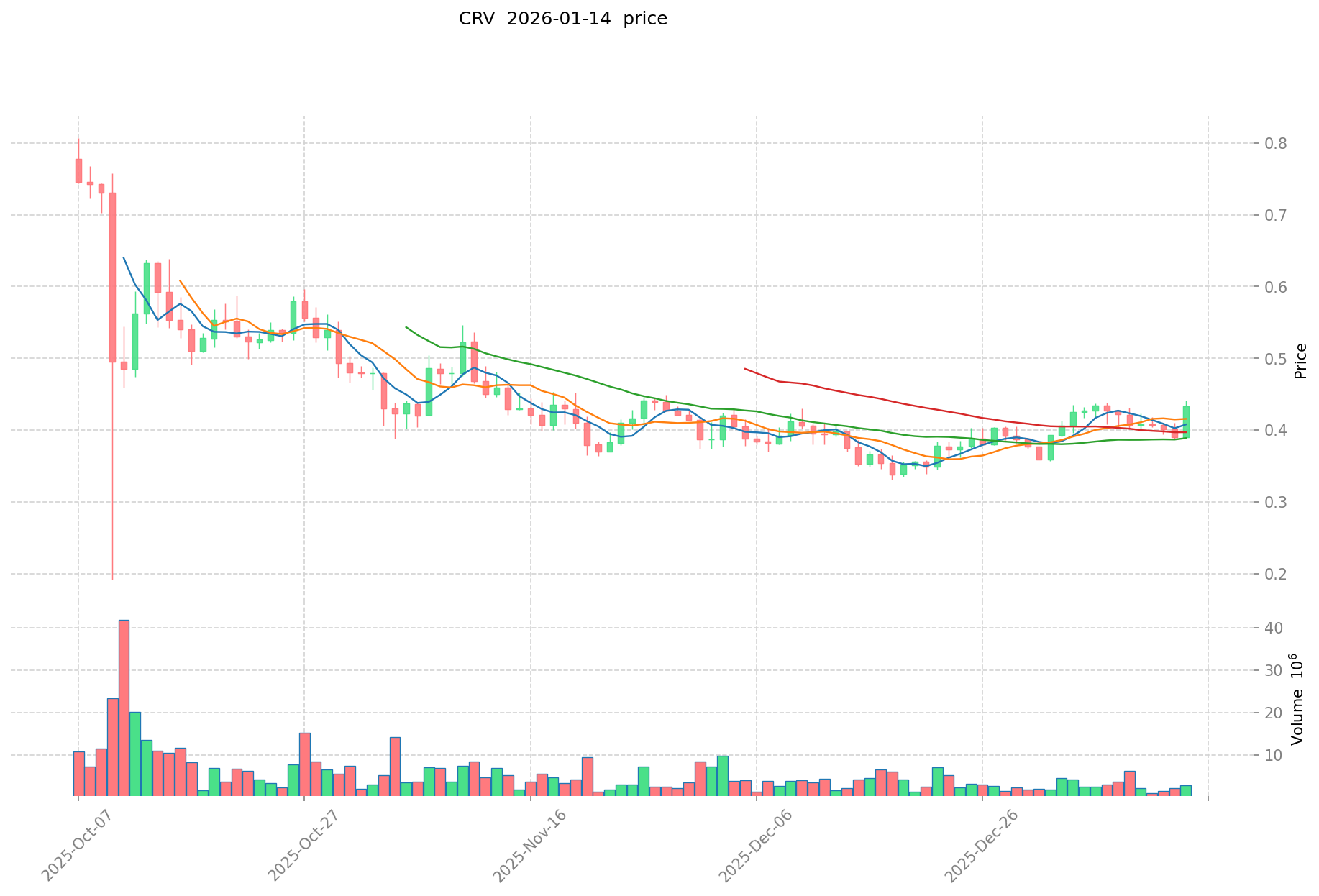
CRV is a significant asset in the cryptocurrency domain, launched in 2020 as part of the decentralized finance (DeFi) ecosystem. As of January 2026, Curve holds a market ranking of 116 with a market capitalization of approximately $638.47 million and a circulating supply of 1.47 billion tokens. The current price stands at around $0.4352. As a decentralized liquidity pool exchange on Ethereum, Curve has established itself as a platform for stablecoin trading with low slippage and transaction fees. With its integration of DeFi protocols and automated exchange mechanisms, CRV has become a subject of interest when investors discuss "Is Curve (CRV) a good investment?" This article provides a comprehensive analysis of CRV's investment value, historical performance, future price projections, and associated risks to serve as a reference for investors.
I. Curve (CRV) Price History Review and Current Investment Value
- 2020: Curve launched in January 2020 as a decentralized exchange focused on stablecoin trading. CRV token was published in August 2020 at an initial price of $13, reaching notable price levels during its early months
- 2020-2024: The token experienced significant price movements, with valuations fluctuating between different market cycles. Price variations reflected broader cryptocurrency market trends and platform adoption rates
- Recent Period: Market data shows price movements with the token trading within a range that demonstrates ongoing market participation and liquidity dynamics
Current Investment Market Status (January 2026)
- Current CRV Price: $0.4352
- 24-Hour Trading Volume: $1,624,235.25
- Market Capitalization: $638,472,930.51
- Circulating Supply: 1,467,079,344 CRV (48.41% of total supply)
- Price Changes: +0.35% (1H), +6.08% (24H), +4.08% (7D), +13.99% (30D), -46.32% (1Y)
- 24-Hour Price Range: $0.4096 - $0.4413
- Number of Token Holders: 97,221
- Listed Exchanges: 58 platforms
View real-time CRV market price
II. Core Factors Affecting Whether CRV Is a Good Investment
Supply Mechanism and Scarcity (CRV Investment Scarcity)
- Circulating Supply vs. Maximum Supply: CRV currently has a circulating supply of 1,467,079,344 tokens, representing approximately 48.41% of its maximum supply of 3,030,303,031 tokens. The total supply stands at 2,341,760,702 tokens, indicating a gradual release mechanism that may influence long-term scarcity.
- Token Emission Schedule: The structured release of CRV tokens over time creates a predictable inflation model. As more tokens enter circulation, the rate of new supply growth may impact market dynamics and investor expectations.
- Investment Implications: The limited maximum supply establishes a ceiling on total token availability. The current market cap to fully diluted valuation ratio of 48.41% suggests significant future dilution potential, which investors should consider when evaluating long-term value.
Institutional Investment and Mainstream Adoption (Institutional Investment in CRV)
- Holder Distribution: CRV has approximately 97,221 token holders, indicating a relatively broad distribution across the DeFi community. This holder base reflects the protocol's integration within decentralized finance infrastructure.
- Exchange Availability: CRV is listed on 58 exchanges, providing substantial liquidity access points. The token's availability across multiple platforms supports market depth and trading accessibility.
- DeFi Integration: Curve Finance's connections with protocols such as iearn and Compound demonstrate its embedded role within the DeFi ecosystem. These integrations provide yield opportunities for liquidity providers, which may influence institutional participation in the protocol.
Macroeconomic Environment Impact on CRV Investment
- DeFi Market Conditions: CRV's performance correlates with broader DeFi adoption trends. Shifts in decentralized exchange volume, stablecoin usage, and liquidity provision activity can affect CRV's utility and market value.
- Stablecoin Trading Demand: As a protocol specializing in efficient stablecoin exchanges with low slippage and fees, Curve's value proposition strengthens during periods of increased stablecoin trading activity.
- Regulatory Environment: Policy developments affecting DeFi protocols, stablecoin regulations, and decentralized governance structures may influence investor sentiment toward CRV and similar governance tokens.
Technology and Ecosystem Development (Technology & Ecosystem for CRV Investment)
- Protocol Efficiency: Curve's algorithmic design enables low-slippage stablecoin trading, addressing a specific market need within DeFi. The protocol's technical infrastructure supports its competitive positioning among decentralized exchanges.
- Liquidity Provider Incentives: The protocol's fee capture mechanism allows liquidity providers to earn trading fees. Integration with yield-generating protocols like iearn and Compound provides additional return opportunities, which may attract capital to Curve pools.
- Governance Functionality: CRV serves as a governance token, enabling holders to participate in protocol decision-making. This utility component adds a dimension beyond speculative value, though governance participation rates vary across token holders.
- Multi-Chain Considerations: CRV is deployed on the Ethereum network (contract address: 0xD533a949740bb3306d119CC777fa900bA034cd52). The protocol's current single-chain implementation focuses its liquidity and activity within the Ethereum ecosystem.
III. CRV Future Investment Predictions and Price Outlook (Is Curve(CRV) worth investing in 2026-2031)
Short-term Investment Prediction (2026, short-term CRV investment outlook)
- Conservative prediction: $0.26 - $0.44
- Neutral prediction: $0.44 - $0.51
- Optimistic prediction: $0.51 - $0.59
Mid-term Investment Outlook (2027-2029, mid-term Curve(CRV) investment forecast)
- Market stage expectation: CRV may experience gradual growth during this period, potentially driven by increased DeFi adoption and platform development.
- Investment return prediction:
- 2027: $0.35 - $0.75
- 2028: $0.56 - $0.93
- 2029: $0.61 - $0.85
- Key catalysts: Expansion of liquidity pools, protocol upgrades, and broader integration within the DeFi ecosystem.
Long-term Investment Outlook (Is CRV a good long-term investment?)
- Baseline scenario: $0.69 - $0.82 (assuming steady protocol development and stable market conditions)
- Optimistic scenario: $0.94 - $1.06 (assuming accelerated DeFi adoption and favorable regulatory environment)
- Risk scenario: Below $0.26 (under adverse market conditions or significant competitive pressures)
Click to view CRV long-term investment and price prediction: Price Prediction
2026-01-14 - 2031 Long-term Outlook
- Baseline scenario: $0.75 - $0.94 (corresponding to steady progress and gradual mainstream application growth)
- Optimistic scenario: $1.00 - $1.31 (corresponding to large-scale adoption and favorable market environment)
- Transformative scenario: Above $1.50 (if the ecosystem achieves breakthrough developments and mainstream popularization)
- 2031-12-31 predicted high: $1.06 (based on optimistic development assumptions)
Disclaimer: These predictions are based on statistical models and historical data analysis. Actual results may vary significantly due to market volatility, regulatory changes, technological developments, and broader economic conditions. This information should not be construed as financial or investment advice. Past performance does not guarantee future results.
| Year |
Predicted High Price |
Predicted Average Price |
Predicted Low Price |
Price Change |
| 2026 |
0.591872 |
0.4352 |
0.26112 |
0 |
| 2027 |
0.74976256 |
0.513536 |
0.35433984 |
18 |
| 2028 |
0.9348409344 |
0.63164928 |
0.5558513664 |
45 |
| 2029 |
0.853737166848 |
0.7832451072 |
0.610931183616 |
79 |
| 2030 |
1.05585356676096 |
0.818491137024 |
0.68753255510016 |
88 |
| 2031 |
0.984030969487104 |
0.93717235189248 |
0.749737881513984 |
115 |
IV. CRV Investment Strategy and Risk Management (How to invest in Curve)
Investment Methodology (CRV investment strategy)
-
Long-term Holding (HODL CRV): This approach suits conservative investors who believe in Curve's protocol fundamentals and decentralized exchange model. Investors may accumulate CRV tokens during market corrections and hold through market cycles, potentially benefiting from protocol growth and DeFi adoption over time.
-
Active Trading: This strategy relies on technical analysis and swing trading opportunities. Traders may leverage CRV's price movements, which have shown volatility with a 24-hour change of 6.08% and a 7-day change of 4.08%. This approach requires continuous market monitoring and understanding of support and resistance levels.
Risk Management (Risk management for CRV investment)
-
Asset Allocation Ratio:
- Conservative investors: Allocate 1-3% of crypto portfolio to CRV
- Moderate investors: Allocate 3-7% of crypto portfolio to CRV
- Aggressive investors: May allocate higher percentages, but should maintain overall portfolio diversification
-
Risk Hedging Solutions: Investors should consider multi-asset portfolio construction, combining CRV with other cryptocurrencies and traditional assets. Hedging tools such as stablecoins can provide liquidity buffers during market downturns. Given CRV's current circulating supply of 1,467,079,344 tokens (representing 48.41% of total supply), investors should monitor token unlock schedules.
-
Secure Storage:
- Cold wallets: Recommended for long-term holdings to minimize exposure to online threats
- Hot wallets: Suitable for active trading but maintain only necessary amounts
- Hardware wallets: Industry-standard devices provide enhanced security for CRV storage
- Note: CRV is an ERC-20 token (contract address: 0xD533a949740bb3306d119CC777fa900bA034cd52), compatible with Ethereum-supporting wallets
V. CRV Investment Risks and Challenges (Risks of investing in Curve)
-
Market Risk: CRV exhibits considerable price volatility, with a 1-year change of -46.32%. The token has experienced substantial fluctuations, ranging from its historical low of $0.180354 to its historical high of $15.37. Current market capitalization stands at approximately $638.47 million, indicating potential for significant price swings. Investors should be prepared for periods of heightened volatility and potential drawdowns.
-
Regulatory Risk: Decentralized exchanges and DeFi protocols face evolving regulatory frameworks across jurisdictions. Policy changes regarding cryptocurrency trading, liquidity pools, and decentralized finance may impact Curve's operations and CRV's value proposition. Different countries maintain varying stances on DeFi protocols, creating uncertainty for global investors.
-
Technical Risk: Smart contract vulnerabilities pose inherent risks to DeFi protocols. While Curve has been operational since January 2020, potential security issues in protocol upgrades or integrations with other DeFi protocols (such as existing integrations) could affect the platform. Network congestion on Ethereum, the underlying blockchain, may lead to increased transaction costs and reduced user experience. Protocol upgrades or changes to tokenomics could also introduce unforeseen technical challenges.
VI. Conclusion: Is Curve a Good Investment?
-
Investment Value Summary: CRV represents exposure to a established decentralized exchange protocol specializing in stablecoin trading with low slippage and fees. The protocol's market position in the DeFi ecosystem and its liquidity provision mechanisms offer potential value. However, the token has experienced substantial price fluctuations, with a notable decline over the past year. Market capitalization of $638.47 million and trading volume of $1.62 million indicate active market participation, though investors should recognize the inherent volatility.
-
Investor Recommendations:
✅ Beginners: Consider dollar-cost averaging (DCA) strategies to mitigate timing risk, combined with secure wallet storage using hardware wallets or reputable cold storage solutions. Start with small allocations to understand protocol mechanics and market dynamics.
✅ Experienced Investors: May explore swing trading opportunities based on technical analysis, while maintaining diversified portfolio positions. Consider monitoring protocol developments, liquidity trends, and DeFi ecosystem growth.
✅ Institutional Investors: Could evaluate strategic long-term allocation as part of broader DeFi exposure, conducting thorough due diligence on protocol security, governance mechanisms, and competitive positioning.
⚠️ Disclaimer: Cryptocurrency investments carry substantial risk due to market volatility, regulatory uncertainty, and technical complexities. This content is provided for informational purposes only and does not constitute investment advice. Investors should conduct independent research and consult with qualified financial advisors before making investment decisions.
VII. FAQ
Q1: What is the current market position of Curve (CRV) and its key metrics?
As of January 2026, CRV holds a market ranking of 116 with a market capitalization of approximately $638.47 million. The token is priced at around $0.4352 with a 24-hour trading volume of $1,624,235.25. CRV has a circulating supply of 1,467,079,344 tokens (48.41% of maximum supply) and is held by 97,221 addresses across 58 exchanges. The token has shown recent positive momentum with gains of 6.08% (24H), 4.08% (7D), and 13.99% (30D), though it experienced a -46.32% decline over the past year.
Q2: What are the primary factors that could influence CRV's investment value?
CRV's investment value is influenced by several core factors: (1) Supply dynamics - with only 48.41% of maximum supply currently circulating, future token emissions may impact scarcity; (2) DeFi ecosystem integration - Curve's connections with protocols like iearn and Compound enhance utility; (3) Stablecoin trading demand - as Curve specializes in efficient stablecoin exchanges, increased stablecoin activity benefits the protocol; (4) Regulatory developments affecting DeFi protocols; and (5) Protocol technical improvements and liquidity provider incentives that attract capital to Curve pools.
Q3: What are the price predictions for CRV from 2026 to 2031?
Short-term predictions for 2026 range from $0.26-$0.59 depending on market conditions. Mid-term forecasts show gradual growth: 2027 ($0.35-$0.75), 2028 ($0.56-$0.93), and 2029 ($0.61-$0.85). Long-term baseline scenario for 2031 projects $0.69-$0.82, while optimistic scenarios suggest $0.94-$1.06 or higher if DeFi adoption accelerates. The predicted high for 2031 stands at $1.06. However, these predictions are statistical models based on historical data and may vary significantly due to market volatility, regulatory changes, and technological developments.
Q4: What investment strategies are suitable for different types of CRV investors?
Conservative investors should consider long-term holding (HODL) with 1-3% portfolio allocation, focusing on accumulation during market corrections. Moderate investors may allocate 3-7% of their crypto portfolio and combine holding with selective trading opportunities. Aggressive investors can pursue active trading strategies leveraging CRV's volatility (recent 24H change of 6.08%), though higher allocations require robust risk management. All investors should use secure storage solutions: cold wallets for long-term holdings, hardware wallets for enhanced security, and maintain only necessary amounts in hot wallets for active trading.
Q5: What are the major risks associated with investing in Curve (CRV)?
CRV investment carries three primary risk categories: (1) Market Risk - substantial price volatility evidenced by a -46.32% annual decline and historical price range from $0.180354 to $15.37, indicating potential for significant drawdowns; (2) Regulatory Risk - evolving DeFi regulations across jurisdictions may impact Curve's operations and token value; (3) Technical Risk - smart contract vulnerabilities, potential security issues in protocol upgrades, Ethereum network congestion affecting transaction costs, and risks from integrations with other DeFi protocols. Investors should conduct thorough due diligence and maintain diversified portfolios.
Q6: How does CRV's token supply mechanism affect its long-term investment potential?
CRV operates with a structured emission schedule where the current circulating supply of 1,467,079,344 tokens represents only 48.41% of the maximum supply of 3,030,303,031 tokens. This means significant future dilution potential exists as approximately 863,680,358 additional tokens (51.59%) will gradually enter circulation. While the limited maximum supply establishes a ceiling on total availability, the predictable inflation model through token releases may create downward pressure on price if demand doesn't keep pace with new supply. Investors should monitor token unlock schedules and consider this dilution factor when evaluating long-term value propositions.
Q7: What makes Curve Finance's protocol unique in the DeFi ecosystem?
Curve Finance distinguishes itself through specialized algorithmic design for low-slippage stablecoin trading, addressing a specific market need within DeFi. The protocol enables efficient stablecoin exchanges with minimal fees, making it attractive for large-volume stablecoin transactions. Additionally, Curve offers liquidity providers the opportunity to earn trading fees while integrating with yield-generating protocols like iearn and Compound for additional returns. CRV tokens serve dual purposes as both governance tokens enabling protocol decision-making and as utility tokens within the ecosystem. The protocol's focus on stablecoin efficiency and its established position since January 2020 contribute to its competitive positioning among decentralized exchanges.
Q8: What security measures should investors take when holding CRV tokens?
Given that CRV is an ERC-20 token (contract address: 0xD533a949740bb3306d119CC777fa900bA034cd52), investors should implement comprehensive security practices. For long-term holdings, cold wallets or hardware wallets (industry-standard devices) provide maximum security by keeping private keys offline and minimizing exposure to online threats. Hot wallets are acceptable for active trading but should only contain amounts necessary for immediate transactions. Investors should verify wallet compatibility with Ethereum-supporting infrastructure, enable two-factor authentication where available, maintain secure backup phrases, and never share private keys. Regular security audits of storage methods and staying informed about potential smart contract vulnerabilities affecting the Curve protocol are also recommended practices.
* The information is not intended to be and does not constitute financial advice or any other recommendation of any sort offered or endorsed by Gate.