This comprehensive guide evaluates whether Dash (DASH) represents a sound investment opportunity in 2026 and beyond. As of January 2026, Dash trades at $63.93 with a market capitalization of $802.45 million, ranking #101 among cryptocurrencies with approximately 96,521 holders across 34 exchanges. The article analyzes Dash's historical price performance, ranging from an all-time low of $0.2139 to $1,493.59, alongside its technological foundation as a decentralized peer-to-peer payment network emphasizing fast transactions and low fees. Price projections through 2031 span conservative to optimistic scenarios, with 2026 forecasts ranging from $53.88 to $93.82 depending on market conditions. The guide addresses investment strategies for diverse investor profiles, comprehensive risk management approaches including asset allocation guidelines and secure storage solutions, and critical risk factors encompassing market volatility, regulatory uncertainty, and technical considerations. Designed for both new and experi
Introduction: Dash (DASH) Investment Position and Market Outlook
DASH is a significant asset in the cryptocurrency field. Since its launch in 2014, it has achieved notable development in digital payments and peer-to-peer transactions. As of January 2026, Dash holds a market capitalization of approximately $802.45 million, with a circulating supply of around 12.55 million coins, and the current price is maintained at approximately $63.93. With its positioning as "digital cash," Dash has gradually become a focal point for investors discussing "Is Dash (DASH) a good investment?" This article will comprehensively analyze Dash's investment value, historical trends, future price predictions, and investment risks to provide reference for investors.
Dash operates on a decentralized peer-to-peer network secured by cryptography, offering a payment method characterized by security and accessibility. The project emphasizes fast transaction speeds and low transaction fees, making it applicable to online transactions and daily life scenarios. With approximately 96,521 holders and listing on 34 exchanges, Dash has established a certain presence in the market. Its market share stands at 0.023%, ranking 101st among cryptocurrencies. The circulating supply represents approximately 66.34% of the maximum supply of 18.92 million coins.
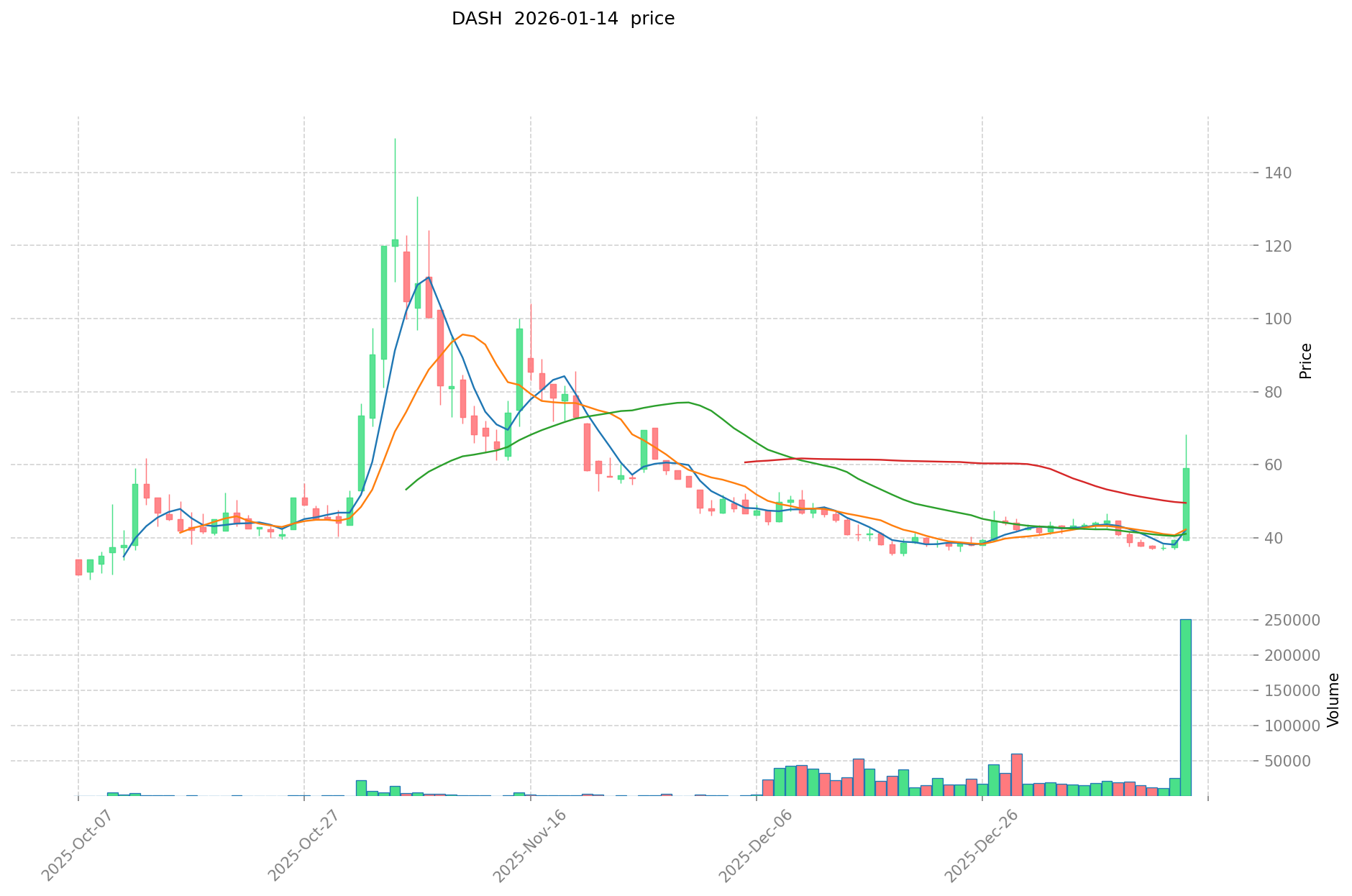
Recent market data shows that DASH has experienced notable price movements, with a 24-hour change of 38.52%, a 7-day change of 47.65%, and a 1-year change of 76.29%. The 24-hour trading volume reached approximately $17.67 million. The all-time high price was recorded at $1,493.59 on December 20, 2017, while the all-time low was $0.2139 on February 14, 2014. Understanding these market dynamics, technical characteristics, and risk factors is essential for evaluating Dash's investment potential in the current cryptocurrency landscape.
I. Dash (DASH) Price History Review and Current Investment Value
- 2017: Price reached over $1,600 during the market boom → Early investors experienced substantial gains
- 2017-2018: Following the peak period → DASH price declined from elevated levels to around $47.26 by December 2018
- 2026-01-14: Current market cycle → DASH trades at approximately $63.93 with 24-hour increase of 38.52%
Current DASH Investment Market Status (January 2026)
- DASH current price: $63.93
- 24-hour trading volume: $17.67 million
- Market capitalization: $802.45 million
- Circulating supply: 12.55 million DASH (66.34% of max supply)
- 30-day price change: +51.4%
- 1-year price change: +76.29%
Click to view real-time DASH market price
II. Core Factors Influencing Whether DASH is a Good Investment
Supply Mechanism and Scarcity (DASH Investment Scarcity)
- Supply structure: Dash has a circulating supply of approximately 12.55 million DASH, representing about 66.34% of its maximum supply of 18.92 million DASH. This controlled supply mechanism influences price dynamics and investment value considerations.
- Historical context: Dash previously reached price levels around $1,493.59 in December 2017, though it has since experienced significant volatility, reflecting how supply dynamics and market conditions interact over time.
- Investment implications: The defined maximum supply cap creates a scarcity element that may support long-term investment considerations, though market conditions and adoption remain critical factors.
Institutional Investment and Mainstream Adoption (Institutional Investment in Dash)
- Market positioning: As of January 2026, Dash ranks 101st by market capitalization at approximately $802.45 million, with a 24-hour trading volume of around $17.67 million, indicating moderate market activity.
- Adoption characteristics: Dash is designed as a payment-focused digital currency with features supporting fast, low-cost transactions. It serves as an alternative to traditional payment methods in various regions, particularly where existing financial systems face technical barriers or where currency stability is a concern.
- Holder base: The network has approximately 96,521 holders and is listed on 34 exchanges, suggesting a distributed user base and reasonable accessibility for investors.
Macroeconomic Environment's Impact on Dash Investment
- Market volatility: Dash experienced substantial price fluctuations in 2025, with a 150% surge from $20 to approximately $50 in June, followed by continued volatility. Such movements reflect sensitivity to broader market sentiment, regulatory developments, and macroeconomic uncertainty.
- Privacy coin positioning: Recent market data indicates increased momentum for privacy-focused cryptocurrencies amid regulatory headlines and macroeconomic uncertainty, which may influence Dash's investment appeal.
- Risk considerations: Like other cryptocurrencies, Dash's price remains affected by market sentiment, regulatory changes, liquidity conditions, and broader economic factors including monetary policy and geopolitical developments.
Technology and Ecosystem Development (Technology & Ecosystem for Dash Investment)
- Technical foundation: Dash operates on a decentralized peer-to-peer network with cryptographic security features. Its governance model and technical infrastructure have been noted by analysts as relatively strong within the privacy coin sector.
- Payment network features: The Dash payment network emphasizes user-oriented design with mobile device integration, supporting low-fee transactions and fast settlement speeds that differentiate it from some traditional payment methods.
- Privacy and efficiency: Dash offers privacy features alongside transaction efficiency, positioning it for use cases in online transactions, daily payments, and international remittances where traditional systems may have limitations.
III. DASH Future Investment Outlook and Price Forecast (Is Dash (DASH) worth investing in 2026-2031)
Short-term Investment Outlook (2026, short-term DASH investment outlook)
Based on available market analysis, Dash is projected to experience varied price movements in 2026:
- Conservative forecast: $53.88 - $63.39
- Neutral forecast: $63.39 - $78.60
- Optimistic forecast: $78.60 - $93.82
Some analysts suggest the price may fluctuate between $145.26 and $435.78 during 2026, with an average around $290.52. However, these projections vary significantly across different sources and should be considered with caution.
Mid-term Investment Outlook (2027-2029, mid-term Dash (DASH) investment forecast)
-
Market stage expectation: Dash is anticipated to enter a period of potential growth driven by continued ecosystem development and broader cryptocurrency market trends.
-
Investment return projections:
- 2027: $74.67 - $106.90 (with an average around $78.60)
- 2028: $78.84 - $105.74 (with an average around $92.75)
- 2029: $62.52 - $132.00 (with an average around $99.24)
-
Key catalysts: Market demand for digital payment solutions, improvements in cryptocurrency infrastructure, ongoing innovation within the Dash ecosystem, and broader adoption of decentralized payment networks may influence price movements during this period.
Analysts from BitcoinWisdom suggest that 2027 prices could range between $87.03 and $97.91, reflecting sustained long-term growth trends.
Long-term Investment Outlook (Is DASH a good long-term investment?)
- Baseline scenario: $61.28 - $123.71 (assuming steady development and moderate market conditions through 2030-2031)
- Optimistic scenario: $119.67 - $153.17 (assuming favorable regulatory environment and increased mainstream adoption)
- Risk scenario: Below $60 (in cases of adverse market conditions or technological setbacks)
For more detailed DASH long-term investment analysis and price predictions, visit: Price Prediction
2026-2031 Extended Outlook
- Baseline scenario: $60 - $120 (corresponding to steady progress and gradual mainstream application growth)
- Optimistic scenario: $120 - $200 (corresponding to large-scale adoption and favorable market conditions)
- Transformative scenario: Above $200 (contingent on breakthrough ecosystem developments and widespread mainstream adoption)
- Projected high point by December 31, 2031: $153.17 (based on optimistic development assumptions)
Disclaimer: These forecasts are based on historical data, market analysis, and various predictive models. Cryptocurrency markets are highly volatile and subject to numerous unpredictable factors including regulatory changes, technological developments, and macroeconomic conditions. Past performance does not guarantee future results. These projections should not be considered as financial advice, and investors should conduct thorough research and consider their risk tolerance before making investment decisions.
| Year |
Predicted High Price |
Predicted Average Price |
Predicted Low Price |
Price Change |
| 2026 |
93.8172 |
63.39 |
53.8815 |
0 |
| 2027 |
106.900896 |
78.6036 |
74.67342 |
22 |
| 2028 |
105.73756272 |
92.752248 |
78.8394108 |
45 |
| 2029 |
131.9957241288 |
99.24490536 |
62.5242903768 |
55 |
| 2030 |
123.713736776508 |
115.6203147444 |
61.278766814532 |
80 |
| 2031 |
153.17379297338112 |
119.667025760454 |
75.39022622908602 |
87 |
IV. Dash Investment Strategy and Risk Management (How to invest in Dash)
Investment Strategy (Dash investment strategy)
Long-term Holding (HODL Dash)
For conservative investors seeking stable exposure to Dash, a long-term holding strategy may be considered. This approach focuses on accumulating positions during market downturns and maintaining holdings through market cycles. Given Dash's established presence since 2014 and its focus on payments infrastructure, investors following this strategy typically view short-term volatility as secondary to the project's long-term development trajectory.
Active Trading
Traders employing active strategies rely on technical analysis and swing trading techniques to capitalize on Dash's price movements. With a 24-hour trading volume of approximately $17.67 million and availability on 34 exchanges as of January 14, 2026, Dash provides sufficient liquidity for various trading strategies. The asset's recent price action shows significant volatility, with a 24-hour range between $45.72 and $68.28, offering potential opportunities for short-term trading approaches.
Risk Management (Risk management for Dash investment)
Asset Allocation Guidelines
- Conservative Investors: May consider limiting Dash exposure to 1-3% of total portfolio value, prioritizing capital preservation
- Moderate Investors: Could allocate 3-7% to Dash as part of a diversified crypto portfolio strategy
- Experienced Investors: Might maintain 7-15% allocation while implementing active risk management protocols
Risk Hedging Approaches
Diversification across multiple digital assets and traditional financial instruments can help manage concentration risk. Investors may consider combining Dash holdings with other cryptocurrency assets that have different risk profiles, as well as maintaining positions in traditional hedging instruments. Regular portfolio rebalancing based on predetermined thresholds can help maintain target allocations despite market volatility.
Secure Storage Solutions
- Hot Wallets: Suitable for active trading amounts, providing convenience for frequent transactions
- Cold Wallets: Recommended for long-term holdings, offering enhanced security through offline storage
- Hardware Wallets: Physical devices that store private keys offline, combining security with reasonable accessibility for periodic transactions
V. Dash Investment Risks and Challenges (Risks of investing in Dash)
Market Risks
Dash exhibits substantial price volatility characteristic of cryptocurrency markets. The asset has experienced a price range from approximately $45.72 to $68.28 within a 24-hour period. Historical data shows the price has fluctuated between an all-time low of $0.213899 (February 14, 2014) and an all-time high of $1493.59 (December 20, 2017). Current trading at $63.93 represents significant deviation from these historical extremes. Market participants should be aware that sudden price movements can occur based on various factors including trading volume changes, market sentiment shifts, and broader cryptocurrency market dynamics.
Regulatory Risks
Cryptocurrency regulatory frameworks vary significantly across jurisdictions and remain subject to ongoing development. Different countries maintain distinct approaches to digital asset classification, taxation, and permissible use cases. Changes in regulatory policies can impact trading access, liquidity, and overall market dynamics for Dash and similar assets. Investors should monitor regulatory developments in their respective jurisdictions and understand that policy shifts may affect asset accessibility and market participation.
Technical Risks
Blockchain networks face various technical considerations including network security maintenance, protocol upgrade implementation, and infrastructure resilience. While Dash operates on an established network that has been active since 2014, all blockchain systems require ongoing development and maintenance. Network upgrades, while potentially beneficial, introduce implementation risks. Security considerations include protecting against various attack vectors and maintaining network integrity. Investors should understand that technical issues, while typically addressed by development teams, can temporarily impact network operations or market perception.
VI. Conclusion: Is Dash a Good Investment?
Investment Value Assessment
Dash presents characteristics of an established digital payment network with a defined market position, currently ranked #101 by market capitalization at approximately $802.45 million. The asset has demonstrated longevity, operating since 2014, and maintains trading presence across 34 exchanges. Price movements show significant volatility, with recent periods showing increases across various timeframes (38.52% over 24 hours, 47.65% over 7 days, 51.4% over 30 days as of January 14, 2026). The circulating supply represents approximately 66.34% of maximum supply, with around 96,521 holders.
Investor Recommendations
✅ New Investors: Consider starting with modest allocations, utilizing dollar-cost averaging approaches, and prioritizing secure storage solutions through reputable wallet providers. Focus on understanding the technology and market dynamics before increasing exposure.
✅ Experienced Investors: May employ swing trading strategies while maintaining core positions, implementing predetermined entry and exit criteria, and utilizing portfolio diversification across multiple digital assets with varying risk profiles.
✅ Institutional Participants: Could evaluate Dash as part of broader digital asset allocation strategies, considering factors such as liquidity requirements, custody solutions, and alignment with institutional investment mandates.
⚠️ Important Notice: Cryptocurrency investments involve substantial risks including potential loss of principal. Market volatility can result in significant value fluctuations over short timeframes. This content provides informational analysis only and does not constitute investment advice, financial guidance, or recommendations to buy, sell, or hold any asset. Individuals should conduct independent research, assess personal risk tolerance, and consult qualified financial advisors before making investment decisions.
VII. FAQ
Q1: What is Dash (DASH) and what makes it different from other cryptocurrencies?
Dash is a decentralized peer-to-peer digital payment network launched in 2014, designed to function as "digital cash" with emphasis on fast transaction speeds and low fees. Unlike many cryptocurrencies, Dash focuses specifically on payment use cases and offers privacy features alongside transaction efficiency. It operates on a cryptographically secured network with approximately 12.55 million DASH in circulation (66.34% of maximum supply of 18.92 million). As of January 2026, Dash maintains a market capitalization of approximately $802.45 million, ranks #101 among cryptocurrencies, and is listed on 34 exchanges with around 96,521 holders.
Q2: How has Dash's price performed historically and what is its current market status?
Dash reached its all-time high of $1,493.59 on December 20, 2017, during the cryptocurrency market boom. Following this peak, the price experienced significant decline to around $47.26 by December 2018. As of January 14, 2026, DASH trades at approximately $63.93, showing notable recent momentum with a 24-hour increase of 38.52%, 7-day increase of 47.65%, and 1-year increase of 76.29%. The 24-hour trading volume stands at approximately $17.67 million. The all-time low was $0.2139 on February 14, 2014, demonstrating the asset's substantial historical volatility.
Q3: What are the price predictions for Dash through 2031?
Price forecasts for Dash vary across different scenarios. For 2026, projections range from $53.88 to $93.82 depending on market conditions. Mid-term forecasts suggest potential ranges of $74.67 to $106.90 for 2027, $78.84 to $105.74 for 2028, and $62.52 to $132.00 for 2029. Long-term projections through 2031 include a baseline scenario of $61.28 to $123.71, an optimistic scenario of $119.67 to $153.17, and a transformative scenario above $200. However, these projections are based on various models and historical data, and cryptocurrency markets remain highly volatile and unpredictable. Past performance does not guarantee future results.
Q4: What are the main risks associated with investing in Dash?
Dash investment involves several key risk categories. Market risks include substantial price volatility, with 24-hour price ranges recently spanning from $45.72 to $68.28. Regulatory risks stem from evolving cryptocurrency frameworks across different jurisdictions, which can impact trading access and market dynamics. Technical risks encompass network security maintenance, protocol upgrade implementation, and infrastructure resilience. Additionally, liquidity considerations, broader cryptocurrency market sentiment, macroeconomic conditions, and competition from other payment-focused digital assets represent ongoing risk factors. Investors should understand that cryptocurrency investments can result in significant loss of principal.
Q5: What investment strategies are suitable for different types of Dash investors?
Investment approaches vary based on investor profiles and objectives. Conservative investors may consider 1-3% portfolio allocation with long-term holding (HODL) strategies, focusing on accumulation during market downturns. Moderate investors could allocate 3-7% within diversified crypto portfolios, potentially combining holding with selective trading. Experienced investors might maintain 7-15% allocation while implementing active risk management and swing trading techniques, utilizing Dash's liquidity across 34 exchanges. All approaches should incorporate secure storage solutions, with hot wallets for active trading amounts and cold or hardware wallets for long-term holdings. Regular portfolio rebalancing and diversification across multiple digital assets can help manage concentration risk.
Q6: How does Dash's supply mechanism affect its investment value?
Dash has a defined maximum supply of 18.92 million DASH, with approximately 12.55 million currently in circulation (66.34% of maximum supply). This controlled supply mechanism creates a scarcity element that may support long-term value considerations. Unlike cryptocurrencies with unlimited or unclear supply models, Dash's capped supply provides predictable issuance dynamics. The remaining 33.66% of supply will be gradually released through the network's reward structure. However, scarcity alone does not determine investment value—adoption rates, technological development, market demand, and broader ecosystem growth remain critical factors influencing price dynamics and overall investment potential.
Q7: What role does Dash play in the digital payments ecosystem?
Dash positions itself as a payment-focused digital currency emphasizing user-oriented design with mobile device integration, fast settlement speeds, and low transaction fees. The network serves as an alternative to traditional payment methods, particularly in regions where existing financial systems face technical barriers or currency stability concerns. Dash's privacy features combined with transaction efficiency make it applicable for online transactions, daily payments, and international remittances. With approximately 96,521 holders and presence on 34 exchanges, Dash has established distributed adoption. However, it faces competition from other payment cryptocurrencies and evolving traditional payment technologies, requiring ongoing development to maintain competitive advantages.
Q8: Should new investors consider Dash as their first cryptocurrency investment?
New investors considering Dash should approach with careful evaluation of their risk tolerance and investment objectives. Dash represents an established cryptocurrency with operational history since 2014, but exhibits significant price volatility characteristic of digital assets. Beginners should consider starting with modest allocations, utilizing dollar-cost averaging to manage entry timing risks, and prioritizing secure storage through reputable wallet providers. Understanding the technology, market dynamics, and broader cryptocurrency ecosystem before increasing exposure is advisable. Diversification across multiple asset classes, including traditional investments, helps manage overall portfolio risk. Consultation with qualified financial advisors and independent research are essential before making any investment decisions.
* The information is not intended to be and does not constitute financial advice or any other recommendation of any sort offered or endorsed by Gate.