This comprehensive analysis evaluates whether De.Fi (DEFI), a 2024-launched Web3 SocialFi and security token, represents a viable investment opportunity. The article examines DEFI's current market position—trading at $0.0003439 with a $645,978 market cap on Gate—alongside its dramatic 98.96% decline from January 2024's $1.09 peak. It dissects core investment factors including token supply mechanics (1.88 billion circulating of 3 billion maximum), institutional adoption trends, macroeconomic influences, and ecosystem development. The guide provides differentiated price forecasts through 2031, actionable investment strategies across risk profiles, comprehensive risk assessments covering market volatility and regulatory uncertainties, and secure storage protocols for ERC-20 token management, enabling informed decision-making for beginner through institutional investors.
Introduction: De.Fi (DEFI) Investment Position and Market Outlook
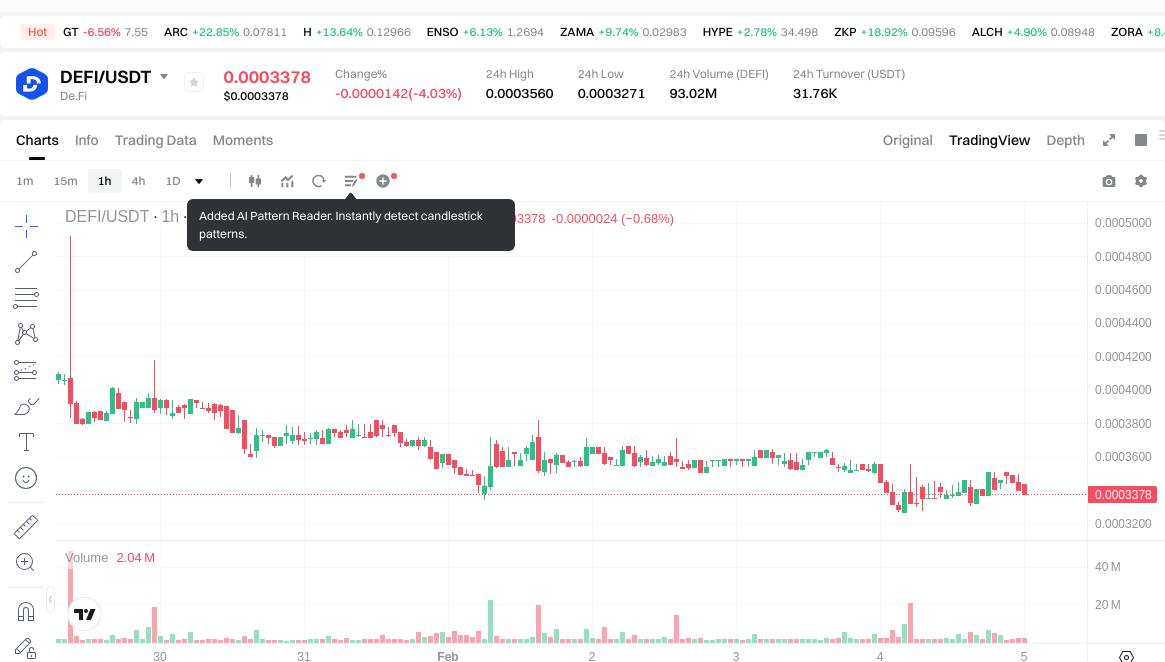
DEFI is a digital asset in the cryptocurrency space, launched in 2024, positioning itself as a Web3 SocialFi and security solution. As of February 2026, De.Fi has a market capitalization of approximately $645,978, with a circulating supply of about 1.88 billion tokens, and a current price around $0.0003439. With its focus on combining accessibility, gamification, and risk mitigation technology, De.Fi has drawn attention in discussions about "Is De.Fi (DEFI) a good investment?" This article provides a comprehensive analysis of DEFI's investment characteristics, historical price movements, future price projections, and associated risks to serve as a reference for investors.
I. De.Fi (DEFI) Price History Review and Current Investment Value
- 2024: DEFI reached $1.09 in January → Early investors experienced significant gains during this period
- 2024-2026: Market underwent substantial correction → DEFI declined from elevated levels to $0.0003439, reflecting broader market volatility
- 2026: Market sentiment shifted → DEFI established new support levels near $0.0003271 as trading stabilized
Current DEFI Investment Market Status (February 2026)
- DEFI current price: $0.0003439
- Market sentiment (Fear & Greed Index): Data indicates cautious sentiment in current market conditions
- 24-hour trading volume: $31,212.33
- Market capitalization: $645,978.20 with circulating supply of 1,878,389,653 DEFI tokens
Click to view real-time DEFI market price
II. Core Factors Influencing Whether DEFI is a Good Investment
Supply Mechanism and Scarcity (DEFI Investment Scarcity)
- De.Fi operates with a circulating supply of approximately 1.88 billion tokens, representing around 62.61% of the maximum supply cap of 3 billion tokens. The controlled release schedule and finite total supply create a framework where token availability remains limited relative to the maximum potential circulation.
- Token economic models that incorporate supply constraints have historically influenced price dynamics in digital asset markets. For DEFI, the gap between current circulation and maximum supply suggests remaining token unlocks may affect future price movements.
- Scarcity characteristics within token economics can serve as one consideration among multiple factors when evaluating long-term positioning, though supply dynamics alone do not determine investment outcomes.
Institutional Investment and Mainstream Adoption (Institutional Investment in DEFI)
- The broader DeFi sector has seen institutional entities such as BlackRock and Franklin Templeton introduce tokenized financial products, providing regulated exposure to decentralized finance mechanisms. These developments indicate growing institutional interest in DeFi infrastructure, though specific institutional holdings data for DEFI tokens remains unspecified.
- According to research referenced by financial advisory sources, suggested DeFi allocations for moderate risk tolerance portfolios range from 1% to 5% of total portfolio value, expanding to 5% to 10% for higher risk tolerance profiles. These allocation frameworks reflect evolving institutional perspectives on DeFi as an asset class.
- Regulatory developments continue to shape the landscape for DeFi projects. Policy frameworks that provide clarity on compliance requirements may influence adoption trajectories, while restrictive measures could present obstacles to mainstream integration.
Macroeconomic Environment Impact on DEFI Investment
- Monetary policy shifts, including interest rate adjustments by central banking authorities, influence capital flows across asset classes. Changes in risk-free rates can affect the relative attractiveness of yield-generating DeFi protocols compared to traditional fixed-income instruments.
- During periods of elevated inflation, digital assets have been evaluated for potential inflation hedging characteristics. The extent to which DEFI tokens may serve such functions depends on multiple factors including adoption rates, utility value, and market liquidity conditions.
- Geopolitical uncertainties and macroeconomic volatility have historically correlated with increased interest in alternative financial systems. DeFi platforms that offer decentralized infrastructure may see varying levels of demand depending on confidence in traditional financial institutions.
Technology and Ecosystem Development (Technology & Ecosystem for DEFI Investment)
- De.Fi positions itself as a Web3 SocialFi and antivirus platform, combining accessibility features with risk mitigation technology. The platform's focus on onboarding new users and gamification elements aims to expand its user base, which currently includes approximately 9,855 token holders.
- DeFi protocol value increasingly derives from real-world utility and integration with tangible assets rather than solely from speculative yield mechanisms. Projects that demonstrate sustainable revenue models through practical applications tend to exhibit greater resilience during market downturns.
- The integration of DeFi applications across lending, decentralized exchanges, and payment infrastructure contributes to ecosystem maturity. For DEFI, ongoing development in areas such as security auditing tools and social finance features may influence long-term adoption and utility value.
III. DEFI Future Investment Forecast and Price Outlook (Is De.Fi(DEFI) worth investing in 2026-2031)
Short-term Investment Forecast (2026, short-term DEFI investment outlook)
- Conservative forecast: $0.000213 - $0.000338
- Neutral forecast: $0.000338 - $0.000417
- Optimistic forecast: $0.000417 - $0.000497
Mid-term Investment Outlook (2027-2029, mid-term De.Fi(DEFI) investment forecast)
- Market stage expectation: DEFI may experience gradual recovery and stabilization phase, with price performance potentially influenced by Web3 SocialFi sector development and overall crypto market sentiment.
- Investment return forecast:
- 2027: $0.000280 - $0.000597
- 2028: $0.000324 - $0.000532
- 2029: $0.000348 - $0.000696
- Key catalysts: Adoption rate of De.Fi's antivirus technology and risk mitigation solutions, growth in SocialFi sector participation, and overall DeFi market expansion trends.
Long-term Investment Outlook (Is DEFI a good long-term investment?)
- Base scenario: $0.000377 - $0.000851 (assuming steady progress in platform development and moderate increase in user adoption)
- Optimistic scenario: $0.000607 - $0.000934 (assuming accelerated mainstream adoption and favorable regulatory environment for Web3 SocialFi platforms)
- Risk scenario: Below $0.000300 (under conditions of intensified market competition, regulatory challenges, or prolonged bear market conditions)
Click to view DEFI long-term investment and price forecast: Price Prediction
2026-2031 Long-term Outlook
- Base scenario: $0.000377 - $0.000851 (corresponding to steady progress and gradual mainstream application improvement)
- Optimistic scenario: $0.000607 - $0.000934 (corresponding to large-scale adoption and favorable market conditions)
- Transformative scenario: Above $0.001000 (in case of breakthrough ecosystem developments and mainstream popularization)
- 2031-12-31 forecast high: $0.000934 (based on optimistic development assumptions)
Disclaimer: The above price forecasts are based on historical data analysis and market trend assessments, representing possible scenarios rather than guaranteed outcomes. Cryptocurrency markets are highly volatile and subject to numerous unpredictable factors. Investors should conduct comprehensive research, assess their own risk tolerance, and consider consulting financial professionals before making any investment decisions. Past performance does not guarantee future results.
| Year |
Predicted High Price |
Predicted Average Price |
Predicted Low Price |
Price Change |
| 2026 |
0.000496566 |
0.0003378 |
0.000212814 |
-1 |
| 2027 |
0.00059657169 |
0.000417183 |
0.00027951261 |
21 |
| 2028 |
0.00053222121225 |
0.000506877345 |
0.0003244015008 |
47 |
| 2029 |
0.000696196033357 |
0.000519549278625 |
0.000348098016678 |
51 |
| 2030 |
0.000851021718387 |
0.000607872655991 |
0.000376881046714 |
76 |
| 2031 |
0.000933692399602 |
0.000729447187189 |
0.000510613031032 |
112 |
IV. DEFI Investment Strategy and Risk Management (How to invest in De.Fi)
Investment Methodology (DEFI investment strategy)
Long-term Holding (HODL DEFI)
For conservative investors seeking steady exposure to Web3 SocialFi and security solutions, a long-term holding strategy may be considered. This approach involves accumulating DEFI tokens during market corrections and maintaining positions through volatility cycles. Given the token's substantial drawdown from its all-time high of $1.09 in January 2024 to current levels around $0.0003439, investors should carefully assess the project's fundamental development progress and ecosystem adoption before committing to extended holding periods.
Active Trading Strategy
Active traders may utilize technical analysis and swing trading techniques to navigate DEFI's price movements. Recent data shows notable volatility, with 24-hour fluctuations ranging between $0.0003271 and $0.000356. Traders should monitor key support and resistance levels, volume patterns (current 24h volume: $31,212), and broader market sentiment. The token's relatively low liquidity and small market cap of approximately $645,978 require particular attention to position sizing and exit strategies.
Risk Management (Risk management for DEFI investment)
Asset Allocation Guidelines
- Conservative Investors: Allocate no more than 1-2% of crypto portfolio to DEFI, with primary holdings in established digital assets
- Aggressive Investors: May consider 3-5% allocation as part of a diversified altcoin strategy
- Professional Investors: Should conduct thorough due diligence on De.Fi's technology roadmap, competitive positioning, and team execution capabilities before determining appropriate exposure levels
Risk Hedging Approaches
Implement a multi-asset portfolio strategy that balances DEFI exposure with:
- Established cryptocurrencies with larger market capitalizations
- Stablecoins for liquidity management
- Traditional financial instruments for overall portfolio stability
Consider setting predetermined stop-loss levels and profit-taking targets to manage the token's high volatility profile.
Secure Storage Solutions
Cold and Hot Wallet Management:
- For long-term holdings, transfer DEFI tokens to cold storage solutions (hardware wallets or air-gapped devices)
- Maintain only necessary amounts in hot wallets for trading or liquidity provision
- Verify the contract address (0x6b0faca7ba905a86f221ceb5ca404f605e5b3131 on Ethereum) before any transaction
Hardware Wallet Recommendations:
- Utilize reputable hardware wallet devices that support ERC-20 tokens
- Enable multi-signature authentication where available
- Maintain secure backup of recovery phrases in multiple physical locations
V. DEFI Investment Risks and Challenges (Risks of investing in De.Fi)
Market Risks
High Volatility Profile:
DEFI has demonstrated significant price fluctuations, with recent performance showing a 14.89% decline over 7 days and a 35.85% decrease over 30 days. The token's annual performance reflects a 98.96% drawdown from previous levels, indicating substantial volatility that investors must be prepared to navigate.
Price Manipulation Concerns:
With a relatively small market capitalization of $645,978 and limited trading volume ($31,212 in 24 hours), the token may be susceptible to price manipulation by large holders. The concentration of supply (approximately 62.61% of max supply in circulation) requires careful consideration of liquidity conditions.
Regulatory Risks
Jurisdictional Policy Uncertainty:
As Web3 SocialFi and security-focused platforms evolve, regulatory frameworks across different jurisdictions remain in development. Investors should monitor:
- Securities classification determinations for tokens providing platform utility
- Anti-money laundering (AML) and know-your-customer (KYC) compliance requirements
- Cross-border transaction regulations affecting decentralized platforms
- Potential restrictions on specific DeFi security tools or services
The regulatory landscape's ongoing evolution may impact DEFI's operational capabilities and market access in various regions.
Technical Risks
Network Security Considerations:
As an ERC-20 token operating on Ethereum, DEFI inherits both the security benefits and potential vulnerabilities of the underlying blockchain. Investors should be aware of:
- Smart contract risks associated with the token contract (0x6b0faca7ba905a86f221ceb5ca404f605e5b3131)
- Potential security vulnerabilities in De.Fi's proprietary antivirus and risk mitigation technologies
- Dependencies on Ethereum network performance and security upgrades
Platform Development and Upgrade Risks:
The successful execution of De.Fi's roadmap to onboard millions of users depends on continuous technical development and feature implementation. Delays, bugs, or failures in platform upgrades could impact token utility and market perception.
VI. Conclusion: Is De.Fi a Good Investment?
Investment Value Summary
DEFI presents a complex investment proposition within the Web3 SocialFi and security sector. The token's current trading price represents a substantial discount from historical levels, which may reflect either a value opportunity or fundamental concerns about project execution and market fit. The platform's focus on risk mitigation technology and gamified accessibility addresses genuine needs in the cryptocurrency ecosystem, though competitive dynamics and adoption metrics require ongoing evaluation.
The token's small market capitalization, limited liquidity, and significant price volatility characterize it as a higher-risk investment suitable primarily for those with strong risk tolerance and diversified portfolios. Long-term investment potential depends heavily on De.Fi's ability to execute its vision of onboarding substantial user numbers and achieving meaningful platform adoption.
Investor Recommendations
✅ Beginners:
- Consider dollar-cost averaging (DCA) approach with small, regular investments if pursuing exposure
- Prioritize secure storage using hardware wallets or reputable software wallets supporting ERC-20 tokens
- Maintain DEFI allocation at minimal portfolio percentage (1-2% or less)
- Thoroughly research the project's development progress and community engagement before investing
✅ Experienced Investors:
- Employ swing trading strategies during periods of increased volatility
- Integrate DEFI within a diversified altcoin portfolio to manage concentration risk
- Monitor key technical levels and volume trends for entry and exit timing
- Evaluate correlation with broader DeFi sector trends and Ethereum network developments
✅ Institutional Investors:
- Conduct comprehensive due diligence on De.Fi's technology stack, team credentials, and competitive positioning
- Assess market opportunity size for Web3 security and SocialFi solutions
- Consider strategic allocation only after evaluating liquidity constraints and potential exit scenarios
- Monitor regulatory developments affecting DeFi security platforms across target markets
⚠️ Disclaimer:
Cryptocurrency investments carry substantial risk, including the potential loss of principal. Market conditions can change rapidly, and past performance does not indicate future results. This analysis is provided for informational purposes only and does not constitute investment advice, financial advice, trading advice, or recommendations of any kind. Investors should conduct independent research, consider their financial situation, and consult with qualified financial advisors before making investment decisions regarding DEFI or any other cryptocurrency.
VII. FAQ
Q1: What is De.Fi (DEFI) and what makes it different from other DeFi tokens?
De.Fi (DEFI) is a Web3 SocialFi and security platform token launched in 2024, combining accessibility features, gamification elements, and risk mitigation technology. Unlike traditional DeFi tokens that focus primarily on financial protocols, DEFI positions itself as an antivirus and security solution designed to protect users from cryptocurrency risks. The platform aims to onboard mainstream users through gamified experiences while providing security tools for the Web3 ecosystem. With approximately 9,855 token holders and a circulating supply of 1.88 billion tokens (62.61% of the 3 billion maximum supply), DEFI operates as an ERC-20 token on the Ethereum network.
Q2: Why has DEFI's price declined significantly from its all-time high?
DEFI reached $1.09 in January 2024 but has since declined to approximately $0.0003439 as of February 2026, representing a 98.96% drawdown. This substantial correction reflects broader cryptocurrency market volatility experienced during 2024-2026, where many altcoins underwent significant price adjustments. The decline may be attributed to multiple factors including general market sentiment shifts, profit-taking by early investors, limited liquidity with a small market capitalization of $645,978, and relatively low trading volume of $31,212 in 24 hours. Additionally, the token's performance may reflect challenges in achieving mainstream adoption and competition within the Web3 security sector. Investors should note that such volatility is characteristic of small-cap cryptocurrency projects.
Q3: What are the projected price ranges for DEFI in 2026 and beyond?
Based on current analysis, DEFI's short-term forecast for 2026 ranges from $0.000213 (conservative) to $0.000497 (optimistic). Mid-term projections show potential prices of $0.000280-$0.000597 for 2027, $0.000324-$0.000532 for 2028, and $0.000348-$0.000696 for 2029. Long-term forecasts for 2030-2031 suggest a base scenario of $0.000377-$0.000851, with optimistic scenarios reaching $0.000607-$0.000934 by 2031. These projections assume various adoption rates and market conditions. However, it is crucial to understand that these forecasts are speculative and based on historical data analysis—they do not constitute guaranteed outcomes. Cryptocurrency markets are highly unpredictable, and actual performance may differ significantly from these projections.
Q4: What percentage of my portfolio should I allocate to DEFI?
Portfolio allocation for DEFI should be determined by your risk tolerance and investment experience. Conservative investors should limit DEFI exposure to 1-2% of their total cryptocurrency portfolio, with primary holdings in established digital assets. Aggressive investors with higher risk tolerance may consider 3-5% allocation as part of a diversified altcoin strategy. Professional investors should conduct comprehensive due diligence on De.Fi's technology roadmap, competitive positioning, and team execution capabilities before determining appropriate exposure levels. Given DEFI's small market capitalization, high volatility (98.96% annual decline), and limited liquidity, it should be considered a higher-risk investment suitable only for those who can afford potential losses. Never invest more than you can afford to lose entirely.
Q5: What are the main risks associated with investing in DEFI?
DEFI carries multiple investment risks that require careful consideration. Market risks include extreme volatility (14.89% decline over 7 days, 35.85% over 30 days), potential price manipulation due to small market cap ($645,978), and limited liquidity ($31,212 daily trading volume). Regulatory risks stem from evolving Web3 and DeFi regulations across jurisdictions, uncertain securities classification, and potential restrictions on security-focused platforms. Technical risks include smart contract vulnerabilities associated with the token contract (0x6b0faca7ba905a86f221ceb5ca404f605e5b3131 on Ethereum), platform development delays or failures, and dependency on Ethereum network security. Additionally, the project's ability to onboard millions of users and achieve mainstream adoption remains unproven, which could impact long-term token utility and value.
Q6: How should I store my DEFI tokens securely?
For optimal security, implement a cold and hot wallet management strategy. Long-term holdings should be transferred to cold storage solutions such as hardware wallets or air-gapped devices that support ERC-20 tokens. Maintain only necessary amounts in hot wallets for active trading or liquidity provision. Before any transaction, always verify the official contract address (0x6b0faca7ba905a86f221ceb5ca404f605e5b3131 on Ethereum). Recommended security practices include using reputable hardware wallet devices, enabling multi-signature authentication where available, and maintaining secure backups of recovery phrases in multiple physical locations. Never share your private keys or seed phrases with anyone, and be cautious of phishing attempts targeting DEFI holders.
Q7: What factors could drive DEFI's price higher in the future?
Several catalysts could potentially influence DEFI's upward price movement. Successful adoption of De.Fi's antivirus technology and risk mitigation solutions could increase token utility and demand. Growth in the broader Web3 SocialFi sector and increased participation may benefit DEFI's positioning. Expansion of the user base beyond the current 9,855 holders through the platform's gamification features could drive network effects. Additionally, favorable regulatory clarity for DeFi security platforms, integration with major DeFi protocols, strategic partnerships within the Web3 ecosystem, and continued development of the platform's technology roadmap may serve as positive catalysts. The controlled token supply (62.61% of maximum currently circulating) could also support price appreciation if demand increases, though supply dynamics alone do not guarantee price performance.
Q8: Is DEFI suitable for beginners in cryptocurrency investing?
DEFI presents significant challenges for beginners due to its high-risk profile and complexity. However, if beginners choose to pursue exposure, they should adopt a dollar-cost averaging (DCA) approach with small, regular investments, prioritize secure storage using hardware wallets or reputable software wallets supporting ERC-20 tokens, maintain minimal portfolio allocation (1-2% or less), and thoroughly research the project's development progress and community engagement before investing. Beginners must understand that DEFI's extreme volatility (98.96% decline from all-time high), limited liquidity, and small market capitalization make it unsuitable as a primary investment. New investors should first gain experience with established cryptocurrencies and develop a solid understanding of blockchain technology, wallet security, and market dynamics before considering higher-risk altcoins like DEFI.
* The information is not intended to be and does not constitute financial advice or any other recommendation of any sort offered or endorsed by Gate.