This comprehensive analysis examines whether Decentralized Social (DESO) represents a viable investment opportunity. As of January 2026, DESO trades at $5.99 with a market capitalization of $63.08 million, backed by institutional investors including Sequoia Capital and a16z. The article evaluates DESO's historical price performance, current market status, and core investment factors including supply mechanisms, institutional adoption, and Layer 1 blockchain technology. It presents price forecasts ranging from conservative scenarios of $5.27-$5.70 to optimistic projections of $6.66-$8.33 for 2026, with long-term outlooks extending through 2031. The analysis details investment strategies for different investor types and comprehensive risk management approaches, while identifying key risks including market volatility, regulatory uncertainty, and technical vulnerabilities. The conclusion provides tailored recommendations for beginners, experienced investors, and institutions, emphasizing that DESO investment carr
Introduction: Decentralized Social (DESO) Investment Position and Market Outlook
DESO is a significant asset in the cryptocurrency field. Since its launch in 2021, it has achieved notable development in the decentralized social media sector. As of January 2026, Decentralized Social holds a market capitalization of approximately $63.08 million, with a circulating supply of around 10.53 million tokens, and the current price is maintained at approximately $5.99. With its positioning as a Layer 1 blockchain designed specifically for decentralized social applications, DESO has gradually become a focal point for investors discussing "Is Decentralized Social (DESO) a good investment?" The platform has secured backing from prominent investors including Sequoia Capital, a16z, and Coinbase, with over 2 million wallets and hundreds of social DApps currently operating on the network. This article will comprehensively analyze DESO's investment characteristics, historical price movements, future price scenarios, and associated risks to provide reference for investors.
- 2021: DESO launched in September 2021 at a price of 0.8 USD. The token experienced significant growth during the initial market enthusiasm for decentralized social platforms.
- 2024: The cryptocurrency market faced volatility throughout the year. DESO recorded a low point at 2.7 USD in November 2024, reflecting broader market corrections affecting the DeSo blockchain ecosystem.
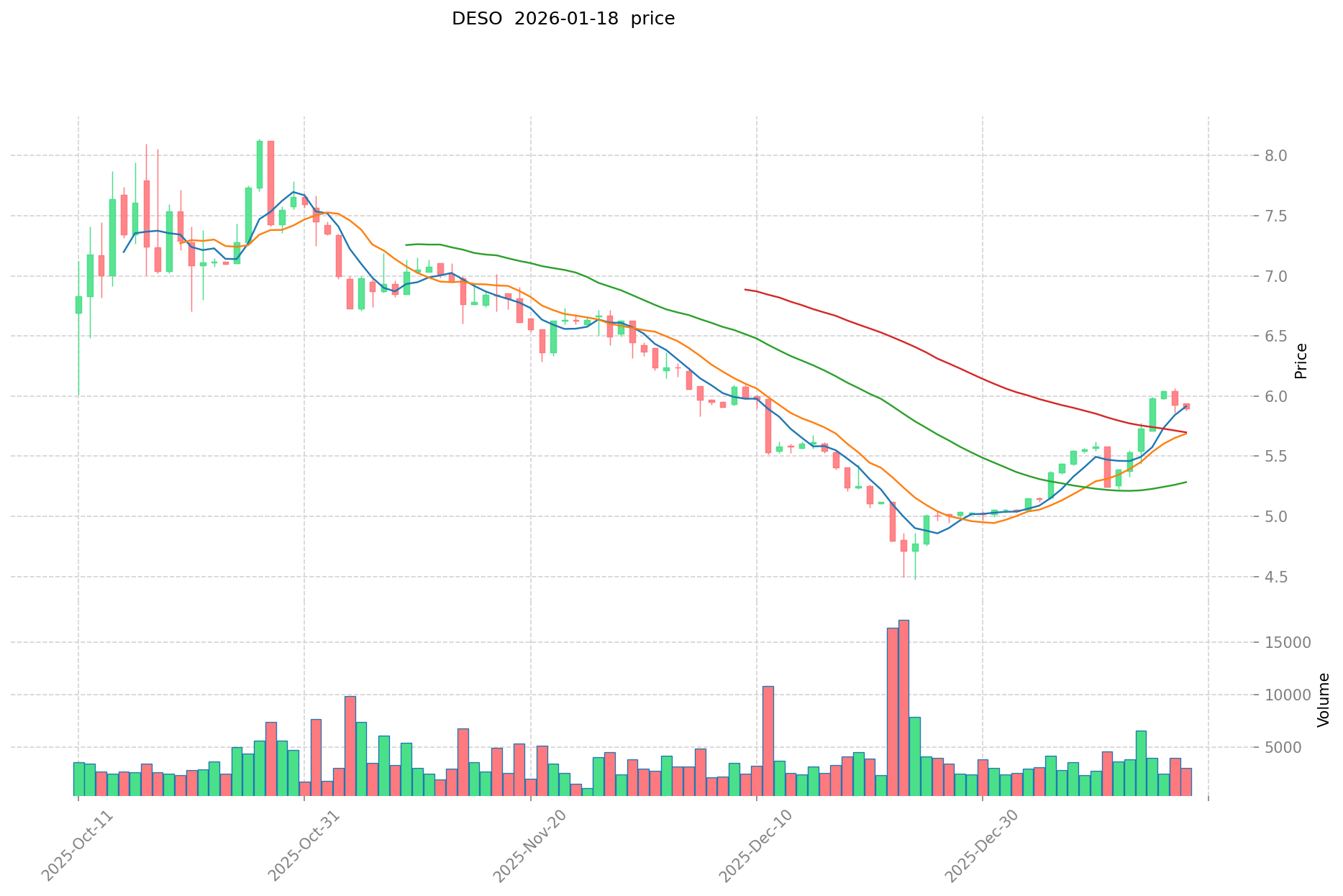
- 2026 (Current Period): As of January 18, 2026, DESO demonstrates a recovery trend with current trading activity showing positive momentum, supported by the platform's expanding ecosystem of over 2 million wallets and hundreds of decentralized social applications.
Current DESO Investment Market Status (January 2026)
- Current DESO Price: 5.989 USD
- 24-hour Trading Volume: 14,970.96 USD
- Market Capitalization: 63.08 million USD
- Circulating Supply: 10.53 million DESO (97.44% of max supply)
- Recent Price Performance:
- 1-hour change: +0.72%
- 24-hour change: +1.83%
- 7-day change: +13.93%
- 30-day change: +12.95%
Click to view real-time DESO market price
The token is currently listed on 2 exchanges, with the fully diluted valuation at 64.73 million USD. DESO maintains a market share of 0.0019% in the overall cryptocurrency market as of the latest update on January 18, 2026.
II. Core Factors Influencing Whether DESO is a Good Investment
Supply Mechanism and Scarcity (DESO Investment Scarcity)
- Supply Structure: DESO has a maximum supply of 10,808,492.69 tokens with a circulating supply of 10,532,253.89 tokens, representing approximately 97.44% of total supply already in circulation
- Limited New Supply: With circulating supply approaching maximum supply, the limited remaining tokens may contribute to potential scarcity dynamics
- Investment Consideration: The high circulation ratio suggests reduced inflationary pressure from new token releases, which could support price stability for long-term holders
Institutional Investment and Mainstream Adoption (Institutional Investment in DESO)
- Early-Stage Institutional Support: According to available information, DeSo (the blockchain platform) has received funding from notable investors including Sequoia Capital, a16z, and Coinbase, having raised over $200 million in total
- Ecosystem Adoption: The platform reportedly supports over 2 million wallets accessible through hundreds of decentralized social applications including Diamond, OpenProsper, NFTz, and Openfund
- Market Position: DESO currently ranks #465 by market capitalization with a market dominance of 0.0019%, indicating relatively limited mainstream adoption compared to major cryptocurrencies
Macroeconomic Environment's Impact on DESO Investment
- Market Volatility Sensitivity: As a mid-cap cryptocurrency, DESO may experience heightened sensitivity to broader macroeconomic conditions including monetary policy shifts and interest rate changes
- Risk Asset Classification: DESO's performance could be influenced by investor appetite for risk assets during periods of economic uncertainty
- Correlation Considerations: Smaller-cap cryptocurrencies often demonstrate different correlation patterns with traditional assets compared to major cryptocurrencies
Technology and Ecosystem Development (Technology & Ecosystem for DESO Investment)
- Layer 1 Blockchain Architecture: DeSo operates as a dedicated Layer 1 blockchain designed specifically for decentralized social media applications, featuring architecture similar to Bitcoin but optimized for social data
- Enhanced Scalability: The platform is built to support complex social media data including posts, user profiles, followers, and content monetization mechanisms at larger scale and throughput
- Application Ecosystem: DESO tokens function within the ecosystem for purchasing social tokens, NFTs, and creating profiles and posts across decentralized social applications
- Open Source Development: The project operates as a fully open-source initiative without a central corporate entity, relying on code and token economics for governance
III. DESO Future Investment Forecast and Price Outlook (Is Decentralized Social(DESO) worth investing in 2026-2031)
Short-term Investment Forecast (2026, short-term DESO investment outlook)
Based on available market projections, DESO shows varying estimates for 2026. Some analytical platforms suggest an average price target around $6.00, with potential fluctuations between $5.70 and $6.66. Alternative forecasting models indicate a possible price level near $5.27, reflecting different methodological approaches and market assumptions.
- Conservative forecast: $5.27 - $5.70
- Neutral forecast: $6.00 - $6.33
- Optimistic forecast: $6.66 - $8.33
Mid-term Investment Outlook (2027-2029, mid-term Decentralized Social(DESO) investment forecast)
- Market stage expectation: The mid-term period may witness gradual ecosystem development and potential expansion of decentralized social media adoption, with market dynamics influenced by broader industry trends and platform utility growth.
- Investment return forecast:
- 2027: $5.45 - $7.35
- 2028: $5.06 - $9.92
- 2029: $7.87 - $8.96
- Key catalysts: Platform ecosystem expansion, user adoption metrics, technological development within the DeSo blockchain infrastructure, and competitive positioning within the decentralized social media sector.
Long-term Investment Outlook (Is DESO a good long-term investment?)
Long-term projections for DESO extend through 2031, with various scenarios reflecting different market conditions and adoption trajectories. The forecasting data suggests potential price appreciation over the extended timeframe, though outcomes remain subject to multiple variables including technological advancement, competitive landscape evolution, and overall crypto market conditions.
- Base scenario: $5.38 - $8.67 (assuming steady platform development and moderate adoption growth)
- Optimistic scenario: $10.23 - $11.79 (assuming accelerated ecosystem expansion and favorable market conditions)
- Risk scenario: Below $5.00 (under adverse market conditions or limited adoption)
Click to view DESO long-term investment and price forecast: Price Prediction
2026-01-18 to 2031 Long-term Outlook
- Base scenario: $5.38 - $8.67 (corresponding to steady progress and gradual mainstream application enhancement)
- Optimistic scenario: $10.23 - $11.79 (corresponding to large-scale adoption and favorable market environment)
- Transformative scenario: Above $11.79 (in case of breakthrough ecosystem developments and mainstream adoption)
- 2031-12-31 forecast high: $11.79 (based on optimistic development assumptions)
Disclaimer: Price predictions are subject to market volatility and should not constitute investment advice. Projections are based on historical data analysis and current market conditions, which may change significantly.
| Year |
Predicted High Price |
Predicted Average Price |
Predicted Low Price |
Price Change |
| 2026 |
6.66222 |
6.002 |
5.7019 |
0 |
| 2027 |
7.3452476 |
6.33211 |
5.4456146 |
5 |
| 2028 |
9.91608426 |
6.8386788 |
5.060622312 |
14 |
| 2029 |
8.9637982371 |
8.37738153 |
7.8747386382 |
39 |
| 2030 |
11.792002241628 |
8.67058988355 |
5.375765727801 |
44 |
| 2031 |
10.64054790509256 |
10.231296062589 |
8.59428869257476 |
70 |
IV. DESO Investment Strategy and Risk Management (How to invest in Decentralized Social)
Investment Methodology (DESO investment strategy)
Long-term Holding (HODL DESO): Suitable for conservative investors
For investors who believe in the long-term potential of decentralized social media infrastructure, holding DESO may align with a patient capital approach. Since its launch on September 29, 2021, at a price of $0.8, DESO has experienced significant price fluctuations, trading at $5.989 as of January 18, 2026. The token's price performance shows substantial volatility, with historical records indicating a previous high of $198.68 on June 20, 2021, and a low of $2.7 on November 5, 2024. Long-term holders should consider the project's fundamental value proposition as a Layer 1 blockchain designed specifically for decentralized social applications, supported by notable investors including Sequoia Capital, a16z, and Coinbase.
Active Trading: Relying on technical analysis and swing trading
Active traders may find opportunities in DESO's price volatility. Recent data shows price changes of 0.72% over 1 hour, 1.83% over 24 hours, 13.93% over 7 days, and 12.95% over 30 days. The 24-hour trading range between $5.876 and $6.002 indicates intraday volatility that may present swing trading opportunities. With a 24-hour trading volume of approximately $14,970.96, traders should assess liquidity conditions before executing larger positions. Technical analysis tools and monitoring of key support and resistance levels may help identify entry and exit points.
Risk Management (Risk management for DESO investment)
Asset Allocation Ratio: Conservative / Aggressive / Professional investors
- Conservative investors: May consider allocating 1-3% of their cryptocurrency portfolio to DESO, given its lower market capitalization and higher risk profile
- Aggressive investors: Could allocate 5-10% for higher potential returns, understanding the associated volatility
- Professional investors: May incorporate DESO into diversified blockchain infrastructure portfolios, with allocation based on comprehensive risk assessment and portfolio construction methodologies
Risk Hedging Strategies: Multi-asset portfolio + hedging instruments
Investors should consider diversification across multiple cryptocurrency categories and traditional assets to mitigate concentration risk. The correlation between DESO and broader cryptocurrency markets should be monitored, as market-wide movements may impact individual token performance. Portfolio construction should account for DESO's current market dominance of 0.0019% and its ranking at position 465 among cryptocurrencies.
Secure Storage: Hot and cold wallets + hardware wallet recommendations
Given that DeSo operates as an independent Layer 1 blockchain with over 2 million wallets, security practices are important for asset protection. Investors should consider:
- Cold storage solutions (hardware wallets) for long-term holdings
- Hot wallets for active trading needs, using only reputable wallet providers
- Multi-signature wallets for larger holdings
- Regular security audits of storage solutions and backup procedures
V. DESO Investment Risks and Challenges (Risks of investing in Decentralized Social)
Market Risk: High volatility and potential price manipulation
DESO demonstrates significant price volatility, as evidenced by its one-year decline of 49.39% and historical price range from $2.7 to $198.68. The token's relatively limited circulating supply of 10,532,253.8854 DESO (97.44% of maximum supply) and modest trading volume may contribute to price sensitivity. With only 2 exchanges listing the token, liquidity constraints could amplify price movements during periods of high buying or selling pressure.
Regulatory Risk: Policy uncertainty across different jurisdictions
As a blockchain platform focused on decentralized social media, DESO may face regulatory scrutiny related to content moderation, data privacy, and social media regulations across various jurisdictions. The evolving regulatory landscape for cryptocurrency projects, particularly those involving social applications and NFTs, introduces uncertainty regarding operational requirements and compliance obligations in different regions.
Technical Risk: Network security vulnerabilities and upgrade failures
As a Layer 1 blockchain, DESO faces technical risks inherent to blockchain infrastructure, including potential security vulnerabilities, network consensus challenges, and the complexity of implementing protocol upgrades. The platform's ability to support complex social media data structures and maintain scalability while ensuring security requires ongoing technical development and maintenance. Smart contract risks and potential bugs in decentralized social applications built on the platform could impact user confidence and adoption.
VI. Conclusion: Is Decentralized Social a Good Investment?
Investment Value Summary: DESO represents a specialized investment in blockchain infrastructure for decentralized social media. The project's backing from notable investors and its unique positioning as a purpose-built social media blockchain provide foundational support, though the token has experienced substantial price volatility with a one-year decline of 49.39%.
Investor Recommendations:
✅ Beginners: Consider dollar-cost averaging (DCA) strategies combined with secure wallet storage practices. Start with small allocations to understand the project's dynamics and market behavior before increasing exposure.
✅ Experienced Investors: May explore swing trading opportunities based on technical analysis, while maintaining core positions as part of a diversified cryptocurrency portfolio that includes exposure to different blockchain categories.
✅ Institutional Investors: Could evaluate strategic long-term positioning in decentralized social infrastructure as part of broader blockchain investment theses, with appropriate risk management frameworks and due diligence processes.
⚠️ Important Notice: Cryptocurrency investments carry substantial risk, including the possibility of complete loss of capital. This content is provided for informational purposes only and does not constitute investment advice, financial advice, trading advice, or recommendations of any kind. Investors should conduct their own research and consult with qualified financial advisors before making investment decisions.
VII. FAQ
Q1: What is DESO and what makes it different from other cryptocurrency investments?
DESO is the native token of Decentralized Social (DeSo), a Layer 1 blockchain specifically designed for decentralized social media applications. Unlike general-purpose blockchains, DeSo is architecturally optimized for social data including posts, profiles, followers, and content monetization. The platform has secured backing from prominent investors including Sequoia Capital, a16z, and Coinbase, with over $200 million raised. As of January 2026, the platform supports over 2 million wallets and hundreds of decentralized social applications such as Diamond, OpenProsper, and NFTz. The token operates as the ecosystem's utility asset for purchasing social tokens, NFTs, and creating profiles across decentralized social applications.
Q2: Has DESO been a profitable investment historically?
DESO's historical performance shows significant volatility since its launch in September 2021 at $0.8. The token reached a historical high of $198.68 on June 20, 2021, but experienced substantial corrections, dropping to a low of $2.7 on November 5, 2024. As of January 18, 2026, DESO trades at approximately $5.99, representing a one-year decline of 49.39%. Recent short-term performance shows recovery momentum with 13.93% gains over 7 days and 12.95% over 30 days. This volatility pattern indicates that investment outcomes have been highly dependent on entry and exit timing, with early investors experiencing both extreme gains and subsequent losses.
Q3: What is the realistic price prediction for DESO in 2026-2031?
Based on available market analysis, DESO shows varying price trajectories depending on adoption scenarios. For 2026, conservative forecasts suggest a range of $5.27-$5.70, while optimistic scenarios project $6.66-$8.33. Mid-term projections (2027-2029) indicate potential ranges from $5.45-$9.92 depending on ecosystem development. Long-term forecasts through 2031 present a base scenario of $5.38-$8.67 under steady development, an optimistic scenario of $10.23-$11.79 with accelerated adoption, and potential upside above $11.79 in transformative scenarios. However, these projections remain subject to significant market volatility and should not be considered guaranteed outcomes or investment advice.
Q4: What are the main risks associated with investing in DESO?
DESO investment carries multiple risk categories. Market risk includes high volatility demonstrated by its historical price range from $2.7 to $198.68, limited liquidity with only 2 exchange listings, and modest 24-hour trading volume of approximately $14,971. Regulatory risk stems from evolving policies regarding decentralized social media, content moderation requirements, and cryptocurrency regulations across jurisdictions. Technical risks include potential network security vulnerabilities, smart contract bugs in ecosystem applications, and challenges in implementing protocol upgrades while maintaining scalability. Additionally, with 97.44% of maximum supply already circulating and market dominance of only 0.0019%, DESO faces competitive pressure and adoption challenges in the broader cryptocurrency market.
Q5: How should different types of investors approach DESO investment?
Investment strategies should align with risk tolerance and experience levels. Conservative beginners may consider allocating 1-3% of their cryptocurrency portfolio to DESO using dollar-cost averaging strategies, starting with small positions to understand market dynamics. Aggressive investors with higher risk tolerance could allocate 5-10% while implementing active trading strategies to capitalize on volatility patterns, using technical analysis for swing trading opportunities. Professional investors might incorporate DESO into diversified blockchain infrastructure portfolios with comprehensive risk assessment frameworks. All investors should employ proper security measures including cold storage solutions for long-term holdings, multi-signature wallets for larger positions, and maintain portfolio diversification across multiple asset categories to mitigate concentration risk.
Q6: What factors should investors monitor to evaluate DESO's investment potential?
Key evaluation factors include ecosystem growth metrics such as wallet adoption beyond the current 2 million users, development of new decentralized social applications on the platform, and user engagement statistics. Technology development indicators include protocol upgrades, scalability improvements, and network security enhancements. Market factors to monitor include trading volume trends, exchange listing expansions beyond current 2 platforms, and institutional investment activity. Broader considerations involve competitive positioning against other Layer 1 blockchains and decentralized social platforms, regulatory developments affecting social media blockchain projects, and macroeconomic conditions influencing risk asset performance. Investors should also track token supply dynamics given the high circulation ratio of 97.44% and any changes in tokenomics that might affect scarcity dynamics.
Q7: Is DESO suitable for long-term holding (HODL) investment strategy?
Long-term holding suitability depends on conviction in decentralized social media infrastructure adoption. DESO's backing from notable investors including Sequoia Capital and a16z provides foundational support, while its specialized Layer 1 architecture represents differentiation in the blockchain space. However, the token's significant volatility (49.39% decline over one year) and current market capitalization of approximately $63 million indicate higher risk compared to established cryptocurrencies. Long-term holders should consider the project's fully open-source nature without central corporate control, which may influence development trajectory. With circulating supply approaching maximum supply (97.44%), reduced inflationary pressure could support price stability for patient investors. This strategy suits those with strong risk tolerance, long investment horizons, and belief in decentralized social media's future adoption, while accepting potential extended periods of price volatility and uncertainty.
* The information is not intended to be and does not constitute financial advice or any other recommendation of any sort offered or endorsed by Gate.