This comprehensive analysis examines whether Decentralized USD (USDD) represents a viable investment opportunity within cryptocurrency portfolios. With a market capitalization of $943.8 million and current price stability around $1.00, USDD functions primarily as a stable value storage mechanism rather than a growth asset. The article evaluates USDD's price history, technical architecture maintained by TRON DAO Reserve, and collateral mechanisms employing TRX, BTC, and TUSD. Key findings reveal price predictions ranging from $0.88 to $2.00 by 2031 under various scenarios, though historical volatility between $0.928067 and $1.052 demonstrates peg sustainability challenges. The analysis provides strategic recommendations for conservative, experienced, and institutional investors, addressing risk management, secure storage on Gate.com and other platforms, and DeFi yield opportunities. Critical considerations include regulatory uncertainties, technical vulnerabilities, and liquidity constraints stemming from modes
Introduction: Decentralized USD (USDD) Investment Position and Market Outlook
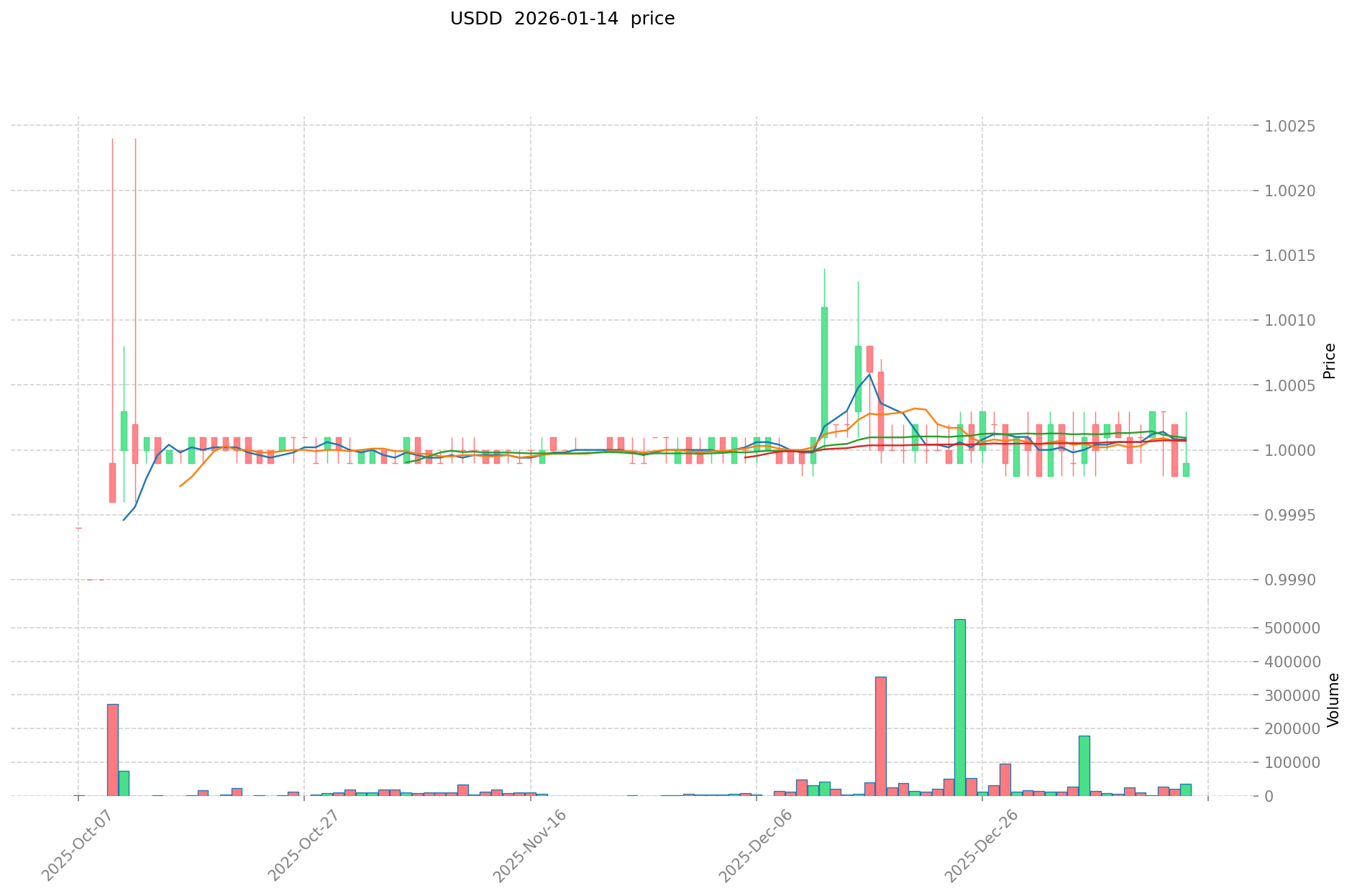
Decentralized USD (USDD) represents a significant stablecoin asset in the cryptocurrency sector, issued by the TRON DAO Reserve since May 2022. As of January 14, 2026, USDD maintains a market capitalization of approximately $943.8 million, with a circulating supply of 943.8 million tokens, and a current price stabilized around $1.00. Ranking 92nd by market capitalization with a market dominance of 0.027%, USDD has positioned itself as a decentralized algorithmic stablecoin with diverse use cases across the blockchain ecosystem. With 457,511 holders and availability on 6 exchanges, the token has established a notable presence in the digital asset landscape. Featuring an internal incentive mechanism and corresponding monetary policy designed to maintain price stability during market fluctuations, USDD aims to consolidate its value as a settlement currency. The asset's historical price range spans from $0.928067 on June 20, 2022, to $1.052 on October 24, 2023, demonstrating its characteristic volatility management. This article provides a comprehensive analysis of USDD's investment characteristics, historical performance trends, future price considerations, and associated investment risks to serve as reference material for market participants evaluating "Is Decentralized USD (USDD) a good investment?"
I. Decentralized USD (USDD) Price History Review and Current Investment Value
- 2022: Initial launch and price volatility emerged → USDD experienced a notable decline, with the price dropping to $0.928067 on June 20, 2022
- 2023: Price stabilization efforts and recovery attempts → USDD reached $1.052 on October 24, 2023, reflecting improved market confidence
- 2024-2025: Sustained stability around peg target → Price maintained close to $1.00, demonstrating the effectiveness of the stablecoin's self-stabilizing mechanism
Current USDD Investment Market Status (January 2026)
- USDD current price: $1.00
- Market sentiment (Fear & Greed Index): Data not provided in reference materials
- 24-hour trading volume: $30,981.26
- Institutional investor holdings: Data not provided in reference materials
Click to view real-time USDD market price
II. Core Factors Affecting Whether USDD Is a Good Investment
Supply Mechanism and Scarcity
- USDD has a current circulating supply of 943,802,255 tokens, with a maximum supply marked as unlimited (∞). This unlimited supply mechanism differs from scarcity-driven assets and reflects its nature as a stablecoin designed to maintain price stability rather than appreciate through supply restrictions.
- The supply mechanism is managed through an internal incentive structure and corresponding monetary policy, which aims to enable self-stabilization during price fluctuations. This design prioritizes stability over scarcity-based value appreciation.
- For investment purposes, USDD's unlimited supply means traditional scarcity-driven long-term appreciation is not the primary value proposition. Instead, its investment relevance lies in its utility as a stable settlement currency within the crypto ecosystem.
Institutional Investment and Mainstream Adoption
- USDD is issued by the TRON DAO Reserve, positioning it within the TRON ecosystem with institutional backing from this decentralized autonomous organization.
- The token has demonstrated measurable adoption with 457,511 holders as of January 14, 2026, indicating a broad user base across the crypto community.
- USDD is available for trading on 6 exchanges, including Gate.com, providing accessibility for investors seeking exposure to this stablecoin.
- According to reference materials, the global stablecoin market reached $300 billion in 2025, with USDD playing a role as a decentralized stablecoin alternative within this expanding sector.
Macroeconomic Environment Impact on USDD Investment
- As a stablecoin pegged to the US dollar, USDD's value proposition shifts during different macroeconomic conditions. While volatile crypto assets may serve as inflation hedges, USDD's stability mechanism makes it function more as a liquidity and transaction tool rather than an inflation hedge.
- In uncertain market environments, stablecoins like USDD can serve as a safe harbor within crypto portfolios, allowing investors to preserve value without exiting the crypto ecosystem entirely.
- Monetary policy changes affecting the US dollar indirectly influence USDD's relative attractiveness compared to other stablecoins and traditional fiat currencies.
Technology and Ecosystem Development
- USDD is deployed on the TRON blockchain (contract address: TXDk8mbtRbXeYuMNS83CfKPaYYT8XWv9Hz), benefiting from TRON's transaction speed and low-cost infrastructure for stablecoin operations.
- The token features an internal incentive mechanism designed to support price stability, which contributes to its utility within decentralized finance applications.
- Reference materials mention USDD 2.0 offering a 12% return opportunity in 2025, suggesting yield-generating mechanisms that may enhance its investment appeal beyond simple price stability.
- USDD's role in DeFi ecosystems, where stablecoins serve as trading pairs, collateral, and liquidity provision tools, supports its functional value for investors engaged in broader crypto market activities.
- The token's integration within the TRON ecosystem positions it for potential growth as TRON-based applications and services expand, though specific ecosystem developments were not detailed in the provided materials.
III. USDD Future Investment Predictions and Price Outlook (Is Decentralized USD(USDD) worth investing in 2026-2031)
Short-term Investment Prediction (2026, short-term USDD investment outlook)
- Conservative Forecast: $0.93 - $1.00
- Neutral Forecast: $1.00 - $1.03
- Optimistic Forecast: $1.03 - $1.06
Mid-term Investment Outlook (2027-2029, mid-term Decentralized USD(USDD) investment forecast)
-
Market Stage Expectation: As a stablecoin designed to maintain a 1:1 peg with the US dollar, USDD is expected to continue its price stability mechanism through over-collateralization with diversified crypto assets including TRX, BTC, and TUSD. The mid-term outlook suggests moderate fluctuations around the dollar parity.
-
Investment Return Prediction:
- 2027: $0.95 - $1.38
- 2028: $1.16 - $1.27
- 2029: $1.11 - $1.28
-
Key Catalysts: The performance of collateral assets (TRX, BTC, TUSD), adoption on TRON blockchain ecosystem, and overall stablecoin market dynamics may influence USDD's stability and trading patterns.
Long-term Investment Outlook (Is USDD a good long-term investment?)
- Baseline Scenario: $0.88 - $1.48 (assuming continued over-collateralization and stable peg maintenance mechanisms)
- Optimistic Scenario: $1.48 - $2.00 (assuming expanded adoption across platforms and strengthened reserve backing)
- Risk Scenario: $0.88 - $0.93 (considering potential market stress or collateral volatility)
Click to view USDD long-term investment and price prediction: Price Prediction
2026-01-14 - 2031 Long-term Outlook
- Base Scenario: $0.88 - $1.48 (corresponding to steady development and gradual mainstream application enhancement)
- Optimistic Scenario: $1.48 - $2.00 (corresponding to large-scale adoption and favorable market conditions)
- Transformative Scenario: Above $2.00 (if ecosystem achieves breakthrough development and mainstream penetration)
- 2031-12-31 Predicted High: $2.00 (based on optimistic development assumptions)
Disclaimer: Price predictions are based on historical data analysis and market trends. Cryptocurrency markets are highly volatile and unpredictable. These forecasts should not be considered as financial advice. Investors should conduct independent research and consider their own risk tolerance before making investment decisions.
| Year |
Predicted High Price |
Predicted Average Price |
Predicted Low Price |
Price Change |
| 2026 |
1.06 |
1 |
0.93 |
0 |
| 2027 |
1.3802 |
1.03 |
0.9476 |
3 |
| 2028 |
1.265355 |
1.2051 |
1.156896 |
20 |
| 2029 |
1.2846366 |
1.2352275 |
1.11170475 |
23 |
| 2030 |
1.7009082675 |
1.25993205 |
0.881952435 |
25 |
| 2031 |
1.9985672143125 |
1.48042015875 |
1.1103151190625 |
48 |
IV. USDD Investment Strategy and Risk Management (How to invest in stablecoins)
Investment Methodology (USDD investment strategy)
Long-term Holding (HODL USDD)
For conservative investors, USDD serves primarily as a stable value storage tool rather than a speculative asset. Given its design as a price-stable cryptocurrency, the primary use case involves:
- Liquidity reserve: Maintaining USDD as a stable portion of a broader crypto portfolio to reduce overall volatility exposure
- Yield generation: Utilizing USDD in DeFi protocols that offer staking or lending opportunities while preserving principal value
- Strategic rebalancing: Converting volatile assets into USDD during periods of market uncertainty
Active Trading
While USDD maintains price stability around the $1 peg, minor price fluctuations may present opportunities:
- Arbitrage opportunities: Trading between exchanges when USDD temporarily deviates from its peg
- Pair trading: Using USDD as a base currency for trading other crypto assets
- Technical considerations: Monitoring the 24-hour price range (recent data shows $0.9998-$1.0003) for micro-trading opportunities
Risk Management (Risk management for USDD investment)
Asset Allocation Ratio
Conservative Investors
- Stablecoins (including USDD): 40-60% of crypto portfolio
- Major cryptocurrencies: 30-40%
- Alternative assets: 10-20%
Aggressive Investors
- Stablecoins (including USDD): 10-20% of crypto portfolio
- Major cryptocurrencies: 50-60%
- Alternative assets: 20-30%
Professional Investors
- Customized allocation based on market conditions and risk models
- Dynamic rebalancing strategies incorporating USDD as a tactical liquidity tool
Risk Hedging Solutions
Multi-asset Portfolio Approach
- Diversification across multiple stablecoins to mitigate single-protocol risk
- Combining USDD with other asset classes (BTC, ETH, traditional stablecoins)
- Geographic and regulatory diversification
Risk Management Tools
- Setting position limits for USDD holdings relative to total portfolio
- Monitoring USDD's backing reserves and transparency reports
- Establishing clear exit strategies if peg stability shows sustained deviation
Secure Storage
Cold and Hot Wallet Solutions
Given USDD's deployment on the TRON network (contract address: TXDk8mbtRbXeYuMNS83CfKPaYYT8XWv9Hz), investors should consider:
Security Best Practices
- Enable multi-signature authentication where possible
- Regular backup of wallet recovery phrases
- Verification of contract addresses before transactions
- Using official TRON blockchain explorer (tronscan.org) for transaction verification
V. USDD Investment Risks and Challenges (Risks of investing in stablecoins)
Market Risks
Price Volatility Considerations
While USDD is designed for price stability, historical data reveals potential concerns:
- Historical price range: $0.928067 (June 20, 2022) to $1.052 (October 24, 2023)
- This 12.4% deviation range indicates periods of peg instability
- Current 24-hour volatility appears minimal ($0.9998-$1.0003), but past performance shows vulnerability during market stress
Market Manipulation Risks
- Relatively modest daily trading volume ($30,981.26) may indicate lower liquidity compared to major stablecoins
- Limited exchange availability (6 exchanges) could create liquidity constraints during market turbulence
- Concentration risks in the TRON ecosystem
Regulatory Risks
Policy Uncertainty Across Jurisdictions
- Evolving stablecoin regulations: Different countries are implementing varied regulatory frameworks for algorithmic and collateralized stablecoins
- Compliance requirements: Increasing scrutiny on reserve backing and transparency mechanisms
- Cross-border restrictions: Potential limitations on USDD usage in certain jurisdictions
- Regulatory classification: Uncertainty regarding whether USDD qualifies as a security, commodity, or payment token in different regions
Governance and Oversight
- TRON DAO Reserve's governance structure and decision-making processes may face regulatory examination
- Transparency requirements for reserve composition and audit practices continue to evolve
Technical Risks
Network Security Vulnerabilities
- Smart contract risks: Potential bugs or exploits in USDD's TRC-20 token implementation
- TRON network dependencies: USDD's security relies on the underlying TRON blockchain's integrity
- Oracle risks: If USDD utilizes price oracles for its stabilization mechanism, oracle manipulation could affect peg stability
Upgrade and Protocol Changes
- Monetary policy adjustments: Changes to USDD's stabilization mechanism or incentive structures
- Network upgrades: TRON blockchain updates could potentially impact USDD functionality
- Reserve management: Modifications to collateral composition or reserve requirements
Operational Risks
- Liquidity crises: During extreme market conditions, redemption mechanisms may face stress
- Depeg scenarios: Historical low of $0.928067 demonstrates vulnerability during market turbulence
- Third-party dependencies: Risks associated with integrated DeFi protocols and exchange platforms
VI. Conclusion: Is stablecoins a Good Investment?
Investment Value Summary
USDD presents a specialized use case within cryptocurrency portfolios rather than a traditional growth investment. With a market capitalization of approximately $943.8 million and deployment on the TRON network, USDD serves primarily as a stable value storage mechanism within the crypto ecosystem. The token's design incorporates incentive mechanisms and monetary policy tools aimed at maintaining price stability around the $1 peg.
The investment proposition centers on:
- Stability preservation: Providing a relatively stable value store amid crypto market volatility
- Ecosystem utility: Facilitating transactions and DeFi activities within TRON-based applications
- Portfolio diversification: Serving as a risk-mitigation tool within broader crypto allocations
However, historical price fluctuations ranging from $0.928067 to $1.052 indicate that USDD's stability mechanism has faced challenges during periods of market stress, which differentiates it from certain other stablecoin options.
Investor Recommendations
✅ Beginners
- Dollar-cost averaging approach: Allocate a small, fixed percentage of crypto portfolio to USDD as a stability anchor
- Secure storage priority: Utilize hardware wallets supporting TRC-20 tokens; verify contract address (TXDk8mbtRbXeYuMNS83CfKPaYYT8XWv9Hz) before transactions
- Education focus: Understand stablecoin mechanisms and TRON DAO Reserve's operations before significant allocation
- Conservative sizing: Limit initial exposure to 5-10% of total crypto holdings
✅ Experienced Investors
- Tactical deployment: Use USDD for portfolio rebalancing and as dry powder for market opportunities
- Wave trading strategies: Capitalize on minor peg deviations (noting the $0.9998-$1.0003 recent range)
- Multi-stablecoin approach: Diversify stablecoin holdings across different mechanisms and ecosystems
- Active monitoring: Track TRON DAO Reserve announcements and reserve composition
- DeFi integration: Explore yield opportunities within TRON ecosystem while maintaining awareness of smart contract risks
✅ Institutional Investors
- Strategic liquidity management: Incorporate USDD as part of a diversified stablecoin allocation strategy
- Due diligence requirements: Conduct thorough analysis of reserve backing, governance structure, and risk management protocols
- Regulatory compliance: Ensure USDD holdings align with institutional mandates and jurisdictional requirements
- Risk-adjusted positioning: Size allocations based on comprehensive assessment of peg stability mechanisms and historical performance
- Operational frameworks: Establish clear policies for entry/exit thresholds and reserve diversification
Final Considerations
USDD's role in a portfolio differs fundamentally from growth-oriented cryptocurrencies. Its value proposition lies in stability preservation rather than capital appreciation. The token's integration with TRON ecosystem (evidenced by 457,511 holders) and availability across 6 exchanges provides reasonable accessibility, though liquidity considerations merit attention during market stress.
Investors should evaluate USDD within the broader context of stablecoin options, considering factors including reserve transparency, historical peg performance, ecosystem integration, and regulatory positioning. The modest daily trading volume and concentrated exchange availability suggest that position sizing should account for potential liquidity constraints.
⚠️ Disclaimer: Cryptocurrency investments involve substantial risks including complete loss of capital. Stablecoins, despite their design objectives, may experience significant deviations from their intended pegs during market stress. This analysis provides informational content only and does not constitute financial, investment, tax, or legal advice. Investors should conduct independent research and consult qualified professionals before making investment decisions. Past performance does not guarantee future results.
VII. FAQ
Q1: Is Decentralized USD (USDD) a good investment for long-term holding?
USDD is primarily designed as a stable value storage tool rather than a long-term appreciation asset. Unlike growth-oriented cryptocurrencies, USDD's investment value centers on maintaining price stability around the $1 peg through its over-collateralization mechanism with diversified crypto assets including TRX, BTC, and TUSD. For long-term investors, USDD serves best as a portfolio stability component—typically allocated at 40-60% for conservative investors or 10-20% for aggressive investors within crypto portfolios. While price predictions suggest a range of $0.88-$2.00 by 2031 under various scenarios, these fluctuations primarily reflect potential stress conditions rather than expected growth. Historical data shows USDD maintained relative stability after initial volatility in 2022 (low of $0.928067), but its unlimited supply mechanism means traditional scarcity-driven appreciation is not the primary value proposition. Investors seeking long-term growth should consider USDD as a risk mitigation and liquidity tool rather than a capital appreciation vehicle.
Q2: How does USDD maintain its $1 peg and what risks does this mechanism face?
USDD maintains its dollar peg through an internal incentive mechanism and corresponding monetary policy managed by the TRON DAO Reserve, utilizing over-collateralization with a basket of crypto assets. When USDD trades below $1, the system incentivizes users to burn USDD in exchange for $1 worth of collateral assets, reducing supply and restoring the peg. Conversely, when USDD trades above $1, users can mint new USDD by depositing collateral, increasing supply to bring the price down. However, this mechanism faces several risks: historical price deviations ranging from $0.928067 to $1.052 demonstrate vulnerability during market stress, particularly when collateral assets experience significant volatility. The relatively modest daily trading volume ($30,981.26) and limited exchange availability (6 exchanges) could create liquidity constraints during turbulent periods. Additionally, the mechanism's effectiveness depends on the stability and diversification of the underlying collateral portfolio, with concentration risks in TRON ecosystem assets potentially affecting peg maintenance during broader market downturns.
Q3: What are the main differences between USDD and other major stablecoins?
USDD distinguishes itself as a decentralized algorithmic stablecoin issued by TRON DAO Reserve, operating on the TRON blockchain with the contract address TXDk8mbtRbXeYuMNS83CfKPaYYT8XWv9Hz. Unlike fiat-collateralized stablecoins such as USDT or USDC that maintain reserves in traditional bank accounts, USDD employs crypto-asset collateralization with TRX, BTC, and TUSD. This approach provides decentralization benefits but introduces volatility risks from collateral price fluctuations. With an unlimited maximum supply (∞) and current circulation of 943.8 million tokens, USDD's supply mechanism prioritizes stability over scarcity. The token ranks 92nd by market capitalization at approximately $943.8 million, significantly smaller than leading stablecoins, which may affect liquidity and adoption. USDD also offers unique yield opportunities, with reference to USDD 2.0 providing a 12% return opportunity in 2025, differentiating it from basic reserve-backed stablecoins. However, its concentrated presence within the TRON ecosystem and limited exchange availability (6 platforms) contrast with the broader distribution of major stablecoins.
Q4: What regulatory risks should investors consider when holding USDD?
USDD faces evolving regulatory challenges as global authorities develop frameworks for algorithmic and crypto-collateralized stablecoins. Different jurisdictions are implementing varied regulatory approaches, creating compliance uncertainties around reserve backing transparency, audit requirements, and token classification. Investors should recognize that USDD may face restrictions in certain regions as regulators scrutinize whether it qualifies as a security, commodity, or payment token. The TRON DAO Reserve's governance structure and decision-making processes may undergo regulatory examination, particularly regarding reserve composition disclosure and operational transparency. Cross-border transaction limitations could emerge as countries establish specific rules for decentralized stablecoins. Additionally, increasing scrutiny on algorithmic stabilization mechanisms following broader stablecoin market events means USDD's monetary policy framework could face regulatory requirements for additional safeguards or reserve ratios. Institutional investors particularly must ensure USDD holdings align with compliance mandates and jurisdictional requirements, as regulatory landscapes continue shifting rapidly in the stablecoin sector.
Q5: How should investors securely store USDD and what are the best practices?
Investors should implement a balanced hot and cold wallet strategy when storing USDD, considering its TRC-20 token deployment on the TRON network. For cold storage (recommended for 80% or more of holdings), hardware wallets supporting TRC-20 tokens provide optimal security for long-term holdings, complemented by paper wallets or offline storage solutions. Hot wallets, suitable for less than 20% of holdings, include TronLink or other TRON-compatible web wallets and exchange wallets for active trading and immediate liquidity needs. Critical security practices include: enabling multi-signature authentication where available, maintaining regular backups of wallet recovery phrases stored in secure physical locations, and always verifying the official contract address (TXDk8mbtRbXeYuMNS83CfKPaYYT8XWv9Hz) before conducting transactions. Investors should use the official TRON blockchain explorer (tronscan.org) to verify all transactions and never share private keys or seed phrases. For those holding substantial amounts, consider distributing holdings across multiple wallet types and addresses to mitigate single-point-of-failure risks, while maintaining detailed records of all wallet addresses and backup locations.
Q6: What role does USDD play in DeFi ecosystems and yield generation?
USDD serves multiple functional roles within decentralized finance ecosystems, primarily within the TRON blockchain environment. As a stable settlement currency, USDD acts as a trading pair base for cryptocurrency exchanges, enabling traders to move between volatile assets without converting to traditional fiat currencies. The token's integration in DeFi protocols allows investors to provide liquidity, where USDD can be paired with other assets in automated market makers (AMMs) to earn transaction fees. Yield generation opportunities include lending USDD through decentralized lending platforms, where borrowers provide collateral to access USDD liquidity, generating interest for lenders. Reference materials indicate USDD 2.0 offered a 12% return opportunity in 2025, suggesting staking or yield farming mechanisms that exceed traditional stablecoin yields. However, investors should recognize that higher yields typically correspond with elevated risk profiles, including smart contract vulnerabilities, protocol-specific risks, and potential impermanent loss in liquidity provision scenarios. The token's utility as collateral in DeFi borrowing positions provides additional use cases, though the relatively lower liquidity compared to major stablecoins may limit efficiency in certain DeFi protocols.
Q7: What are the key indicators to monitor for USDD investment decisions?
Investors should track several critical metrics when evaluating USDD positions: peg stability remains paramount, monitoring deviations from the $1 target with historical context showing a range between $0.928067 and $1.052. The collateralization ratio of underlying reserve assets (TRX, BTC, TUSD) provides insight into the system's ability to maintain the peg during market stress—higher collateralization ratios generally indicate greater stability margins. Trading volume trends, currently at approximately $30,981.26 daily, signal market liquidity and potential ease of position entry/exit. The holder count progression (currently 457,511) indicates adoption trends and ecosystem growth. Exchange availability and trading pair diversity affect accessibility and arbitrage efficiency. Investors should also monitor TRON DAO Reserve announcements regarding reserve composition changes, monetary policy adjustments, or protocol upgrades. The Fear & Greed Index for the broader crypto market provides context for potential stress scenarios affecting stablecoin stability. Technical indicators like the 24-hour price range ($0.9998-$1.0003 recently) reveal micro-volatility patterns that may present arbitrage opportunities. Finally, tracking TRON blockchain metrics including transaction volumes and network activity provides broader ecosystem health indicators affecting USDD's utility and demand.
Q8: How does USDD compare as an investment during different macroeconomic conditions?
USDD's investment characteristics shift significantly across varying macroeconomic environments. During high inflation periods, while some cryptocurrencies may serve as inflation hedges, USDD's dollar peg means it preserves purchasing power relative to the US dollar but does not provide protection against dollar depreciation. In such scenarios, USDD functions best as a tactical liquidity position within crypto portfolios rather than an inflation-resistant store of value. During market uncertainty and high volatility, USDD serves as a safe harbor allowing investors to preserve capital within the crypto ecosystem without converting to traditional fiat, avoiding potential tax implications and maintaining immediate deployment capability for market opportunities. In rising interest rate environments, USDD's relative attractiveness depends on comparative yields—if traditional dollar-denominated instruments offer superior risk-adjusted returns, capital may flow away from USDD unless DeFi yield opportunities remain competitive. During financial system stress or banking sector concerns, decentralized stablecoins like USDD may attract capital seeking alternatives to traditional banking infrastructure, though regulatory responses in such scenarios remain uncertain. Investors should recognize that USDD's dollar peg means its macroeconomic exposure primarily reflects US monetary policy impacts, making diversification across multiple stablecoin types and asset classes prudent for comprehensive risk management.
* The information is not intended to be and does not constitute financial advice or any other recommendation of any sort offered or endorsed by Gate.