This comprehensive analysis examines DeepBook (DEEP) as a potential investment opportunity within the Sui DeFi ecosystem. The article evaluates DEEP's market fundamentals, including its $122.8 million market cap and CLOB-based trading infrastructure offering enhanced liquidity control compared to traditional AMMs. Key investment considerations include supply dynamics (currently 25% circulating), institutional recognition via Grayscale Trust, and technical capabilities delivering 390-millisecond settlement times. The analysis covers short-term volatility risks, mid-term growth catalysts from ecosystem expansion, and long-term price forecasts ranging from $0.086 to $0.137 by 2031. Suitable for risk-aware investors, DEEP requires careful portfolio allocation (1-10% depending on risk tolerance), secure storage practices, and understanding of regulatory uncertainties affecting DeFi protocols. Available on Gate and 24 other exchanges.
Introduction: DeepBook (DEEP)'s Investment Position and Market Prospects
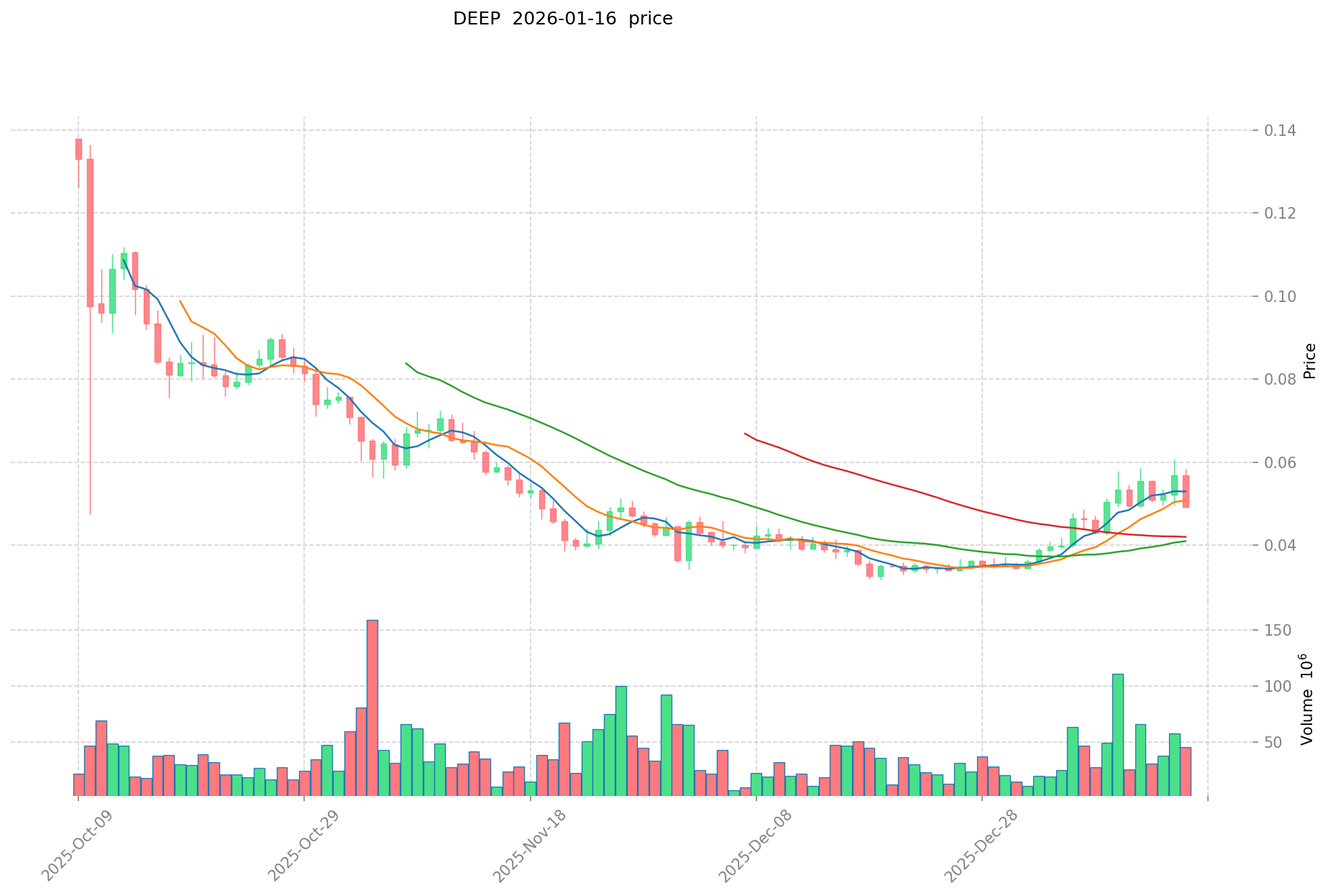
DEEP is a notable asset in the cryptocurrency landscape, operating as a decentralized central limit order book (CLOB) built on the Sui blockchain. As of January 17, 2026, DEEP maintains a market capitalization of approximately $122.8 million, with a circulating supply of 2.5 billion tokens and a current trading price around $0.04912. The token ranks 326th in the cryptocurrency market by market cap, with a circulating ratio of 25% against its maximum supply of 10 billion tokens.
DeepBook distinguishes itself through its technical architecture, leveraging Sui's parallel execution capabilities, sub-second latency, and low transaction fees to facilitate on-chain trading. The platform's order book structure aims to provide liquidity for the Sui DeFi ecosystem, offering liquidity providers enhanced control compared to traditional automated market maker models. With approximately 46,558 holders and availability across 25 exchanges, DEEP has established a measurable presence in the decentralized finance sector.
The token's price history shows notable volatility: it recorded a price range between $0.005263 on October 14, 2024, and $0.34572 on January 18, 2025. Recent performance data indicates a 38.7% increase over the past 30 days, while showing a decline of 3.49% in the 24-hour period and 6.98% over the past week. The fully diluted market cap stands at $491.2 million, representing a market cap to FDV ratio of 25%.
This analysis examines DEEP's investment characteristics, historical price movements, future price considerations, and associated risks to provide information for those evaluating DeepBook (DEEP) as a potential investment consideration within their portfolio strategy.
I. DeepBook (DEEP) Price History Review and Investment Value Status
DEEP Historical Price Trends and Investment Returns
- 2024: Initial Launch → On October 14, 2024, DEEP recorded a low price of $0.005263
- 2025: Market Recovery → DEEP price showed upward movement, with the token experiencing price fluctuations in the early months
- 2026: Recent Performance → As of January 17, 2026, DEEP trades at approximately $0.04912, representing notable volatility from earlier price levels
Current DEEP Investment Market Status (January 2026)
- DEEP Current Price: $0.04912
- Market Sentiment (Fear & Greed Index): Data not available in provided materials
- 24-hour Trading Volume: $2,430,897.63
- Institutional Investor Holdings: 46,558 holders recorded
- Market Capitalization: $122.8 million
- Circulating Supply: 2.5 billion DEEP (25% of total supply)
- Total Supply: 10 billion DEEP
- Listed on 25 exchanges
Click to view real-time DEEP market price
II. Core Factors Influencing Whether DEEP is a Good Investment
Supply Mechanism and Scarcity (DEEP Investment Scarcity)
- Supply Structure Analysis: DeepBook (DEEP) implements a fixed supply model with a maximum supply of 10 billion tokens. Currently, only 2.5 billion tokens (25%) are in circulation, with a total supply reaching 10 billion tokens. This controlled release mechanism creates a structured scarcity framework that may influence long-term price dynamics.
- Historical Price Behavior: Since its launch in October 2024 at an initial price of $0.005, DEEP has experienced significant price fluctuations. The token reached a notable price level of $0.34572 in January 2025, representing substantial growth from its starting point. As of January 17, 2026, DEEP trades at $0.04912, reflecting the volatility inherent in early-stage DeFi protocol tokens.
- Investment Implications: The 75% of tokens yet to be released into circulation represents a key consideration for investment analysis. The gradual unlock schedule may affect supply-demand dynamics over time, making the current circulating supply ratio a relevant factor in evaluating investment timing.
Institutional Investment and Mainstream Adoption (Institutional Investment in DEEP)
- Institutional Recognition: DeepBook has attracted attention from institutional players, with Grayscale establishing a DEEP Trust, indicating institutional-grade recognition of the protocol. This development suggests growing confidence from traditional financial institutions in the protocol's infrastructure.
- Ecosystem Integration: As the primary wholesale liquidity venue within the Sui DeFi ecosystem, DeepBook serves as foundational infrastructure for various financial services. The protocol processes over $15 million in daily clearing volume with settlement times of approximately 390 milliseconds, demonstrating operational capability that may appeal to institutional users.
- Adoption Metrics: DeepBook currently has approximately 46,558 token holders and is listed on 25 exchanges, indicating a developing but still emerging adoption base within the broader cryptocurrency market.
Macroeconomic Environment's Impact on DEEP Investment
- Market Correlation: As a DeFi infrastructure token within the cryptocurrency sector, DEEP's performance may be influenced by broader macroeconomic conditions affecting digital asset markets, including monetary policy shifts and interest rate changes that impact risk asset allocation.
- DeFi Market Dynamics: The decentralized finance sector's overall health significantly affects DEEP's investment outlook. Market conditions favoring decentralized trading infrastructure and on-chain liquidity solutions may create supportive environments for DeepBook's adoption and token value.
- Competitive Landscape: DeepBook operates within a competitive DeFi trading infrastructure market, where shifts in user preferences, technological innovations, and regulatory developments across different blockchain ecosystems may influence its relative positioning and investment attractiveness.
Technology and Ecosystem Development (Technology & Ecosystem for DEEP Investment)
- Technical Architecture: DeepBook leverages Sui blockchain's parallel execution capabilities, sub-second latency, and low transaction fees to deliver a high-performance on-chain exchange. The central limit order book (CLOB) architecture provides deeper liquidity control compared to traditional automated market maker (AMM) models, potentially attracting sophisticated liquidity providers.
- Protocol Performance: The platform's ability to settle trades in approximately 390 milliseconds with daily clearing volumes exceeding $15 million demonstrates technical scalability that may support increased adoption as the Sui ecosystem grows.
- Ecosystem Positioning: DeepBook's role as the primary liquidity infrastructure for Sui DeFi positions it to potentially benefit from broader ecosystem growth. The protocol's integration with various financial services within the Sui network creates network effects that may influence its long-term investment value.
- Development Roadmap: The protocol's 2026 roadmap indicates ongoing development efforts, suggesting continued technical evolution and feature expansion that may affect its competitive positioning within the DeFi infrastructure landscape.
III. DEEP Future Investment Forecast and Price Outlook (Is DeepBook(DEEP) worth investing in 2026-2031)
Short-term DEEP Investment Outlook (2026)
- Conservative Forecast: $0.034664 - $0.04952
- Neutral Forecast: $0.04952
- Optimistic Forecast: $0.04952 - $0.0638808
Mid-term DeepBook(DEEP) Investment Forecast (2027-2028)
- Market Phase Expectation: DeepBook may experience gradual growth as the Sui ecosystem continues to develop and the CLOB model gains adoption among liquidity providers seeking greater control over price execution.
- Investment Return Forecast:
- 2027: $0.03685526 - $0.077112544 (approximately 15% potential increase from 2026 baseline)
- 2028: $0.05419424232 - $0.07961870168 (approximately 36% potential increase from 2026 baseline)
- Key Catalysts: Expansion of Sui DeFi ecosystem, increased liquidity provision, and potential integration with broader financial services may contribute to price movement.
Long-term Investment Outlook (Is DEEP a good long-term investment?)
- Baseline Scenario: $0.086201052726291 - $0.13713803842819 (assuming steady ecosystem growth and sustained adoption of the CLOB architecture)
- Optimistic Scenario: $0.097955741734422 - $0.13713803842819 (assuming accelerated adoption, enhanced liquidity depth, and favorable market conditions)
- Risk Scenario: Price may face downward pressure if market volatility intensifies, liquidity provision decreases, or competing DeFi protocols gain dominance.
For more information on DEEP long-term investment and price forecasts: Price Prediction
2026-2031 Long-term Outlook
- Baseline Scenario: $0.086201052726291 - $0.107263753392444 (corresponding to steady progress and gradual mainstream application enhancement)
- Optimistic Scenario: $0.097955741734422 - $0.13713803842819 (corresponding to large-scale adoption and favorable market environment)
- Transformative Scenario: Above $0.13713803842819 (if the ecosystem achieves breakthrough developments and mainstream adoption)
- Predicted High Point by 2031-12-31: $0.13713803842819 (based on optimistic development assumptions)
Disclaimer: These forecasts are based on historical patterns and statistical models. Future market dynamics, technological developments, regulatory changes, and macroeconomic factors may lead to actual results differing from predictions. This analysis does not constitute investment advice.
| Year |
Predicted High Price |
Predicted Average Price |
Predicted Low Price |
Price Change |
| 2026 |
0.0638808 |
0.04952 |
0.034664 |
0 |
| 2027 |
0.077112544 |
0.0567004 |
0.03685526 |
15 |
| 2028 |
0.07961870168 |
0.066906472 |
0.05419424232 |
36 |
| 2029 |
0.1040328733128 |
0.07326258684 |
0.0564121918668 |
49 |
| 2030 |
0.107263753392444 |
0.0886477300764 |
0.08421534357258 |
80 |
| 2031 |
0.13713803842819 |
0.097955741734422 |
0.086201052726291 |
99 |
IV. DEEP Investment Strategy and Risk Management (How to invest in Decentralized Exchange Liquidity)
Investment Methodology (DEEP investment strategy)
-
Long-term Holding (HODL DEEP): Suitable for conservative investors who believe in the long-term development of Sui ecosystem and decentralized liquidity infrastructure. This approach involves acquiring DEEP tokens and holding them through market cycles, focusing on the protocol's fundamental value proposition as a core liquidity layer.
-
Active Trading: Relies on technical analysis and swing trading operations. Traders may capitalize on DEEP's price movements by monitoring key support and resistance levels, volume trends, and correlation with Sui ecosystem developments. Given the token's relatively high volatility, active traders should employ strict entry and exit disciplines.
Risk Management (Risk management for DEEP investment)
-
Asset Allocation Ratio:
- Conservative investors: Allocate 1-3% of crypto portfolio to DEEP
- Aggressive investors: May allocate 5-10% depending on risk tolerance
- Professional investors: Can consider larger positions with appropriate hedging strategies
-
Risk Hedging Solutions: Construct a diversified portfolio combining DEEP with major cryptocurrencies, stablecoins, and other DeFi protocol tokens. Consider using derivatives or options (where available) to hedge against significant downside risks.
-
Secure Storage:
- Cold wallets: Hardware wallets supporting Sui network for long-term holdings
- Hot wallets: Reputable Sui-compatible wallets for active trading and liquidity provision
- Best practice: Maintain majority of holdings in cold storage with only necessary amounts in hot wallets
V. DEEP Investment Risks and Challenges (Risks of investing in Decentralized Exchange Liquidity)
-
Market Risk: DEEP exhibits substantial volatility with 24-hour price fluctuations and significant price movements across different timeframes. The token's relatively small market capitalization and trading volume may expose investors to liquidity risks and potential price manipulation concerns.
-
Regulatory Risk: Uncertainties surrounding cryptocurrency regulations in various jurisdictions may impact DeFi protocols and their native tokens. Changes in policy stance toward decentralized exchanges and liquidity protocols could affect DEEP's adoption and value proposition.
-
Technical Risk: As a protocol built on Sui blockchain, DEEP faces potential network security vulnerabilities, smart contract risks, and protocol upgrade complications. Issues with the underlying Sui infrastructure or DeepBook's order book architecture could negatively impact token value and user confidence.
VI. Conclusion: Is Decentralized Exchange Liquidity a Good Investment?
-
Investment Value Summary: DEEP demonstrates potential as infrastructure for Sui's DeFi ecosystem, with its order book architecture offering advantages for sophisticated liquidity provision. However, the token experiences considerable short-term price volatility and faces competition from established DEX protocols.
-
Investor Recommendations:
✅ Beginners: Implement dollar-cost averaging strategy with secure wallet storage, start with small allocations to understand the protocol's mechanics
✅ Experienced Investors: Consider swing trading opportunities combined with portfolio diversification across multiple DeFi protocols
✅ Institutional Investors: Evaluate strategic long-term allocation as part of broader DeFi infrastructure exposure, with comprehensive due diligence on protocol fundamentals
⚠️ Disclaimer: Cryptocurrency investments carry substantial risks. This content is for informational purposes only and does not constitute investment advice. Conduct thorough research and consider your financial situation before making investment decisions.
VII. FAQ
Q1: What makes DeepBook (DEEP) different from other decentralized exchange tokens?
DeepBook (DEEP) is a decentralized central limit order book (CLOB) built on the Sui blockchain, distinguishing itself through its technical architecture rather than using traditional automated market maker (AMM) models. The protocol leverages Sui's parallel execution capabilities to achieve sub-second latency (approximately 390 milliseconds settlement time) and low transaction fees, processing over $15 million in daily clearing volume. This CLOB structure provides liquidity providers with enhanced control over price execution compared to AMM-based DEXs, positioning DeepBook as foundational infrastructure for the Sui DeFi ecosystem rather than a standalone trading platform.
Q2: Is DEEP a good short-term investment in 2026?
Short-term DEEP investment carries significant volatility risk. While the token showed a 38.7% increase over the past 30 days, it also experienced a 6.98% decline over the past week and 3.49% drop in 24 hours as of January 17, 2026. Conservative short-term forecasts for 2026 range from $0.034664 to $0.0638808, with the current price around $0.04912. The token's relatively small market capitalization of $122.8 million and limited trading volume of $2.43 million suggest liquidity constraints that may amplify price swings. Short-term traders should employ strict risk management strategies and only allocate capital they can afford to lose, given the high volatility inherent in early-stage DeFi protocol tokens.
Q3: What percentage of my portfolio should I allocate to DEEP?
Portfolio allocation to DEEP should align with your risk tolerance and investment objectives. Conservative investors focused on capital preservation should consider allocating 1-3% of their cryptocurrency portfolio to DEEP, treating it as a speculative position within a diversified DeFi infrastructure exposure. Aggressive investors with higher risk tolerance may allocate 5-10% depending on their conviction in the Sui ecosystem's growth prospects. Professional investors with comprehensive risk management frameworks can consider larger positions, potentially combined with hedging strategies using derivatives where available. The key consideration is that only 25% of DEEP's total supply currently circulates, with 75% yet to be released, which may affect supply-demand dynamics over time.
Q4: How does institutional investment affect DEEP's long-term prospects?
Institutional recognition of DEEP, exemplified by Grayscale's establishment of a DEEP Trust, signals growing confidence from traditional financial institutions in the protocol's infrastructure. This institutional-grade validation may enhance DEEP's credibility and potentially attract additional institutional liquidity providers seeking exposure to Sui DeFi ecosystem. However, institutional involvement also introduces considerations around regulatory scrutiny and compliance requirements that could affect the protocol's operational flexibility. The presence of approximately 46,558 token holders and listing on 25 exchanges indicates developing but still emerging mainstream adoption. Long-term investment value will likely depend on whether institutional adoption translates into sustained liquidity provision and integration with broader financial services within the Sui network.
Q5: What are the primary risks of investing in DEEP?
DEEP investment carries multiple risk dimensions. Market risk includes substantial price volatility—the token traded between $0.005263 (October 2024) and $0.34572 (January 2025)—and relatively low liquidity that may expose investors to price manipulation concerns. Regulatory risk stems from evolving cryptocurrency regulations that may impact DeFi protocols and their native tokens, particularly regarding decentralized exchange operations. Technical risk encompasses potential smart contract vulnerabilities, security issues with the underlying Sui blockchain infrastructure, and complications during protocol upgrades. Additionally, competitive risk exists as DeepBook operates in a crowded DeFi trading infrastructure market where established protocols with larger ecosystems may limit adoption. Investors should conduct comprehensive due diligence and only invest capital they can afford to lose entirely.
Q6: Is DEEP suitable for long-term holding (HODL strategy)?
DEEP may suit long-term holding for investors with conviction in the Sui ecosystem's growth trajectory and the value proposition of CLOB-based liquidity infrastructure. The protocol's role as the primary wholesale liquidity venue within Sui DeFi creates potential network effects that could benefit long-term holders as the ecosystem expands. Long-term forecasts suggest potential price appreciation to $0.086-$0.137 by 2031 under optimistic scenarios, representing approximately 175-279% increase from current levels. However, long-term holders must accept significant uncertainty: 75% of token supply remains unlocked, the Sui ecosystem is still maturing, and competitive dynamics in DeFi infrastructure remain fluid. A HODL strategy requires conviction in DeepBook's fundamental value proposition, secure cold storage practices, and tolerance for extended periods of price volatility without guaranteed outcomes.
Q7: How can I securely store DEEP tokens?
Secure DEEP storage requires hardware wallets supporting the Sui network for long-term holdings, as cold storage provides maximum protection against unauthorized access and online threats. For active trading and liquidity provision activities, reputable Sui-compatible hot wallets offer necessary functionality while accepting higher security trade-offs. Best practice involves maintaining the majority of DEEP holdings in cold storage with only necessary trading amounts in hot wallets. Investors should verify wallet compatibility with Sui network before transferring tokens, enable all available security features including two-factor authentication, maintain secure backup of recovery phrases in multiple physical locations, and never share private keys or seed phrases with third parties. Regular security audits of wallet software and staying informed about potential vulnerabilities in the Sui ecosystem contribute to comprehensive token security.
Q8: What catalysts could drive DEEP price appreciation in 2027-2028?
Several catalysts may influence DEEP price movement during the 2027-2028 timeframe. Expansion of the Sui DeFi ecosystem represents a primary driver, as increased on-chain activity and application diversity could enhance demand for DeepBook's liquidity infrastructure. Growth in sophisticated liquidity provision from professional market makers seeking the control offered by CLOB architecture may increase protocol usage and token utility. Integration with broader financial services within and beyond the Sui network could expand DeepBook's addressable market. Technological improvements to settlement speed, fee structures, or order matching algorithms may enhance competitive positioning. Favorable macroeconomic conditions supporting risk asset allocation to DeFi protocols could create tailwinds. Conversely, negative catalysts include competing protocols gaining market share, regulatory restrictions on decentralized exchanges, or technical issues affecting user confidence. Mid-term forecasts suggest potential price ranges of $0.037-$0.077 (2027) and $0.054-$0.080 (2028), representing approximately 15-36% potential appreciation under neutral scenarios.
* The information is not intended to be and does not constitute financial advice or any other recommendation of any sort offered or endorsed by Gate.