DeepNode (DN) is a decentralized AI infrastructure network launched in January 2026, featuring a proprietary Proof-of-Work-Relevance (PoWR) consensus mechanism that rewards utility-based contributions. With a current market capitalization of $3.72 million, DN price at $0.1655, and presence across 15 exchanges including Gate, the token presents both opportunities and significant risks for cryptocurrency investors. This comprehensive analysis evaluates DN's investment characteristics through multiple lenses: historical price volatility (-88.16% over 30 days), supply scarcity dynamics (22.5% circulating), and technology differentiation. Price forecasts suggest ranges from $0.10-$0.18 in 2026, potentially reaching $0.22-$0.28 by 2031 under favorable scenarios, depending on network expansion and enterprise adoption. The article provides strategic guidance for different investor profiles—from conservative dollar-cost averaging approaches to active trading strategies—while highlighting critical risks including marke
Introduction: DeepNode (DN) Investment Position and Market Outlook
DN represents a notable asset in the cryptocurrency sector, launched in January 2026 with a focus on decentralized artificial intelligence infrastructure. As of January 30, 2026, DN maintains a market capitalization of approximately $3.72 million, with a circulating supply of 22.5 million tokens and a current price around $0.1655. Positioned as a decentralized AI infrastructure network utilizing a Proof-of-Work-Relevance (PoWR) consensus mechanism, DN has attracted attention from investors exploring "Is DeepNode (DN) a good investment?" The project facilitates collaboration among developers, validators, miners, and enterprises to build, deploy, and monetize AI models across various industries. This article provides a comprehensive analysis of DN's investment characteristics, historical price movements, future price considerations, and associated risks to serve as a reference for investors.
I. DeepNode (DN) Price History Review and Current Investment Value Status
- January 2026: DN token launched on January 8, 2026 → Initial market participants observed significant price volatility during the launch period
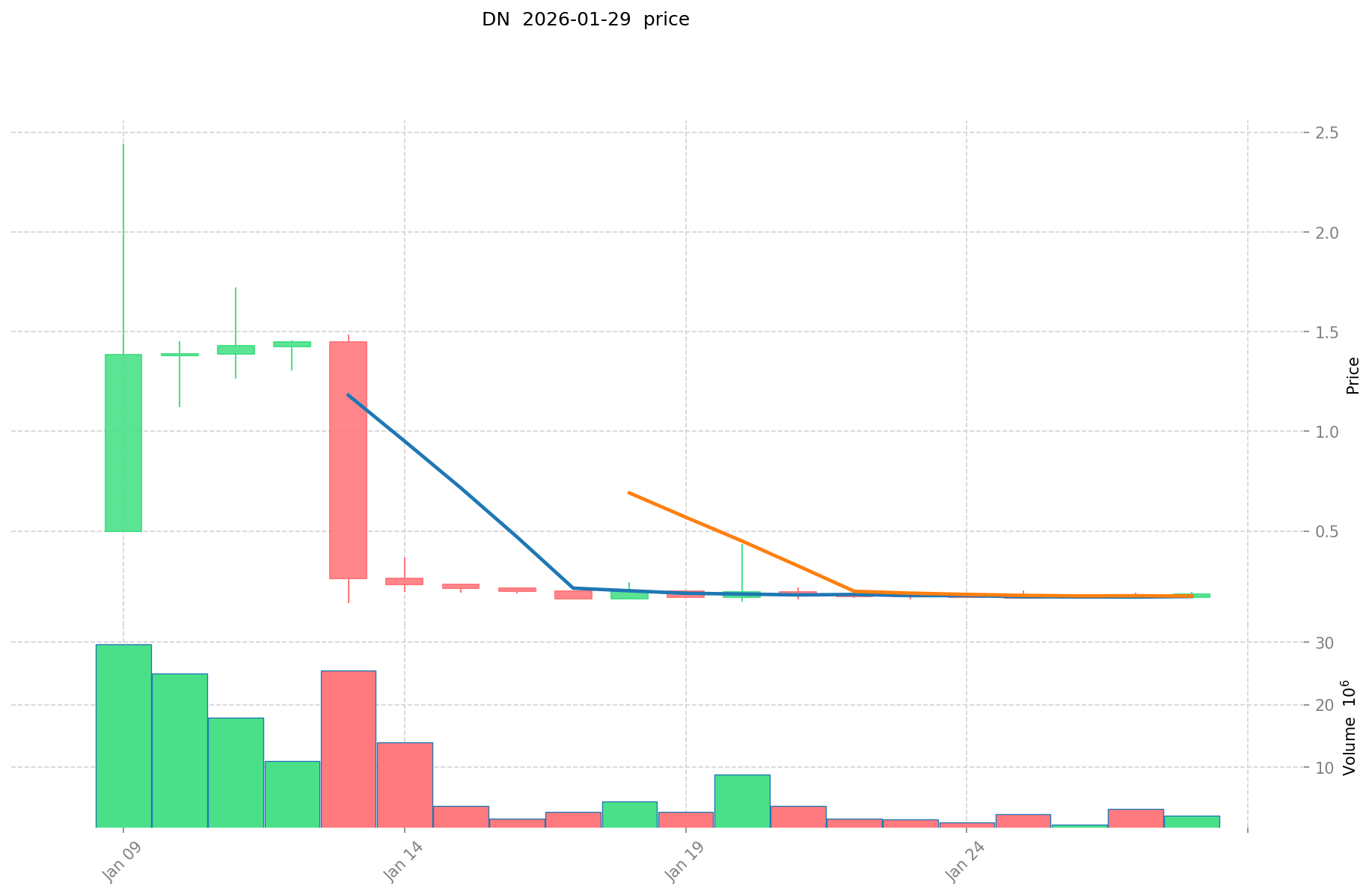
- January 9, 2026: Price reached $2.4426 during early trading phase → DN experienced substantial price movement in its first days of trading
- January 13, 2026: Market correction phase → Price adjusted from previous levels to $0.14, reflecting typical early-stage token price discovery dynamics
Current DN Investment Market Status (January 2026)
- DN current price: $0.1655
- 24-hour trading volume: $317,930.79
- Circulating supply: 22,500,000 DN (22.5% of total supply)
- Market capitalization: $3,723,750
- Fully diluted valuation: $16,550,000
- Number of holders: 39,972
- Listed on 15 exchanges
Click to view real-time DN market price
II. Core Factors Influencing Whether DN is a Good Investment (Is DeepNode(DN) a Good Investment)
Supply Mechanism and Scarcity (DN investment scarcity)
- Total supply capped at 100,000,000 DN tokens with current circulating supply of 22,500,000 tokens (22.5% circulation ratio) → creates potential scarcity dynamics affecting price and investment value
- Current market capitalization stands at $3,723,750 with fully diluted valuation at $16,550,000 → indicates room for valuation expansion as circulating supply increases
- Investment significance: The controlled supply release mechanism and maximum cap may support long-term investment considerations for participants evaluating scarcity-based value propositions
Institutional Investment and Mainstream Adoption (Institutional investment in DN)
- DeepNode maintains presence across 15 exchanges with approximately 39,972 token holders as of January 2026 → reflects growing market participation
- The project operates on BSC infrastructure with contract address verified on BscScan → provides transparency for institutional verification
- Investment positioning: DeepNode's Proof-of-Work-Relevance (PoWR) consensus mechanism aims to reward contributors based on actual utility rather than speculation → potentially appealing to entities focused on fundamental value assessment
Macroeconomic Environment Impact on DN Investment
- Decentralized AI infrastructure investment outlook: In the 2026 macro environment, market analysis suggests DeepNode represents a participant in the emerging decentralized AI infrastructure sector
- Price volatility indicators: DN experienced -88.16% change over 30-day period with 24-hour fluctuation of -14.07% → reflects high volatility characteristics requiring consideration in risk assessment
- Market conditions: Current price of $0.1655 compared to recorded high of $2.4426 (January 9, 2026) and low of $0.14 (January 13, 2026) → demonstrates significant price range within short timeframe
Technology and Ecosystem Development (Technology & Ecosystem for DN investment)
- Proof-of-Work-Relevance (PoWR) consensus mechanism: Proprietary system designed to reward network participants based on actual utility contributions → differentiates technical approach from speculation-focused models
- Decentralized AI infrastructure network: Enables developers, validators, miners, and enterprises to collaboratively build, deploy, and monetize AI models across industries → provides use case foundation for ecosystem development
- Investment consideration: DeepNode's price outlook depends on execution factors including mainnet development and adoption metrics → suggests investment evaluation should account for implementation milestones rather than market speculation alone
III. DN Future Investment Forecast and Price Outlook (Is DeepNode(DN) worth investing in 2026-2031)
Short-term Investment Forecast (2026, short-term DN investment outlook)
- Conservative forecast: $0.10 - $0.14
- Neutral forecast: $0.15 - $0.17
- Optimistic forecast: $0.17 - $0.18
Mid-term Investment Outlook (2027-2029, mid-term DeepNode(DN) investment forecast)
- Market stage expectation: DN may enter a development phase as the network continues building its decentralized AI infrastructure and expanding its PoWR consensus mechanism adoption.
- Investment return forecast:
- 2027: $0.14 - $0.25
- 2028: $0.19 - $0.26
- 2029: $0.20 - $0.26
- Key catalysts: Network expansion, AI model deployment growth, enterprise adoption, and overall crypto market sentiment.
Long-term Investment Outlook (Is DN a good long-term investment?)
- Base scenario: $0.20 - $0.26 (assuming steady ecosystem development and moderate AI sector growth)
- Optimistic scenario: $0.25 - $0.28 (assuming accelerated adoption and favorable market conditions)
- Risk scenario: $0.10 - $0.15 (in case of limited adoption or adverse market conditions)
Check DN long-term investment and price forecast: Price Prediction
2026-01-30 - 2031 Long-term Outlook
- Base scenario: $0.22 - $0.25 (corresponding to steady progress and gradual mainstream application)
- Optimistic scenario: $0.25 - $0.27 (corresponding to large-scale adoption and favorable market environment)
- Transformative scenario: Above $0.28 (if ecosystem achieves breakthrough progress and mainstream adoption)
- 2031-12-31 predicted high: $0.28 (based on optimistic development assumptions)
Disclaimer: The information provided is for reference only and does not constitute investment advice. Cryptocurrency investments carry significant risks, and past performance does not guarantee future results. Investors should conduct their own research and consult with financial advisors before making investment decisions.
| Year |
Predicted High Price |
Predicted Average Price |
Predicted Low Price |
Price Change |
| 2026 |
0.176066 |
0.1661 |
0.101321 |
0 |
| 2027 |
0.25320284 |
0.171083 |
0.14199889 |
3 |
| 2028 |
0.2630572208 |
0.21214292 |
0.1930500572 |
27 |
| 2029 |
0.258984076736 |
0.2376000704 |
0.199584059136 |
43 |
| 2030 |
0.27063836018912 |
0.248292073568 |
0.22097994547552 |
49 |
| 2031 |
0.277627782060059 |
0.25946521687856 |
0.246491956034632 |
56 |
IV. DeepNode Investment Strategy and Risk Management (How to invest in AI infrastructure tokens)
Investment Methodology (DeepNode investment strategy)
-
Long-term Holding (HODL DeepNode): This approach may suit investors who believe in the long-term development of decentralized AI infrastructure. Holding DN tokens could potentially align with the growth trajectory of the network's adoption across industries, though market conditions and project execution remain key variables.
-
Active Trading: Traders may leverage technical analysis and momentum strategies given DN's price volatility. The token has demonstrated significant price fluctuations, with a 24-hour change of -14.07% and a 30-day decline of -88.16%, suggesting opportunities for swing trading, though requiring careful risk assessment and timing.
Risk Management (Risk management for DeepNode investment)
V. DeepNode Investment Risks and Challenges (Risks of investing in AI infrastructure tokens)
-
Market Risk: DN has exhibited substantial volatility, with prices ranging from a high of $2.4426 (January 9, 2026) to a low of $0.14 (January 13, 2026). The current circulating supply represents 22.5% of maximum supply, which may lead to price pressure as additional tokens enter circulation. Trading volume of approximately $317,930 indicates relatively limited liquidity compared to major cryptocurrencies.
-
Regulatory Risk: Decentralized AI infrastructure projects operate in an evolving regulatory landscape. Different jurisdictions maintain varying approaches to cryptocurrency regulation and AI governance, creating uncertainty around compliance requirements and potential restrictions that could impact network operations and token utility.
-
Technical Risk: The proprietary Proof-of-Work-Relevance (PoWR) consensus mechanism represents a novel approach in the blockchain space. As with any new technology, potential vulnerabilities, implementation challenges, or scalability issues could emerge during network growth. The success of the platform depends on continuous technical development and the ability to attract developers, validators, and enterprise users.
VI. Conclusion: Is AI Infrastructure Token a Good Investment?
-
Investment Value Summary: DeepNode operates in the growing intersection of decentralized infrastructure and artificial intelligence, targeting collaboration among developers, validators, miners, and enterprises. The project's unique PoWR consensus mechanism aims to reward utility-based contributions. However, the token has experienced significant price volatility since launch, with an 88.16% decline over 30 days, reflecting early-stage market dynamics and broader cryptocurrency market conditions.
-
Investor Recommendations:
✅ Beginners: Consider dollar-cost averaging (DCA) strategies to mitigate timing risk, and prioritize secure wallet storage for any holdings
✅ Experienced Investors: May explore swing trading opportunities while maintaining diversified portfolio allocation and implementing stop-loss measures
✅ Institutional Investors: Could evaluate strategic positioning based on long-term AI infrastructure trends, though thorough due diligence on technology implementation and market adoption is essential
⚠️ Disclaimer: Cryptocurrency investments carry substantial risk due to market volatility, regulatory uncertainty, and technological factors. This content is for informational purposes only and does not constitute financial advice. Investors should conduct independent research and consult qualified financial advisors before making investment decisions.
VII. FAQ
Q1: What is DeepNode (DN) and how does its Proof-of-Work-Relevance (PoWR) mechanism work?
DeepNode is a decentralized AI infrastructure network that launched in January 2026, utilizing a proprietary Proof-of-Work-Relevance (PoWR) consensus mechanism. Unlike traditional proof-of-work systems that reward computational power alone, PoWR rewards network participants based on actual utility contributions to the ecosystem. The platform facilitates collaboration among developers, validators, miners, and enterprises to build, deploy, and monetize AI models across various industries. The mechanism aims to align incentives with productive network activity rather than speculative participation, distinguishing DN's technical approach from conventional blockchain consensus models.
Q2: What are the key metrics and current market status of DeepNode as of January 2026?
As of January 30, 2026, DeepNode maintains a market capitalization of approximately $3.72 million with a current price around $0.1655. The circulating supply stands at 22.5 million tokens, representing 22.5% of the maximum supply of 100 million DN tokens. The token is listed on 15 exchanges with approximately 39,972 holders and a 24-hour trading volume of $317,930.79. The fully diluted valuation reaches $16.55 million. Since its launch on January 8, 2026, DN has experienced significant price volatility, ranging from a high of $2.4426 on January 9 to a low of $0.14 on January 13, reflecting typical early-stage token price discovery dynamics.
Q3: What price forecasts exist for DeepNode from 2026 to 2031?
For 2026, short-term forecasts include: conservative ($0.10-$0.14), neutral ($0.15-$0.17), and optimistic ($0.17-$0.18) scenarios. Mid-term projections suggest: 2027 ($0.14-$0.25), 2028 ($0.19-$0.26), and 2029 ($0.20-$0.26). Long-term outlook for 2031 indicates a predicted high of $0.28, average of $0.26, and low of $0.25 under optimistic development assumptions. Base scenario projections for 2031 range between $0.22-$0.25, while transformative scenarios could exceed $0.28 if the ecosystem achieves breakthrough adoption. These forecasts depend on network expansion, AI model deployment growth, enterprise adoption, and overall cryptocurrency market sentiment.
Q4: What are the main investment risks associated with DeepNode tokens?
DeepNode presents three primary risk categories: Market Risk includes substantial price volatility, with DN declining 88.16% over 30 days and experiencing significant daily fluctuations, plus limited liquidity compared to major cryptocurrencies. Regulatory Risk encompasses uncertainty around cryptocurrency and AI governance across different jurisdictions, potentially impacting network operations and token utility. Technical Risk involves the novel PoWR consensus mechanism's potential vulnerabilities, implementation challenges, scalability issues, and dependency on continuous technical development to attract developers, validators, and enterprise users. Additionally, the current circulating supply of 22.5% may create price pressure as additional tokens enter circulation.
Q5: What investment strategies and portfolio allocation recommendations apply to DeepNode?
Two primary investment approaches exist: Long-term Holding (HODL) suits investors believing in decentralized AI infrastructure's long-term development, aligning with network adoption growth trajectories. Active Trading leverages technical analysis and momentum strategies, capitalizing on DN's significant price volatility for swing trading opportunities. Regarding asset allocation: conservative investors should limit exposure to 1-3% of total portfolio, moderate investors may allocate 3-5%, while experienced investors could consider 5-10% with active monitoring. Risk management includes portfolio diversification across multiple blockchain projects and traditional assets, plus secure storage solutions: hot wallets for trading portions, cold wallets for long-term holdings, and hardware wallets (Ledger, Trezor) for significant positions.
Q6: How does DeepNode's supply mechanism impact its investment characteristics?
DeepNode implements a controlled supply mechanism with a total cap of 100 million DN tokens, of which 22.5 million (22.5%) currently circulate. This creates potential scarcity dynamics that may influence price and investment value over time. The current market capitalization of $3.72 million compared to a fully diluted valuation of $16.55 million indicates substantial room for valuation expansion as circulating supply increases. The controlled supply release mechanism and maximum cap may support long-term investment considerations for participants evaluating scarcity-based value propositions, though investors should account for potential price pressure as additional tokens enter circulation through network rewards and ecosystem development activities.
Q7: What factors should investors consider when evaluating DeepNode's investment potential?
Key evaluation factors include: Ecosystem Development - progress in mainnet development, adoption metrics, and enterprise integration success determine fundamental value. Market Positioning - DN's presence across 15 exchanges and 39,972 holders reflects growing participation, while BSC infrastructure provides transparency for institutional verification. Technology Differentiation - the PoWR mechanism's ability to reward utility-based contributions versus speculative models distinguishes DN's approach. Macroeconomic Context - broader cryptocurrency market conditions and AI infrastructure sector trends significantly impact price performance. Investors should prioritize fundamental analysis over short-term price movements, conducting independent research and consulting financial advisors before making investment decisions, as cryptocurrency investments carry substantial risk and past performance does not guarantee future results.
Q8: What secure storage options exist for DeepNode tokens and which suit different investor profiles?
Three primary storage solutions accommodate different investment approaches: Hot Wallets suit active traders requiring frequent access, though users should verify platform security credentials and implement two-factor authentication. Cold Wallets (offline storage) are recommended for long-term holdings, minimizing exposure to online security threats and providing enhanced protection for substantial positions. Hardware Wallets such as Ledger or Trezor devices offer optimal security for significant holdings, combining offline storage with user-controlled private keys. Investors should match storage solutions to their trading frequency and holding period: active traders may maintain trading portions in secure hot wallets while storing long-term holdings in cold or hardware wallets, implementing a tiered security approach based on allocation size and risk tolerance.
* The information is not intended to be and does not constitute financial advice or any other recommendation of any sort offered or endorsed by Gate.