DeepNode (DN) is a decentralized AI infrastructure token operating on BSC as a BEP-20 asset with a market cap of $3.82 million and current price around $0.17. This comprehensive analysis evaluates DN's investment viability through multiple dimensions: market performance showing 87.87% decline over 30 days but available on 15 exchanges including Gate; technology fundamentals featuring proprietary Proof-of-Work-Relevance consensus rewarding utility-based contributions; and risk assessment covering market volatility, regulatory uncertainty, and technical dependencies. The article examines price forecasts spanning 2026-2031, ranging from conservative projections of $0.14-$0.27 to optimistic scenarios above $0.35. Investment recommendations differentiate strategies for beginners, experienced traders, and institutional investors, emphasizing risk management through portfolio allocation (1-15% depending on risk tolerance), secure BEP-20 wallet storage, and dollar-cost averaging approaches. While DN represents early-
Introduction: DeepNode (DN)'s Investment Position and Market Prospects
DN is an emerging asset in the cryptocurrency sector, serving as a decentralized AI infrastructure network that enables developers, validators, miners, and enterprises to collaboratively build, deploy, and monetize AI models across industries. As of January 30, 2026, DeepNode holds a market capitalization of approximately $3.82 million, with a circulating supply of 22.5 million tokens and a current price around $0.17. The token has experienced notable volatility, with a 24-hour trading volume of approximately $343,716 and recent price fluctuations showing a 7.39% decrease over the past day. Operating on the BEP-20 standard within the BSC ecosystem, DN employs a proprietary Proof-of-Work-Relevance (PoWR) consensus mechanism that rewards contributors based on actual utility. With approximately 39,972 holders and listing on 15 exchanges, DeepNode has attracted attention from investors evaluating "Is DeepNode (DN) a good investment?" This article provides a comprehensive analysis of DN's investment value, historical trends, future price predictions, and associated risks to assist investors in making informed decisions.
I. DeepNode (DN) Price History Review and Investment Value Status
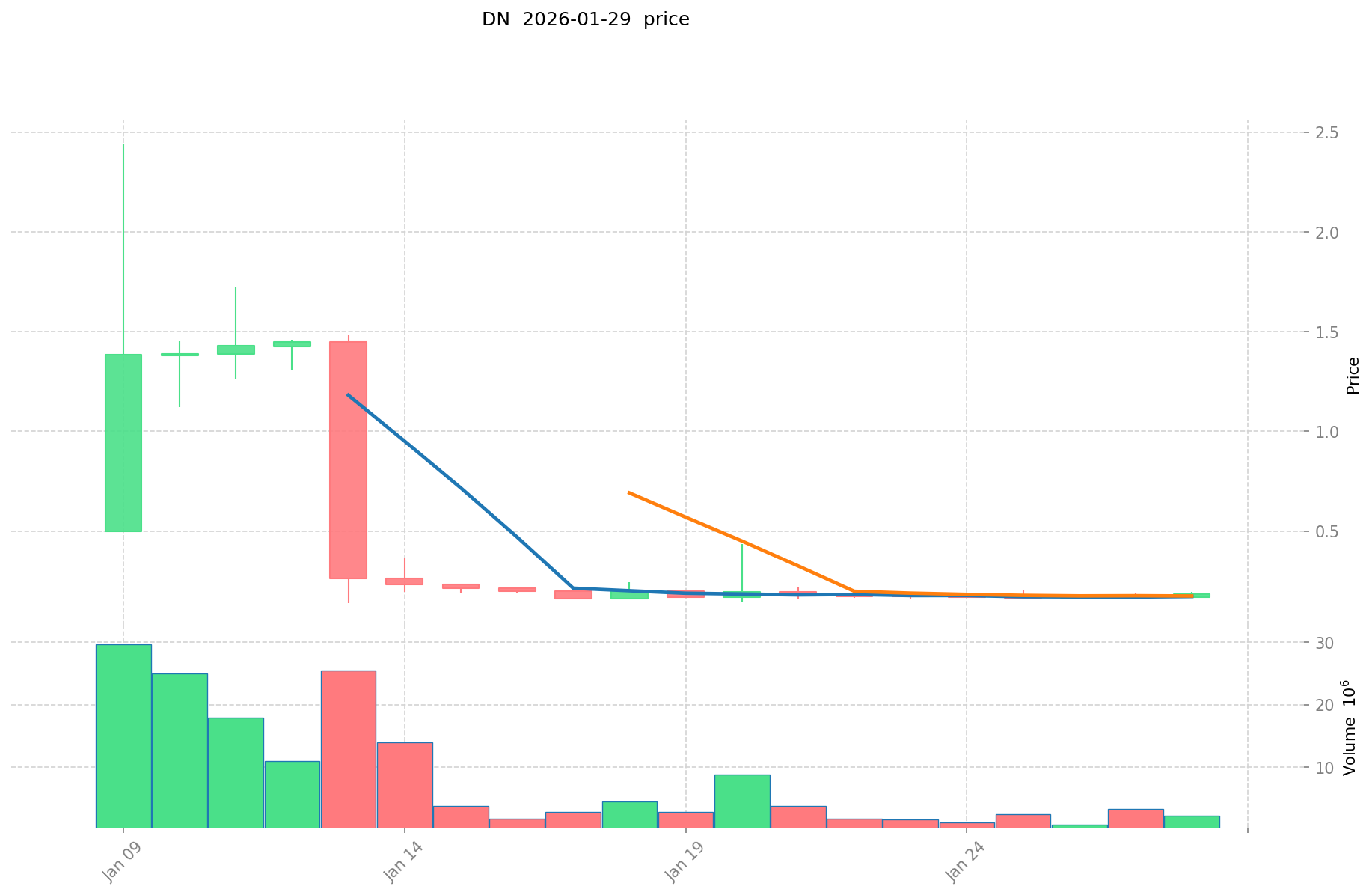
- January 2026: DeepNode experienced significant volatility after its launch on January 8, 2026 → Price fluctuated from an early peak of $2.4426 to subsequent decline
- January 13, 2026: Market correction occurred → DN price reached a lower level of $0.14
- Mid to Late January 2026: Downward trend continued → Price declined from higher levels to current range around $0.17
Current DN Investment Market Status (January 2026)
- DN current price: $0.1699
- 24-hour trading volume: $343,716.48
- Market capitalization: $3,822,750
- Circulating supply: 22,500,000 DN (22.5% of total supply)
- Fully diluted valuation: $16,990,000
- Market share: 0.00056%
- Price changes: -0.29% (1H), -7.39% (24H), -3.96% (7D), -87.87% (30D)
- Total supply: 100,000,000 DN
- Holder count: 39,972
- Available on: 15 exchanges
Click to view real-time DN market price
II. Core Factors Influencing Whether DN is a Good Investment
Supply Mechanism and Scarcity (DN investment scarcity)
- DeepNode has a maximum supply cap of 100,000,000 DN tokens, with a current circulating supply of 22,500,000 tokens, representing 22.5% of the total supply.
- The fixed maximum supply creates a defined scarcity model that may influence long-term value dynamics as adoption expands.
- Investment consideration: the controlled supply structure could serve as a foundational element for long-term valuation assessment, though market performance depends on multiple factors beyond supply metrics.
Institutional Investment and Mainstream Adoption (Institutional investment in DN)
- DeepNode has secured listings on Gate, KuCoin, and Binance Alpha, providing access to institutional-grade trading infrastructure and enhanced market reach.
- The token is currently available on 15 exchanges, reflecting early-stage market distribution efforts.
- Network participation shows 39,972 holders as of January 30, 2026, indicating growing user adoption in the decentralized AI infrastructure sector.
Macroeconomic Environment's Impact on DN Investment
- As a decentralized AI infrastructure token, DN's investment profile may be influenced by broader trends in AI technology adoption and blockchain infrastructure development.
- Market conditions and investor sentiment toward emerging technology sectors can affect liquidity and price volatility.
- The token operates within the evolving landscape of decentralized computing networks, where demand patterns may correlate with AI model deployment needs and computational resource pricing.
Technology and Ecosystem Development (Technology & Ecosystem for DN investment)
- DeepNode employs a proprietary Proof-of-Work-Relevance (PoWR) consensus mechanism designed to reward contributors based on utility rather than speculative activity.
- The network provides infrastructure for developers, validators, miners, and enterprises to build, deploy, and monetize AI models across industries.
- The platform's BEP-20 token standard on BSC enables integration with existing DeFi protocols and cross-chain compatibility.
- Ecosystem development focuses on decentralized AI infrastructure, positioning the project within the intersection of artificial intelligence and blockchain technology sectors.
III. DN Future Investment Forecast and Price Outlook (Is DeepNode(DN) worth investing in 2026-2031)
Short-term Investment Forecast (2026, short-term DN investment outlook)
- Conservative forecast: $0.14 - $0.17
- Neutral forecast: $0.17 - $0.19
- Optimistic forecast: $0.19 - $0.21
Based on current market data, DN exhibits noticeable volatility in the short term. The token has experienced a decline of approximately 7.39% over the past 24 hours, with a 30-day drop of 87.87%. However, data from certain sources suggest a potential recovery trend within a 7-30 day timeframe. Given the current circulating supply of 22.5 million DN (22.5% of total supply) and the relatively low market capitalization, price movements may be influenced by liquidity conditions and market sentiment fluctuations.
Mid-term Investment Outlook (2027-2028, mid-term DeepNode(DN) investment forecast)
- Market stage expectation: transition from initial price discovery to gradual ecosystem development phase
- Investment return forecast:
- 2027: $0.09 - $0.21
- 2028: $0.11 - $0.25
- Key catalysts: expansion of the decentralized AI infrastructure network, growth in developer and validator participation, and potential integration with enterprise AI deployment solutions
During the mid-term period, DN's performance may be tied to the maturation of its Proof-of-Work-Relevance (PoWR) consensus mechanism and the practical utility demonstrated by AI model deployment activities. The token's value proposition centers on rewarding contributions based on actual utility rather than speculation, which could attract long-term participants as the ecosystem develops.
Long-term Investment Outlook (Is DN a good long-term investment?)
- Base scenario: $0.25 - $0.31 (assuming steady ecosystem growth and maintained market position)
- Optimistic scenario: $0.31 - $0.35 (assuming accelerated adoption of decentralized AI infrastructure and favorable market conditions)
- Risk scenario: below $0.14 (under adverse market conditions or significant competitive pressure)
For detailed DN long-term investment and price forecast: Price Prediction
2026-01-30 to 2031 Long-term Outlook
- Base scenario: $0.14 - $0.27 (corresponding to stable progress and steady growth in mainstream application)
- Optimistic scenario: $0.31 - $0.35 (corresponding to large-scale adoption and favorable market environment)
- Transformational scenario: above $0.35 (subject to breakthrough developments in the ecosystem and mainstream adoption)
- Predicted high by 2031-12-31: $0.35 (based on optimistic development assumptions)
Disclaimer: Price forecasts are based on historical data, current market conditions, and project fundamentals. Cryptocurrency markets are highly volatile and subject to various risks including regulatory changes, technological developments, and market sentiment shifts. These forecasts do not constitute financial advice and should not be relied upon as the sole basis for investment decisions. Actual results may differ materially from projections.
| Year |
Predicted High Price |
Predicted Average Price |
Predicted Low Price |
Price Change |
| 2026 |
0.190857 |
0.1689 |
0.141876 |
0 |
| 2027 |
0.206860275 |
0.1798785 |
0.091738035 |
5 |
| 2028 |
0.25138020375 |
0.1933693875 |
0.11215424475 |
13 |
| 2029 |
0.311324713875 |
0.222374795625 |
0.1289773814625 |
30 |
| 2030 |
0.3495731787225 |
0.26684975475 |
0.25617576456 |
57 |
| 2031 |
0.351361072079325 |
0.30821146673625 |
0.246569173389 |
81 |
IV. DeepNode Investment Strategy and Risk Management (How to invest in DeepNode)
Investment Methodology (DeepNode investment strategy)
Long-term Holding (HODL DeepNode)
For conservative investors seeking stable exposure to decentralized AI infrastructure, a long-term holding strategy may be appropriate. This approach involves acquiring DN tokens and maintaining positions through market cycles, based on confidence in the project's fundamental value proposition. Given DeepNode's focus on AI model deployment and its Proof-of-Work-Relevance (PoWR) consensus mechanism, long-term holders typically evaluate the network's utility growth and adoption metrics rather than short-term price movements.
Active Trading
Active traders may engage with DN through technical analysis and swing trading strategies. With a 24-hour trading volume of approximately $343,716 and price fluctuations between $0.1618 and $0.195 in the recent 24-hour period, there exist opportunities for short-term position management. Traders typically monitor support and resistance levels, volume patterns, and broader cryptocurrency market sentiment to inform entry and exit decisions.
Risk Management (Risk management for DeepNode investment)
Asset Allocation Ratios
- Conservative Investors: Consider limiting DeepNode exposure to 1-3% of total cryptocurrency portfolio allocation, given the asset's volatility characteristics
- Moderate Investors: May allocate 3-7% of crypto holdings to DN, balancing growth potential with risk exposure
- Experienced Investors: Could consider 7-15% allocation as part of a diversified AI-focused crypto strategy, depending on risk tolerance and market analysis
Risk Hedging Solutions
A multi-asset portfolio approach can help manage DeepNode-specific risks. Investors may consider:
- Diversification across multiple cryptocurrency sectors (Layer 1 protocols, DeFi, AI infrastructure)
- Correlation analysis with major cryptocurrencies to understand portfolio behavior
- Position sizing based on volatility metrics and personal risk tolerance
- Regular portfolio rebalancing to maintain target allocation ratios
Secure Storage
Given that DN operates on the BSC (BNB Smart Chain) network as a BEP-20 token, investors should prioritize security:
- Cold Wallets: Hardware wallets supporting BEP-20 tokens provide enhanced security for long-term holdings
- Hot Wallets: Software wallets with multi-signature capabilities for active trading positions
- Hardware Wallet Recommendations: Devices compatible with BSC network that support BEP-20 token standards
- Security Practices: Enable two-factor authentication, verify contract addresses (0x9b6a1d4fa5d90e5f2d34130053978d14cd301d58), and conduct small test transactions before large transfers
V. DeepNode Investment Risks and Challenges (Risks of investing in DeepNode)
Market Risk
High Volatility
DeepNode demonstrates significant price volatility characteristics. The token experienced a 7.39% decline over 24 hours and a 30-day depreciation of approximately 87.87%. The price has traded between an all-time high of $2.4426 (January 9, 2026) and an all-time low of $0.14 (January 13, 2026), illustrating substantial price swings within short timeframes. Such volatility presents both opportunity and risk for market participants.
Market Liquidity Considerations
With a market capitalization of approximately $3.82 million and 24-hour trading volume of $343,716, DeepNode operates within a relatively limited liquidity environment compared to larger cryptocurrency projects. Lower liquidity can result in increased price slippage during larger transactions and potentially wider bid-ask spreads.
Regulatory Risk
Policy Uncertainty Across Jurisdictions
Cryptocurrency regulation varies significantly across different countries and continues to evolve. Projects focused on AI infrastructure and decentralized networks may face:
- Changing regulatory frameworks for cryptocurrency classification and taxation
- Potential restrictions on AI-related blockchain applications in certain jurisdictions
- Compliance requirements that may affect project development or token accessibility
- Cross-border regulatory coordination challenges affecting international operations
Investors should monitor regulatory developments in their respective jurisdictions and consider how policy changes might impact DeepNode's operations and token utility.
Technical Risk
Network Security Considerations
As a BEP-20 token on the BSC network, DeepNode inherits both the benefits and risks associated with this infrastructure. Technical risks include:
- Smart contract vulnerabilities that could affect token functionality or security
- Dependency on BSC network performance and security
- Potential exploits or attacks targeting the broader ecosystem
- Integration risks with AI model deployment infrastructure
Development and Upgrade Challenges
The implementation of the Proof-of-Work-Relevance (PoWR) consensus mechanism represents an innovative approach to rewarding network contributors. However, novel technical implementations may face:
- Unexpected technical issues during network upgrades or modifications
- Challenges in scaling the network as adoption grows
- Coordination requirements among developers, validators, and miners
- Potential delays in roadmap execution or feature deployment
VI. Conclusion: Is DeepNode a Good Investment?
Investment Value Summary
DeepNode represents a project at the intersection of decentralized infrastructure and artificial intelligence, addressing the growing need for collaborative AI model development and deployment. With a circulating supply of 22.5 million tokens (22.5% of maximum supply) and presence on 15 exchanges, the project demonstrates early-stage market establishment. The proprietary PoWR consensus mechanism differentiates DeepNode from traditional proof-of-work or proof-of-stake systems by emphasizing utility-based rewards.
However, significant price volatility and recent sharp corrections (87.87% decline over 30 days) indicate that short-term price movements remain highly unpredictable. The project's relatively small market capitalization and limited liquidity suggest it remains in an early development phase, with corresponding risk-reward characteristics.
Investor Recommendations
✅ Beginners
- Consider dollar-cost averaging (DCA) approach to mitigate timing risk
- Store DN tokens in secure hardware wallets compatible with BEP-20 standards
- Limit initial exposure to amounts comfortable with complete loss potential
- Thoroughly research the project's whitepaper and technical documentation before investing
- Start with small positions to understand price behavior and market dynamics
✅ Experienced Investors
- Implement swing trading strategies based on technical analysis and volume patterns
- Maintain portfolio diversification across multiple cryptocurrency sectors
- Monitor project development milestones and network growth metrics
- Consider position sizing based on volatility-adjusted risk metrics
- Establish clear entry, exit, and stop-loss parameters aligned with risk tolerance
✅ Institutional Investors
- Evaluate DeepNode within broader AI infrastructure and decentralized computing thesis
- Conduct comprehensive due diligence on technical architecture and team capabilities
- Consider strategic allocation as part of venture-style cryptocurrency portfolio
- Assess regulatory implications across relevant operating jurisdictions
- Monitor network adoption metrics and developer activity as key performance indicators
⚠️ Disclaimer: Cryptocurrency investments carry substantial risk, including the possibility of complete capital loss. This content provides information for educational purposes and does not constitute investment advice. Price volatility, regulatory uncertainty, and technical risks characterize the cryptocurrency market. Individuals should conduct independent research, assess personal risk tolerance, and consider consulting qualified financial advisors before making investment decisions.
VII. FAQ
Q1: What is DeepNode (DN) and what makes it different from other cryptocurrency projects?
DeepNode is a decentralized AI infrastructure network that enables developers, validators, miners, and enterprises to collaboratively build, deploy, and monetize AI models across industries. The key differentiator is its proprietary Proof-of-Work-Relevance (PoWR) consensus mechanism, which rewards contributors based on actual utility rather than speculative activity or computational power alone. Operating as a BEP-20 token on the BSC network, DN combines blockchain infrastructure with AI model deployment capabilities, positioning itself at the intersection of two rapidly evolving technology sectors.
Q2: Why has DeepNode experienced such significant price volatility since launch?
DN launched on January 8, 2026, with an initial peak of $2.4426 before declining approximately 87.87% over the following 30 days to current levels around $0.17. This extreme volatility stems from several factors: the token's early-stage status with limited market history, relatively low liquidity (24-hour volume of approximately $343,716), and a small market capitalization of $3.82 million. Additionally, only 22.5% of the total supply is currently in circulation, which can amplify price movements. Early-stage cryptocurrency projects typically experience significant price discovery phases as the market establishes valuation benchmarks.
Q3: Is DeepNode suitable for long-term investment or better for short-term trading?
The answer depends on investment objectives and risk tolerance. For long-term holders, DeepNode's value proposition centers on the growth potential of decentralized AI infrastructure and the utility of its PoWR consensus mechanism. Conservative investors might allocate 1-3% of their portfolio for long-term holding based on fundamental technology assessment. For active traders, DN's volatility (7.39% 24-hour decline, price range of $0.1618-$0.195 recently) presents opportunities for swing trading strategies based on technical analysis. However, the limited liquidity environment requires careful position sizing to manage slippage risks during larger transactions.
Q4: What are the main risks associated with investing in DeepNode?
DeepNode presents multiple risk categories that investors should evaluate: (1) Market Risk - extreme volatility with an 87.87% 30-day decline and fluctuation between all-time high of $2.4426 and low of $0.14; (2) Liquidity Risk - relatively small market capitalization and trading volume may result in price slippage and wider bid-ask spreads; (3) Regulatory Risk - evolving cryptocurrency regulations and potential restrictions on AI-related blockchain applications across different jurisdictions; (4) Technical Risk - smart contract vulnerabilities, dependency on BSC network security, and implementation challenges with the novel PoWR consensus mechanism. The project remains in an early development phase, carrying corresponding risk-reward characteristics.
Q5: What are the price predictions for DeepNode through 2031?
Based on current analysis, short-term forecasts for 2026 range from $0.14 (conservative) to $0.21 (optimistic). Mid-term predictions suggest $0.09-$0.21 for 2027 and $0.11-$0.25 for 2028, depending on ecosystem development and network adoption. Long-term projections through 2031 range from a base scenario of $0.25-$0.31 to an optimistic scenario of $0.31-$0.35, with transformational potential above $0.35 under breakthrough adoption conditions. These forecasts assume continued ecosystem development, increased validator participation, and integration with enterprise AI deployment solutions. However, cryptocurrency markets remain highly unpredictable, and actual results may differ materially from projections due to market sentiment, regulatory changes, technological developments, and competitive dynamics.
Q6: How should investors store DeepNode tokens securely?
Since DeepNode operates as a BEP-20 token on the BSC (BNB Smart Chain) network, investors should prioritize security through appropriate storage solutions. For long-term holdings, cold storage using hardware wallets compatible with BEP-20 tokens and BSC network provides enhanced security against online threats. For active trading positions, software wallets with multi-signature capabilities offer balance between accessibility and security. Essential security practices include enabling two-factor authentication, verifying the correct contract address (0x9b6a1d90e5f2d34130053978d14cd301d58), conducting small test transactions before large transfers, and maintaining backup recovery phrases in secure offline locations. Investors should never share private keys or recovery phrases and should use reputable wallet providers with established security track records.
Q7: What factors should I monitor to evaluate DeepNode's investment potential?
Key evaluation metrics include: (1) Network Growth - monitor the number of holders (currently 39,972), developer participation, and validator activity on the network; (2) Ecosystem Development - track implementation progress of the PoWR consensus mechanism and real-world AI model deployment use cases; (3) Market Metrics - observe trading volume trends, liquidity improvements, and exchange listings beyond the current 15 platforms; (4) Token Economics - monitor circulation supply increases from the current 22.5% toward the maximum 100 million token cap; (5) Technical Milestones - follow project roadmap execution, network upgrades, and security audit results; (6) Competitive Landscape - assess developments in decentralized AI infrastructure and positioning relative to alternative projects; (7) Regulatory Environment - track policy changes affecting cryptocurrency and AI-blockchain integration across relevant jurisdictions.
Q8: What allocation strategy is appropriate for DeepNode in a cryptocurrency portfolio?
Portfolio allocation should align with individual risk tolerance and investment experience. Conservative investors might consider limiting DeepNode exposure to 1-3% of total cryptocurrency holdings, given the asset's significant volatility characteristics and early-stage development status. Moderate investors comfortable with higher risk exposure may allocate 3-7% as part of a diversified cryptocurrency strategy that includes exposure to multiple sectors. Experienced investors with specific interest in AI infrastructure and tolerance for volatility could consider 7-15% allocation, though this should be balanced with holdings in more established cryptocurrencies and traditional assets. Regardless of allocation percentage, investors should implement regular portfolio rebalancing to maintain target ratios and consider dollar-cost averaging to mitigate timing risks in this highly volatile asset.
* The information is not intended to be and does not constitute financial advice or any other recommendation of any sort offered or endorsed by Gate.