This comprehensive analysis evaluates Dego Finance (DEGO) as an investment opportunity by examining its position as a cross-chain NFT+DeFi protocol. Currently trading at $0.42 with an $8.87 million market cap, DEGO provides infrastructure for NFT creation, mining, auctions, and trading across Ethereum and Binance Smart Chain. The article reviews historical performance from its $1.19 launch price to a $33.41 peak, covering tokenomics with 21 million fully circulated tokens, current market metrics showing 1,138 holders across 16 exchanges, and technical specifications. Investment strategies range from conservative dollar-cost averaging to active trading approaches, with detailed risk management guidance addressing market volatility, regulatory uncertainty, and technical challenges. Price scenarios outline baseline, optimistic, and risk-based ranges through 2031, while FAQ sections address investor questions across experience levels. The analysis concludes that DEGO suits tactical positioning within NFT/DeFi por
Introduction: Dego Finance (DEGO) Investment Position and Market Prospects
DEGO is a notable asset in the cryptocurrency space, having been launched in September 2020 and achieving recognition in the cross-chain NFT and DeFi sectors. As of January 2026, DEGO maintains a market capitalization of approximately $8.87 million, with a circulating supply of 21 million tokens and a current price around $0.42. Positioned as a cross-chain NFT+DeFi protocol and infrastructure platform, DEGO has become a subject of discussion among investors evaluating "Is Dego Finance (DEGO) a good investment?" This article provides a comprehensive analysis of DEGO's investment characteristics, historical performance, future price considerations, and associated risks to serve as a reference for investors.
DEGO operates as an open NFT ecosystem that enables users to create, mine, auction, and trade NFTs while providing cross-chain infrastructure for blockchain projects. The platform features various NFT management tools including NFT Foundry for creating unique digital assets, NFT mining mechanisms, auction systems, and the Treasureland marketplace. As the native utility token, DEGO serves multiple functions including platform governance, user incentives, NFT operations (minting, staking, auction, trading), and value capture through transaction contributions.
Currently ranked 1258 by market capitalization with a dominance of 0.00028%, DEGO is available on 16 exchanges and has approximately 1,138 token holders. The token has experienced notable price volatility since its launch, with historical data showing a launch price of $1.19 in 2020 and a peak of $33.41 in March 2021. Recent performance indicates a 24-hour trading volume of $26,891 and price movements showing a decline of 0.3% over 24 hours, 8.21% over 7 days, and 78.33% over the past year. With full token circulation achieved (100% of max supply), DEGO's market cap equals its fully diluted valuation at $8.87 million.
I. DEGO Price History Review and Current Investment Value
- 2021: DEGO reached a notable peak at $33.41 on March 14, representing a significant return for early-stage investors who participated during the project's initial launch period
- 2022-2023: During the extended bear market cycle, the token experienced substantial price correction from its previous peak to below $2.00
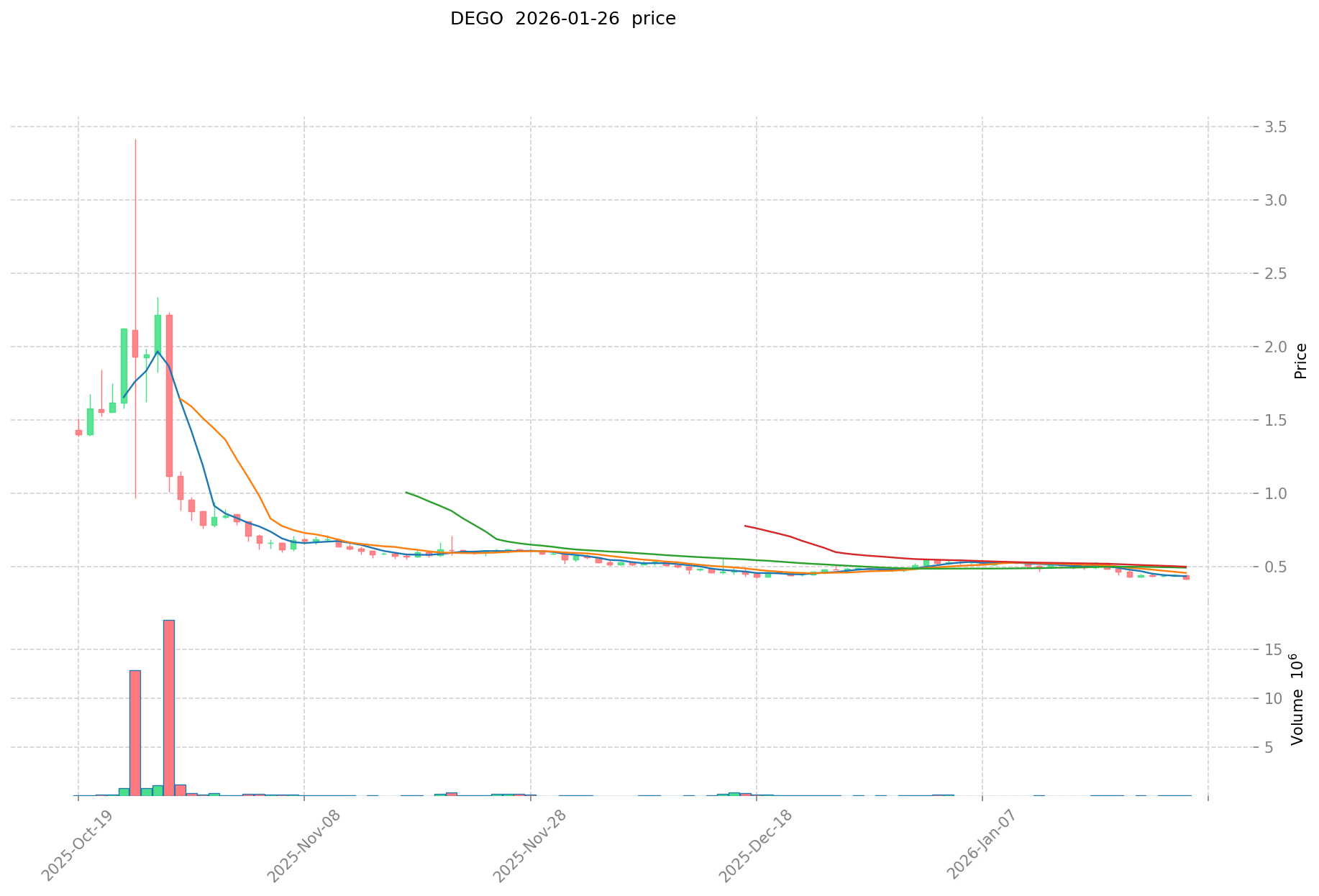
- 2024-2025: As of January 2026, DEGO trades at $0.4225, reflecting the broader market recovery patterns observed across the digital asset sector
Current DEGO Investment Market Status (January 2026)
- DEGO Current Price: $0.4225
- 24-hour Trading Volume: $26,891.83
- Market Capitalization: $8,872,500
- Circulating Supply: 21,000,000 DEGO (100% of maximum supply)
- Recent Price Movement: -0.3% (24h), -8.21% (7d), -12.49% (30d)
Click to view real-time DEGO market price
II. Core Factors Affecting Whether DEGO is a Good Investment (Is Dego Finance(DEGO) a Good Investment)
Supply Mechanism and Scarcity (DEGO investment scarcity)
- Fixed Supply Model → DEGO has a maximum supply of 21,000,000 tokens with full circulation already achieved, which may contribute to scarcity-driven value dynamics
- Historical Price Patterns: The token previously experienced significant price appreciation, reaching elevated levels in early 2021, though current valuations reflect a substantial decline from those peaks
- Investment Implication: The capped supply structure provides a fundamental scarcity element that could support long-term investment considerations, though market performance depends on multiple additional factors
Institutional Investment and Mainstream Adoption (Institutional investment in DEGO)
- Current Market Position: DEGO maintains a market capitalization of approximately $8,872,500 with a ranking of #1258 among digital assets, suggesting a relatively modest institutional footprint
- Holder Distribution: The token has approximately 1,138 holders, indicating a developing community base
- Exchange Availability: DEGO is listed on 16 exchanges, providing reasonable accessibility for investment participation
Macroeconomic Environment Impact on DEGO Investment
- Market Sentiment Indicators: Current technical indicators suggest cautious market conditions, with moving averages reflecting downward trends in recent periods
- Volatility Characteristics: Recent price movements show fluctuations ranging from $0.4123 to $0.4353 within 24-hour periods, indicating moderate short-term volatility
- Broader Market Dynamics: As with other digital assets, DEGO's investment attractiveness may be influenced by general monetary policy shifts, inflation hedging considerations, and global economic uncertainty, though specific correlations require ongoing assessment
Technology and Ecosystem Development (Technology & Ecosystem for DEGO investment)
- Cross-chain Infrastructure: DEGO operates as a cross-chain NFT+DeFi protocol providing infrastructure for NFT creation, mining, auction, and trading activities
- Platform Functionality: The ecosystem includes multiple components such as NFT Foundry for creating unique digital assets, NFT mining mechanisms, auction systems, and the Treasureland marketplace
- Technical Foundation: The protocol supports both ERC20 and BEP20 token standards through deployments on Ethereum and BSC networks, enabling broader ecosystem interoperability
- Governance and Utility: DEGO tokens serve multiple functions including platform governance, user incentive programs, NFT-related operations, and ecosystem fee structures, which provide fundamental utility supporting long-term value considerations
III. DEGO Future Investment Predictions and Price Outlook (Is Dego Finance(DEGO) worth investing in 2026-2031)
Short-term Investment Prediction (2026, short-term DEGO investment outlook)
- Conservative prediction: $0.23 - $0.42
- Neutral prediction: $0.42 - $0.52
- Optimistic prediction: $0.52 - $0.62
Mid-term Investment Outlook (2027-2029, mid-term Dego Finance(DEGO) investment forecast)
- Market stage expectation: The token may experience gradual growth as the NFT and DeFi sectors continue to evolve, with potential fluctuations influenced by broader market conditions and ecosystem developments.
- Investment return prediction:
- 2027: $0.44 - $0.57
- 2028: $0.29 - $0.77
- 2029: $0.60 - $0.71
- Key catalysts: NFT market dynamics, cross-chain infrastructure adoption, platform governance developments, and overall crypto market trends.
Long-term Investment Outlook (Is DEGO a good long-term investment?)
- Baseline scenario: $0.36 - $0.88 (assuming steady ecosystem growth and moderate market conditions)
- Optimistic scenario: $0.63 - $1.12 (assuming enhanced adoption of NFT+DeFi protocols and favorable market environment)
- Risk scenario: $0.22 - $0.44 (under adverse market conditions or limited ecosystem expansion)
Click to view DEGO long-term investment and price prediction: Price Prediction
2026-01-27 - 2031 Long-term Outlook
- Baseline scenario: $0.36 - $0.88 (corresponding to steady progress and gradual mainstream application growth)
- Optimistic scenario: $0.63 - $1.12 (corresponding to large-scale adoption and favorable market environment)
- Transformative scenario: Above $1.12 (if ecosystem achieves breakthrough progress and mainstream popularization)
- 2031-12-31 predicted high: $1.12 (based on optimistic development assumptions)
Disclaimer: Price predictions are inherently speculative and subject to numerous variables including market volatility, regulatory changes, technological developments, and broader economic conditions. Historical performance does not guarantee future results. This analysis should not be construed as investment advice, and individuals should conduct their own research and consult with financial professionals before making investment decisions.
| Year |
Predicted High Price |
Predicted Average Price |
Predicted Low Price |
Price Change |
| 2026 |
0.61538 |
0.4244 |
0.229176 |
0 |
| 2027 |
0.5666801 |
0.51989 |
0.4367076 |
23 |
| 2028 |
0.771464771 |
0.54328505 |
0.293373927 |
28 |
| 2029 |
0.70996490334 |
0.6573749105 |
0.60478491766 |
55 |
| 2030 |
0.8750974808576 |
0.68366990692 |
0.3623450506676 |
61 |
| 2031 |
1.122312519199872 |
0.7793836938888 |
0.631300792049928 |
84 |
IV. DEGO Investment Strategy and Risk Management (How to invest in DEGO)
Investment Methodology (DEGO investment strategy)
Long-term Holding (HODL DEGO): Suitable for Conservative Investors
For investors with a long-term perspective, holding DEGO may offer potential benefits from the project's NFT ecosystem development. This strategy involves acquiring DEGO tokens and maintaining positions through market fluctuations, focusing on the fundamental value proposition of the cross-chain NFT+DeFi protocol. Conservative investors may consider this approach as part of a diversified portfolio, particularly if they believe in the long-term viability of NFT infrastructure and cross-chain solutions.
Active Trading: Relying on Technical Analysis and Swing Trading
Active traders may engage with DEGO through technical analysis and short-term trading strategies. Given the token's 24-hour trading volume of approximately $26,891.83 and availability across 16 exchanges, there exists sufficient liquidity for tactical positioning. Traders might utilize price action analysis, considering the token's recent fluctuations: -0.4% over 1 hour, -0.3% over 24 hours, and -8.21% over 7 days. The 24-hour price range between $0.4123 and $0.4353 provides reference points for potential entry and exit levels.
Risk Management (Risk management for DEGO investment)
Asset Allocation Ratios: Conservative / Aggressive / Professional Investors
- Conservative Investors: May consider allocating no more than 1-2% of their crypto portfolio to DEGO, given its relatively small market capitalization of approximately $8.87 million and ranking of 1258.
- Aggressive Investors: Could allocate 3-5% of their crypto portfolio, accepting higher volatility for potential returns from NFT sector exposure.
- Professional Investors: May implement dynamic allocation strategies based on technical indicators, market conditions, and ecosystem developments, potentially ranging from 2-8% depending on risk tolerance and market analysis.
Risk Hedging Solutions: Multi-asset Portfolio + Risk Management Tools
Investors should consider diversification across multiple asset classes and blockchain ecosystems. Given DEGO's focus on NFT+DeFi integration, portfolio construction might include exposure to established cryptocurrencies, DeFi protocols, and other NFT platforms. Position sizing should account for DEGO's volatility characteristics, as evidenced by its substantial decline of 78.33% over one year.
Secure Storage: Hot and Cold Wallets + Hardware Wallet Recommendations
DEGO tokens exist on multiple blockchain networks, with contract addresses on both Ethereum (0x3Da932456D082CBa208FEB0B096d49b202Bf89c8) and Binance Smart Chain (0x3da932456d082cba208feb0b096d49b202bf89c8). Investors should:
- Utilize hardware wallets for long-term storage of significant holdings
- Maintain small amounts in hot wallets only for active trading or platform interactions
- Verify contract addresses through official sources (Etherscan, BscScan) before transactions
- Consider multi-signature solutions for institutional holdings
V. DEGO Investment Risks and Challenges (Risks of investing in DEGO)
Market Risk: High Volatility and Price Fluctuation
DEGO demonstrates significant price volatility. The token currently trades at $0.4225, representing a substantial distance from its historical peak. The 24-hour price range indicates approximately 5.5% intraday volatility. The 7-day decline of 8.21% and 30-day decline of 12.49% reflect ongoing downward pressure. The market capitalization of approximately $8.87 million suggests relatively limited liquidity compared to larger cryptocurrencies, which may amplify price movements during periods of buying or selling pressure.
Regulatory Risk: Policy Uncertainty Across Different Jurisdictions
As a cross-chain NFT+DeFi protocol, DEGO operates in a regulatory landscape that continues to evolve globally. Different jurisdictions maintain varying approaches to cryptocurrency regulation, NFT classification, and DeFi protocols. Investors should monitor regulatory developments in their respective countries, as changes in policy frameworks could affect token accessibility, trading venues, or usage scenarios. The project's multi-chain presence (Ethereum and BSC) may provide some operational flexibility but does not eliminate regulatory considerations.
Technical Risk: Network Security Vulnerabilities and Upgrade Challenges
DEGO's infrastructure encompasses multiple components including NFT Foundry, NFT mining mechanisms, auction systems, and marketplace integration. The complexity of cross-chain operations introduces potential technical challenges. While the project utilizes established blockchain networks (Ethereum and BSC), smart contract vulnerabilities, integration issues, or upgrade complications could affect platform functionality. The token holder count of 1,138 suggests a relatively concentrated user base, which may indicate adoption challenges or technical barriers to broader participation.
VI. Conclusion: Is DEGO a Good Investment?
Investment Value Summary
DEGO presents a specialized investment opportunity within the NFT+DeFi intersection. The project's infrastructure approach, offering tools for NFT creation, mining, auction, and trading, addresses specific use cases in the digital asset ecosystem. However, the token's performance metrics indicate substantial challenges, with the current price representing a significant decline from historical levels. The fully circulating supply of 21,000,000 tokens and market cap to fully diluted valuation ratio of 100% indicate complete token distribution, eliminating concerns about future supply inflation.
Investor Recommendations:
✅ Beginners: Consider dollar-cost averaging with small allocations + secure wallet storage. Given the project's complexity and volatility, new investors should thoroughly research NFT ecosystems and DeFi protocols before committing capital. Start with minimal exposure while learning about platform features and market dynamics.
✅ Experienced Investors: May employ swing trading strategies + portfolio allocation approaches. Technical traders might identify opportunities within the token's price ranges, while maintaining strict risk management protocols. Consider DEGO as a tactical position within a broader NFT or DeFi sector allocation rather than a core holding.
✅ Institutional Investors: Could evaluate strategic positioning based on NFT infrastructure thesis. Professional investors should conduct comprehensive due diligence on the project's technical architecture, competitive positioning, user adoption metrics, and development activity before considering any allocation.
⚠️ Disclaimer: Cryptocurrency investment carries substantial risk. This content is provided for informational purposes only and does not constitute investment advice. Market conditions can change rapidly, and past performance does not indicate future results. Investors should conduct independent research and consider their financial situation, risk tolerance, and investment objectives before making any investment decisions.
VII. FAQ
Q1: What is the current price of DEGO and how has it performed historically?
As of January 2026, DEGO trades at approximately $0.42 with a market capitalization of $8.87 million. The token has experienced significant volatility since its launch in September 2020, starting at $1.19 and reaching an all-time high of $33.41 in March 2021. Recent performance shows declines of 0.3% over 24 hours, 8.21% over 7 days, and 78.33% over the past year. The token maintains a fully circulating supply of 21 million tokens (100% of maximum supply), eliminating concerns about future dilution. With availability on 16 exchanges and approximately 1,138 holders, DEGO represents a relatively small-cap digital asset with moderate liquidity.
Q2: What makes DEGO unique in the cryptocurrency market?
DEGO operates as a cross-chain NFT+DeFi protocol and infrastructure platform that enables users to create, mine, auction, and trade NFTs. The platform features several distinctive components including NFT Foundry for creating unique digital assets, NFT mining mechanisms, auction systems, and the Treasureland marketplace. The protocol supports both ERC20 and BEP20 token standards through deployments on Ethereum and Binance Smart Chain networks, providing broader ecosystem interoperability. DEGO tokens serve multiple utility functions including platform governance, user incentive programs, NFT-related operations (minting, staking, auction, trading), and ecosystem fee structures, differentiating it from single-purpose tokens.
Q3: What are the main risks associated with investing in DEGO?
DEGO investment carries several significant risks. Market risk includes high volatility, with the token showing substantial price fluctuations and a current value far below its historical peak. The relatively small market cap of $8.87 million and ranking of #1258 suggest limited liquidity that may amplify price movements. Regulatory risk stems from evolving global frameworks around cryptocurrency, NFTs, and DeFi protocols across different jurisdictions. Technical risk involves potential smart contract vulnerabilities, cross-chain integration challenges, and platform upgrade complications. The concentrated user base of 1,138 holders may indicate adoption challenges. Investors should carefully assess these risks against their risk tolerance and investment objectives.
Q4: What is the price prediction for DEGO through 2031?
Short-term predictions for 2026 range from conservative ($0.23-$0.42) to optimistic ($0.52-$0.62) scenarios. Mid-term outlook suggests potential ranges of $0.44-$0.57 for 2027, $0.29-$0.77 for 2028, and $0.60-$0.71 for 2029. Long-term projections through 2031 indicate a baseline scenario of $0.36-$0.88, an optimistic scenario of $0.63-$1.12, and a risk scenario of $0.22-$0.44. The 2031 predicted high reaches $1.12 under favorable development assumptions. However, these predictions are inherently speculative and subject to numerous variables including market volatility, regulatory changes, technological developments, and broader economic conditions. Historical performance does not guarantee future results.
Q5: How should different types of investors approach DEGO investment?
Conservative investors may consider allocating 1-2% of their crypto portfolio to DEGO, focusing on long-term holding (HODL) strategies based on the project's NFT ecosystem development potential. Aggressive investors could allocate 3-5% with acceptance of higher volatility for potential NFT sector returns. Professional investors might implement dynamic allocation strategies ranging from 2-8% based on technical indicators and market conditions. Beginners should consider dollar-cost averaging with small allocations and secure wallet storage while learning about NFT ecosystems. Experienced investors may employ swing trading strategies within the token's price ranges while maintaining strict risk management protocols. All investors should utilize hardware wallets for significant holdings and verify contract addresses through official sources.
Q6: What factors could positively impact DEGO's investment value?
Several factors could enhance DEGO's investment prospects. The fixed supply model of 21 million tokens with full circulation achieved provides fundamental scarcity that could support value appreciation. Cross-chain infrastructure adoption and growth in NFT market activity represent key catalysts for ecosystem expansion. Platform governance developments, enhanced marketplace functionality, and successful integration of new features could attract additional users and holders. Broader crypto market trends favoring NFT+DeFi protocols could create positive momentum. Increased institutional interest in NFT infrastructure and mainstream adoption of digital collectibles and assets might drive demand. Successful technical upgrades, security audits, and strategic partnerships could strengthen the project's competitive position within the evolving digital asset landscape.
Q7: Where can investors purchase and store DEGO tokens securely?
DEGO tokens are available on 16 cryptocurrency exchanges, providing reasonable accessibility for investors. The token exists on multiple blockchain networks with contract addresses on Ethereum (0x3Da932456D082CBa208FEB0B096d49b202Bf89c8) and Binance Smart Chain (0x3da932456d082cba208feb0b096d49b202bf89c8). For secure storage, investors should utilize hardware wallets for long-term holdings of significant amounts, maintain only small amounts in hot wallets for active trading or platform interactions, and verify contract addresses through official sources such as Etherscan or BscScan before conducting transactions. Institutional investors should consider multi-signature solutions for enhanced security. Proper wallet management and security practices are essential given the token's presence across multiple blockchain ecosystems.
Q8: Is DEGO suitable as a long-term investment?
DEGO's suitability as a long-term investment depends on individual risk tolerance and portfolio objectives. Positive factors include the fixed supply model eliminating future dilution concerns, cross-chain NFT+DeFi infrastructure addressing specific market needs, and multiple utility functions supporting fundamental value. However, significant considerations include the current market cap of only $8.87 million, substantial decline from historical peaks, limited holder base of 1,138 participants, and competitive pressures in the NFT infrastructure space. Long-term scenarios project potential ranges from $0.36-$0.88 (baseline) to $0.63-$1.12 (optimistic) by 2031, but these remain speculative. DEGO may serve as a tactical position within a diversified NFT or DeFi sector allocation rather than a core portfolio holding, particularly suited for investors with conviction in NFT infrastructure development and tolerance for high volatility.
* The information is not intended to be and does not constitute financial advice or any other recommendation of any sort offered or endorsed by Gate.