This comprehensive analysis evaluates DeXe (DEXE) as a decentralized finance governance token with a current market cap of $150.94 million and price of $3.234 as of January 2026. The article examines DEXE's multi-functional utility including DAO governance participation, portfolio management features, and innovative buyback-burn mechanisms that offset unlimited supply concerns. Historical performance reveals significant volatility with an 81.89% annual decline, coupled with moderate liquidity ($60K daily volume) and modest holder base of 3,025 across 22 exchanges including Gate. Investment analysis presents differentiated strategies for conservative, active, and institutional investors, coupled with essential risk management approaches addressing market volatility, regulatory uncertainty, and technical vulnerabilities. Price forecasts through 2031 range from conservative $2.14-$2.80 to optimistic $8.19 scenarios, while emphasizing that cryptocurrency investments carry substantial risk and require independent
Introduction: DeXe (DEXE) Investment Position and Market Outlook
DEXE is a notable asset in the cryptocurrency sector, having been launched in October 2020. The token serves as a core component within the decentralized autonomous organization (DAO) governance framework. As of January 16, 2026, DEXE has a market capitalization of approximately $150.94 million, with a circulating supply of around 46.67 million tokens, and a current price hovering near $3.23. Positioned as an ERC-20 native functional token for the Dexe.network platform, DEXE has gradually become a focal point for investors evaluating "Is DeXe (DEXE) a good investment?" This article provides a comprehensive analysis of DEXE's investment value, historical performance, future price projections, and associated risks to offer reference for investors.
Dexe.network operates as an online, decentralized, and autonomous cryptocurrency portfolio environment powered by smart contracts. The platform includes tools for virtual currency allocation and automatic rebalancing, while addressing security concerns related to private key and API transfers. DEXE token holders can participate in network governance decisions through voting mechanisms, with participation in DAO activities requiring token holdings. The platform's economic model incorporates a buyback mechanism where 30% of trading commissions are used to repurchase tokens from the market, with one-third being burned, one-third allocated to a vault, and one-third distributed to DEXE holders. Additionally, users can stake up to 10% of their capital value in DEXE tokens as insurance against potential losses.
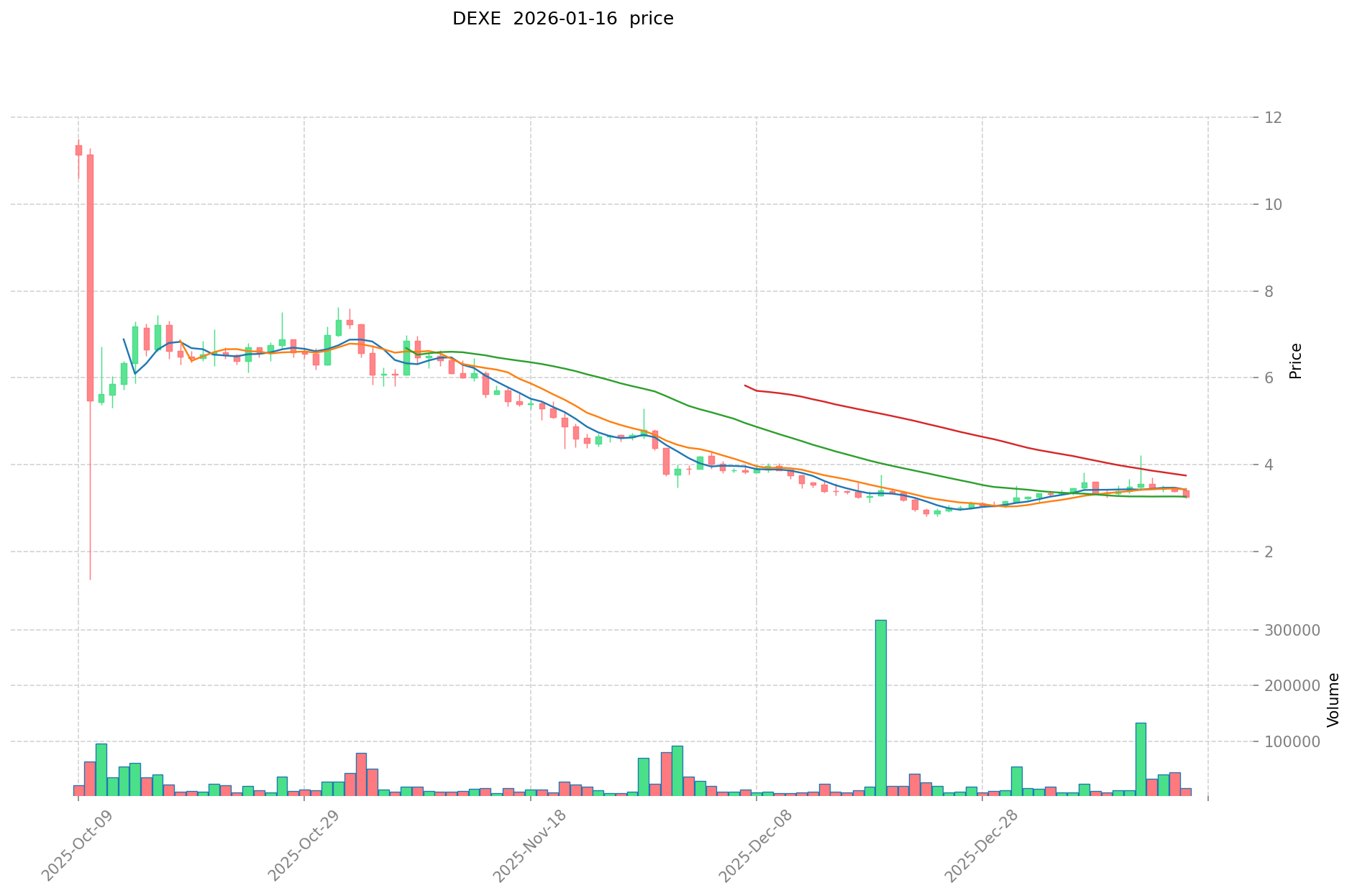
The token has experienced notable price volatility since its inception, with a recorded peak of $32.38 in March 2021 and a low of $0.67 in November 2020. Recent market performance shows a decline of 4.42% over the past 24 hours, 3.42% over the past week, and 7.84% over the past month, with a year-over-year decrease of 81.89%. With a market dominance of 0.0092% and a circulating supply representing approximately 47.17% of the total supply of 96.50 million tokens, DEXE is currently ranked 284th by market capitalization. The token is available on 22 exchanges and has approximately 3,025 holders, indicating a developing ecosystem with room for potential growth and adoption.
I. DeXe (DEXE) Historical Price Review and Current Investment Value
- 2020: DEXE launched with an initial offering price of $0.5, establishing its position as a decentralized cryptocurrency portfolio management platform
- 2021: The token experienced significant price movement, with trading activity reflecting early adoption of the platform's governance and reward mechanisms
- Market cycles: Price fluctuations have occurred across multiple timeframes, with the token demonstrating volatility characteristic of DeFi-focused assets
Current DEXE Investment Market Status (January 2026)
- DEXE current price: $3.234
- 24-hour price change: -4.42%
- 24-hour trading volume: $60,337.26
- Market capitalization: $150,941,386.06
- Circulating supply: 46,673,279.55 DEXE (47.17% of total supply)
- Total supply: 96,504,599.34 DEXE
- Number of holders: 3,025
- Listed on 22 exchanges
Click to view real-time DEXE market price
- 1-hour change: -0.58%
- 7-day change: -3.42%
- 30-day change: -7.84%
- 1-year change: -81.89%
- 24-hour high: $3.47
- 24-hour low: $3.211
The token currently ranks #284 by market capitalization, with a market dominance of 0.0092%. The fully diluted market cap stands at $312,095,874.25, representing the potential total value if all tokens were in circulation.
II. Core Factors Influencing Whether DEXE is a Good Investment
Supply Mechanism and Scarcity (DEXE Investment Scarcity)
-
Maximum Supply Structure: DEXE has an infinite maximum supply, with a total supply of 96,504,599.34 tokens and a circulating supply of 46,673,279.55 tokens (47.17% circulation ratio). This unlimited supply model may affect long-term scarcity expectations.
-
Token Economic Mechanism: The platform implements a buyback and distribution mechanism where 30% of trader commissions are used to repurchase DEXE tokens from the market. One-third of these tokens are burned, one-third sent to the vault, and one-third distributed to DEXE holders, creating deflationary pressure that may support token value.
-
Investment Implications: The infinite supply ceiling presents potential dilution concerns for long-term holders. However, the buyback-and-burn mechanism partially offsets inflationary pressure, making the actual supply dynamics a key consideration for investment decisions.
Institutional Investment and Mainstream Adoption (Institutional Investment in DEXE)
-
Market Positioning: DEXE ranks 284th by market capitalization with approximately $150.94 million in circulating market cap, representing 0.0092% market dominance. The token is listed on 22 exchanges and holds approximately 3,025 holders.
-
Adoption Indicators: The project operates as a decentralized portfolio management platform within the DeFi ecosystem. The governance structure requires DEXE token ownership for DAO participation, creating utility-driven demand among active platform users.
Macroeconomic Environment Impact on DEXE Investment
-
Market Performance Context: DEXE shows a bearish trend across multiple timeframes, with declines of 0.58% (1H), 4.42% (24H), 3.42% (7D), 7.84% (30D), and 81.89% (1Y). The current price of $3.234 represents a significant decline from its historical peak of $32.38 recorded in March 2021.
-
Volatility Characteristics: The 24-hour price range of $3.211 to $3.47 indicates ongoing volatility. The fully diluted market cap of $312.10 million suggests substantial potential dilution risk as more tokens enter circulation.
-
Broader Market Sensitivity: As a DeFi-focused governance token, DEXE's investment attractiveness remains influenced by overall cryptocurrency market sentiment, regulatory developments affecting decentralized finance, and macroeconomic conditions impacting risk asset appetite.
Technology and Ecosystem Development (Technology & Ecosystem for DEXE Investment)
-
Core Infrastructure: DEXE operates as an ERC-20 token on the Ethereum blockchain (contract address: 0xde4EE8057785A7e8e800Db58F9784845A5C2Cbd6), utilizing Ethereum's established security and smart contract capabilities for its decentralized portfolio management functions.
-
Platform Functionality: The DeXe.network provides tools for cryptocurrency portfolio allocation, automatic rebalancing, and risk management. Users can stake up to 10% of their portfolio value in DEXE tokens as insurance against potential losses.
-
Governance and Utility: DEXE token holders participate in governance decisions through voting mechanisms. The platform creates value linkage through its commission structure, where successful traders earn fees from strategy subscribers, with a portion used for token buybacks.
-
Ecosystem Positioning: As a DeFi-focused platform addressing decentralized interconnection between users and traders, DEXE's long-term investment value depends on continued adoption of its portfolio management services and the growth of decentralized trading strategies within the broader cryptocurrency ecosystem.
III. DEXE Future Investment Forecast and Price Outlook (Is DeXe(DEXE) worth investing in 2026-2031)
Short-term Investment Forecast (2026, short-term DEXE investment outlook)
- Conservative forecast: $2.14 - $2.80
- Neutral forecast: $2.80 - $3.24
- Optimistic forecast: $3.24 - $3.63
Mid-term Investment Outlook (2027-2029, mid-term DeXe(DEXE) investment forecast)
-
Market stage expectation: The mid-term period may witness gradual development as the platform continues to refine its decentralized governance and portfolio management features. Market conditions and broader DeFi sector performance could influence price movements.
-
Investment return forecast:
- 2027: $2.68 - $4.84
- 2028: $3.48 - $4.80
- 2029: $3.08 - $6.57
-
Key catalysts: Potential factors include increased adoption of DAO governance mechanisms, expansion of platform features, strategic partnerships, and overall growth in the decentralized finance ecosystem.
Long-term Investment Outlook (Is DEXE a good long-term investment?)
- Base scenario: $4.36 - $6.01 (assuming steady platform development and moderate market conditions)
- Optimistic scenario: $6.01 - $8.19 (assuming accelerated adoption, favorable regulatory environment, and strong DeFi sector growth)
- Risk scenario: Below $3.00 (in case of prolonged market downturns, technological challenges, or increased competition)
For detailed DEXE long-term investment and price predictions, visit: Price Prediction
2026-01-16 - 2031 Long-term Outlook
- Base scenario: $4.36 - $5.52 (corresponding to steady progress and gradual mainstream application growth)
- Optimistic scenario: $5.52 - $8.19 (corresponding to large-scale adoption and favorable market conditions)
- Transformative scenario: Above $8.19 (if the ecosystem achieves breakthrough developments and mainstream adoption)
- 2031-12-31 forecast high: $8.19 (based on optimistic development assumptions)
Disclaimer: These forecasts are based on historical data and market analysis models. Cryptocurrency markets are highly volatile and unpredictable. Price predictions should not be considered as investment advice. Investors should conduct their own research and assess their risk tolerance before making any investment decisions.
| Year |
Predicted High Price |
Predicted Average Price |
Predicted Low Price |
Price Change |
| 2026 |
3.62768 |
3.239 |
2.13774 |
0 |
| 2027 |
4.8410094 |
3.43334 |
2.6780052 |
6 |
| 2028 |
4.799122652 |
4.1371747 |
3.475226748 |
27 |
| 2029 |
6.56817855372 |
4.468148676 |
3.08302258644 |
38 |
| 2030 |
6.0147983401974 |
5.51816361486 |
4.3593492557394 |
70 |
| 2031 |
8.188402988090754 |
5.7664809775287 |
4.670849591798247 |
78 |
IV. DeXe Investment Strategy and Risk Management (How to invest in DeXe)
Investment Methodology (DeXe investment strategy)
Long-term Holding (HODL DeXe)
For conservative investors seeking steady exposure to the DeFi portfolio management sector, a long-term holding strategy may be considered. DeXe's governance model, where DEXE token holders participate in DAO decisions, provides ongoing utility beyond speculative trading. The token's multi-functional design—encompassing governance rights, reward distribution mechanisms, and insurance capabilities—creates potential value drivers for patient investors.
This approach suits investors who believe in the long-term development of decentralized asset management solutions and are prepared to weather market volatility.
Active Trading
Traders employing technical analysis may focus on DeXe's price movements, which have shown notable volatility. Recent data indicates price changes of -0.58% (1H), -4.42% (24H), and -3.42% (7D), suggesting short-term fluctuations that active traders might attempt to capitalize on through swing trading strategies.
Active trading requires continuous market monitoring, technical analysis skills, and understanding of support and resistance levels. The 24-hour price range between $3.211 and $3.47 demonstrates intraday volatility that may present trading opportunities.
Risk Management (Risk management for DeXe investment)
Asset Allocation Ratios
- Conservative investors: Consider limiting DEXE exposure to 1-3% of total crypto portfolio, given the token's volatility and relatively smaller market capitalization of approximately $150.94 million
- Aggressive investors: May allocate 5-10% of their crypto holdings, balancing potential returns against higher risk tolerance
- Professional investors: Could implement dynamic allocation strategies based on market conditions, technical indicators, and fundamental developments within the DeXe ecosystem
Risk Hedging Approaches
Diversification remains fundamental to managing crypto investment risk. Investors might consider:
- Combining DEXE with larger-cap cryptocurrencies and stablecoins to balance portfolio volatility
- Utilizing correlation analysis to select complementary assets that may perform differently under various market conditions
- Implementing stop-loss orders to limit potential downside exposure during adverse market movements
Secure Storage Solutions
Proper token storage is essential for protecting DEXE holdings:
- Hot wallets: Convenient for active trading but expose tokens to online security risks; suitable for smaller amounts needed for frequent transactions
- Cold wallets: Offline storage solutions like hardware wallets (Ledger, Trezor) provide enhanced security for long-term holdings
- Best practice: Store the majority of DEXE tokens in cold storage, maintaining only trading amounts in hot wallets
As an ERC-20 token deployed on Ethereum (contract address: 0xde4EE8057785A7e8e800Db58F9784845A5C2Cbd6), DEXE is compatible with Ethereum-supporting wallets.
V. DeXe Investment Risks and Challenges (Risks of investing in DeXe)
Market Risks
High Volatility: DeXe has experienced substantial price fluctuations, with a 1-year decline of -81.89% from previous levels. The historical price range from $0.671563 (November 7, 2020) to $32.38 (March 8, 2021) demonstrates extreme volatility characteristic of mid-cap cryptocurrency assets.
Liquidity Considerations: With a circulating supply of approximately 46.67 million tokens (representing 47.17% of total supply) and 24-hour trading volume of $60,337.26, investors should be aware that larger orders may experience slippage or difficulty executing at desired prices.
Market Cap Position: Ranked #284 by market capitalization with 0.0092% market dominance, DEXE represents a smaller-cap crypto asset that may experience amplified price movements compared to major cryptocurrencies.
Regulatory Risks
Decentralized finance platforms face evolving regulatory landscapes across jurisdictions:
- Regulatory frameworks for DeFi protocols and governance tokens remain uncertain in many countries
- Potential future regulations could impact DeXe's operational model, particularly its DAO governance structure and commission mechanisms
- Cross-border regulatory differences create compliance complexities for platforms operating globally
- Changes in securities laws or token classification could affect DEXE's legal status in various jurisdictions
Technical Risks
Smart Contract Vulnerabilities: As a platform operating through autonomous smart contracts, DeXe faces inherent technical risks:
- Potential security vulnerabilities in smart contract code could be exploited by malicious actors
- Bugs or coding errors might result in unexpected behavior or loss of funds
- While audits can reduce risks, no smart contract system can be guaranteed completely secure
Network Dependencies: As an ERC-20 token on Ethereum, DEXE's functionality depends on:
- Ethereum network stability and performance
- Gas fee fluctuations that may impact transaction costs
- Potential Ethereum protocol changes or upgrades
Platform Development Risk: The success of DeXe depends on continued development, user adoption, and competition within the DeFi portfolio management space.
VI. Conclusion: Is DeXe a Good Investment?
Investment Value Summary
DeXe presents a specialized investment opportunity within the decentralized finance portfolio management sector. The token's multi-functional utility—combining governance participation, reward mechanisms, and insurance features—creates diverse value propositions for different investor types. The platform addresses specific challenges in DeFi by providing tools for asset allocation and automated rebalancing while eliminating certain third-party risks.
However, the investment case must be balanced against substantial considerations:
- The token has experienced significant volatility, including an 81.89% decline over the past year
- Market capitalization of approximately $151 million places DEXE in the mid-cap category with corresponding liquidity and volatility characteristics
- The circulating supply represents 47.17% of total supply, with unlimited maximum supply potentially affecting long-term tokenomics
Investor Recommendations
✅ Beginners
- Consider dollar-cost averaging (DCA) strategies to mitigate timing risk and reduce exposure to short-term volatility
- Prioritize secure storage solutions, utilizing hardware wallets for long-term holdings
- Start with modest allocation sizes (1-2% of crypto portfolio) to gain experience while limiting risk exposure
- Focus on understanding DeXe's governance mechanisms and platform functionality before investing
✅ Experienced Investors
- May employ swing trading strategies based on technical analysis, given observed price volatility patterns
- Consider DeXe as part of a diversified DeFi portfolio, combining with complementary protocol tokens
- Monitor on-chain metrics, governance proposals, and platform development updates for informed decision-making
- Implement risk management protocols including position sizing rules and stop-loss mechanisms
✅ Institutional Investors
- Evaluate DeXe within the broader DeFi infrastructure landscape and portfolio management solutions
- Conduct thorough due diligence on smart contract security, team background, and competitive positioning
- Consider strategic allocation as part of thematic DeFi exposure with appropriate risk controls
- Assess regulatory implications across relevant jurisdictions before establishing positions
⚠️ Important Disclaimer
Cryptocurrency investments carry substantial risk, including potential loss of principal. DeXe's price volatility, regulatory uncertainties, and technical complexities make it particularly suitable only for investors who understand these risks and can afford potential losses. This analysis is provided for informational purposes only and does not constitute financial, investment, or trading advice. Investors should conduct independent research and consult qualified financial advisors before making investment decisions.
VII. FAQ
Q1: What is DeXe (DEXE) and what makes it unique in the DeFi space?
DeXe (DEXE) is an ERC-20 governance token that powers a decentralized autonomous cryptocurrency portfolio management platform. What sets it apart is its comprehensive approach combining DAO governance, automated portfolio rebalancing, and built-in risk management features. The platform enables users to follow and replicate successful trading strategies without transferring private keys or API access, addressing key security concerns in decentralized finance. DEXE token holders participate in governance decisions through voting mechanisms, while the ecosystem incorporates a unique economic model where 30% of trading commissions fund token buybacks—with one-third burned, one-third allocated to a vault, and one-third distributed to holders. Additionally, users can stake up to 10% of their portfolio value in DEXE tokens as insurance against potential losses, creating multiple utility layers beyond simple governance participation.
Q2: How has DEXE performed historically and what is its current market position?
DEXE has experienced significant volatility since its October 2020 launch at $0.5. The token reached its all-time high of $32.38 in March 2021 but has since declined substantially, currently trading at approximately $3.234 as of January 16, 2026—representing an 81.89% decrease over the past year. Recent performance shows continued bearish momentum with declines of 4.42% (24H), 3.42% (7D), and 7.84% (30D). The token maintains a market capitalization of approximately $150.94 million, ranking #284 with 0.0092% market dominance. With 46.67 million tokens in circulation (47.17% of the 96.5 million total supply), DEXE is listed on 22 exchanges and has approximately 3,025 holders. The 24-hour trading volume of $60,337.26 indicates moderate liquidity, while the fully diluted market cap of $312.10 million suggests potential dilution risk as more tokens enter circulation.
Q3: What are the main risks associated with investing in DEXE?
Investing in DEXE carries several significant risks that potential investors must carefully consider. Market risk is substantial, evidenced by extreme volatility ranging from $0.67 to $32.38 historically and the recent 81.89% annual decline. As a mid-cap cryptocurrency with relatively low liquidity ($60,337 daily volume), larger trades may experience slippage. Regulatory risk remains uncertain, as DeFi platforms and governance tokens face evolving legal frameworks across jurisdictions that could impact operations. Technical risks include smart contract vulnerabilities despite audits, potential bugs that could result in fund losses, and dependency on Ethereum network stability. The unlimited maximum supply creates long-term dilution concerns, though partially offset by the buyback-and-burn mechanism. Additionally, platform adoption risk exists as success depends on continued user growth in a competitive DeFi landscape. Given the 47.17% circulating supply ratio, future token releases could create additional selling pressure. These factors make DEXE suitable only for investors with high risk tolerance who can afford potential total loss.
Q4: What is the price forecast for DEXE through 2031?
Price predictions for DEXE through 2031 vary significantly across scenarios. For 2026, forecasts range from $2.14-$2.80 (conservative), $2.80-$3.24 (neutral), to $3.24-$3.63 (optimistic). Mid-term projections show potential recovery: 2027 ($2.68-$4.84), 2028 ($3.48-$4.80), and 2029 ($3.08-$6.57), assuming gradual platform development and favorable DeFi sector conditions. Long-term outlook for 2030-2031 presents three scenarios: base case ($4.36-$6.01) assuming steady development, optimistic case ($6.01-$8.19) with accelerated adoption and favorable regulations, and risk scenario (below $3.00) during prolonged downturns. The predicted 2031 high of $8.19 represents potential 153% growth from current levels under optimistic assumptions. However, these forecasts depend on multiple uncertain factors including platform adoption, competitive dynamics, regulatory developments, and overall crypto market conditions. Investors should note that cryptocurrency price predictions have historically proven unreliable, and these projections should not be considered investment advice or guarantees of future performance.
Q5: What investment strategy should I use for DEXE?
The appropriate DEXE investment strategy depends on your risk tolerance, experience level, and investment goals. Conservative investors might consider a long-term holding (HODL) approach, allocating 1-3% of their crypto portfolio to DEXE and focusing on the token's governance utility and potential DeFi sector growth over multiple years. This suits those who believe in decentralized asset management solutions and can withstand volatility. Active traders may capitalize on DEXE's price fluctuations through swing trading strategies, leveraging technical analysis and the observed intraday volatility (recent 24-hour range: $3.211-$3.47). Aggressive investors might allocate 5-10% of crypto holdings, while professional investors could implement dynamic allocation based on market conditions. Dollar-cost averaging (DCA) helps mitigate timing risk for all investor types. Essential risk management includes diversification with larger-cap cryptocurrencies and stablecoins, implementing stop-loss orders, and proper security through cold storage solutions (hardware wallets) for the majority of holdings. Regardless of strategy, investors should only allocate capital they can afford to lose completely, conduct independent research, and consider consulting qualified financial advisors.
Q6: How does DEXE's tokenomics and supply mechanism affect its investment potential?
DEXE's tokenomics present a mixed picture for investment consideration. The token has an unlimited maximum supply with 96.5 million total supply and 46.67 million circulating (47.17% circulation ratio), creating potential long-term dilution concerns that could pressure prices as more tokens enter the market. However, the platform implements a deflationary counterbalance through its commission mechanism: 30% of trader fees fund market buybacks, with one-third of purchased tokens burned (reducing supply), one-third sent to a vault, and one-third distributed to DEXE holders. This creates ongoing demand pressure and rewards long-term holders. The economic model also requires DEXE ownership for DAO participation, generating utility-driven demand beyond speculation. The buyback-and-burn mechanism partially offsets inflationary pressure from the unlimited supply ceiling, though effectiveness depends on platform trading volume and adoption. With current market cap of $151 million versus fully diluted valuation of $312 million, substantial dilution risk exists if remaining tokens are released rapidly. Investment attractiveness ultimately depends on whether platform growth and buyback activity can outpace token issuance—making adoption metrics and trading volume critical indicators for evaluating DEXE's tokenomic sustainability.
Q7: Is DEXE suitable for institutional investors?
DEXE presents both opportunities and challenges for institutional consideration. On the positive side, the token offers exposure to the growing DeFi portfolio management sector through a platform with clearly defined utility functions including governance, reward distribution, and insurance mechanisms. The DAO structure provides institutional investors with governance participation rights, while the commission-based buyback mechanism creates value alignment between platform success and token appreciation. The ERC-20 standard ensures compatibility with institutional custody solutions, and listing on 22 exchanges provides multiple access points. However, significant institutional concerns exist: the $151 million market cap and 0.0092% market dominance classify DEXE as a mid-cap asset with higher volatility and liquidity constraints compared to major cryptocurrencies. The relatively low 24-hour volume ($60,337) may present execution challenges for larger institutional positions. Regulatory uncertainty surrounding DeFi governance tokens creates compliance complexities across jurisdictions. Smart contract risks, despite potential audits, require thorough due diligence. The unlimited supply with only 47.17% circulating creates dilution concerns. For institutions, DEXE might serve as a small thematic allocation within broader DeFi exposure, subject to rigorous risk assessment, regulatory review, and appropriate position sizing—likely not exceeding 1-2% of crypto allocations.
Q8: What factors could significantly increase or decrease DEXE's value in the coming years?
Several key catalysts could drive DEXE price movements in either direction. Positive factors include: accelerated adoption of the platform's portfolio management services, particularly if the number of holders (currently 3,025) grows substantially; successful implementation of new features or strategic partnerships that enhance utility; favorable regulatory clarity for DeFi protocols and governance tokens; broader crypto bull market momentum lifting DeFi sector valuations; increased trading volume generating higher buyback activity through the commission mechanism; and successful DAO governance demonstrating effective decentralized decision-making. Conversely, negative pressures could emerge from: prolonged crypto bear markets reducing overall sector valuations; increased competition from alternative DeFi portfolio management platforms; smart contract vulnerabilities or security breaches eroding user trust; unfavorable regulatory developments restricting DeFi operations; Ethereum network issues affecting platform functionality; token dilution from remaining 52.83% supply entering circulation faster than demand growth; and failure to achieve user adoption targets resulting in insufficient buyback activity. The 81.89% annual decline demonstrates downside potential during adverse conditions. Ultimately, DEXE's value trajectory depends on the platform's ability to capture meaningful market share in decentralized asset management while navigating technical, regulatory, and competitive challenges inherent to the DeFi ecosystem.
* The information is not intended to be and does not constitute financial advice or any other recommendation of any sort offered or endorsed by Gate.