This comprehensive analysis evaluates whether Dill (DL) represents a viable investment opportunity in the blockchain infrastructure space. Trading at $0.002121 with a $2.51 million market cap as of January 2026, DL focuses on scalability and decentralization for gaming and AI applications. The article examines DL's technical architecture supporting 800,000 TPS throughput, institutional backing from FSL and Binance incubator, and 30+ validator partnerships, while analyzing historical performance showing -85.91% annual decline. Price predictions range from $0.00163-$0.00305 (2026) to $0.00339-$0.00395 (2030 optimistic scenario). Key investment considerations include high volatility, limited liquidity, substantial future token dilution (only 19.75% circulating supply), and regulatory uncertainties. The analysis provides tailored investment strategies for beginners through institutional investors, comprehensive risk management frameworks, and guidance for secure DL storage on Gate exchange. Suitable for investors
Introduction: Dill (DL) Investment Position and Market Outlook
DL is an emerging asset in the cryptocurrency space. As of January 2026, Dill holds a market capitalization of approximately $2.51 million, with a circulating supply of 1.185 billion tokens and a current trading price around $0.002121. The project positions itself as a new paradigm blockchain emphasizing decentralization and scalability, particularly targeting decentralized applications in gaming and AI-driven use cases. With backing from entities including FSL, Modular Capital, and Binance incubation, alongside over 30 validator partnerships and more than 10,000 independent stakers globally, Dill has established initial infrastructure support. This article provides an analysis of DL's investment characteristics, historical performance trends, future outlook considerations, and associated risk factors to assist readers in evaluating its position within the digital asset landscape.
I. Dill (DL) Price History Review and Current Investment Value
- 2025-09-19: DL reached a price level of $0.001, representing a notable low point in its trading history.
- 2025-09-21: DL experienced a price movement to $0.02025, reflecting a period of market volatility.
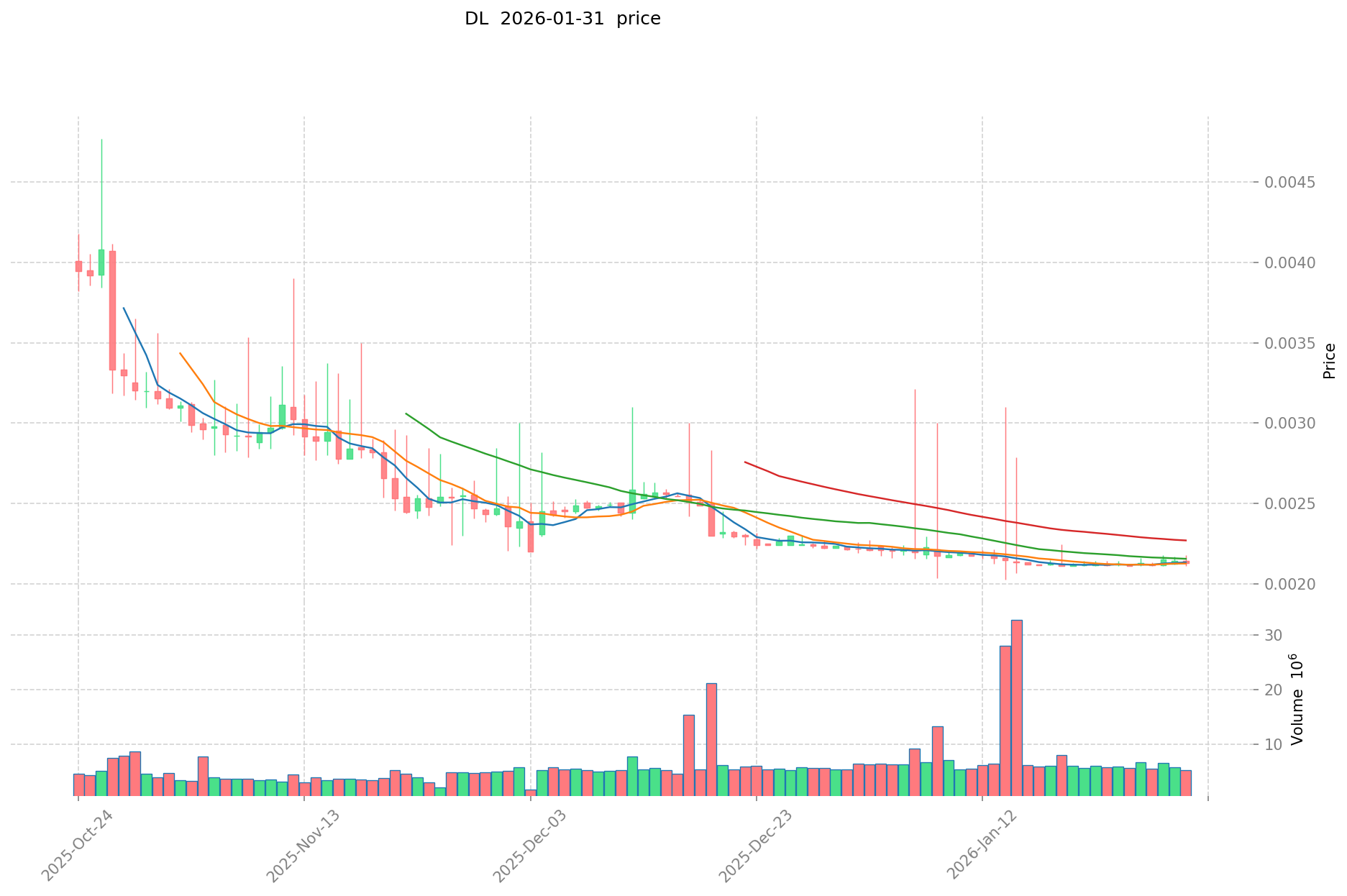
- 2025-2026: Following the September volatility, DL entered a consolidation phase, with prices adjusting from higher levels to approximately $0.002121.
Current DL Investment Market Status (January 2026)
- DL current price: $0.002121
- 24-hour trading volume: $11,712.87
- Market capitalization: $2,513,385
- Circulating supply: 1,185,000,000 DL (19.75% of total supply)
- Price changes: -0.24% (1H), -0.51% (24H), -0.55% (7D), -3.67% (30D)
Click to view real-time DL market price
II. Core Factors Influencing Whether DL is a Good Investment (Is Dill(DL) a Good Investment)
Supply Mechanism and Scarcity (DL Investment Scarcity)
- Supply structure → Influences price and investment value
- DL has a maximum supply of 6 billion tokens, with a current circulating supply of 1.185 billion tokens (19.75% of total supply). The controlled release schedule may impact scarcity dynamics over time.
- Investment significance: The structured token release mechanism, including planned airdrop unlocks, represents a key factor for evaluating long-term investment potential.
Institutional Investment and Mainstream Adoption (Institutional Investment in DL)
- Institutional backing: Dill is supported by FSL, Modular Capital, and Binance incubator, alongside founders and angel investors from established projects.
- Validator partnerships: The network has formed partnerships with over 30 validator organizations, including P2P and InfStones, alongside more than 10,000 independent stakers globally.
- Adoption considerations: The project's focus on high-scalability applications for gaming and AI agents may influence its adoption trajectory in specific market segments.
Macroeconomic Environment's Impact on DL Investment
- Market positioning: As of January 31, 2026, DL maintains a market cap of approximately $2.51 million with a fully diluted valuation of $12.73 million, representing a market cap to FDV ratio of 19.75%.
- Trading activity: The 24-hour trading volume stands at $11,712.87, with the token listed on 4 exchanges and held by 3,030 addresses.
- Performance context: DL has experienced price fluctuations, with recent performance showing declines of -0.51% (24h), -0.55% (7d), -3.67% (30d), and -85.91% (1y) as of the current date.
Technology and Ecosystem Development (Technology & Ecosystem for DL Investment)
- Scalability architecture: Dill employs sharding across data and consensus layers, combined with a two-tier staking model and stateless light validators, designed to support throughput of up to 800,000 TPS and 20MB/s.
- Node infrastructure: The network architecture is designed to accommodate up to 1 million permissionless nodes, emphasizing decentralization and accessibility.
- Minipool staking mechanism: The innovative staking model combines institutional and community participation, aiming to create leveraged growth opportunities for network participants.
- Target applications: The platform focuses on serving dApps requiring high scalability, decentralization, and sovereignty, particularly in gaming and agentic application sectors.
III. DL Future Investment Prediction and Price Outlook (Is Dill(DL) worth investing in 2026-2030)
Short-term Investment Prediction (2026, short-term DL investment outlook)
- Conservative Prediction: $0.00163 - $0.00212
- Neutral Prediction: $0.00212 - $0.00258
- Optimistic Prediction: $0.00258 - $0.00305
Mid-term Investment Outlook (2027-2028, mid-term Dill(DL) investment forecast)
-
Market Stage Expectation: DL may enter a phase of steady development as its blockchain infrastructure matures and validator network expands. The token's performance could be influenced by adoption in gaming and agentic applications, as well as broader market sentiment toward Layer-1 solutions.
-
Investment Return Prediction:
- 2027: $0.00230 - $0.00272
- 2028: $0.00204 - $0.00300
-
Key Catalysts: expansion of validator partnerships, growth in staking participation, and increased adoption of Dill's infrastructure by decentralized applications requiring high scalability.
Long-term Investment Outlook (Is DL a good long-term investment?)
- Baseline Scenario: $0.00224 - $0.00339 (assuming continued ecosystem development and stable market conditions through 2030)
- Optimistic Scenario: $0.00339 - $0.00395 (assuming significant increase in dApp adoption and favorable regulatory environment)
- Risk Scenario: Below $0.00200 (under conditions of prolonged market downturn or technical challenges)
Click to view DL long-term investment and price prediction: Price Prediction
2026-2030 Long-term Outlook
- Base Scenario: $0.00204 - $0.00305 (corresponding to steady progress and gradual mainstream application adoption)
- Optimistic Scenario: $0.00339 - $0.00395 (corresponding to large-scale adoption and favorable market environment)
- Transformative Scenario: Above $0.00400 (if ecosystem achieves breakthrough developments and mainstream penetration)
- 2030-12-31 Predicted High: $0.00386 (based on optimistic development assumptions)
Disclaimer: Price predictions are subject to market volatility and various external factors. Past performance does not guarantee future results.
| Year |
Predicted High Price |
Predicted Average Price |
Predicted Low Price |
Price Change |
| 2026 |
0.00305424 |
0.002121 |
0.00163317 |
0 |
| 2027 |
0.002717001 |
0.00258762 |
0.0023029818 |
22 |
| 2028 |
0.002997110865 |
0.0026523105 |
0.002042279085 |
25 |
| 2029 |
0.0039545949555 |
0.0028247106825 |
0.002118533011875 |
33 |
| 2030 |
0.00386420421366 |
0.003389652819 |
0.00223717086054 |
59 |
| 2031 |
0.004352314219596 |
0.00362692851633 |
0.002792734957574 |
71 |
IV. Dill Investment Strategy and Risk Management (How to invest in Dill)
Investment Methodology (Dill investment strategy)
Long-term Holding (HODL Dill): Suitable for conservative investors
For investors seeking long-term exposure to blockchain infrastructure projects, a buy-and-hold strategy may be appropriate. This approach involves accumulating DL tokens during periods of lower valuation and maintaining positions through market cycles. Given Dill's focus on scalability and decentralization infrastructure, long-term holders may benefit from potential network growth as more dApps, gaming applications, and AI agent platforms adopt the ecosystem. However, investors should consider the project's current early stage, with a circulating supply representing only 19.75% of the maximum supply, which may lead to future dilution effects.
Active Trading: Relying on technical analysis and swing trading
Active traders may utilize technical analysis to identify entry and exit points based on price patterns, volume trends, and momentum indicators. As of January 31, 2026, DL exhibits relatively modest 24-hour trading volume of approximately $11,712.87, which may present liquidity considerations for larger position sizes. Short-term traders should monitor key support and resistance levels, with recent 24-hour range between $0.002111 and $0.002151. The token's recent performance shows negative trends across multiple timeframes (-0.24% in 1H, -0.51% in 24H, -0.55% in 7D, and -3.67% in 30D), suggesting a consolidation phase that may precede either breakout or breakdown scenarios.
Risk Management (Risk management for Dill investment)
Asset Allocation Ratio: Conservative / Aggressive / Professional investors
- Conservative investors: May consider limiting DL exposure to 1-3% of total crypto portfolio, given the project's early stage and limited trading history. This approach prioritizes capital preservation while maintaining modest exposure to potential upside.
- Aggressive investors: Could allocate 5-10% of crypto holdings to DL, accepting higher volatility in exchange for potentially greater returns from network growth and ecosystem expansion.
- Professional investors: Institutional participants or experienced traders might employ dynamic allocation strategies, adjusting positions based on technical indicators, network metrics, and broader market conditions, potentially ranging from 3-15% depending on market phase.
Risk Hedging Solutions: Multi-asset portfolio + hedging instruments
Investors can implement diversification strategies by pairing DL holdings with established layer-1 blockchain assets, stablecoins, or negatively correlated assets to reduce portfolio volatility. Position sizing techniques such as dollar-cost averaging may help mitigate timing risk, particularly given the token's significant decline from its historical high of $0.02025. For more sophisticated investors, derivatives instruments (where available) or portfolio rebalancing strategies can provide additional risk management layers.
Secure Storage: Hot/cold wallets + hardware wallet recommendations
Given that DL operates as a BEP-20 token on BSC (contract address: 0xcd806d0eb9465020994c9e977cbe34fe430172ae), investors should prioritize secure storage solutions:
- Hot wallets: For active trading amounts only, using reputable BSC-compatible wallets with strong security protocols
- Cold storage: For long-term holdings, hardware wallets supporting BSC such as Ledger or Trezor devices provide enhanced security through offline private key storage
- Best practices: Enable two-factor authentication, verify contract addresses before transactions, and maintain backup recovery phrases in secure, offline locations
V. Dill Investment Risks and Challenges (Risks of investing in Dill)
Market Risk: High volatility and price manipulation
DL demonstrates considerable price volatility, with a 1-year performance decline of -85.91% from peak levels. The token's relatively limited trading volume and modest market capitalization of approximately $2.51 million may expose investors to higher volatility and potential liquidity constraints during periods of market stress. With only 4 exchanges currently listing the token and approximately 3,030 holders, the market depth may be insufficient to absorb large orders without significant price impact. Additionally, the wide disparity between historical high ($0.02025) and historical low ($0.001) indicates substantial price swings that could result in significant short-term losses.
Regulatory Risk: Policy uncertainty across different jurisdictions
As a blockchain infrastructure project supporting decentralized applications, Dill operates within an evolving regulatory landscape. Different jurisdictions maintain varying approaches to crypto asset classification, taxation, and permissibility. Changes in regulatory frameworks related to blockchain networks, staking mechanisms, or token classifications could impact the project's operations, token utility, or accessibility in specific markets. Investors should monitor regulatory developments in their respective jurisdictions and assess compliance implications for their holdings.
Technical Risk: Network security vulnerabilities and upgrade failures
Dill's architecture involves complex technical components including sharding across data and consensus layers, two-tier staking models, and stateless light validators designed to support up to 800,000 TPS and 20MB/s throughput. While these innovations aim to achieve scalability and decentralization, they also introduce technical implementation risks. Potential vulnerabilities in smart contracts, consensus mechanisms, or network protocols could compromise security or functionality. Additionally, as the network evolves and implements upgrades to support its ambitious goals of accommodating up to 1 million permissionless nodes, execution risks related to protocol changes or compatibility issues may emerge. The project's early stage and relatively recent launch (September 2025) mean that the network has limited operational history for assessing long-term technical resilience.
VI. Conclusion: Is Dill a Good Investment?
Investment Value Summary: Dill presents notable long-term potential as a blockchain infrastructure project focused on scalability and decentralization, but exhibits substantial short-term price volatility.
Dill's value proposition centers on addressing scalability challenges for decentralized applications, particularly in gaming and AI agent sectors. The project's technical approach combining sharding, two-tier staking, and light validator architecture aims to deliver significant throughput improvements while maintaining decentralization. Support from notable backers and partnerships with over 30 validator partners including P2P and InfStones, along with more than 10,000 solo stakers, indicates growing ecosystem participation.
However, the token's performance trajectory shows considerable near-term headwinds, with negative trends across multiple timeframes and significant decline from historical highs. The limited circulating supply (19.75% of maximum) suggests potential future token releases that could affect price dynamics. Market capitalization and trading volume remain modest compared to established blockchain infrastructure projects.
Investor Recommendations:
✅ Beginners: Dollar-cost averaging + secure wallet storage
- Implement systematic purchasing strategies to mitigate timing risk
- Prioritize security by using hardware wallets for long-term holdings
- Limit initial exposure to small portfolio percentages while learning about the project
- Avoid leveraged positions or investments exceeding risk tolerance
✅ Experienced Investors: Swing trading + portfolio allocation
- Apply technical analysis to identify favorable entry and exit points
- Consider DL as a speculative allocation within a diversified crypto portfolio
- Monitor network metrics, partnership announcements, and ecosystem development
- Maintain disciplined position sizing and risk management protocols
✅ Institutional Investors: Strategic long-term allocation
- Evaluate Dill as part of blockchain infrastructure thesis
- Conduct thorough due diligence on technical architecture and team capabilities
- Assess token economics and vesting schedules for supply dynamics
- Consider participation in staking mechanisms for potential yield generation
⚠️ Disclaimer: Cryptocurrency investment carries substantial risk, and this content is provided for informational purposes only and does not constitute investment advice. Investors should conduct independent research and consult with financial professionals before making investment decisions.
VII. FAQ
Q1: What is Dill (DL) and what makes it different from other blockchain infrastructure projects?
Dill is a Layer-1 blockchain platform emphasizing scalability and decentralization, with a current market cap of approximately $2.51 million and a token price of $0.002121 as of January 2026. The project distinguishes itself through its technical architecture combining sharding across data and consensus layers, a two-tier staking model, and stateless light validators designed to support throughput of up to 800,000 TPS and 20MB/s. Unlike many blockchain platforms, Dill specifically targets high-scalability applications in gaming and AI-driven use cases, with an infrastructure designed to accommodate up to 1 million permissionless nodes. The project has established partnerships with over 30 validator organizations and more than 10,000 independent stakers globally, backed by entities including FSL, Modular Capital, and Binance incubator.
Q2: Is Dill (DL) a good investment for 2026?
DL's investment suitability depends on risk tolerance and investment horizon. As of January 2026, the token shows short-term challenges with negative performance across multiple timeframes (-0.51% in 24H, -0.55% in 7D, -3.67% in 30D, and -85.91% over 1 year). Conservative 2026 price predictions range from $0.00163 to $0.00305, with the token currently trading at $0.002121. The project's early stage, limited circulating supply (19.75% of maximum supply), and modest trading volume of $11,712.87 suggest substantial volatility risk. However, for investors with higher risk tolerance and longer time horizons, the project's technical innovation and institutional backing may present growth opportunities. Conservative investors should limit DL exposure to 1-3% of crypto portfolio, while aggressive investors might consider 5-10% allocation.
Q3: What are the main risks of investing in Dill (DL)?
DL investment carries three primary risk categories. Market risk includes high volatility evidenced by an 85.91% decline from peak levels, limited liquidity with only 4 exchange listings and approximately 3,030 holders, and modest trading volume that may result in significant price impact for larger orders. Regulatory risk involves evolving policy frameworks across jurisdictions that could affect token classification, staking mechanisms, or accessibility. Technical risk encompasses potential vulnerabilities in the complex architecture including sharding, consensus mechanisms, and smart contracts, along with execution risks related to protocol upgrades and network expansion plans. The project's limited operational history since its September 2025 launch provides insufficient data for long-term technical resilience assessment.
Q4: What is Dill's price prediction for 2027-2030?
Price predictions for DL through 2030 vary across scenarios. For 2027, estimates range from $0.00230 to $0.00272, assuming continued ecosystem development and validator network expansion. The 2028 outlook projects $0.00204 to $0.00300, contingent on increased adoption in gaming and AI agent applications. Long-term predictions through 2030 show a base scenario of $0.00224 to $0.00339 under stable market conditions, an optimistic scenario of $0.00339 to $0.00395 assuming significant dApp adoption and favorable regulations, and a risk scenario below $0.00200 in prolonged downturns. The 2030 predicted high reaches $0.00386 based on optimistic development assumptions. These forecasts depend on factors including validator partnerships expansion, staking participation growth, and mainstream adoption of Dill's infrastructure by decentralized applications requiring high scalability.
Q5: How should I store DL tokens securely?
DL operates as a BEP-20 token on Binance Smart Chain (contract address: 0xcd806d0eb9465020994c9e977cbe34fe430172ae), requiring BSC-compatible storage solutions. For active trading amounts, use reputable hot wallets with strong security protocols and BSC support. For long-term holdings, hardware wallets such as Ledger or Trezor devices that support BSC provide enhanced security through offline private key storage. Best practices include enabling two-factor authentication on all wallet interfaces, verifying contract addresses before each transaction, maintaining backup recovery phrases in secure offline locations, and never sharing private keys or seed phrases. Consider diversifying storage across multiple solutions, with hot wallets for trading amounts and cold storage for long-term holdings.
Q6: What investment strategy is best for Dill (DL)?
Investment strategy selection depends on experience level and risk profile. Beginners should employ dollar-cost averaging to mitigate timing risk, prioritize hardware wallet security for holdings, limit initial exposure to small portfolio percentages while learning about the project, and avoid leveraged positions. Experienced investors may pursue swing trading strategies using technical analysis to identify entry and exit points based on support and resistance levels, consider DL as speculative allocation within diversified portfolios, monitor network metrics and partnership announcements, and maintain disciplined position sizing with risk management protocols. Institutional investors should evaluate Dill as part of blockchain infrastructure thesis, conduct thorough due diligence on technical architecture and team capabilities, assess token economics and vesting schedules for supply dynamics, and consider participation in staking mechanisms for yield generation.
Q7: What factors could drive DL's future price appreciation?
Several catalysts could influence DL's price trajectory. Network expansion through increased validator partnerships beyond the current 30+ organizations and growth in the 10,000+ independent staker base may enhance network security and decentralization. Adoption of Dill's infrastructure by decentralized applications in gaming and AI agent sectors requiring high scalability could drive utility and demand. Technical milestone achievements such as demonstrating sustained throughput approaching the targeted 800,000 TPS and successful network upgrades supporting the goal of 1 million permissionless nodes may increase market confidence. Token supply dynamics including the scheduled release of the remaining 80.25% of maximum supply will impact scarcity and price. Additionally, broader market conditions, regulatory clarity, and continued backing from institutional partners including FSL, Modular Capital, and Binance incubator could provide fundamental support.
Q8: How does DL's tokenomics affect its investment value?
DL's tokenomics structure significantly impacts investment considerations. The project has a maximum supply of 6 billion tokens with current circulating supply of 1.185 billion tokens (19.75% of total supply), indicating substantial future token releases that may create dilution effects. As of January 2026, the market cap to fully diluted valuation ratio stands at 19.75%, suggesting the current market price does not fully reflect the impact of maximum supply circulation. The controlled release schedule, including planned airdrop unlocks, represents a key factor for evaluating long-term investment potential. The innovative minipool staking mechanism combines institutional and community participation, potentially creating leveraged growth opportunities for network participants. Investors should monitor token unlock schedules and circulating supply changes as these events may influence price dynamics through increased selling pressure or adjusted scarcity perceptions.
* The information is not intended to be and does not constitute financial advice or any other recommendation of any sort offered or endorsed by Gate.