This comprehensive analysis examines whether Dimitra (DMTR) is a viable investment, evaluating the blockchain-based agricultural technology platform's features, market potential, and associated risks. The article explores DMTR's price history from its $5.95 peak in 2021 to current valuations of $0.007879, alongside detailed price forecasts through 2031 across conservative, neutral, and optimistic scenarios. Readers will discover core investment factors including supply mechanics, institutional adoption, macroeconomic impacts, and technological ecosystem development. The guide provides actionable investment strategies—from long-term holding for conservative investors to active trading techniques for experienced traders—alongside comprehensive risk management frameworks covering asset allocation, hedging solutions, and secure storage methods. Essential risk considerations include market volatility, regulatory uncertainties, technical vulnerabilities, and liquidity constraints that potential investors must evalu
Introduction: Dimitra (DMTR)'s Investment Position and Market Outlook
Dimitra (DMTR) is a blockchain platform focused on democratizing agricultural technology globally. Launched in September 2021, the platform provides farmers worldwide with access to blockchain, machine learning, IoT sensors, and satellite technology through a mobile interface to enhance productivity, reduce costs, and mitigate risks. As of January 29, 2026, DMTR holds a market capitalization of approximately $5.49 million, with a circulating supply of around 697.09 million tokens and a current price of $0.007879. Trading across 6 exchanges and supported by 10,361 holders, DMTR represents a niche segment within the agricultural technology sector of the cryptocurrency market. The platform's approach to integrating blockchain solutions with global agricultural development practices has positioned it as a subject of discussion among investors evaluating "Is Dimitra (DMTR) a good investment?" This article provides a comprehensive analysis of DMTR's investment characteristics, historical price movements, future price projections, and associated investment risks to serve as a reference for potential investors.
I. DMTR Price History Review and Current Investment Value
- 2021: On September 23, DMTR reached a notable price level of $5.95 → representing a significant valuation period for early participants
- 2022: Market adjustment phase → price declined to $0.00269344 on December 17, reflecting broader market conditions
- 2021-2022: Market cycle transition → from peak valuation levels to lower price ranges amid changing market dynamics
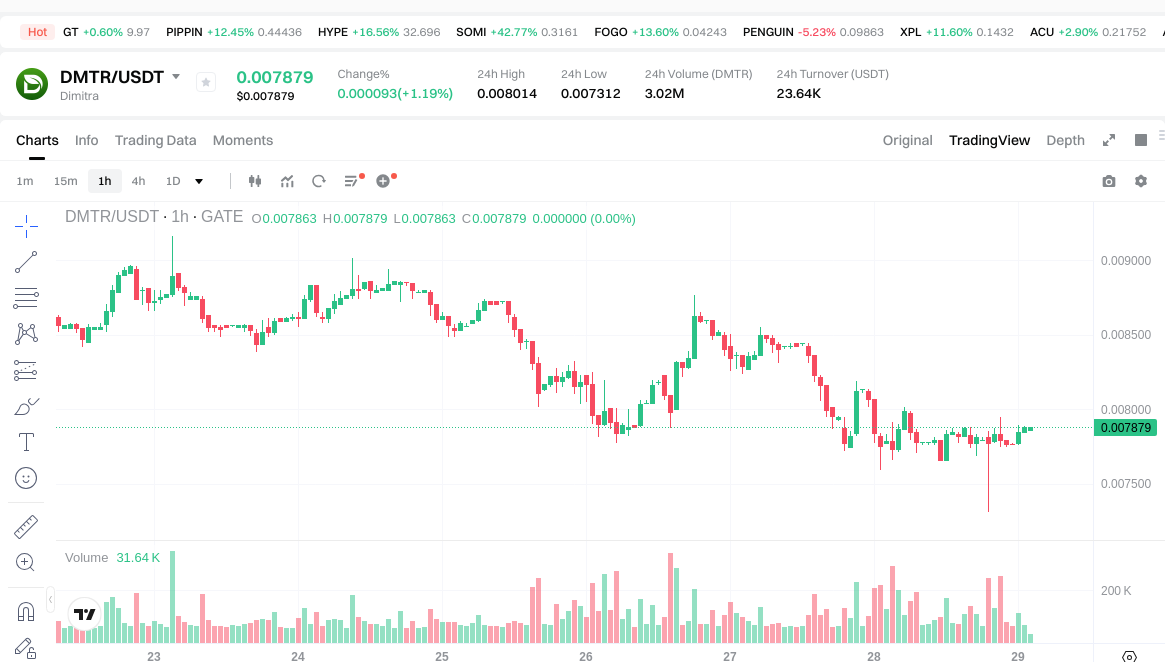
Current DMTR Investment Market Status (January 2026)
- DMTR current price: $0.007879
- Market sentiment (Fear & Greed Index): Data not available in provided materials
- 24-hour trading volume: $23,610.30
- Institutional investor holdings: Approximately 10,361 holders recorded
Click to view real-time DMTR market price
II. Core Factors Affecting Whether DMTR is a Good Investment (Is Dimitra(DMTR) a Good Investment)
Supply Mechanism and Scarcity (DMTR investment scarcity)
- Supply Structure → Dimitra (DMTR) has a maximum supply of 1,000,000,000 tokens, with approximately 697,090,054.65 tokens currently in circulation, representing a circulating supply ratio of about 69.71%
- Scarcity Characteristics → With the circulating supply approaching 70% of the maximum supply, the token's scarcity profile may influence its long-term valuation dynamics
- Investment Implication → The defined supply cap and existing circulation ratio represent structural factors that may affect investment considerations, though market demand and utility remain critical determinants of value
Institutional Investment and Mainstream Adoption (Institutional investment in DMTR)
- Market Participation → As of January 2026, Dimitra has approximately 10,361 holders, indicating a community-based holding structure
- Exchange Presence → DMTR is available on 6 exchanges, including Gate.com, providing multiple access points for investors
- Adoption Context → The platform's focus on agricultural technology democratization through blockchain, machine learning, IoT sensors, and satellite technology positions it within a specialized sector that may attract interest from agricultural and technology-focused participants
Macroeconomic Environment's Impact on DMTR Investment
- Market Positioning → Dimitra operates in a niche sector combining blockchain technology with agricultural applications, which may exhibit different sensitivities to macroeconomic conditions compared to general cryptocurrency markets
- Risk Consideration → The token's market capitalization of approximately $5.49 million and ranking of 1487 suggest it represents a smaller-cap investment with corresponding volatility characteristics
- Economic Context → Broader cryptocurrency market conditions, regulatory developments, and risk appetite in digital asset markets may influence DMTR's investment appeal
Technology and Ecosystem Development (Technology & Ecosystem for DMTR investment)
- Platform Infrastructure → Dimitra provides a mobile platform integrating blockchain, machine learning, IoT sensors, and satellite technology designed to help farmers globally increase production, reduce costs, and manage risks
- Application Focus → The platform addresses agricultural challenges including sustainability, poverty, hunger, climate change, carbon emissions, freshwater conservation, and soil protection
- Ecosystem Utility → By connecting cryptocurrency investment cycles with agricultural development practices, Dimitra aims to provide practical utility in the agricultural technology sector
- Contract Deployment → DMTR is deployed on the Ethereum network (contract address: 0x51cb253744189f11241becb29bedd3f1b5384fdb), providing access to Ethereum's ecosystem infrastructure
III. DMTR Future Investment Forecast and Price Outlook (Is Dimitra(DMTR) worth investing in 2026-2031)
Short-term Investment Forecast (2026, short-term DMTR investment outlook)
- Conservative forecast: $0.00479643 - $0.007863
- Neutral forecast: $0.007863 - $0.01069368
- Optimistic forecast: $0.01069368 and above
Mid-term Investment Outlook (2027-2029, mid-term Dimitra(DMTR) investment forecast)
- Market phase expectation: During 2027-2029, DMTR may experience gradual development, with price potentially showing incremental growth patterns as the agricultural technology sector evolves.
- Investment return forecast:
- 2027: $0.006494838 - $0.0132680262
- 2028: $0.01014586479 - $0.015556992678
- 2029: $0.01019546679564 - $0.0187811230446
- Key catalysts: Platform adoption in agricultural markets, technological integration advancements, and potential expansion of blockchain applications in the agricultural sector.
Long-term Investment Outlook (Is DMTR a good long-term investment?)
- Base scenario: $0.008531995897404 - $0.018995764450824 (assuming steady platform development and moderate market conditions)
- Optimistic scenario: $0.012458323820756 - $0.022635546096867 (assuming enhanced adoption and favorable market environment)
- Risk scenario: Below $0.007863 (under challenging market conditions or limited platform adoption)
View DMTR long-term investment and price forecast: Price Prediction
2026-2031 Long-term Outlook
- Base scenario: $0.00479643 - $0.0160981054668 (corresponding to steady progress and gradual mainstream application enhancement)
- Optimistic scenario: $0.012458323820756 - $0.022635546096867 (corresponding to large-scale adoption and favorable market environment)
- Transformative scenario: Above $0.022635546096867 (if ecosystem achieves breakthrough progress and mainstream popularization)
- 2031-12-31 forecast high: $0.022635546096867 (based on optimistic development assumptions)
Disclaimer: Price forecasts are subject to significant uncertainty and market volatility. Historical performance does not guarantee future results. These projections should not be considered as financial advice.
| Year |
Predicted High Price |
Predicted Average Price |
Predicted Low Price |
Price Change |
| 2026 |
0.01069368 |
0.007863 |
0.00479643 |
0 |
| 2027 |
0.0132680262 |
0.00927834 |
0.006494838 |
17 |
| 2028 |
0.015556992678 |
0.0112731831 |
0.01014586479 |
43 |
| 2029 |
0.0187811230446 |
0.013415087889 |
0.01019546679564 |
70 |
| 2030 |
0.018995764450824 |
0.0160981054668 |
0.008531995897404 |
104 |
| 2031 |
0.022635546096867 |
0.017546934958812 |
0.012458323820756 |
122 |
IV. Dimitra Investment Strategy and Risk Management (How to invest in Dimitra)
Investment Methodology (Dimitra investment strategy)
Long-term Holding (HODL Dimitra): Suitable for Conservative Investors
For investors focused on long-term value creation, holding DMTR aligns with supporting agricultural technology democratization globally. This approach minimizes transaction costs and capitalizes on potential adoption growth as the platform expands its mobile-based blockchain solutions for farmers. Given Dimitra's focus on sustainable agricultural practices addressing global challenges like poverty, hunger, and climate change, long-term holders may benefit from increased utility as the ecosystem matures.
Active Trading: Relying on Technical Analysis and Swing Trading
Active traders can leverage DMTR's price volatility for potential gains. The token's 24-hour trading volume of $23,610 and availability on 6 exchanges provide liquidity opportunities. Technical traders should monitor key support and resistance levels, with recent data showing a 24-hour range between $0.007312 (low) and $0.008014 (high). Short-term traders should note the 1-hour price change of +0.22% and 24-hour change of +0.98%, while being aware of broader downward trends (-5.65% over 7 days, -50.13% over 30 days).
Risk Management (Risk management for Dimitra investment)
Asset Allocation Ratio: Conservative / Aggressive / Professional Investors
- Conservative Investors: Allocate 1-3% of crypto portfolio to DMTR, given its market cap ranking of #1487 and market dominance of 0.00024%. This limited exposure minimizes risk while maintaining exposure to the agricultural technology sector.
- Aggressive Investors: May allocate 5-10% of crypto holdings, accepting higher volatility for potential upside as adoption increases.
- Professional Investors: Could incorporate DMTR as part of a thematic agricultural technology or emerging blockchain use-case portfolio, with position sizing based on risk-adjusted return models.
Risk Hedging Solutions: Multi-Asset Portfolio + Hedging Tools
Investors should diversify across different crypto categories (major cryptocurrencies, DeFi, infrastructure tokens) to offset sector-specific risks. Consider pairing DMTR holdings with more established assets to balance volatility. Given the token's -84.50% decline over the past year, hedging strategies through stablecoins or profit-taking mechanisms during recovery periods can help protect capital.
Secure Storage: Hot and Cold Wallets + Hardware Wallet Recommendations
DMTR, deployed on the Ethereum network (contract address: 0x51cb253744189f11241becb29bedd3f1b5384fdb), can be stored in various wallet solutions:
- Cold Storage: Hardware wallets (Ledger, Trezor) for long-term holdings
- Hot Wallets: MetaMask or Trust Wallet for active trading, ensuring regular security updates
- Exchange Storage: Only for short-term trading positions, not recommended for large holdings
With 10,361 holders, maintaining personal custody through self-hosted wallets reduces counterparty risk.
V. Dimitra Investment Risks and Challenges (Risks of investing in Dimitra)
Market Risk: High Volatility and Potential Price Manipulation
DMTR demonstrates significant price volatility, with a 30-day decline of -50.13% and a 1-year decrease of -84.50%. The token's current price of $0.007879 represents a substantial decline from its all-time high of $5.95 (September 23, 2021). The relatively modest 24-hour trading volume of $23,610 and circulating market cap of approximately $5.49 million suggest lower liquidity, which can amplify price swings. Investors should be prepared for rapid price movements and potential challenges with order execution during volatile periods.
Regulatory Risk: Policy Uncertainty Across Different Countries
As a blockchain platform operating in the agricultural sector across multiple countries, Dimitra faces varying regulatory frameworks. Agricultural subsidies, data privacy laws, and cryptocurrency regulations differ significantly by jurisdiction, creating compliance complexities. Changes in digital asset regulations or agricultural technology policies in key markets could impact platform adoption and token utility. Investors should monitor regulatory developments in regions where Dimitra operates, as policy shifts could affect the project's growth trajectory.
Technical Risk: Network Security Vulnerabilities and Upgrade Failures
Dimitra's platform integrates multiple technologies including blockchain, machine learning, IoT sensors, and satellite technology. This complexity introduces potential technical challenges:
- Smart Contract Vulnerabilities: As an ERC-20 token on Ethereum, DMTR relies on smart contract security. Any vulnerabilities in the contract code could expose holders to risks.
- Integration Challenges: The platform's reliance on diverse technologies (IoT, satellite data, mobile applications) creates multiple points of potential failure.
- Network Dependencies: Performance and security depend on the underlying Ethereum network, subject to congestion, high gas fees, and protocol-level issues.
- Adoption Barriers: Technical literacy requirements for farmers in developing regions may slow platform adoption, affecting token utility.
Investors should assess the project's technical audit history and development activity when evaluating these risks.
VI. Conclusion: Is Dimitra a Good Investment?
Investment Value Summary: Dimitra addresses genuine global challenges in agricultural sustainability through blockchain technology, offering potential long-term value as the platform develops. However, the token has experienced severe price declines, with current valuation at $0.007879 compared to an all-time high of $5.95, reflecting broader market conditions and adoption challenges. The circulating supply represents 69.71% of total supply (697 million of 971 million tokens), with a maximum supply of 1 billion tokens, providing some clarity on future dilution.
Investor Recommendations:
✅ Beginners: Consider dollar-cost averaging (DCA) with small allocations (1-2% of portfolio) if interested in agricultural technology applications. Prioritize secure wallet storage and thorough project research before investing. Given the high volatility and -84.50% annual decline, new investors should approach with extreme caution.
✅ Experienced Investors: May explore swing trading opportunities based on technical patterns, while maintaining diversified holdings across multiple sectors. Monitor project development milestones, partnership announcements, and adoption metrics in target agricultural markets. Consider position sizing that accounts for the token's current downtrend and limited liquidity.
✅ Institutional Investors: Could evaluate DMTR as part of thematic portfolios focused on blockchain applications in emerging markets or sustainable development goals. Due diligence should include assessment of the team's execution capability, partnership network, and competitive positioning within agricultural technology. The relatively small market cap ($5.49 million) and trading volume suggest this remains a speculative, early-stage investment.
⚠️ Disclaimer: Cryptocurrency investments carry substantial risk. DMTR's significant price declines, modest liquidity, and dependence on agricultural sector adoption create elevated uncertainty. This analysis is for informational purposes only and does not constitute financial advice. Investors should conduct independent research and consider their risk tolerance before making investment decisions.
VII. FAQ
Q1: Is Dimitra (DMTR) a good investment for beginners in 2026?
DMTR carries significant risks for beginners due to its extreme volatility and substantial price decline of -84.50% over the past year. For novice investors, it is advisable to limit exposure to 1-2% of a crypto portfolio using dollar-cost averaging (DCA) strategy, and only if genuinely interested in blockchain applications for agricultural technology. Beginners should prioritize secure storage through hardware wallets and conduct thorough research on the project's development progress before investing. The token's current price of $0.007879 represents a dramatic decline from its all-time high of $5.95, indicating high-risk characteristics that may not suit risk-averse or inexperienced investors.
Q2: What is the realistic price prediction for DMTR by 2031?
Based on various growth scenarios, DMTR's price forecast for 2031 ranges from $0.012458323820756 (conservative scenario) to $0.022635546096867 (optimistic scenario), representing potential increases of 58% to 187% from current levels of $0.007879. The base scenario projects a predicted average price of $0.017546934958812 by December 31, 2031. These projections assume steady platform adoption in agricultural markets, technological integration improvements, and favorable market conditions. However, given the token's historical volatility and current downtrend, investors should treat these forecasts as speculative references rather than guaranteed outcomes, as actual results may vary significantly based on market dynamics and project execution.
Q3: How does DMTR's supply structure affect its investment value?
DMTR has a maximum supply of 1 billion tokens, with approximately 697.09 million tokens (69.71%) currently in circulation, providing relative clarity on potential future dilution. The defined supply cap creates a scarcity framework that may influence long-term valuation dynamics, though utility and market demand remain the primary value drivers. With the circulating supply already approaching 70% of maximum supply, additional token releases may have limited dilutive impact compared to projects with lower circulation ratios. However, the token's investment value depends more critically on platform adoption, technological development, and real-world utility in agricultural applications rather than supply mechanics alone.
Q4: What are the main risks of investing in Dimitra (DMTR)?
DMTR presents three primary risk categories: Market Risk includes extreme volatility with a 30-day decline of -50.13% and low liquidity ($23,610 daily volume), which can amplify price swings; Regulatory Risk stems from operating across multiple jurisdictions with varying agricultural technology and cryptocurrency regulations that could impact platform operations; Technical Risk involves potential vulnerabilities in smart contract security, integration challenges with multiple technologies (IoT, satellite, blockchain), and dependency on Ethereum network performance. Additionally, adoption barriers in developing regions may slow growth, while the token's ranking of #1487 and market cap of $5.49 million indicate a small-cap, speculative investment with elevated risk profiles.
Q5: What investment strategy works best for DMTR?
The optimal strategy depends on investor profile and risk tolerance. Long-term holding (HODL) suits conservative investors who believe in agricultural technology democratization, allocating 1-3% of crypto portfolios to minimize risk while maintaining exposure to the sector's potential growth. Active trading may appeal to experienced traders leveraging technical analysis on DMTR's volatility, with the token showing a 24-hour trading range between $0.007312 and $0.008014. Regardless of strategy, risk management is critical: diversify across different crypto categories, use hardware wallets for secure storage (DMTR is an ERC-20 token at contract address 0x51cb253744189f11241becb29bedd3f1b5384fdb), and never invest more than you can afford to lose given the token's -84.50% annual decline.
Q6: How does Dimitra's agricultural technology platform create utility for DMTR tokens?
Dimitra provides a mobile platform integrating blockchain, machine learning, IoT sensors, and satellite technology designed to help farmers globally increase production, reduce costs, and manage risks. The platform addresses critical agricultural challenges including sustainability, poverty, hunger, climate change, carbon emissions, freshwater conservation, and soil protection. This practical utility connects cryptocurrency investment cycles with real-world agricultural development practices, potentially creating long-term value as adoption expands. However, with only 10,361 current holders and availability on 6 exchanges, the ecosystem remains in early development stages, and token utility depends significantly on successful platform adoption in target agricultural markets.
Q7: Should institutional investors consider DMTR for portfolio allocation?
Institutional investors may evaluate DMTR as part of thematic portfolios focused on blockchain applications in emerging markets or sustainable development goals, but should recognize its early-stage, speculative nature. The token's small market cap ($5.49 million), limited trading volume ($23,610 daily), and ranking of #1487 indicate it remains a high-risk, niche investment. Due diligence should thoroughly assess the team's execution capability, partnership network strength, competitive positioning within agricultural technology, and realistic adoption timelines. Institutional allocation should be minimal (if any) and proportionate to the elevated risk profile, with comprehensive risk management frameworks and regular monitoring of development milestones and market conditions.
Q8: What are the key catalysts that could drive DMTR price growth in 2026-2027?
Potential catalysts for DMTR price appreciation include: Platform Adoption expansion in agricultural markets, particularly in developing regions where the technology addresses critical farming challenges; Partnership Announcements with agricultural organizations, government agencies, or technology providers that validate the platform's utility; Technological Integration advancements demonstrating successful deployment of blockchain, IoT, and satellite solutions; Market Recovery in broader cryptocurrency markets that could lift small-cap tokens; and Regulatory Clarity in key jurisdictions that facilitates platform operations. However, given the token's current downtrend (-50.13% over 30 days) and historical performance, investors should maintain realistic expectations and monitor concrete development progress rather than relying solely on speculative catalysts.
* The information is not intended to be and does not constitute financial advice or any other recommendation of any sort offered or endorsed by Gate.