DIMO is a blockchain-based platform enabling vehicle owners to create digital twins as NFTs and monetize automotive data through decentralized applications including DeFi loans, peer-to-peer sharing, and usage-based insurance. As of January 2026, DIMO trades at $0.01152 with a $4.83 million market cap and 419.53 million circulating tokens, representing a 41.95% circulation ratio of its 1 billion maximum supply. The token has experienced significant volatility, declining 88.39% over the past year from a $2.00 peak in February 2024. This analysis examines DIMO's tokenomics, ecosystem development, price history, and investment potential while evaluating market risks including limited liquidity, regulatory uncertainty, and early-stage adoption challenges. Price forecasts range from conservative $0.01156 to optimistic $0.024420761852062 by 2031, contingent on platform adoption and market conditions. Investment recommendations vary by risk tolerance: conservative allocation at 1-3% for beginners through active trad
Introduction: DIMO (DIMO) Investment Position and Market Outlook
DIMO is a notable asset in the cryptocurrency sector, having launched in December 2022 and achieved considerable recognition in the automotive data and mobility space. As of January 2026, DIMO holds a market capitalization of approximately $4.83 million, with a circulating supply of around 419.53 million tokens, and the current price stands at approximately $0.01152. Positioned as a blockchain-based platform for vehicle data liberation and automotive applications, DIMO has gradually become a focal point for investors considering "Is DIMO (DIMO) a good investment?" This article provides a comprehensive analysis of DIMO's investment value, historical price trends, future price predictions, and associated investment risks to serve as a reference for investors.
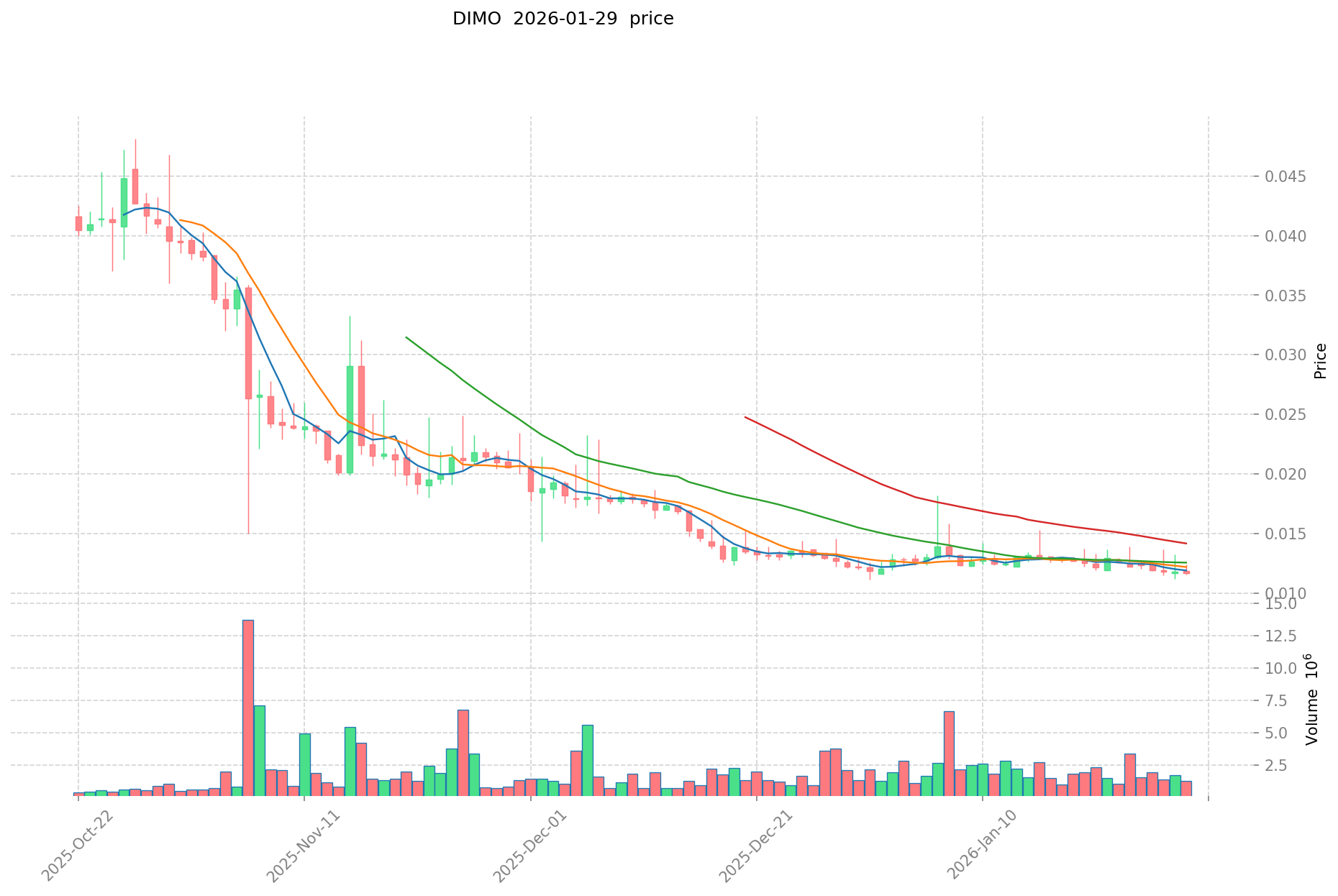
DIMO addresses critical inefficiencies in the trillion-dollar automotive industry by enabling users to create digital twins of their vehicles as NFTs on the blockchain, stream verified data through DIMO Miners equipped with EVM wallets, and access decentralized applications including DeFi auto loans, peer-to-peer car sharing, and usage-based insurance services. The platform's current market dominance stands at 0.00036%, with approximately 8,469 token holders and a circulating supply representing 41.95% of the total supply of 1 billion tokens. The token has experienced notable price volatility, with a recorded price of $2 in February 2024 and a low of $0.01113 in December 2025, reflecting an 88.39% decline over the past year as of January 2026.
I. DIMO Price History Review and Current Investment Value Status
- 2018: DIMO price reached $1.05 → Investors experienced notable returns during early market period
- 2021: DIMO achieved $5.89 price level → Price showed upward momentum during broader crypto market expansion
- 2022: Project secured $9 million in funding from CoinFund, Variant Fund, and Slow Ventures in September, followed by mainnet launch in December → Price movement reflected development progress
- 2024: DIMO recorded an all-time high of $2.00 on February 1st → Market valuation demonstrated growth phase
- 2025: Price declined to $0.01113 by December 31st → Market correction from previous levels
Current DIMO Investment Market Status (January 2026)
- DIMO current price: $0.01152
- Market sentiment (Fear & Greed Index): Data not available in provided materials
- 24-hour trading volume: $14,181.14
- Institutional investor holdings: 8,469 token holders recorded
Click to view real-time DIMO market price
II. Core Factors Influencing Whether DIMO is a Good Investment
Supply Mechanism and Scarcity (DIMO Investment Scarcity)
- DIMO operates with a maximum supply of 1,000,000,000 tokens, with approximately 419,528,408 tokens currently in circulation, representing a circulating ratio of 41.95%
- The defined maximum supply cap establishes a framework for potential scarcity dynamics as circulation approaches total supply
- Investment consideration: The relationship between fixed maximum supply and growing circulation may influence long-term supply-demand dynamics
Institutional Investment and Mainstream Adoption (Institutional Investment in DIMO)
- As of January 29, 2026, DIMO has 8,469 token holders, indicating a developing user base
- The token is available for trading on 4 exchanges, reflecting current market accessibility
- Market capitalization stands at approximately $4.83 million with a fully diluted valuation of $11.52 million, suggesting early-stage market positioning
Macroeconomic Environment Impact on DIMO Investment
- DIMO's market dominance of 0.00036% positions it within the broader cryptocurrency market landscape
- The token's market cap to fully diluted valuation ratio of 41.95% reflects current circulation relative to maximum potential valuation
- Broader market conditions and regulatory developments in the automotive data and blockchain sectors may influence investment dynamics
Technology and Ecosystem Development (Technology & Ecosystem for DIMO Investment)
- DIMO platform enables users to create digital twins of vehicles as NFTs on the blockchain, utilizing DIMO Miners with integrated EVM wallets for verified data streaming
- The ecosystem supports applications including decentralized finance automotive loans, peer-to-peer car sharing, Web3 ride-sharing services, and usage-based insurance solutions
- Users can earn DIMO tokens through platform participation, creating a token utility model tied to automotive data utilization
- The platform addresses data fragmentation challenges in the automotive industry by establishing an open platform for developers focused on mobility applications
III. DIMO Future Investment Forecast and Price Outlook (Is DIMO(DIMO) worth investing in 2026-2031)
Short-term Investment Forecast (2026, short-term DIMO investment outlook)
- Conservative forecast: $0.010982 - $0.01156
- Neutral forecast: $0.01156 - $0.01300
- Optimistic forecast: $0.01300 - $0.01445
Mid-term Investment Outlook (2027-2029, mid-term DIMO(DIMO) investment forecast)
- Market stage expectation: During the 2027-2029 period, DIMO may experience gradual price fluctuations with potential growth phases, reflecting evolving market dynamics and ecosystem development.
- Investment return forecast:
- 2027: $0.00715275 - $0.01391535
- 2028: $0.00821070675 - $0.01709442225
- 2029: $0.0143606607075 - $0.0198604882125
- Key catalysts: Platform adoption trends, automotive industry integration developments, and broader market conditions may influence price performance.
Long-term Investment Outlook (Is DIMO a good long-term investment?)
- Base scenario: $0.012806844857597 - $0.024420761852062 (assuming steady ecosystem development and moderate market conditions through 2030-2031)
- Optimistic scenario: $0.020994827635406 - $0.024420761852062 (assuming enhanced platform adoption and favorable market environment)
- Risk scenario: Below $0.012806844857597 (under adverse market conditions or challenges in ecosystem expansion)
View DIMO long-term investment and price prediction: Price Prediction
2026-01-29 - 2031 Long-term Outlook
- Base scenario: $0.01156 - $0.01756889341875 (corresponding to steady progress and gradual mainstream application growth)
- Optimistic scenario: $0.01756889341875 - $0.024420761852062 (corresponding to large-scale adoption and favorable market environment)
- Transformative scenario: Above $0.024420761852062 (if the ecosystem achieves breakthrough progress and mainstream adoption)
- 2031-12-31 projected high: $0.024420761852062 (based on optimistic development assumptions)
Disclaimer: Price forecasts are based on available market data and predictive models. Cryptocurrency markets are highly volatile and subject to numerous unpredictable factors. These projections should not be considered as financial advice. Always conduct thorough research and consult with financial professionals before making investment decisions.
| Year |
Predicted High Price |
Predicted Average Price |
Predicted Low Price |
Price Change |
| 2026 |
0.01445 |
0.01156 |
0.010982 |
0 |
| 2027 |
0.01391535 |
0.013005 |
0.00715275 |
12 |
| 2028 |
0.01709442225 |
0.013460175 |
0.00821070675 |
16 |
| 2029 |
0.0198604882125 |
0.015277298625 |
0.0143606607075 |
32 |
| 2030 |
0.024420761852062 |
0.01756889341875 |
0.013176670064062 |
52 |
| 2031 |
0.022044569017176 |
0.020994827635406 |
0.012806844857597 |
82 |
IV. DIMO Investment Strategy and Risk Management (How to invest in DIMO)
Investment Methodology (DIMO investment strategy)
-
Long-term Holding (HODL DIMO): Suitable for conservative investors who believe in the long-term potential of decentralized vehicle data platforms. This approach involves accumulating DIMO tokens during market downturns and holding through volatility cycles.
-
Active Trading: Relies on technical analysis and swing trading strategies. Traders may monitor price movements around key support levels (recent low at $0.01113) and resistance zones (24-hour high at $0.01216) to identify entry and exit points.
Risk Management (Risk management for DIMO investment)
V. DIMO Investment Risks and Challenges (Risks of investing in DIMO)
-
Market Risk: DIMO exhibits notable price volatility, with 24-hour changes of -2.11%, 7-day decline of -10.45%, and annual performance showing -88.39% decrease. The market capitalization of approximately $4.83 million represents a relatively small cap asset, which typically experiences higher volatility. Daily trading volume of $14,181 indicates limited liquidity that may impact large order execution.
-
Regulatory Risk: The automotive data sector faces evolving regulatory frameworks across different jurisdictions. Data privacy regulations, vehicle connectivity standards, and cryptocurrency compliance requirements vary significantly between countries, creating uncertainty for platform adoption and token utility.
-
Technical Risk: As an ERC-20 token on Ethereum, DIMO inherits blockchain infrastructure dependencies. Network congestion may affect transaction costs and speed. The platform's reliance on DIMO Miner hardware devices and IoT connectivity introduces additional technical complexities. Smart contract vulnerabilities or protocol upgrade failures could impact token functionality.
-
Adoption Risk: With 8,469 token holders and presence on 4 exchanges, DIMO's ecosystem remains in early development stages. The success depends on widespread adoption by vehicle owners, developers building applications, and automotive industry partnerships.
VI. Conclusion: Is DIMO a Good Investment?
-
Investment Value Summary: DIMO represents an innovative approach to decentralizing automotive data through blockchain technology. The platform's concept of creating vehicle digital twins and enabling data monetization addresses real industry inefficiencies. However, the token has experienced significant price decline over the past year, and the project operates within a nascent market segment with uncertain adoption timelines.
-
Investor Recommendations:
✅ Beginners: Consider small position sizing through dollar-cost averaging strategy, storing tokens in secure hardware wallets, and thoroughly researching the automotive data market before investment
✅ Experienced Investors: May explore swing trading opportunities around technical levels, maintain diversified exposure across mobility-focused blockchain projects, and monitor development milestones and partnership announcements
✅ Institutional Investors: Evaluate DIMO as a speculative allocation within broader IoT and mobility innovation portfolios, considering the long-term thesis of decentralized vehicle data networks
⚠️ Disclaimer: Cryptocurrency investments carry substantial risk. DIMO's limited liquidity, high volatility, and early-stage ecosystem development require careful consideration. This analysis is for informational purposes only and does not constitute investment advice. Conduct thorough due diligence and consult financial professionals before making investment decisions.
VII. FAQ
Q1: What is DIMO and how does it generate value for token holders?
DIMO is a blockchain-based platform that enables vehicle owners to create digital twins of their cars as NFTs, stream verified vehicle data, and monetize this information through various decentralized applications. Token holders can earn DIMO tokens by connecting their vehicles via DIMO Miners with integrated EVM wallets, contributing data to the network, and participating in the ecosystem. The platform supports applications including DeFi automotive loans, peer-to-peer car sharing, Web3 ride-sharing services, and usage-based insurance, creating multiple utility pathways for the DIMO token within the automotive data economy.
Q2: What are the main risks associated with investing in DIMO?
DIMO carries significant investment risks including extreme price volatility (88.39% decline over the past year), limited liquidity with daily trading volume of only $14,181, and a relatively small market capitalization of approximately $4.83 million. Additional risks include regulatory uncertainty surrounding automotive data privacy and cryptocurrency compliance, technical dependencies on Ethereum blockchain infrastructure and IoT connectivity, adoption challenges with only 8,469 current token holders, and the early-stage nature of the decentralized vehicle data market. The platform's success depends on widespread adoption by vehicle owners, developer participation, and automotive industry partnerships, all of which remain uncertain.
Q3: How does DIMO's tokenomics affect its long-term investment potential?
DIMO operates with a maximum supply of 1 billion tokens, with approximately 419.53 million tokens currently in circulation, representing a 41.95% circulating ratio. This defined supply cap establishes potential scarcity dynamics as circulation approaches the maximum supply. The token's fully diluted valuation stands at $11.52 million, compared to the current market cap of $4.83 million, indicating significant dilution risk as additional tokens enter circulation. The fixed maximum supply framework may support long-term value appreciation if demand growth outpaces supply release, though the substantial uncirculated supply (58.05%) represents potential selling pressure that investors should consider when evaluating long-term holding strategies.
Q4: What is the recommended investment allocation for DIMO?
Investment allocation recommendations vary by investor profile and risk tolerance. Conservative investors should limit DIMO exposure to 1-3% of their total portfolio, focusing on long-term holding strategies and accumulating during market downturns. Moderate investors may consider 3-7% allocation within a diversified cryptocurrency portfolio, combining passive holding with selective trading opportunities. Experienced investors with higher risk tolerance might allocate 7-15% while implementing active monitoring and risk management protocols. All investors should store DIMO tokens securely using hardware wallets for long-term holdings or EVM-compatible wallets for active trading, implement two-factor authentication, and maintain offline backups of recovery phrases.
Q5: What are DIMO's price predictions for 2026-2031?
For 2026, DIMO price forecasts range from a conservative $0.010982-$0.01156 to an optimistic $0.01300-$0.01445. Mid-term projections for 2027-2029 show potential growth with 2027 ranging $0.00715275-$0.01391535, 2028 at $0.00821070675-$0.01709442225, and 2029 reaching $0.0143606607075-$0.0198604882125. Long-term outlook through 2031 presents a base scenario of $0.012806844857597-$0.024420761852062 and an optimistic scenario potentially reaching $0.024420761852062 by December 2031. These forecasts assume varying degrees of ecosystem development, platform adoption, and favorable market conditions, though cryptocurrency markets remain highly volatile and unpredictable.
Q6: How does DIMO compare to other blockchain automotive data projects?
DIMO distinguishes itself by focusing specifically on creating vehicle digital twins as NFTs and enabling direct data monetization through DIMO Miners equipped with EVM wallets. With a market dominance of 0.00036% and presence on 4 exchanges, DIMO operates within a niche segment of the blockchain industry addressing the trillion-dollar automotive sector's data fragmentation challenges. The platform's approach of building an open developer ecosystem for mobility applications, combined with support for DeFi automotive loans, peer-to-peer sharing, and usage-based insurance, creates multiple value streams. However, the project's relatively small user base of 8,469 token holders and limited trading volume indicate early-stage market positioning compared to more established blockchain infrastructure projects.
Q7: What technological factors should investors monitor when considering DIMO?
Investors should monitor several critical technological aspects including the development and adoption rate of DIMO Miners, the platform's smart contract security and audit history, integration capabilities with various vehicle makes and models, and the growth of decentralized applications built on the DIMO ecosystem. As an ERC-20 token on Ethereum, DIMO inherits network dependencies that affect transaction costs and speed during congestion periods. Key indicators include the expansion of supported vehicle connectivity protocols, partnerships with automotive manufacturers or data providers, developer activity within the ecosystem, and the technical reliability of data streaming and verification mechanisms. Platform upgrades, security incidents, or major technical milestones can significantly impact token valuation and investment thesis.
Q8: What are the best entry and exit strategies for DIMO investment?
Entry strategies should focus on dollar-cost averaging during market downturns, particularly when prices approach identified support levels near recent lows ($0.01113). Investors may consider accumulating positions when negative sentiment dominates or during broader cryptocurrency market corrections. For active traders, technical analysis around 24-hour price ranges and volume patterns can identify short-term opportunities. Exit strategies depend on individual goals: long-term holders might set price targets based on ecosystem adoption milestones or market cap thresholds, while active traders should establish stop-loss orders below support levels and take-profit targets at resistance zones. Risk management requires regular portfolio rebalancing, profit-taking during strong rallies, and maintaining predetermined allocation limits regardless of market enthusiasm or fear.
* The information is not intended to be and does not constitute financial advice or any other recommendation of any sort offered or endorsed by Gate.