This comprehensive analysis evaluates DODO's investment potential as a next-generation decentralized liquidity infrastructure platform on Gate. The article reviews DODO's historical performance, current market positioning at $0.01752 with a $17.52 million market cap, and examines core factors influencing investment value including token supply mechanisms, ecosystem development, and macroeconomic impacts. Short-term forecasts range from $0.0124-$0.0232, while long-term projections through 2031 reach $0.0505 under optimistic scenarios. The analysis presents investment strategies for different investor profiles, risk management approaches, and detailed examinations of market, technical, and regulatory risks. Suitable for investors seeking comprehensive guidance on DODO trading opportunities across Ethereum and BSC networks.
Introduction: DODO's Investment Position and Market Outlook
DODO represents a significant asset within the cryptocurrency sector, having been launched in September 2020 as a next-generation on-chain liquidity infrastructure based on active market maker algorithms. As of January 24, 2026, DODO maintains a market capitalization of approximately $17.52 million, with a fully circulating supply of 1 billion tokens. The current trading price stands at around $0.01752, reflecting its position as a decentralized trading platform that utilizes a liquidity pool model and supports on-chain trading operations. With its distinctive positioning as a proactive market-making solution, DODO has become a focal point among investors examining "Is DODO a good investment?" This analysis comprehensively examines DODO's investment characteristics, historical price movements, future price projections, and associated investment risks to provide reference material for market participants.
DODO's market presence is characterized by its ranking at position 934 among cryptocurrencies, with a market dominance of 0.00054%. The token is traded across 24 exchanges and maintains a holder base of 15,756 addresses. Recent price trends indicate a 0.46% increase over 24 hours, though the token has experienced a 5.37% decline over the past seven days and an 85.13% decrease over the one-year period. The token's historical price range spans from $0.01663396 recorded in December 2025 to a peak of $8.38 observed in February 2021, demonstrating significant price volatility throughout its market history.
I. DODO Price History Review and Current Investment Value Status
- 2020: Token launched in September at $0.1 → Early investors experienced initial price discovery phase
- 2021: Market expansion phase → DODO price reached peak levels in February during broader market rally
- 2022-2024: Extended consolidation period → Price experienced significant corrections from previous highs
- 2025: Recent market volatility → Price approached lower price range levels in December
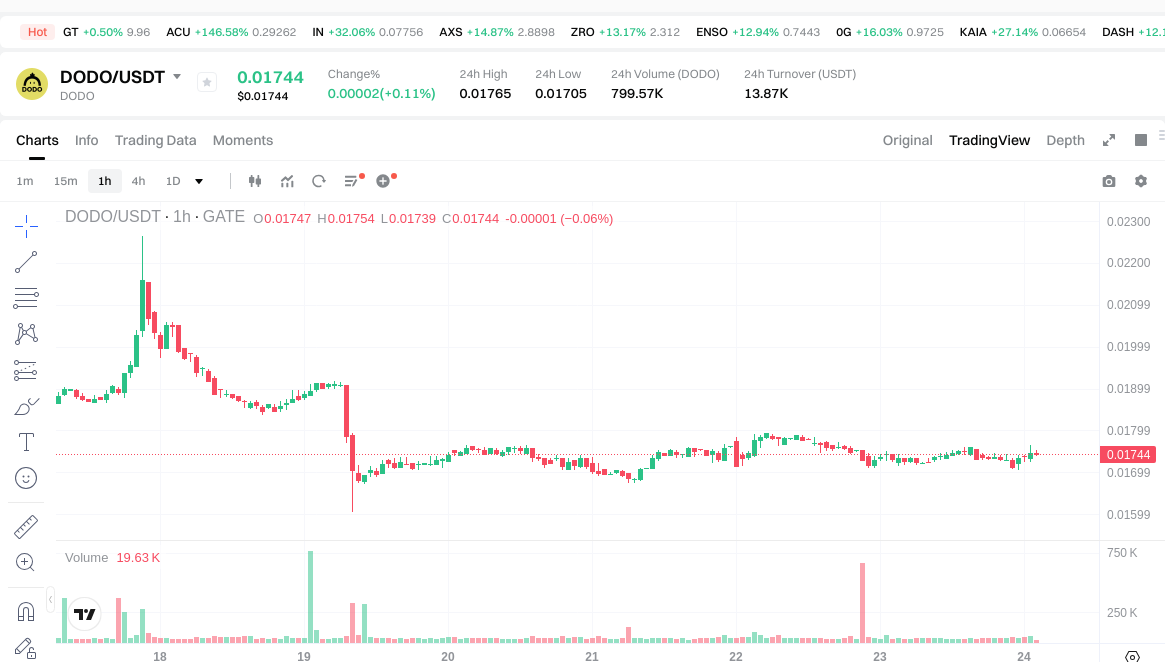
Current DODO Investment Market Status (January 2026)
- DODO current price: $0.01752
- Market sentiment (Fear & Greed Index): Data not available in provided materials
- 24-hour trading volume: $13,879.83
- Institutional investor holdings: Data not available in provided materials
Click to view real-time DODO market price
II. Core Factors Affecting Whether DODO is a Good Investment (Is DODO(DODO) a Good Investment)
Supply Mechanism and Scarcity (DODO investment scarcity)
- Fixed supply mechanism → impacts price and investment value
- The total supply of DODO is capped at 1,000,000,000 tokens, with 100% currently in circulation, creating a defined scarcity model
- Investment significance: the fixed supply structure may provide support for long-term investment considerations
Institutional Investment and Mainstream Adoption (Institutional investment in DODO)
- Market presence: DODO is listed on 24 exchanges, indicating a certain level of market accessibility
- Holder base: approximately 15,756 token holders as of current data
- The level of institutional adoption and enterprise integration remains an area for further observation
Macroeconomic Environment's Impact on DODO Investment
- Monetary policy and interest rate changes → may alter investment attractiveness across digital assets
- Market volatility: DODO has experienced significant price fluctuations, with a 1-year change of -85.13%
- Broader economic uncertainty can influence risk appetite for DeFi-related tokens
Technology and Ecosystem Development (Technology & Ecosystem for DODO investment)
- Proactive Market Maker (PMM) algorithm: DODO's core technology aims to provide on-chain liquidity infrastructure
- Decentralized exchange functionality: operates on a fund pool model with on-chain trading
- Multi-chain deployment: DODO has contract addresses on both Ethereum (ETH) and Binance Smart Chain (BSC), expanding its ecosystem reach
- DeFi applications: as a liquidity platform, DODO's value proposition is tied to the growth and adoption of decentralized finance use cases
III. DODO Future Investment Forecast and Price Outlook (Is DODO (DODO) worth investing in 2026-2031)
Short-term Investment Forecast (2026, short-term DODO investment outlook)
- Conservative forecast: $0.0124 - $0.0175
- Neutral forecast: $0.0175 - $0.0210
- Optimistic forecast: $0.0210 - $0.0232
Mid-term Investment Outlook (2027-2029, mid-term DODO (DODO) investment forecast)
-
Market stage expectation: Based on the provided data, DODO may experience gradual growth during the mid-term period, with potential fluctuations influenced by overall market conditions and ecosystem development.
-
Investment return forecast:
- 2027: $0.0169 - $0.0293
- 2028: $0.0238 - $0.0312
- 2029: $0.0260 - $0.0291
-
Key catalysts: Potential factors may include liquidity infrastructure adoption, partnership developments, and overall DeFi market sentiment.
Long-term Investment Outlook (Is DODO a good long-term investment?)
- Base scenario: $0.0249 - $0.0412 (assuming steady ecosystem development and moderate market conditions)
- Optimistic scenario: $0.0349 - $0.0505 (assuming enhanced adoption and favorable market environment)
- Risk scenario: Below $0.0223 (under adverse market conditions or competitive pressure)
View DODO long-term investment and price prediction: Price Prediction
2026-01-24 - 2031 Long-term Outlook
- Base scenario: $0.0249 - $0.0412 (corresponding to steady progress and gradual mainstream application improvement)
- Optimistic scenario: $0.0349 - $0.0505 (corresponding to large-scale adoption and favorable market environment)
- Transformative scenario: Above $0.0505 (if ecosystem achieves breakthrough progress and mainstream popularization)
- 2031-12-31 predicted high: $0.0505 (based on optimistic development assumptions)
Disclaimer: These forecasts are based on historical data and market analysis. Cryptocurrency investments carry substantial risk, and past performance does not guarantee future results. Investors should conduct thorough research and consider their risk tolerance before making investment decisions.
| Year |
Predicted High Price |
Predicted Average Price |
Predicted Low Price |
Price Change |
| 2026 |
0.0231952 |
0.01744 |
0.0123824 |
0 |
| 2027 |
0.029257344 |
0.0203176 |
0.016863608 |
15 |
| 2028 |
0.03123221472 |
0.024787472 |
0.02379597312 |
41 |
| 2029 |
0.0291302370944 |
0.02800984336 |
0.0260491543248 |
59 |
| 2030 |
0.041140857927168 |
0.0285700402272 |
0.024855934997664 |
63 |
| 2031 |
0.050540401161916 |
0.034855449077184 |
0.022307487409397 |
98 |
IV. DODO Investment Strategy and Risk Management (How to invest in DODO)
Investment Methodology (DODO investment strategy)
Long-term Holding (HODL DODO)
Long-term holding represents a passive investment approach suitable for investors with lower risk tolerance. This strategy involves acquiring DODO tokens and maintaining positions through market cycles, based on the assumption that the project's underlying value proposition may develop over extended timeframes. Investors adopting this approach typically focus on fundamental factors such as protocol development, liquidity infrastructure improvements, and ecosystem expansion rather than short-term price movements.
Active Trading
Active trading strategies involve frequent position adjustments based on technical analysis and market timing. Traders utilizing this approach may analyze DODO's price movements, trading volumes, and technical indicators to identify potential entry and exit points. Given DODO's price fluctuations (ranging from $0.01705 to $0.01765 within 24 hours as of January 24, 2026), active trading requires continuous market monitoring and risk management discipline.
Risk Management (Risk management for DODO investment)
Asset Allocation Ratios
- Conservative Investors: May consider limiting DODO exposure to a small percentage of their crypto portfolio (typically 1-3%), given its market capitalization of approximately $17.52 million and historical volatility
- Moderate Investors: Could allocate 3-7% of their crypto holdings to DODO, balancing potential opportunities with risk exposure
- Experienced Investors: May take larger positions (7-15%) while maintaining strict stop-loss protocols and portfolio rebalancing schedules
Risk Hedging Solutions
Diversification across multiple asset classes and cryptocurrencies can help mitigate concentration risk. Investors may consider:
- Maintaining positions across different market cap categories
- Including both high-liquidity and specialized DeFi assets
- Utilizing stablecoins as a buffer during periods of heightened volatility
Secure Storage
Cold and Hot Wallet Solutions:
- Hot Wallets: Suitable for actively traded DODO amounts, providing convenient access through mobile or web-based applications
- Cold Storage: Recommended for long-term holdings, utilizing hardware wallets or air-gapped solutions to minimize exposure to online security threats
- Hardware Wallet Options: Devices such as Ledger and Trezor offer secure offline storage with support for Ethereum and BSC networks, where DODO operates
Given that DODO exists on both Ethereum (contract: 0x43dfc4159d86f3a37a5a4b3d4580b888ad7d4ddd) and BSC (contract: 0x67ee3cb086f8a16f34bee3ca72fad36f7db929e2), investors should ensure their storage solutions support both networks.
V. DODO Investment Risks and Challenges (Risks of investing in DODO)
Market Risks
High Volatility: DODO has experienced substantial price movements, with a 1-year decline of approximately 85.13% as of January 24, 2026. The token's historical price range spans from an all-time high of $8.38 (February 20, 2021) to an all-time low of $0.01663396 (December 19, 2025), demonstrating significant volatility patterns.
Liquidity Considerations: With a 24-hour trading volume of approximately $13,879.83 and availability on 24 exchanges, liquidity conditions may vary across trading venues. Lower liquidity environments can potentially result in increased price slippage during larger transactions.
Market Cap Positioning: DODO's market capitalization of approximately $17.52 million represents roughly 0.00054% of the total cryptocurrency market, placing it in the smaller market cap category where price movements can be more pronounced.
Regulatory Risks
Jurisdictional Uncertainty: Decentralized exchange protocols and liquidity infrastructure face evolving regulatory frameworks across different jurisdictions. Changes in regulatory approaches toward DeFi platforms, automated market makers, and token issuance mechanisms may impact DODO's operational environment.
Compliance Requirements: As regulatory standards for decentralized finance continue to develop, projects like DODO may need to adapt their operational structures or implement additional compliance measures, which could affect protocol economics or user experience.
Technical Risks
Smart Contract Vulnerabilities: As a protocol operating on Ethereum and BSC networks, DODO relies on smart contract infrastructure. Potential security vulnerabilities, coding errors, or exploits could impact user funds or protocol functionality.
Network Dependencies: DODO's performance is tied to the underlying blockchain networks it operates on. Network congestion, high gas fees on Ethereum, or technical issues on BSC could affect user experience and trading efficiency.
Protocol Development: Ongoing development, upgrades, and improvements to the active market maker algorithm or liquidity infrastructure carry implementation risks. Technical changes may not perform as expected or could introduce unforeseen complications.
VI. Conclusion: Is DODO a Good Investment?
Investment Value Summary
DOOO operates as a decentralized trading platform utilizing a liquidity pool model and active market maker algorithm for on-chain transactions. The project's focus on next-generation liquidity infrastructure and cost-free new asset issuance represents its core value proposition within the DeFi ecosystem.
However, the token has experienced substantial price decline over the past year (approximately 85.13% decrease), with current pricing near historical lows. The project maintains a fully diluted market cap equal to its circulating market cap ($17.52 million), indicating complete token circulation among approximately 15,756 holders.
Investor Recommendations
✅ Newcomers: Consider gradual accumulation strategies (dollar-cost averaging) combined with secure storage solutions. Prioritize understanding DODO's protocol mechanics and DeFi fundamentals before committing significant capital.
✅ Experienced Investors: May explore tactical trading approaches based on technical analysis while maintaining disciplined position sizing. Consider DODO within a diversified DeFi portfolio rather than as a concentrated position.
✅ Institutional Participants: Evaluate DODO's protocol development roadmap, competitive positioning within the DEX landscape, and long-term liquidity infrastructure trends as part of comprehensive DeFi sector allocation strategies.
⚠️ Important Notice: Cryptocurrency investments carry substantial risk, including the potential for complete loss of capital. This analysis is provided for informational purposes only and does not constitute investment advice. Prospective investors should conduct thorough independent research and consider their individual risk tolerance, financial situation, and investment objectives before making any investment decisions.
VII. FAQ
Q1: What is DODO and how does it differ from traditional decentralized exchanges?
DODO is a next-generation on-chain liquidity infrastructure platform launched in September 2020 that utilizes a Proactive Market Maker (PMM) algorithm. Unlike traditional automated market makers (AMMs) that rely on constant product formulas, DODO's PMM algorithm actively adjusts liquidity concentration to provide more efficient capital utilization and reduced slippage for traders. The platform operates across multiple blockchain networks, including Ethereum (contract: 0x43dfc4159d86f3a37a5a4b3d4580b888ad7d4ddd) and Binance Smart Chain (contract: 0x67ee3cb086f8a16f34bee3ca72fad36f7db929e2), supporting decentralized trading through a fund pool model with on-chain execution.
Q2: What factors have contributed to DODO's significant price decline over the past year?
DODO has experienced an approximately 85.13% decline over the one-year period ending January 24, 2026, with the current price at $0.01752 compared to its all-time high of $8.38 in February 2021. This substantial decrease reflects several factors including broader cryptocurrency market corrections following the 2021 bull market, competitive pressure within the decentralized exchange sector, and evolving market preferences for liquidity infrastructure solutions. Additionally, the token's relatively small market capitalization of approximately $17.52 million and market dominance of 0.00054% makes it more susceptible to volatility compared to larger-cap cryptocurrencies.
Q3: How liquid is DODO and where can it be traded?
DODO is currently listed on 24 cryptocurrency exchanges with a 24-hour trading volume of approximately $13,879.83 as of January 24, 2026. While the token maintains multi-exchange availability, the relatively modest trading volume indicates moderate liquidity conditions compared to major cryptocurrencies. The token has a total supply of 1 billion tokens with 100% in circulation, distributed among approximately 15,756 holder addresses. Prospective traders should be aware that lower liquidity environments may result in increased price slippage during larger transactions, particularly on exchanges with lower trading volumes.
Q4: What are the price projections for DODO through 2031?
Short-term forecasts for 2026 range from a conservative $0.0124-$0.0175 to an optimistic $0.0210-$0.0232. Mid-term projections show potential gradual growth: 2027 ($0.0169-$0.0293), 2028 ($0.0238-$0.0312), and 2029 ($0.0260-$0.0291). Long-term outlook through 2031 presents a base scenario of $0.0249-$0.0412, with optimistic projections reaching $0.0349-$0.0505 under favorable market conditions. The 2031 predicted high stands at $0.0505, representing approximately 188% growth from current levels. However, these forecasts carry substantial uncertainty and depend on factors including ecosystem development, DeFi sector adoption, competitive dynamics, and broader market conditions.
Q5: What are the primary risks associated with investing in DODO?
DODO investment carries multiple risk categories. Market risks include high volatility (85.13% one-year decline), modest liquidity ($13,879.83 daily volume), and small market cap positioning ($17.52 million). Technical risks involve smart contract vulnerabilities inherent in DeFi protocols, network dependency on Ethereum and BSC infrastructure, and potential implementation challenges during protocol upgrades. Regulatory risks encompass evolving jurisdictional frameworks for decentralized exchanges and potential compliance requirements that may impact protocol operations. The token's price has traded within a wide historical range from $0.01663396 (all-time low) to $8.38 (all-time high), demonstrating substantial volatility patterns.
Q6: What investment allocation strategy is appropriate for DODO?
Recommended allocation strategies vary by investor profile. Conservative investors may consider limiting DODO exposure to 1-3% of their cryptocurrency portfolio given the token's historical volatility and smaller market capitalization. Moderate investors could allocate 3-7% while implementing strict risk management protocols. Experienced investors with higher risk tolerance may take positions of 7-15% while maintaining disciplined stop-loss mechanisms and regular portfolio rebalancing. All allocations should be part of a diversified cryptocurrency portfolio and should not represent capital that investors cannot afford to lose entirely. Given DODO's 85.13% one-year decline, any allocation should reflect thorough understanding of downside risks.
Q7: How should DODO tokens be securely stored?
DODO operates on both Ethereum and Binance Smart Chain networks, requiring compatible storage solutions for both ecosystems. Hot wallets (mobile or web-based applications) are suitable for actively traded amounts, providing convenient access but with higher security exposure. Cold storage solutions, including hardware wallets such as Ledger and Trezor, are recommended for long-term holdings, offering offline security protection against online threats. Investors should ensure their chosen storage solution supports both Ethereum (contract: 0x43dfc4159d86f3a37a5a4b3d4580b888ad7d4ddd) and BSC (contract: 0x67ee3cb086f8a16f34bee3ca72fad36f7db929e2) networks. For substantial holdings, consider splitting allocations across multiple storage methods to mitigate single-point-of-failure risks.
Q8: Is DODO suitable for long-term investment or short-term trading?
DODO's suitability depends on individual investment objectives and risk tolerance. Long-term holding (HODL) may appeal to investors focusing on the protocol's fundamental value proposition, including its PMM algorithm innovation and liquidity infrastructure positioning within the DeFi ecosystem. This approach requires tolerance for significant volatility, as evidenced by the 85.13% one-year decline. Short-term trading strategies may capitalize on DODO's price fluctuations (ranging from $0.01705 to $0.01765 within 24 hours), but require continuous monitoring, technical analysis expertise, and disciplined risk management. Given the token's historical performance and current market positioning, neither approach guarantees positive returns, and both strategies carry substantial risk of capital loss.
* The information is not intended to be and does not constitute financial advice or any other recommendation of any sort offered or endorsed by Gate.