This comprehensive guide evaluates whether Dolomite (DOLO) represents a sound investment opportunity within the DeFi ecosystem. As of January 2026, DOLO trades at $0.05482 with a market capitalization of $19.79 million, offering exposure to an innovative modular money market protocol integrated with DEX functionality on Berachain infrastructure. The article analyzes DOLO's tokenomics, featuring a capped supply of 1 billion tokens with 36.1% currently circulating, alongside its technical advantages including smart debt and collateral mechanisms that enable users to maintain staking rewards while borrowing. Historical price volatility ranging from $0.02897 to $0.4 indicates substantial risk alongside growth potential. Price forecasts suggest gradual appreciation from 2026 through 2031, with 2031 high reaching $0.1583 under optimistic scenarios. The analysis provides investment strategies for different investor types, risk management frameworks, and identifies key catalysts including ecosystem adoption and capit
Introduction: Dolomite (DOLO) Investment Position and Market Outlook
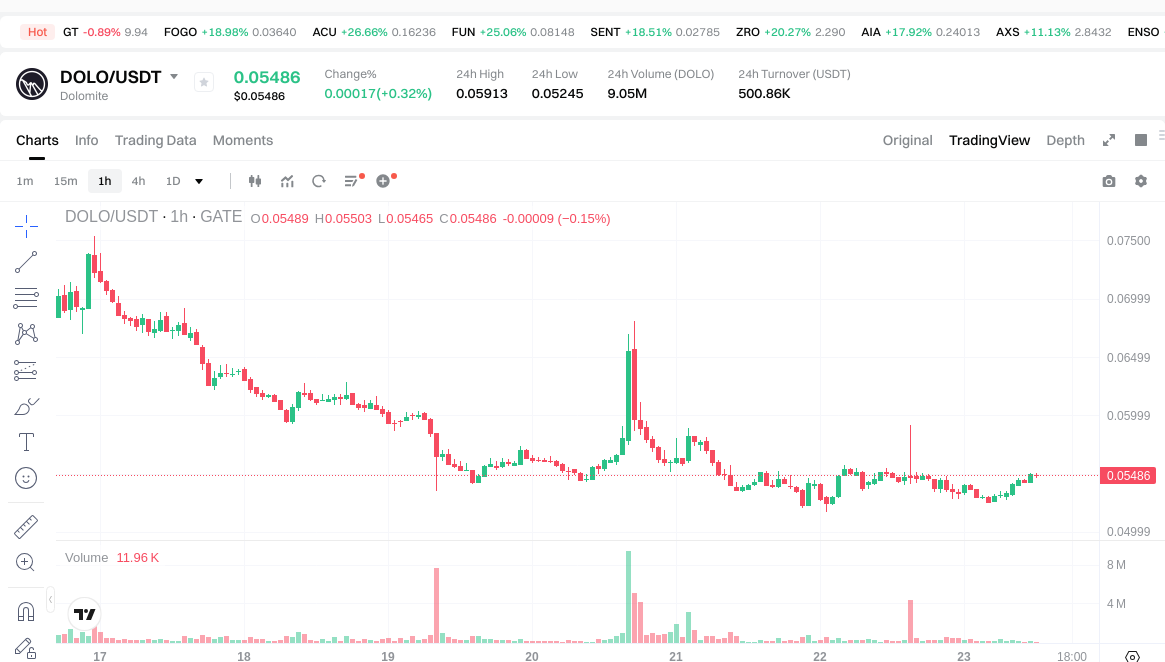
DOLO is a notable asset in the cryptocurrency field. As of January 23, 2026, Dolomite holds a market capitalization of approximately $19.79 million with a circulating supply of 361 million tokens, while the current price stands at around $0.05482. With its positioning as a modular money market integrated with DEX functionality, DOLO has gradually become a focal point for investors discussing "Is Dolomite (DOLO) a good investment?" Ranking at #884 in the cryptocurrency market and maintaining a market dominance of 0.0017%, DOLO represents 36.1% of its fully diluted valuation. This article comprehensively analyzes DOLO's investment value, historical trends, future price predictions, and investment risks to provide reference for investors.
I. Historical Price Review and Current Investment Value of DOLO
- 2025: DOLO experienced significant price volatility throughout the year → Price ranged from $0.02897 to $0.4, representing a wide fluctuation band
- June 2025: Token reached its lower price boundary at $0.02897 → Market showed relatively weak performance during this period
- August 2025: DOLO climbed to $0.4 level → Price demonstrated notable upward momentum following its June price level
Current DOLO Investment Market Status (January 2026)
- DOLO current price: $0.05482
- 24-hour trading volume: $502,900.92
- Market capitalization: $19,790,020
- Circulating supply: 361,000,000 DOLO (36.1% of total supply)
- Market share: 0.0017%
Click to view real-time DOLO market price
II. Core Factors Influencing Whether DOLO is a Good Investment (Is Dolomite(DOLO) a Good Investment)
Supply Mechanism and Scarcity (DOLO investment scarcity)
- Maximum Supply Capped at 1 Billion Tokens → DOLO has a fixed maximum supply of 1,000,000,000 tokens, with current circulation at 361,000,000 tokens (36.1% of total supply), establishing a defined scarcity framework that may influence long-term price dynamics.
- Historical Price Patterns → The token has demonstrated price volatility, with historical data showing price movements between $0.02897 and $0.4, reflecting market response to supply-demand dynamics and ecosystem developments.
- Investment Significance → The controlled supply mechanism, combined with gradual token circulation, represents a foundational element for evaluating long-term investment considerations in the context of DeFi market adoption.
Institutional Investment and Mainstream Adoption (Institutional investment in DOLO)
- Market Position → As of January 23, 2026, DOLO maintains a market capitalization of approximately $19.79 million with a market dominance of 0.0017%, indicating early-stage market positioning.
- Exchange Availability → The token is listed on 24 exchanges, providing accessibility for institutional and retail participants, with trading infrastructure supporting broader market participation.
- Ecosystem Integration → Dolomite's integration with Berachain infrastructure and its positioning within active DeFi ecosystems may influence institutional consideration, though specific institutional holding data is not currently disclosed.
Macroeconomic Environment's Impact on DOLO Investment
- DeFi Market Conditions → Broader cryptocurrency market sentiment and regulatory developments concerning DeFi protocols may affect DOLO's investment attractiveness, particularly as modular money market solutions respond to changing yield environments.
- Capital Efficiency Narrative → In varying interest rate environments, Dolomite's value proposition of enabling borrowing while maintaining staking rewards and governance rights may appeal to investors seeking capital efficiency.
- Risk Appetite Dynamics → Market uncertainty and volatility tolerance levels influence investor allocation to emerging DeFi tokens, with DOLO's 30-day performance showing 38.32% growth amid fluctuating market conditions.
Technology and Ecosystem Development (Technology & Ecosystem for DOLO investment)
- Modular Money Market Architecture → Dolomite's integration of DEX functionality with lending markets provides technical differentiation, enabling users to borrow against assets without sacrificing staking rewards or governance participation.
- Smart Debt and Collateral Mechanism → The protocol's "smart debt & collateral" system allows users to earn fees on both debt and collateral positions, potentially offsetting borrowing costs and enhancing capital efficiency for participants.
- Isolated Position Management → The platform's support for unlimited isolated positions enables precise strategy management across multiple DeFi applications, positioning DOLO within the evolving landscape of composable DeFi infrastructure and potentially supporting long-term ecosystem value.
- Berachain Integration → Deployment on Berachain infrastructure (contract address: 0x0f81001ef0a83ecce5ccebf63eb302c70a39a654) connects DOLO to emerging blockchain ecosystems, with ecosystem growth potentially influencing token utility and adoption trajectories.
III. DOLO Future Investment Forecast and Price Outlook (Is Dolomite (DOLO) worth investing in 2026-2031)
Short-term Investment Forecast (2026, short-term DOLO investment outlook)
- Conservative forecast: $0.0527 - $0.0549
- Neutral forecast: $0.0549 - $0.0697
- Optimistic forecast: $0.0697 or above
Mid-term Investment Outlook (2027-2029, mid-term Dolomite (DOLO) investment forecast)
-
Market stage expectation: Based on the provided data, DOLO may experience gradual growth during the mid-term period, with the average price potentially rising from approximately $0.0623 in 2027 to around $0.0848 in 2029, reflecting an increase of over 36% during this timeframe.
-
Investment return forecast:
- 2027: $0.0461 - $0.0872
- 2028: $0.0538 - $0.0949
- 2029: $0.0729 - $0.1145
-
Key catalysts: The modular money market design integrated with DEX functionality, the ability for users to maintain staking rewards and governance rights while borrowing, and the "smart debt & collateral" mechanism that enables fee generation may serve as potential growth drivers for the platform.
Long-term Investment Outlook (Is DOLO a good long-term investment?)
- Base scenario: $0.0718 - $0.1127 (assuming steady ecosystem development and stable market conditions through 2030-2031)
- Optimistic scenario: $0.1127 - $0.1583 (assuming increased adoption of the platform's capital efficiency features and favorable DeFi market trends)
- Risk scenario: Below $0.0690 (in case of reduced DeFi activity or challenges in user adoption)
View DOLO long-term investment and price forecast: Price Prediction
2026-01-23 to 2031 Long-term Outlook
- Base scenario: $0.0690 - $0.1127 (corresponding to steady progress and gradual mainstream application growth)
- Optimistic scenario: $0.1127 - $0.1583 (corresponding to large-scale adoption and favorable market environment)
- Transformative scenario: Above $0.1583 (if the ecosystem achieves breakthrough developments and mainstream penetration)
- 2031-12-31 forecast high: $0.1583 (based on optimistic development assumptions)
Disclaimer: The forecasts presented are based on historical data and market analysis models, and should not be considered as investment advice. Cryptocurrency markets are highly volatile and unpredictable. Past performance does not guarantee future results. Investors should conduct their own research and consult with financial professionals before making investment decisions.
| Year |
Predicted High Price |
Predicted Average Price |
Predicted Low Price |
Price Change |
| 2026 |
0.0696722 |
0.05486 |
0.0526656 |
0 |
| 2027 |
0.08717254 |
0.0622661 |
0.046076914 |
13 |
| 2028 |
0.0948935364 |
0.07471932 |
0.0537979104 |
36 |
| 2029 |
0.11448867807 |
0.0848064282 |
0.072933528252 |
54 |
| 2030 |
0.12655239248145 |
0.099647553135 |
0.0717462382572 |
81 |
| 2031 |
0.158339961931515 |
0.113099972808225 |
0.068990983413017 |
106 |
IV. DOLO Investment Strategy and Risk Management (How to invest in Dolomite)
Investment Methodology (DOLO investment strategy)
-
Long-term Holding (HODL DOLO): Suitable for conservative investors seeking exposure to modular DeFi money markets. This approach involves holding DOLO tokens while potentially benefiting from the platform's growth and utility within the Berachain ecosystem.
-
Active Trading: Relies on technical analysis and swing trading strategies. Traders may consider the token's price volatility, with 24-hour fluctuations and recent 7-day decline of 17.47%, alongside the 30-day gain of 38.32%, to identify potential entry and exit points.
Risk Management (Risk management for DOLO investment)
V. DOLO Investment Risks and Challenges (Risks of investing in Dolomite)
-
Market Risk: DOLO exhibits notable price volatility, with historical data showing movements from a low of $0.02897 to $0.4. The token's relatively modest market capitalization of approximately $19.79 million may contribute to price sensitivity and liquidity considerations.
-
Regulatory Risk: As a DeFi protocol token, DOLO faces evolving regulatory frameworks across different jurisdictions. Regulatory developments affecting decentralized finance, lending protocols, or the broader cryptocurrency sector could impact the token's utility and market performance.
-
Technical Risk: Potential concerns include smart contract vulnerabilities, protocol upgrade implementations, and integration dependencies within the Berachain ecosystem. The protocol's modular architecture requires ongoing development and security maintenance.
VI. Conclusion: Is Dolomite a Good Investment?
-
Investment Value Summary: DOLO represents exposure to an innovative modular money market concept within the DeFi space. The token's circulating supply of 361 million (36.1% of total supply) and integration with DEX functionality present potential utility value. However, price movements have shown considerable variability, with year-over-year decline of 56.77% offset by recent 30-day gains.
-
Investor Recommendations:
✅ Beginners: Consider dollar-cost averaging with secure wallet storage; thorough research of the Dolomite platform's mechanisms recommended before investment
✅ Experienced Investors: Evaluate swing trading opportunities while monitoring platform development milestones; maintain diversified DeFi portfolio allocation
✅ Institutional Investors: Assess strategic positioning in modular DeFi infrastructure with appropriate due diligence on protocol mechanics and market positioning
⚠️ Disclaimer: Cryptocurrency investment carries substantial risk. This content is for informational purposes only and does not constitute investment advice. Conduct independent research and consider consulting financial professionals before making investment decisions.
VII. FAQ
Q1: What is DOLO's current market position and how does it compare to other DeFi tokens?
As of January 23, 2026, DOLO holds a market capitalization of approximately $19.79 million, ranking #884 in the cryptocurrency market with a market dominance of 0.0017%. The token has a circulating supply of 361 million tokens (36.1% of total supply) priced at around $0.05482. Compared to established DeFi protocols, DOLO represents an early-stage project with a relatively modest market cap, which may translate to higher volatility but also potential growth opportunities. The token is listed on 24 exchanges, providing reasonable accessibility for investors. Its unique positioning as a modular money market integrated with DEX functionality on Berachain infrastructure differentiates it from traditional lending protocols.
Q2: How does Dolomite's technology provide value to DOLO token holders?
Dolomite's core value proposition centers on capital efficiency through its innovative "smart debt & collateral" mechanism. The platform allows users to borrow against their assets without sacrificing staking rewards or governance rights, enabling them to maintain multiple income streams simultaneously. Users can earn fees on both debt and collateral positions, potentially offsetting borrowing costs. The protocol's support for unlimited isolated positions enables precise strategy management across multiple DeFi applications, enhancing composability. This technical architecture creates utility for DOLO within the ecosystem, as the token facilitates these capital-efficient operations and may benefit from increased platform adoption.
Q3: What are the key price milestones DOLO has experienced, and what does this indicate about investment volatility?
DOLO has demonstrated significant price volatility throughout its trading history. In 2025, the token's price ranged from a low of $0.02897 (June 2025) to a high of $0.4 (August 2025), representing approximately 1,280% variation within this range. As of January 2026, the token is trading at $0.05482, reflecting a year-over-year decline of 56.77%, though recent performance shows a 30-day gain of 38.32% and a 7-day decline of 17.47%. This price action indicates considerable volatility characteristic of emerging DeFi tokens with relatively low market capitalization. Investors should be prepared for substantial price swings and consider position sizing accordingly within their broader portfolio allocation strategy.
Q4: What are the realistic price forecasts for DOLO through 2031?
Based on market analysis models, DOLO price forecasts suggest gradual growth potential under various scenarios. For 2026, conservative estimates range from $0.0527 to $0.0549, neutral forecasts from $0.0549 to $0.0697, and optimistic projections at $0.0697 or above. Mid-term projections indicate potential average prices rising from approximately $0.0623 in 2027 to around $0.0848 in 2029, reflecting over 36% growth. Long-term forecasts for 2030-2031 present a base scenario range of $0.0718 to $0.1127, with optimistic scenarios reaching $0.1127 to $0.1583 if ecosystem adoption accelerates. By 2031, the predicted high reaches $0.1583 under favorable development assumptions. These forecasts assume continued ecosystem development and should be viewed as analytical projections rather than guaranteed outcomes.
Q5: What are the primary risks associated with investing in DOLO?
DOLO investment carries multiple risk categories that investors should carefully evaluate. Market risk is significant, with the token's relatively modest $19.79 million market cap contributing to potential liquidity constraints and price sensitivity to trading volume. Regulatory risk remains a concern as evolving DeFi regulations across jurisdictions could impact protocol operations and token utility. Technical risk includes potential smart contract vulnerabilities, protocol upgrade challenges, and dependency on Berachain ecosystem development. The token's historical price volatility, ranging from $0.02897 to $0.4, demonstrates substantial downside potential alongside growth opportunities. Additionally, the fact that only 36.1% of total supply is currently circulating means future token releases could create selling pressure. Conservative investors should limit allocation to 1-3% of their crypto portfolio, while even experienced investors should maintain diversification and implement appropriate risk management strategies.
Q6: How should different investor types approach DOLO investment?
Investment approach should align with experience level and risk tolerance. Beginners are advised to utilize dollar-cost averaging strategies, investing small amounts regularly rather than lump sums, while storing tokens in secure wallet solutions. Thorough research of Dolomite's platform mechanics, including how the smart debt and collateral system functions, is essential before committing capital. Experienced investors might evaluate swing trading opportunities based on technical analysis, considering the token's demonstrated volatility patterns, while maintaining diversified DeFi portfolio allocations. Position sizes should be carefully managed, with moderate investors allocating 3-7% and experienced participants up to 10% of their crypto holdings. Institutional investors should conduct comprehensive due diligence on protocol mechanics, security audits, and competitive positioning within the modular DeFi landscape before establishing strategic positions.
Q7: What factors could drive DOLO price appreciation in the future?
Several catalysts could potentially support DOLO price appreciation over time. Increased adoption of Dolomite's capital efficiency features, particularly the ability to maintain staking rewards while borrowing, may attract more users seeking yield optimization. Growth in the Berachain ecosystem could drive demand for integrated protocols like Dolomite. Broader DeFi market expansion and favorable conditions for lending protocols could benefit DOLO's positioning. The token's fixed maximum supply of 1 billion tokens creates a defined scarcity framework that may support valuation as demand increases. Additionally, successful implementation of the platform's modular architecture and expansion of isolated position functionality could enhance utility. However, these potential catalysts face counterbalancing factors including competitive pressures from established DeFi protocols, market volatility, and execution risks in platform development.
Q8: Where can investors purchase DOLO and what storage options are recommended?
DOLO is available for trading on 24 cryptocurrency exchanges, providing multiple access points for investors. The token's contract address on Berachain is 0x0f81001ef0a83ecce5ccebf63eb302c70a39a654, which investors should verify before transactions. For storage, a tiered approach is recommended based on investment strategy. Active traders may utilize hot wallets connected to exchanges for immediate trading access, accepting the higher security risks in exchange for liquidity. Long-term holders should prioritize cold storage solutions, particularly hardware wallets, which provide offline security for substantial positions. For significant holdings, multi-signature wallets offer enhanced security through distributed key management. Investors should never store large amounts on exchanges for extended periods and should implement regular security practices including backup procedures and verification of wallet addresses before transactions.
* The information is not intended to be and does not constitute financial advice or any other recommendation of any sort offered or endorsed by Gate.