This comprehensive analysis examines whether DuckChain (DUCK) presents a viable investment opportunity in 2024-2031. DUCK, the first consumer layer blockchain on TON launched in January 2025, bridges multiple ecosystems including Ethereum and Bitcoin via Arbitrum Orbit infrastructure, currently trading at $0.0012408 with a $7.32 million market cap. The article evaluates DUCK's price history, technological differentiation, and supply mechanics while presenting tiered price forecasts ranging from conservative to optimistic scenarios through 2031. Key investment factors include institutional adoption (252,588 holders across 15 Gate-listed exchanges), Telegram ecosystem integration targeting 950 million users, and account abstraction technology lowering blockchain barriers. The analysis addresses critical risks including high volatility (73% decline from $0.05 launch price), regulatory uncertainty across jurisdictions, and technical complexities of cross-chain operations. Investment strategies are tailored for co
Introduction: DuckChain (DUCK) Investment Position and Market Outlook
DUCK is an emerging asset in the cryptocurrency sector. Since its launch in January 2025, it has developed as the first consumer layer blockchain on TON, bridging TON with Ethereum (EVM), Bitcoin (BTC), and other ecosystems using Arbitrum Orbit infrastructure. As of January 27, 2026, DUCK has a market capitalization of approximately $7.32 million, with a circulating supply of 5.9 billion tokens, and the current price is around $0.0012408. With a total supply of 9.45 billion tokens and a maximum supply of 10 billion, the circulating supply represents 59% of the fully diluted valuation.
DuckChain aims to lower barriers for Web2 users through a unified gas system via Telegram Stars and account abstraction, allowing users to perform on-chain operations directly within Telegram. The project serves over 252,588 holders and is available on 15 exchanges. Recent price movements show a 4.51% increase over 24 hours, a 19.29% rise over 7 days, and an 11.55% gain over 30 days, though the token experienced a decline of 73.01% over the past year from its launch price of $0.05.
Positioned to make blockchain interaction as simple as sending a message on Telegram for 950 million global users, DUCK has become a subject of analysis when investors consider "Is DuckChain (DUCK) a good investment?" This article provides a comprehensive examination of DUCK's investment characteristics, historical price trends, future price projections, and associated risks to assist investors in their research.
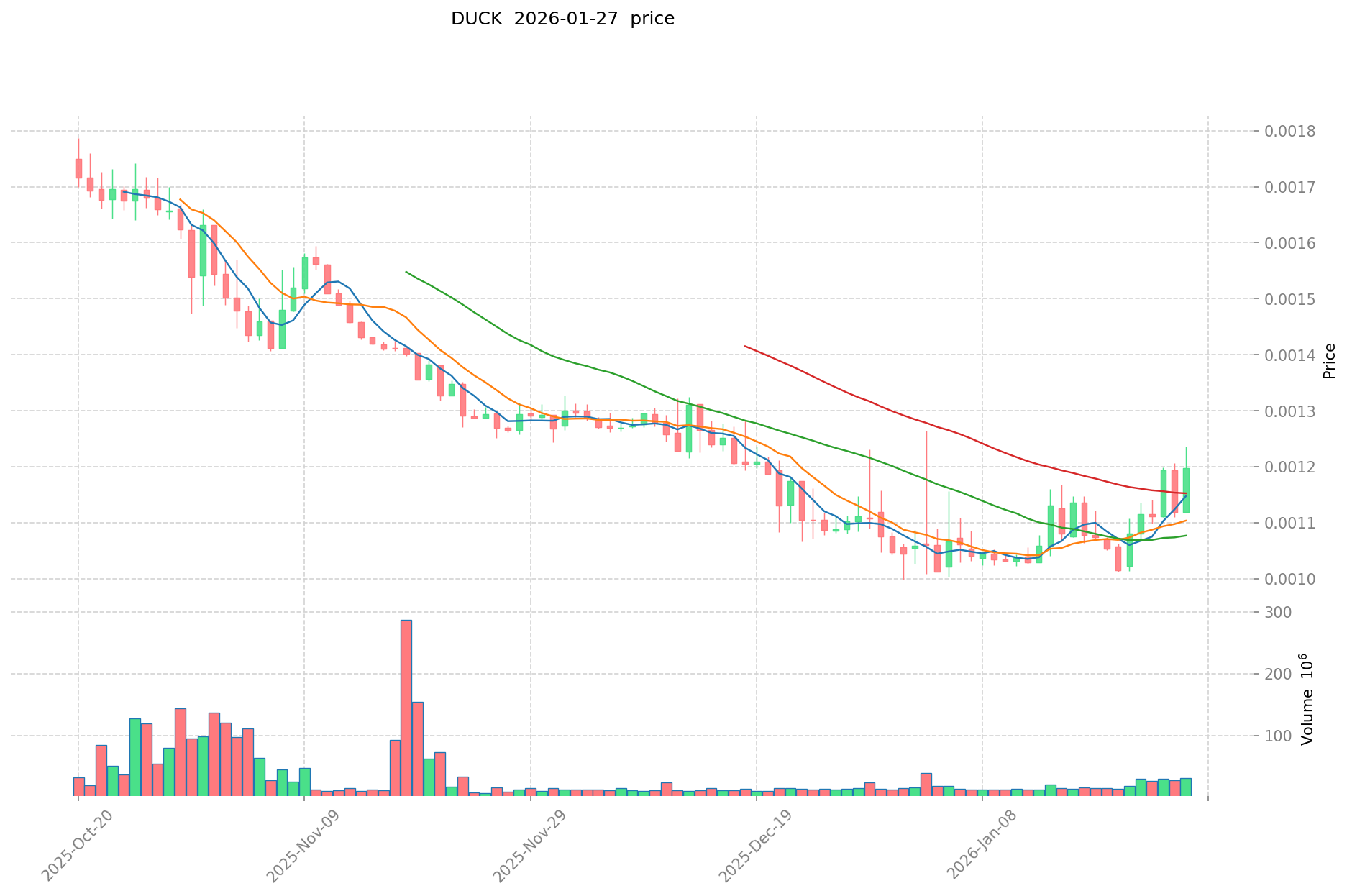
I. DUCK Price History Review and Current Investment Value
- 2025: Initial listing → Price fluctuated between $0.01816 and $0.001915
- January 2025: Peak period → DUCK price reached $0.01816 on January 16, 2025
- October 2025: Market adjustment → Price declined to approximately $0.002359
- January 2026: Recent performance → DUCK trading at $0.0012408, showing a recovery with a 19.29% increase over the past 7 days
Current DUCK Investment Market Status (January 2026)
- DUCK current price: $0.0012408
- 24-hour trading volume: $37,294.14
- Market capitalization: $7,320,720
- Circulating supply: 5.9 billion DUCK (59% of total supply)
- Number of holders: 252,588
- Listed on 15 exchanges
Click to view real-time DUCK market price
II. Core Factors Affecting Whether DUCK is a Good Investment (Is DuckChain(DUCK) a Good Investment)
Supply Mechanism and Scarcity (DUCK investment scarcity)
- Token supply structure → impacts price and investment value
- DuckChain has a maximum supply of 10,000,000,000 DUCK tokens, with a current circulating supply of 5,900,000,000 DUCK (59% of max supply)
- The controlled supply release mechanism may influence long-term price dynamics
- Investment significance: scarcity characteristics are key factors supporting long-term investment considerations
Institutional Investment and Mainstream Adoption (Institutional investment in DUCK)
- Holder base: DuckChain currently has 252,588 holders
- Exchange availability: DUCK is listed on 15 exchanges, including platforms such as Bitget
- Telegram ecosystem integration: DuckChain's position as the first consumer layer blockchain on TON provides exposure to Telegram's 950 million user base
- Strategic partnerships: Integration with Arbitrum Orbit infrastructure bridges TON with Ethereum (EVM), Bitcoin (BTC), and other ecosystems
Macroeconomic Environment's Impact on DUCK Investment
- Blockchain adoption trends: moderate growth expected from 2025 to 2030 with improvements in blockchain adoption and ecosystem maturity
- Market positioning: DuckChain's role in connecting multiple ecosystems may provide diversification benefits
- Web3 adoption: unified gas system via Telegram Stars and account abstraction lowers barriers for Web2 users, potentially expanding the user base
Technology and Ecosystem Development (Technology & Ecosystem for DUCK investment)
- Cross-chain infrastructure: utilizes Arbitrum Orbit's infrastructure to connect TON with Ethereum (EVM), Bitcoin (BTC), and other ecosystems
- Developer tools: provides familiar development environment for building dApps and migrating applications to the Telegram ecosystem
- User experience improvements: account abstraction and unified gas system simplify blockchain interactions for mainstream users
- Ecosystem expansion: supports thousands of dApps directly within Telegram, enabling Web3 experiences comparable to Web2 applications
- Mission-driven development: aims to make blockchain interactions as intuitive as sending messages on Telegram
III. DUCK Future Investment Forecast and Price Outlook (Is DuckChain(DUCK) worth investing in 2026-2031)
Short-term Investment Forecast (2026, short-term DUCK investment outlook)
- Conservative forecast: $0.000820 - $0.001067
- Neutral forecast: $0.001243 - $0.001423
- Optimistic forecast: $0.001551 - $0.001603
Mid-term Investment Outlook (2027-2029, mid-term DuckChain(DUCK) investment forecast)
- Market stage expectation: DuckChain may experience growth driven by expansion within the TON ecosystem and broader adoption of Telegram-integrated blockchain solutions
- Investment return forecast:
- 2027: $0.001067 - $0.001551 (approximately 14% annual change)
- 2028: $0.000877 - $0.002156 (approximately 19% annual change)
- 2029: $0.001220 - $0.002532 (approximately 46% annual change)
- Key catalysts: Integration depth with Telegram ecosystem, developer adoption of Arbitrum Orbit infrastructure, user growth in TON-based dApps, and improvements in account abstraction features
Long-term Investment Outlook (Is DUCK a good long-term investment?)
- Base scenario: $0.001872 - $0.002297 (assuming steady ecosystem development and moderate user adoption through 2030-2031)
- Optimistic scenario: $0.002113 - $0.002480 (assuming accelerated adoption and favorable market conditions)
- Risk scenario: Below $0.000877 (under adverse market conditions or significant competitive pressure)
View DUCK long-term investment and price forecast: Price Prediction
2026-01-27 to 2031 Long-term Outlook
- Base scenario: $0.001872 - $0.002297 (corresponding to steady progress and gradual mainstream application enhancement)
- Optimistic scenario: $0.002113 - $0.002532 (corresponding to large-scale adoption and favorable market environment)
- Transformative scenario: Above $0.002532 (if the ecosystem achieves breakthrough progress and mainstream popularization)
- 2031-12-31 predicted high: $0.002480 (based on optimistic development assumptions)
Disclaimer: These forecasts are based on historical data patterns and current market information. Cryptocurrency markets are subject to volatility and multiple risk factors. These projections should not be considered as investment advice, and actual performance may differ materially from these estimates.
| Year |
Predicted High Price |
Predicted Average Price |
Predicted Low Price |
Price Change |
| 2026 |
0.001602954 |
0.0012426 |
0.000820116 |
0 |
| 2027 |
0.00155082693 |
0.001422777 |
0.00106708275 |
14 |
| 2028 |
0.00215586284925 |
0.001486801965 |
0.00087721315935 |
19 |
| 2029 |
0.002531652045903 |
0.001821332407125 |
0.001220292712773 |
46 |
| 2030 |
0.00241590637143 |
0.002176492226514 |
0.001871783314802 |
75 |
| 2031 |
0.00247989524289 |
0.002296199298972 |
0.002112503355054 |
85 |
IV. DUCK Investment Strategy and Risk Management (How to invest in DuckChain)
Investment Methodology (DUCK investment strategy)
-
Long-term Holding (HODL DUCK): Suitable for conservative investors
For investors who believe in DuckChain's long-term vision of making blockchain accessible to Telegram's 950 million users, holding DUCK tokens may align with a patient approach. This strategy typically involves acquiring tokens and maintaining positions through market fluctuations, focusing on the project's fundamental development rather than short-term price movements.
-
Active Trading: Relies on technical analysis and swing operations
Active traders may utilize technical indicators to identify entry and exit points based on DUCK's price movements. Given the token's 24-hour volatility of 4.51% and 7-day change of 19.29%, traders might find opportunities in shorter timeframes. However, this approach requires continuous market monitoring and understanding of trading patterns.
Risk Management (Risk management for DUCK investment)
-
Asset Allocation Ratio: Conservative / Aggressive / Professional investors
- Conservative investors: May allocate 1-3% of their crypto portfolio to DUCK, balancing exposure with established assets
- Aggressive investors: Might consider 5-10% allocation, accepting higher volatility for potential growth
- Professional investors: Could employ dynamic allocation strategies based on market conditions and technical signals
-
Risk Hedging Solutions: Multi-asset portfolio + hedging tools
Diversification across different blockchain ecosystems and asset classes can help mitigate concentration risk. Investors might consider pairing DUCK holdings with stablecoins or assets from different categories to reduce portfolio volatility.
-
Secure Storage: Hot/cold wallets + hardware wallet recommendations
Given that DUCK operates on the TON blockchain (contract address: EQDWXjnVWheFemaAaFn-Cp4nDehvGllrXOZ8wqHm8sDEwn_c), investors should use TON-compatible wallets. Hardware wallets supporting TON network provide enhanced security for long-term storage, while mobile wallets may suit users requiring frequent access for trading.
V. DUCK Investment Risks and Challenges (Risks of investing in DuckChain)
-
Market Risk: High volatility, price manipulation potential
DUCK has demonstrated significant price fluctuations, with a recorded low of $0.000606 and high of $0.01816. The current market capitalization of approximately $7.32 million represents a relatively small position in the crypto market (0.00037% dominance), which may contribute to increased volatility. Lower market cap assets can experience sharper price movements due to lower liquidity.
-
Regulatory Risk: Policy uncertainty across different countries
As a project bridging multiple blockchain ecosystems including TON, Ethereum, and Bitcoin through Arbitrum Orbit infrastructure, DuckChain operates in a complex regulatory environment. Different jurisdictions maintain varying approaches to crypto asset regulation, which could impact the project's operations and token accessibility.
-
Technical Risk: Network security vulnerabilities, upgrade failures
While DuckChain leverages Arbitrum Orbit's infrastructure to connect TON with other ecosystems, any technical issues in the underlying protocols, smart contract vulnerabilities, or integration challenges could affect the platform's functionality and token value. The complexity of cross-chain operations introduces additional technical considerations.
VI. Conclusion: Is DuckChain a Good Investment?
-
Investment Value Summary: DUCK presents growth potential through its positioning as a consumer-focused blockchain layer on TON, though it exhibits considerable short-term price volatility.
-
Investor Recommendations:
✅ Beginners: Dollar-cost averaging approach + secure wallet storage
✅ Experienced investors: Swing trading strategies + diversified portfolio allocation
✅ Institutional investors: Strategic long-term positioning with appropriate risk controls
⚠️ Disclaimer: Cryptocurrency investment carries substantial risk. This content is for informational purposes only and does not constitute investment advice.
VII. FAQ
Q1: What is DuckChain's current market position and how does it compare to other blockchain projects?
DuckChain currently holds a market capitalization of approximately $7.32 million with a circulating supply of 5.9 billion tokens (59% of total supply), representing 0.00037% market dominance. As the first consumer layer blockchain on TON, DuckChain distinguishes itself through its integration with Telegram's ecosystem of 950 million users and cross-chain infrastructure connecting TON with Ethereum (EVM), Bitcoin (BTC), and other ecosystems via Arbitrum Orbit. The project serves 252,588 holders and is listed on 15 exchanges. While its market cap is relatively small compared to established blockchain platforms, its unique positioning as a Telegram-integrated solution and unified gas system via Telegram Stars provides differentiation in the consumer blockchain space.
Q2: What are the main price forecasts for DUCK from 2026 to 2031?
Price projections for DUCK show a graduated growth trajectory across different scenarios. For 2026, conservative estimates range from $0.000820 to $0.001067, neutral forecasts suggest $0.001243 to $0.001423, and optimistic scenarios project $0.001551 to $0.001603. Medium-term forecasts indicate potential appreciation, with 2027 estimates at $0.001067-$0.001551 (14% annual change), 2028 at $0.000877-$0.002156 (19% annual change), and 2029 at $0.001220-$0.002532 (46% annual change). Long-term projections for 2030-2031 range from $0.001872 to $0.002480 under base and optimistic scenarios, assuming ecosystem development and increased adoption. These forecasts reflect historical patterns and current market data, though actual performance may vary significantly due to market volatility.
Q3: What are the primary risks associated with investing in DUCK?
DUCK investment carries several categories of risk. Market risk includes high volatility, evidenced by a price range from $0.000606 to $0.01816, and the token's small market cap ($7.32 million) contributes to potential price manipulation and liquidity constraints. Regulatory risk stems from DuckChain's operation across multiple blockchain ecosystems (TON, Ethereum, Bitcoin) through Arbitrum Orbit infrastructure, exposing it to varying regulatory frameworks across jurisdictions. Technical risk involves potential vulnerabilities in cross-chain operations, smart contract security, and integration complexities between different blockchain protocols. Additionally, the token has experienced a 73.01% decline from its launch price of $0.05, demonstrating substantial downside risk potential. Investors should implement appropriate risk management strategies including diversified allocation and secure storage solutions.
Q4: How does DuckChain's technology differentiate it from other blockchain platforms?
DuckChain's technological differentiation centers on three core elements: cross-chain infrastructure, user accessibility, and ecosystem integration. The platform utilizes Arbitrum Orbit's infrastructure to bridge TON with Ethereum (EVM), Bitcoin (BTC), and other ecosystems, creating interoperability across major blockchain networks. Its unified gas system via Telegram Stars and account abstraction technology significantly lowers barriers for Web2 users, enabling blockchain operations directly within Telegram without requiring specialized knowledge. This approach targets Telegram's 950 million user base, positioning DuckChain as a consumer-focused blockchain layer. The platform supports thousands of dApps within the Telegram environment, providing developers with familiar tools for building and migrating applications while offering users Web3 experiences comparable to traditional Web2 applications.
Q5: What investment strategies are recommended for different types of DUCK investors?
Investment strategies for DUCK vary based on investor profiles and risk tolerance. Conservative investors might allocate 1-3% of their crypto portfolio to DUCK, utilizing a long-term holding (HODL) strategy with dollar-cost averaging to mitigate timing risk and focusing on the project's fundamental development rather than short-term volatility. Aggressive investors could consider 5-10% allocation with active trading approaches, leveraging technical analysis to capitalize on DUCK's observed volatility patterns (4.51% in 24 hours, 19.29% over 7 days). Professional investors might employ dynamic allocation strategies with sophisticated risk management tools, including multi-asset portfolio diversification and hedging instruments. All investor categories should prioritize secure storage using TON-compatible wallets, with hardware wallets recommended for long-term holdings and mobile wallets for active trading requirements.
Q6: What factors could drive DUCK's future price appreciation?
Several catalysts could influence DUCK's price trajectory through 2031. Ecosystem expansion within the TON network and increased adoption of Telegram-integrated blockchain solutions represent primary growth drivers. Developer adoption of DuckChain's Arbitrum Orbit infrastructure and the growth of TON-based dApps could expand the platform's utility and user base. Improvements in account abstraction features and the unified gas system may lower barriers for Web2 users, potentially tapping into Telegram's 950 million user base. Broader blockchain adoption trends from 2025 to 2030, combined with DuckChain's cross-chain positioning connecting multiple ecosystems, could provide diversification benefits and increased demand. The project's current holder base of 252,588 and listing on 15 exchanges suggests growing network effects that may strengthen with continued development.
Q7: How does DuckChain's token supply structure impact investment considerations?
DuckChain's token economics feature a maximum supply of 10 billion DUCK tokens, with a current circulating supply of 5.9 billion (59% of maximum supply). This controlled supply release mechanism may influence long-term price dynamics through scarcity characteristics. The remaining 4.1 billion tokens (41% of max supply) not yet in circulation represent potential future dilution that investors should factor into valuation assessments. With 59% circulating supply relative to fully diluted valuation, DUCK's current market cap of $7.32 million translates to a fully diluted valuation of approximately $12.4 million. The gradual token release schedule, combined with the project's holder base of 252,588, suggests a distribution strategy designed to balance liquidity provision with price stability considerations. Understanding this supply structure is essential for evaluating DUCK's long-term investment potential and scarcity profile.
Q8: What are the key milestones that could validate DuckChain's investment thesis?
Critical milestones for evaluating DuckChain's investment viability include quantifiable metrics across adoption, technology, and market performance categories. User growth metrics such as expansion beyond the current 252,588 holder base and increased daily active users conducting on-chain operations through Telegram would demonstrate product-market fit. Developer adoption indicators including the number of dApps built on the platform and successful migrations from other ecosystems would validate the technological infrastructure. Exchange listings beyond the current 15 platforms and improvements in trading volume from the current $37,294.14 daily average would enhance liquidity and accessibility. Technical achievements such as enhanced cross-chain functionality, security audits, and upgrades to account abstraction features would strengthen the platform's foundation. Partnership announcements with major projects in TON, Ethereum, or Bitcoin ecosystems could expand DuckChain's network effects and utility.
* The information is not intended to be and does not constitute financial advice or any other recommendation of any sort offered or endorsed by Gate.