This comprehensive guide examines whether Dynex (DNX), a neuromorphic computing token launched in September 2022, represents a viable investment opportunity. As of January 2026, DNX trades at $0.046 with a $4.93 million market cap, offering exposure to decentralized AI infrastructure compatible with PyTorch, TensorFlow, and IBM Qiskit frameworks. The article analyzes DNX's price trajectory from its $1.23 peak in March 2024, current market volatility patterns, and forecasts ranging from $0.032 to $0.100 through 2031 under various scenarios. Key investment factors include high supply circulation (96.6%), ecosystem development potential, and trading opportunities across Gate and five other exchanges. The guide addresses critical risks including substantial price volatility, regulatory uncertainties, and limited market liquidity while providing tailored investment strategies for beginners, experienced traders, and institutional investors seeking neuromorphic computing sector exposure.
Introduction: Dynex (DNX) Investment Status and Market Outlook
Dynex (DNX) represents a specialized asset in the cryptocurrency sector, launched in September 2022 as a next-generation neuromorphic computing platform. As of January 29, 2026, DNX maintains a market capitalization of approximately $4.93 million, with a circulating supply of around 106.26 million tokens, and a current price near $0.046. The platform positions itself as a decentralized neuromorphic supercomputing network compatible with frameworks including PyTorch, Google TensorFlow, and IBM Qiskit, finding applications across finance, medicine, construction, and other sectors. With its ranking at 1540 in the cryptocurrency market and a market dominance of 0.00015%, DNX has become a subject of analysis when investors consider "Is Dynex (DNX) a good investment?" This article provides a comprehensive examination of DNX's investment characteristics, historical price movements, future price analysis, and associated risks to serve as a reference for potential investors.
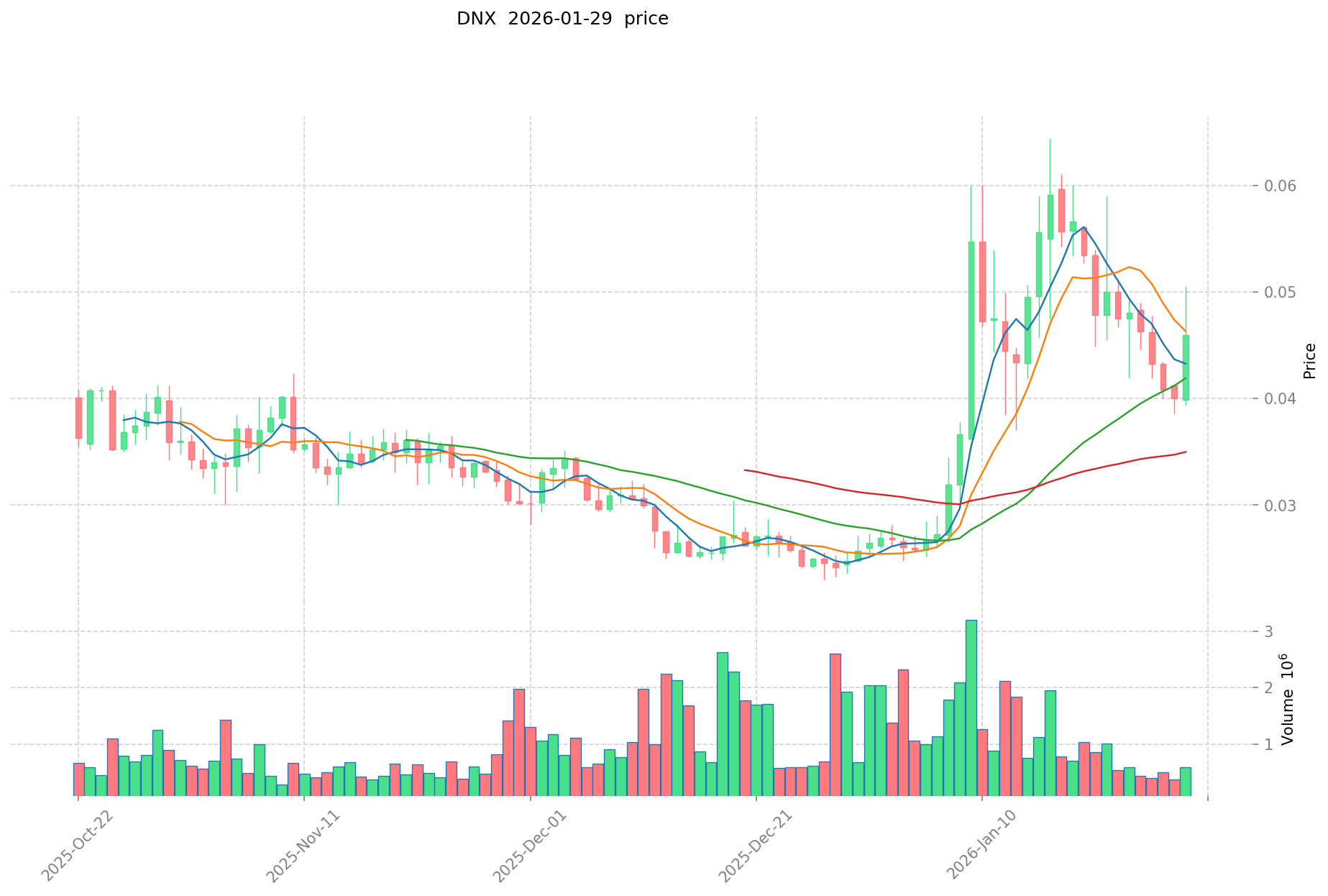
I. DNX Price History Review and Current Investment Value
- 2024: On March 9, DNX reached a price milestone at $1.23 → representing a notable performance period for early investors
- 2024: Throughout the year, DNX experienced significant volatility → price movements ranged from $0.002 in early January to higher levels in March
- 2025-2026: Market cycles demonstrated considerable fluctuation → from $0.05057 declining to $0.03934 within 24-hour trading periods
Current DNX Investment Market Status (January 2026)
- DNX current price: $0.04642
- Market sentiment: Positive short-term momentum with 15.21% increase over 24 hours
- 24-hour trading volume: $26,271.28
- Circulating supply: 106,259,529.67 DNX (96.60% of total supply)
- Market capitalization: $4,932,567.37
- Fully diluted valuation: $4,933,225.11
View real-time DNX market price
Recent Price Trends Analysis
- 1-hour performance: -2.03% decrease
- 7-day performance: -7.97% decline
- 30-day performance: 85.17% increase
- 1-year performance: -66.94% decrease from previous levels
Market Position Indicators
- Market dominance: 0.00015%
- Listed on 6 exchanges
- Initial offering price: $0.08
- Market cap to FDV ratio: 96.6%
II. Core Factors Influencing Whether DNX is a Good Investment
Supply Mechanism and Scarcity (DNX Investment Scarcity)
- Supply constraints play a role in influencing price and investment value
- Historical context: Dynex (DNX) has a maximum supply of 110,000,000 tokens, with approximately 106,259,529 tokens currently in circulation, representing a circulation ratio of 96.6%
- The market cap to fully diluted valuation ratio stands at 96.6%, indicating that the circulating supply is approaching the maximum supply
- Investment significance: The limited supply expansion potential may contribute to scarcity dynamics as the circulating supply nears the maximum threshold
Institutional Investment and Mainstream Adoption (Institutional Investment in DNX)
- Technical analysis from January 2026 indicated bullish signals, with 92.86% of moving average indicators showing positive trends
- Dynex's neuromorphic computing platform has potential applications across multiple sectors including finance, medicine, construction, and military
- The platform's compatibility with established frameworks such as PyTorch, Google TensorFlow, and IBM Qiskit may contribute to broader technical adoption
- The computing power marketplace allows miners to earn income through tasks while enabling AI professionals to participate in the ecosystem
Macroeconomic Environment's Impact on DNX Investment
- Market volatility remains a factor, with DNX experiencing price fluctuations: 24-hour price change of 15.21%, 7-day change of -7.97%, and 30-day change of 85.17%
- Short-term price predictions are noted to be highly volatile and dependent on market sentiment, trading volume, and external factors
- The broader crypto asset market conditions and regulatory developments may influence investment attractiveness
Technology and Ecosystem Development (Technology & Ecosystem for DNX Investment)
- Dynex operates as a neuromorphic computing platform built on a flexible blockchain protocol utilizing Proof of Useful Work (PoUW) miners
- The platform establishes a decentralized neuromorphic supercomputing network that aims to surpass traditional computing efficiency
- The computing power marketplace creates a dual-sided economic model where miners provide computational resources and AI professionals can access these resources for various applications
- Integration with major AI and machine learning frameworks (PyTorch, Google TensorFlow, IBM Qiskit) positions the platform for potential technical ecosystem expansion
- The platform enables direct AI implementation from the code level, which may offer technical advantages for computational applications
III. DNX Future Investment Forecast and Price Outlook (Is Dynex(DNX) worth investing in 2026-2031)
Short-term Investment Forecast (2026, short-term DNX investment outlook)
- Conservative forecast: $0.0324683 - $0.04573
- Neutral forecast: $0.04573 - $0.05327545
- Optimistic forecast: $0.0608209
Mid-term Investment Outlook (2027-2029, mid-term Dynex(DNX) investment forecast)
- Market stage expectation: DNX may enter a phase of moderate growth, with price fluctuations reflecting broader market conditions and ecosystem development progress.
- Investment return forecast:
- 2027: $0.030899761 - $0.0559392225
- 2028: $0.033856548475 - $0.0584298497875
- 2029: $0.03843264325275 - $0.081951959877187
- Key catalysts: Compatibility with AI frameworks such as PyTorch, Google TensorFlow, and IBM Qiskit; expansion of the decentralized neuromorphic supercomputing network; growth in the computing power marketplace; broader adoption across finance, medicine, and other sectors.
Long-term Investment Outlook (Is Dynex a good long-term investment?)
- Base scenario: $0.06646586539005 - $0.079620567915164 (assuming steady ecosystem development and gradual mainstream application adoption)
- Optimistic scenario: $0.090005859382359 - $0.100321915573106 (assuming large-scale adoption and favorable market conditions)
- Risk scenario: Below $0.0324683 (under adverse market conditions or significant setbacks in ecosystem development)
Click to view DNX long-term investment and price forecast: Price Prediction
2026-01-29 - 2031 Long-term Outlook
- Base scenario: $0.06646586539005 - $0.079620567915164 (corresponding to steady progress and gradual increase in mainstream applications)
- Optimistic scenario: $0.090005859382359 - $0.100321915573106 (corresponding to large-scale adoption and favorable market environment)
- Transformative scenario: Above $0.100321915573106 (if the ecosystem achieves breakthrough progress and mainstream popularization)
- 2031-12-31 forecast high: $0.100321915573106 (based on optimistic development assumptions)
Disclaimer: The above forecasts are based on available data and analytical models. Actual market performance may vary significantly due to multiple factors including market volatility, regulatory changes, technological developments, and macroeconomic conditions. These projections do not constitute financial advice, and potential investors should conduct their own research and consult with qualified financial advisors before making investment decisions.
| Year |
Predicted High Price |
Predicted Average Price |
Predicted Low Price |
Price Change |
| 2026 |
0.0608209 |
0.04573 |
0.0324683 |
-1 |
| 2027 |
0.0559392225 |
0.05327545 |
0.030899761 |
14 |
| 2028 |
0.0584298497875 |
0.05460733625 |
0.033856548475 |
17 |
| 2029 |
0.081951959877187 |
0.05651859301875 |
0.03843264325275 |
21 |
| 2030 |
0.090005859382359 |
0.069235276447968 |
0.06646586539005 |
49 |
| 2031 |
0.100321915573106 |
0.079620567915164 |
0.07325092248195 |
71 |
IV. Dynex Investment Strategy and Risk Management (How to invest in Neuromorphic Computing Tokens)
Investment Methodology (Dynex investment strategy)
-
Long-term Holding (HODL Dynex): Suitable for conservative investors seeking exposure to the neuromorphic computing sector. This approach involves accumulating DNX tokens during market corrections and holding through volatility cycles, focusing on the platform's long-term development trajectory and adoption in AI computing markets.
-
Active Trading: Relies on technical analysis and swing trading strategies. Given DNX's historical volatility, with a 24-hour price fluctuation range between $0.03934 and $0.05057, traders may capitalize on short-term price movements. Key technical indicators include monitoring trading volume patterns and support/resistance levels established during recent price ranges.
Risk Management (Risk management for Dynex investment)
V. Dynex Investment Risks and Challenges (Risks of investing in Neuromorphic Computing Tokens)
-
Market Risks: DNX exhibits substantial volatility with a 24-hour price change of 15.21% and 30-day fluctuation of 85.17%. The token experienced a decline from its historical peak of $1.23 (March 2024) to current levels around $0.046, representing significant price correction. Market capitalization of approximately $4.93 million indicates limited liquidity, which may amplify price swings during large transactions.
-
Regulatory Risks: Neuromorphic computing tokens face evolving regulatory frameworks across jurisdictions. Policy uncertainties regarding AI infrastructure tokens and decentralized computing networks may impact project operations and token utility. Cross-border regulatory divergence presents challenges for platform expansion and institutional adoption.
-
Technical Risks: Platform security considerations include smart contract vulnerabilities in the computing power marketplace and potential network disruptions during protocol upgrades. The integration with frameworks like PyTorch, Google TensorFlow, and IBM Qiskit introduces dependency risks on third-party technology stacks. Mining network stability through the PoUW consensus mechanism requires ongoing technical maintenance and security auditing.
VI. Conclusion: Is Neuromorphic Computing Token a Good Investment?
-
Investment Value Summary: Dynex demonstrates potential in the emerging neuromorphic computing sector, with compatibility across major AI frameworks and applications spanning finance, healthcare, and defense industries. The platform's computing power marketplace creates utility-driven demand for DNX tokens. However, the token exhibits elevated short-term volatility, as evidenced by recent price fluctuations and a current trading price significantly below historical peaks.
-
Investor Recommendations:
✅ Beginners: Implement dollar-cost averaging strategies with monthly or bi-weekly purchases; prioritize secure wallet storage solutions; limit initial allocation to 1-2% of total crypto portfolio.
✅ Experienced Investors: Consider swing trading opportunities during volatility windows; maintain diversified exposure across AI and computing infrastructure tokens; employ stop-loss mechanisms at 15-20% below entry points.
✅ Institutional Investors: Evaluate strategic positioning in neuromorphic computing infrastructure as part of broader AI technology exposure; conduct thorough due diligence on platform adoption metrics and partnership developments; consider staged entry positions across multiple quarters.
⚠️ Disclaimer: Cryptocurrency investments carry substantial risk due to market volatility, regulatory uncertainties, and technological complexities. This content serves informational purposes only and does not constitute financial, investment, or trading advice. Investors should conduct independent research and consult qualified financial advisors before making investment decisions.
VII. FAQ
Q1: What is Dynex (DNX) and why might it be considered for investment?
Dynex (DNX) is a neuromorphic computing platform token launched in September 2022, representing a decentralized supercomputing network compatible with major AI frameworks including PyTorch, Google TensorFlow, and IBM Qiskit. The platform utilizes a Proof of Useful Work (PoUW) consensus mechanism and operates a computing power marketplace where miners earn income by providing computational resources for AI applications across finance, medicine, construction, and other sectors. As of January 29, 2026, DNX trades at approximately $0.046 with a market capitalization of $4.93 million. Investment consideration stems from its positioning in the emerging neuromorphic computing sector and compatibility with mainstream AI development frameworks, though investors should note the token's significant volatility and modest market liquidity.
Q2: What are the primary risks associated with investing in Dynex (DNX)?
The primary risks include substantial market volatility, with DNX exhibiting price fluctuations ranging from 15.21% in 24 hours to 85.17% over 30 days, and a significant decline from its March 2024 peak of $1.23 to current levels around $0.046. The token's limited market capitalization of approximately $4.93 million indicates constrained liquidity, potentially amplifying price movements during larger transactions. Additional risks encompass evolving regulatory frameworks for AI infrastructure tokens across different jurisdictions, technical vulnerabilities in smart contracts and the computing power marketplace, and dependency risks on third-party technology integrations with frameworks like PyTorch and TensorFlow. The platform's security requires ongoing auditing, particularly given the complexity of the PoUW mining network.
Q3: How does Dynex's supply mechanism affect its investment potential?
Dynex has a maximum supply of 110,000,000 tokens, with approximately 106,259,529 tokens currently in circulation, representing a 96.6% circulation ratio. The market cap to fully diluted valuation ratio stands at 96.6%, indicating that circulating supply is approaching the maximum threshold with limited expansion potential remaining. This high circulation percentage may contribute to scarcity dynamics as the available supply for future distribution becomes increasingly constrained. However, investors should recognize that supply scarcity alone does not guarantee price appreciation, as demand factors, platform adoption, and overall market conditions remain critical determinants of token value.
Q4: What are the projected price ranges for DNX through 2031?
Short-term forecasts for 2026 suggest a range between $0.0324683 (conservative) and $0.0608209 (optimistic). Mid-term projections indicate potential growth to $0.030899761-$0.0559392225 by 2027, expanding to $0.03843264325275-$0.081951959877187 by 2029. Long-term forecasts for 2031 present a base scenario of $0.06646586539005-$0.079620567915164, an optimistic scenario reaching $0.090005859382359-$0.100321915573106, and a transformative scenario potentially exceeding $0.100321915573106. These projections assume various development trajectories including steady ecosystem growth, increased mainstream adoption, and favorable market conditions. However, actual performance may vary significantly due to market volatility, regulatory changes, technological developments, and macroeconomic factors.
Q5: What investment strategies are recommended for different investor profiles interested in DNX?
Conservative investors should consider allocating 1-3% of their crypto portfolio to DNX using dollar-cost averaging strategies with monthly or bi-weekly purchases, focusing on long-term holding during market corrections while prioritizing secure cold wallet storage for holdings exceeding $1,000 equivalent. Experienced investors may allocate 3-5% with quarterly rebalancing, employing active trading strategies that capitalize on DNX's volatility patterns, implementing stop-loss mechanisms at 15-20% below entry points, and diversifying across AI and computing infrastructure tokens. Institutional investors should evaluate strategic positioning with up to 10% allocation through staged entry positions across multiple quarters, conducting thorough due diligence on platform adoption metrics, partnership developments, and maintaining correlation analysis with broader computing and AI sector tokens to minimize concentrated risk exposure.
Q6: How does Dynex's technology differentiate it from traditional computing platforms?
Dynex operates as a neuromorphic computing platform built on a flexible blockchain protocol utilizing Proof of Useful Work (PoUW) miners, establishing a decentralized supercomputing network that aims to surpass traditional computing efficiency. The platform enables direct AI implementation from the code level and creates a dual-sided economic model through its computing power marketplace, where miners provide computational resources while AI professionals access these resources for various applications. Integration with major frameworks including PyTorch, Google TensorFlow, and IBM Qiskit positions the platform for potential technical ecosystem expansion. Unlike traditional centralized computing infrastructure, Dynex's decentralized architecture distributes computational tasks across a network of miners, potentially offering advantages in scalability, cost efficiency, and accessibility for AI development and deployment.
Q7: What factors should investors monitor to evaluate Dynex's investment prospects?
Investors should monitor several key factors including trading volume patterns and liquidity metrics, given the current 24-hour trading volume of $26,271.28 and market dominance of 0.00015%. Platform adoption metrics across target sectors (finance, medicine, construction, military) and expansion of the computing power marketplace provide indicators of ecosystem growth. Technical developments including framework integration updates, smart contract security audits, and network stability through the PoUW consensus mechanism warrant ongoing assessment. External factors such as regulatory developments affecting AI infrastructure tokens, broader cryptocurrency market conditions, and macroeconomic trends influencing institutional adoption of decentralized computing solutions should also be tracked. Additionally, monitoring competitive positioning relative to other neuromorphic computing and AI infrastructure projects helps contextualize Dynex's market standing.
Q8: Is Dynex suitable for beginner cryptocurrency investors?
Dynex presents significant challenges for beginner investors due to its substantial volatility, modest market capitalization, and specialized focus on neuromorphic computing technology. The token's 24-hour price fluctuations reaching 15.21% and 30-day variations of 85.17% require risk tolerance and market understanding that beginners may not possess. The limited liquidity indicated by its $4.93 million market cap and ranking at position 1540 in the cryptocurrency market suggests potential difficulty executing larger trades without price impact. However, beginners interested in gaining exposure to the AI computing sector might consider Dynex as a minor portfolio component (1-2% allocation maximum) using dollar-cost averaging strategies, secure wallet storage solutions, and a long-term holding perspective. Comprehensive research, understanding of the underlying technology, and consultation with qualified financial advisors remain essential prerequisites before investment.
* The information is not intended to be and does not constitute financial advice or any other recommendation of any sort offered or endorsed by Gate.