This comprehensive guide evaluates whether Eclipse (ES) represents a viable investment opportunity, analyzing the Ethereum-native Solana Virtual Machine Layer 2 solution launched in 2025. Eclipse combines modular blockchain components—Ethereum for settlement, Solana Virtual Machine for execution, and Celestia for data availability—supported by institutional backing from Placeholder VC, Polychain, and industry leaders. The analysis examines ES's current market position ($24.03M market cap, $0.1602 price, ranked #796), historical price movements ($0.0723-$0.50 range), and 30-day momentum of 86.65%. Key investment considerations include supply dynamics (15% circulating of 1B total), technical architecture risks, regulatory uncertainties, and market volatility inherent in lower-cap assets. The guide provides differentiated strategies for new, experienced, and institutional investors, alongside risk management approaches and detailed FAQ addressing storage on Gate and other critical decision factors. Long-term out
Introduction: Eclipse (ES) Investment Position and Market Prospects
Eclipse (ES) represents a notable development in the cryptocurrency sector, having launched in 2025 as Ethereum's first Solana Virtual Machine (SVM) Layer 2 solution. As of January 22, 2026, ES maintains a market capitalization of approximately $24.03 million with a circulating supply of 150 million tokens, currently trading at $0.1602. The project ranks #796 in the cryptocurrency market with a market dominance of 0.0050%.
Eclipse's technical architecture combines modular blockchain components: Ethereum for settlement, Solana Virtual Machine for execution, and Celestia for data availability. This modular approach positions ES within the Layer 2 scaling solutions category. The project has secured backing from investment entities including Placeholder VC, Hack VC, DBA, Polychain, Tribe, and Parafi, alongside support from industry figures such as Mustafa Al-Bassam (Celestia), Tarun Chitra (Gauntlet/Robot VC), Anatoly Yakovenko (Solana), and others.
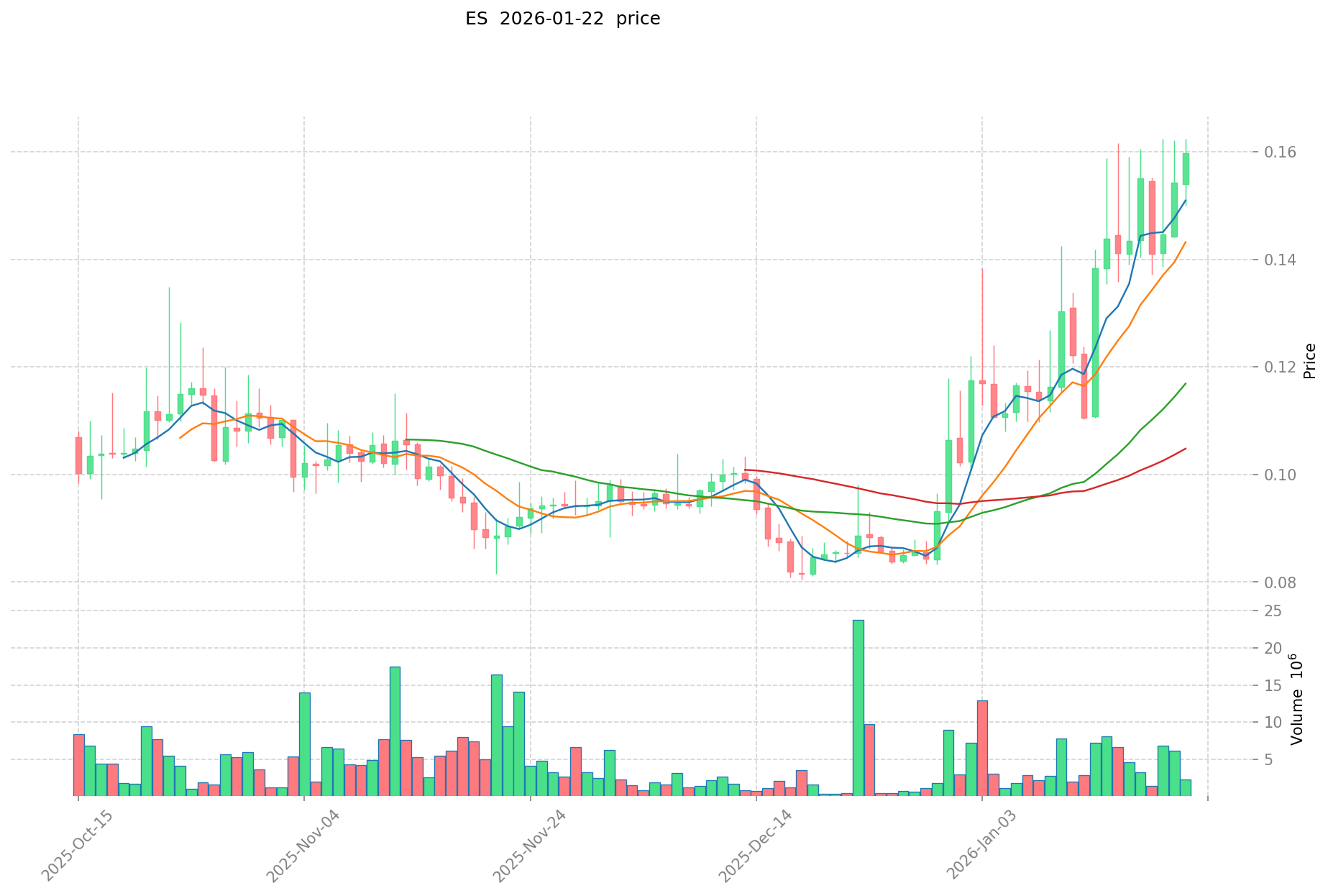
Recent price performance shows a 30-day increase of 86.65%, with 24-hour trading volume at $194,404.66. The token has experienced price movements between its record level of $0.5 (July 16, 2025) and $0.0723 (October 10, 2025). With a current circulating supply representing 15% of the maximum supply of 1 billion tokens, ES demonstrates characteristics that merit examination when investors consider "Is Eclipse (ES) a good investment?" This analysis will explore ES's investment characteristics, historical price movements, future price considerations, and associated risks to provide reference information for market participants.
I. Token (ES) Historical Price Review and Current Investment Value
- 2025: Eclipse (ES) launched in July → Token experienced price discovery phase
- 2025: Initial trading period → ES price fluctuated between $0.0723 and $0.5
- Q3-Q4 2025: Market adjustment phase → Price declined from higher levels to lower trading ranges
Current ES Investment Market Status (January 2026)
- ES current price: $0.1602
- 24-hour trading volume: $194,404.67
- Circulating supply: 150,000,000 ES (15% of total supply)
- Market capitalization: $24,030,000
Click to view real-time ES market price
II. Core Factors Influencing Whether ES is a Good Investment (Is Eclipse(ES) a Good Investment)
Supply Mechanism and Scarcity (ES Investment Scarcity)
- Total Supply & Circulation → Impact on Price and Investment Value
- Eclipse (ES) has a maximum supply of 1,000,000,000 tokens, with a current circulating supply of 150,000,000 tokens, representing 15% of the total supply. The circulating market cap stands at approximately $24.03 million, while the fully diluted market cap is around $160.2 million. This relatively low circulation ratio suggests potential for supply expansion, which investors should consider when evaluating scarcity dynamics.
- Historical Price Performance: ES has experienced price fluctuations since its launch, with recorded highs reaching $0.5 and lows at $0.0723. The current price of approximately $0.1602 reflects a 30-day increase of 86.65%, indicating recent positive momentum. However, investors should approach such historical movements with caution and avoid drawing absolute conclusions about future performance.
- Investment Implication: The gap between circulating supply and maximum supply indicates that scarcity may evolve as more tokens enter circulation. Long-term investment considerations should account for potential dilution effects and the project's token distribution schedule.
Institutional Investment and Mainstream Adoption (Institutional Investment in ES)
- Institutional Support: Eclipse is backed by prominent investment firms including Placeholder VC, Hack VC, DBA, Polychain, Tribe, and Parafi. Additionally, the project has garnered endorsements from notable industry figures such as Mustafa Al-Bassam (Celestia), Tarun Chitra (Gauntlet / Robot VC), Anatoly Yakovenko (Solana), Zanyar Sherwani (Jito), Santiago R. Santos (ParaFi), Ryan Watkins (Syncracy), and Hasu (Flashbots).
- Market Presence: ES is currently listed on 23 exchanges, with approximately 777 holders, suggesting early-stage adoption. The project's 24-hour trading volume of approximately $194,404 indicates developing market activity.
- Investment Value Enhancement: Strong backing from established venture capital firms and industry leaders may contribute to enhanced credibility and potential for ecosystem development, though investors should conduct independent assessment of fundamentals.
Macroeconomic Environment's Impact on ES Investment
- Market Context: Broader macroeconomic factors, including monetary policy shifts, interest rate adjustments, and global financial conditions, can influence investor appetite for digital assets. Changes in traditional financial markets may affect capital flows into cryptocurrency projects like Eclipse.
- Risk Considerations: Geopolitical uncertainties and regulatory developments across jurisdictions continue to shape the investment landscape for digital assets. Investors should monitor these external factors as part of comprehensive risk assessment.
Technology and Ecosystem Development (Technology & Ecosystem for ES Investment)
- Architectural Innovation: Eclipse positions itself as Ethereum's first Solana Virtual Machine (SVM) Layer 2 solution, combining modular architecture components: Ethereum for settlement, SVM for execution, and Celestia for data availability. This architectural approach aims to deliver enhanced performance characteristics.
- Technical Positioning: The integration of multiple blockchain technologies represents Eclipse's attempt to address scalability and performance challenges. However, the practical impact of these technical features on long-term investment value depends on execution, adoption, and competitive dynamics.
- Ecosystem Applications: The potential for DeFi, NFT, and payment applications within Eclipse's infrastructure could contribute to ecosystem growth, though actual adoption and utility development remain key factors for investors to monitor over time.
III. ES Future Investment Prediction and Price Outlook (Is Eclipse(ES) worth investing in 2026-2031)
Short-term ES Investment Outlook (2026)
- Conservative Forecast: $0.1087 - $0.1599
- Neutral Forecast: $0.1599
- Optimistic Forecast: $0.1599 - $0.2174
Mid-term Eclipse(ES) Investment Forecast (2027-2029)
-
Market Stage Expectation: Eclipse may experience gradual adoption growth during this period, with development centered around its modular architecture combining Ethereum settlement, SVM execution, and Celestia data availability. The token's performance could be influenced by broader Layer 2 ecosystem developments and integration progress.
-
Investment Return Forecast:
- 2027: $0.1377 - $0.1942
- 2028: $0.1531 - $0.2010
- 2029: $0.1884 - $0.2747
-
Key Catalysts: Expansion of Eclipse's L2 infrastructure, potential growth in decentralized application deployments leveraging SVM execution efficiency, and broader institutional engagement with modular blockchain solutions.
Long-term Investment Outlook (Is Eclipse a good long-term investment?)
- Base Scenario: $0.1601 - $0.2355 (assuming steady development of Eclipse's technical infrastructure and moderate ecosystem expansion)
- Optimistic Scenario: $0.2355 - $0.3955 (assuming accelerated adoption of Eclipse's modular architecture, successful integration with major protocols, and favorable market conditions for Layer 2 solutions)
- Risk Scenario: Below $0.1086 (in cases of significant technical challenges, competitive pressure from alternative L2 solutions, or adverse regulatory developments affecting the broader crypto ecosystem)
View ES long-term investment and price prediction: Price Prediction
2026-01-22 - 2031 Long-term Outlook
- Base Scenario: $0.1601 - $0.2355 (corresponding to steady progress and gradual mainstream application adoption)
- Optimistic Scenario: $0.2355 - $0.3955 (corresponding to large-scale adoption and favorable market environment)
- Transformative Scenario: Above $0.3955 (if the ecosystem achieves breakthrough developments and mainstream adoption)
- 2031-12-31 Predicted High: $0.3955 (based on optimistic development assumptions)
Disclaimer: The above predictions are for informational purposes only and do not constitute investment advice. Cryptocurrency markets are highly volatile and subject to numerous unpredictable factors. Past performance does not guarantee future results. Investors should conduct independent research and consider their risk tolerance before making investment decisions.
| Year |
Predicted High Price |
Predicted Average Price |
Predicted Low Price |
Price Change |
| 2026 |
0.2173552 |
0.15982 |
0.1086776 |
0 |
| 2027 |
0.194245228 |
0.1885876 |
0.137668948 |
17 |
| 2028 |
0.2009872347 |
0.191416414 |
0.1531331312 |
19 |
| 2029 |
0.27468255409 |
0.19620182435 |
0.188353751376 |
22 |
| 2030 |
0.306074845986 |
0.23544218922 |
0.1601006886696 |
46 |
| 2031 |
0.39530743570038 |
0.270758517603 |
0.22472956961049 |
69 |
IV. Eclipse Investment Strategy and Risk Management (How to invest in Eclipse)
Investment Strategy (Eclipse investment strategy)
Long-term Holding (HODL Eclipse)
Long-term holding Eclipse (ES) may appeal to investors who prioritize a patient approach. This strategy involves acquiring ES tokens and maintaining positions through market fluctuations, based on the belief that Eclipse's Layer 2 infrastructure combining Ethereum settlement, Solana Virtual Machine execution, and Celestia data availability could develop over time.
Key considerations for long-term holders include:
- Market Position Assessment: As of January 22, 2026, Eclipse holds the #796 ranking with a market capitalization of approximately $24.03 million and a circulating supply of 150 million tokens out of a maximum supply of 1 billion tokens (15% circulation ratio).
- Price Historical Context: The token has experienced price ranges from $0.0723 (recorded around October 2025) to $0.50 (reached around July 2025), with the current price at approximately $0.1602.
- Institutional Support: Eclipse has received backing from investors including Placeholder VC, Hack VC, DBA, Polychain, Tribe, and Parafi, as well as industry figures from Celestia, Gauntlet, Solana, Jito, and others.
Active Trading
Active trading Eclipse involves shorter-term positions based on technical analysis and market momentum. Recent price movements show:
- Recent Volatility: The 30-day price change shows an increase of approximately 86.65%, while 24-hour and 7-day changes indicate increases around 5.29% and 5.26% respectively.
- Trading Range: Within the past 24 hours, ES traded between $0.15002 and $0.16228.
- Volume Considerations: The 24-hour trading volume stands at approximately $194,404.66.
Traders should note that Eclipse is listed on 23 exchanges, which may provide liquidity options but also requires consideration of price variations across platforms.
Risk Management (Risk management for Eclipse investment)
Asset Allocation Approaches
Conservative Allocation
- Limit Eclipse exposure to a small percentage (1-3%) of overall cryptocurrency portfolio
- Focus on established assets with Eclipse as a supplementary position
- Consider Eclipse's relatively lower market cap and higher volatility profile
Moderate Allocation
- Allocate 5-10% of cryptocurrency holdings to Eclipse
- Balance with larger-cap assets and stablecoins
- Monitor the 15% circulating supply ratio and potential supply expansion impacts
Aggressive Allocation
- Position Eclipse as a 10-20% portfolio component
- Suitable for investors with higher risk tolerance
- Requires active monitoring of Layer 2 ecosystem developments and competitive dynamics
Risk Hedging Strategies
Diversification Approach
- Combine Eclipse holdings with assets across different blockchain ecosystems
- Include exposure to Ethereum (given Eclipse's settlement layer), Solana ecosystem tokens, and other Layer 2 solutions
- Consider stablecoin reserves for opportunistic rebalancing
Volatility Management
- Implement dollar-cost averaging to mitigate timing risk
- Set predetermined exit points based on personal risk parameters
- Monitor the token's distance from historical price extremes ($0.0723 low and $0.50 high)
Secure Storage Solutions
Cold and Hot Wallet Strategy
Eclipse tokens are deployed with contract addresses on both Ethereum (ERC20: 0x6055dc6ff1077eebe5e6d2ba1a1f53d7ef8430de) and Eclipse mainnet (GnBAskb2SQjrLgpTjtgatz4hEugUsYV7XrWU1idV3oqW). Storage options include:
- Cold Wallet Storage: For long-term holdings, hardware wallets supporting Ethereum ERC20 tokens provide enhanced security
- Hot Wallet Management: For active trading, use reputable wallet software with two-factor authentication
- Multi-Signature Options: Consider multi-sig wallets for larger holdings
- Exchange Storage: While convenient for trading, exchange custody involves counterparty risk; withdraw assets for long-term storage
Security Best Practices
- Verify contract addresses before transactions using official block explorers (Etherscan, Eclipse Explorer)
- Maintain secure backup of private keys and recovery phrases
- Use separate wallets for different allocation strategies (trading vs. holding)
- Regularly review security protocols for storage solutions
V. Eclipse Investment Risks and Challenges (Risks of investing in Eclipse)
Market Risks
Volatility Characteristics
Eclipse exhibits significant price volatility, common in lower market cap cryptocurrency assets. The token's historical price range from $0.0723 to $0.50 represents substantial percentage swings. The recent 30-day increase of approximately 86.65% illustrates the potential for rapid price movements in either direction.
Key volatility factors include:
- Limited Liquidity: With a 24-hour trading volume around $194,404.66 and market cap of approximately $24.03 million, Eclipse may experience larger price impacts from moderate-sized orders
- Market Cap Positioning: Ranked #796, Eclipse represents a smaller project subject to greater percentage fluctuations compared to larger-cap assets
- Supply Dynamics: With only 15% of maximum supply currently circulating (150 million of 1 billion tokens), future token releases could impact price dynamics
Market Manipulation Considerations
Lower market cap assets may be more susceptible to price manipulation tactics. The combination of limited liquidity, concentration of holdings (777 holders recorded), and relatively low trading volumes can create conditions where market movements may not always reflect fundamental developments.
Regulatory Risks
Jurisdictional Uncertainty
Cryptocurrency regulatory frameworks vary significantly across jurisdictions and continue evolving. Eclipse, as a Layer 2 solution involving multiple blockchain components (Ethereum, Solana Virtual Machine, Celestia), operates in a complex regulatory environment.
Potential regulatory considerations include:
- Classification Ambiguity: Regulatory treatment of Layer 2 tokens and their relationship to underlying networks remains undefined in many jurisdictions
- Cross-Border Operations: Eclipse's multi-chain architecture may raise questions about regulatory jurisdiction and compliance requirements
- Policy Evolution: Changes in cryptocurrency regulations in major markets could impact Eclipse's operational environment and token utility
Compliance Requirements
Investors should be aware that:
- Cryptocurrency tax treatment varies by jurisdiction and may change
- Exchange availability can be affected by regulatory developments
- Reporting requirements for cryptocurrency holdings differ across regions
Technical Risks
Network Security Vulnerabilities
As a relatively newer Layer 2 solution combining multiple technological components, Eclipse faces various technical risk vectors:
Smart Contract Risk
- The Eclipse token operates via smart contracts on Ethereum and its own network
- Contract vulnerabilities or exploits could affect token functionality or value
- Bridge mechanisms between chains introduce additional security considerations
Architectural Complexity
- Eclipse's design integrates Ethereum settlement, Solana Virtual Machine execution, and Celestia data availability
- Each component represents a potential point of technical failure or security vulnerability
- Cross-chain interactions add complexity compared to single-chain solutions
Upgrade and Development Risks
Technical challenges may arise from:
- Protocol upgrades or changes to underlying dependencies (Ethereum, Solana VM, Celestia)
- Compatibility issues during network updates
- Competition from alternative Layer 2 solutions with different technical approaches
- Development team execution risks in maintaining and advancing the technology
Operational Risks
- Network downtime or performance degradation could affect user experience and adoption
- Data availability challenges if dependencies fail to perform as designed
- Potential bugs or inefficiencies discovered in production environments
VI. Conclusion: Is Eclipse a Good Investment?
Investment Value Summary
Eclipse (ES) represents a Layer 2 solution attempting to combine Ethereum settlement, Solana Virtual Machine execution, and Celestia data availability. The project has secured backing from multiple investment firms and industry participants, suggesting institutional interest in its technical approach.
Key investment considerations include:
Current Market Position
- Ranked #796 with approximately $24.03 million market capitalization
- Current price around $0.1602, with historical range from $0.0723 to $0.50
- Limited circulating supply (15% of maximum supply)
- Available on 23 exchanges
Price Movement Context
- Recent 30-day increase of approximately 86.65% indicates significant momentum
- Short-term price volatility remains considerable
- Market cap and volume suggest exposure to liquidity constraints
Long-term Potential Factors
- Technical approach combining multiple blockchain ecosystems
- Institutional backing from various investment entities
- Position in the evolving Layer 2 ecosystem
Investment Challenges
- High price volatility characteristic of lower market cap assets
- Complex technical architecture with multiple dependency risks
- Uncertain regulatory landscape for multi-chain Layer 2 solutions
- Early-stage project with limited operating history
Investor Recommendations
✅ New Investors
Suggested Approach:
- Dollar-Cost Averaging: Consider regular small purchases rather than large single positions to reduce timing risk
- Position Sizing: Limit Eclipse exposure to 1-3% of cryptocurrency portfolio given the project's market cap and volatility profile
- Secure Storage: Transfer tokens from exchanges to hardware wallets supporting Ethereum ERC20 tokens for long-term holdings
- Education Priority: Study Eclipse's technical architecture, Layer 2 ecosystem dynamics, and blockchain fundamentals before committing significant capital
Risk Awareness:
- Understand that Eclipse's price history shows substantial percentage swings
- Recognize that lower market cap assets may experience liquidity challenges
- Be prepared for potential portfolio value fluctuations
✅ Experienced Investors
Suggested Approach:
- Active Management: Monitor technical indicators, volume patterns, and price action relative to the $0.0723-$0.50 historical range
- Portfolio Integration: Position Eclipse within a diversified cryptocurrency allocation including Ethereum, Solana ecosystem assets, and other Layer 2 solutions
- Rebalancing Strategy: Implement systematic rebalancing based on predetermined thresholds to manage exposure during price movements
- Research Depth: Evaluate Eclipse's competitive positioning against alternative Layer 2 solutions and track ecosystem development progress
Advanced Considerations:
- Assess the impact of the 85% non-circulating token supply and potential release schedules
- Monitor holder distribution (currently 777 holders) and exchange liquidity metrics
- Evaluate technical developments and potential protocol upgrades
✅ Institutional Investors
Suggested Approach:
- Strategic Allocation: Consider Eclipse as part of a broader Layer 2 infrastructure thesis within cryptocurrency portfolios
- Due Diligence: Conduct thorough technical audits, team assessment, and competitive analysis before position establishment
- Risk Framework: Integrate Eclipse exposure within structured risk management protocols appropriate for early-stage blockchain projects
- Monitoring Systems: Implement ongoing tracking of project developments, network metrics, and ecosystem growth indicators
Institutional Considerations:
- Evaluate custody solutions suitable for institutional requirements
- Assess regulatory implications across relevant jurisdictions
- Consider position sizing relative to liquidity constraints and market impact
- Establish clear exit criteria and rebalancing parameters
⚠️ Important Notice
Cryptocurrency investments carry substantial risks including potential complete loss of capital. Eclipse, with its relatively lower market capitalization and significant price volatility, presents particular risk characteristics. This analysis is provided for informational purposes only and does not constitute investment advice, financial planning, or recommendation to buy, sell, or hold Eclipse tokens. Investment decisions should be made based on individual circumstances, risk tolerance, and professional consultation. Past performance, including Eclipse's historical price movements, does not indicate future results. Regulatory changes, technical failures, market conditions, or other factors could materially affect Eclipse's value. Investors should only allocate capital they can afford to lose and should conduct their own research before making investment decisions.
VII. FAQ
Q1: What is Eclipse (ES) and how does it work as a Layer 2 solution?
Eclipse is Ethereum's first Solana Virtual Machine (SVM) Layer 2 solution that combines modular blockchain components. It uses Ethereum for settlement, Solana Virtual Machine for execution, and Celestia for data availability. This architecture aims to deliver enhanced performance by leveraging the security of Ethereum while utilizing SVM's execution efficiency and Celestia's data availability infrastructure. The token operates via smart contracts on both Ethereum (ERC20) and Eclipse mainnet, with a maximum supply of 1 billion tokens and current circulating supply of 150 million tokens (15%).
Q2: How has Eclipse (ES) performed since its launch in 2025?
Eclipse launched in July 2025 and has experienced significant price volatility. The token reached a high of $0.50 on July 16, 2025, and a low of $0.0723 on October 10, 2025. As of January 22, 2026, ES trades at approximately $0.1602 with a market capitalization of $24.03 million. The recent 30-day period shows an increase of approximately 86.65%, indicating substantial momentum. However, this volatility reflects the characteristics of lower market cap assets and should be considered when evaluating investment decisions.
Q3: What are the main risks associated with investing in Eclipse?
Eclipse investments carry several risk categories:
Market Risks: High volatility due to limited liquidity ($194,404.66 daily volume), lower market cap positioning (#796 ranking), and concentration of holdings (777 holders). The 15% circulating supply ratio suggests potential dilution from future token releases.
Technical Risks: Complex architecture involving multiple blockchain components creates various vulnerability points including smart contract risks, cross-chain bridge security, and dependency on Ethereum, SVM, and Celestia infrastructure.
Regulatory Risks: Uncertain classification of Layer 2 tokens across jurisdictions and evolving cryptocurrency regulatory frameworks may impact operations and token utility.
Q4: How should different types of investors approach Eclipse (ES)?
Investment approaches vary by experience level:
New Investors should limit Eclipse exposure to 1-3% of cryptocurrency portfolios, utilize dollar-cost averaging strategies, and prioritize secure storage in hardware wallets. Focus on education about Layer 2 ecosystems before significant capital allocation.
Experienced Investors can implement 5-10% portfolio allocations with active monitoring of technical indicators, systematic rebalancing strategies, and integration within diversified cryptocurrency holdings including Ethereum and other Layer 2 solutions.
Institutional Investors should conduct thorough due diligence including technical audits and team assessment, establish structured risk management protocols, and evaluate custody solutions meeting institutional requirements while considering regulatory implications across relevant jurisdictions.
Q5: What factors could influence Eclipse's future price performance?
Several factors may impact Eclipse's price trajectory. Technical development progress and successful integration with major protocols could drive positive momentum. Expansion of decentralized applications leveraging SVM execution efficiency and broader institutional engagement with modular blockchain solutions represent potential catalysts. Conversely, competitive pressure from alternative Layer 2 solutions, technical challenges, regulatory developments affecting the crypto ecosystem, and macroeconomic conditions influencing investor appetite for digital assets could negatively affect performance. The token's current circulating supply of 15% means future releases could impact supply dynamics.
Q6: Where can Eclipse (ES) tokens be purchased and stored?
Eclipse is currently listed on 23 exchanges, providing multiple acquisition channels. The token operates with contract addresses on both Ethereum (ERC20: 0x6055dc6ff1077eebe5e6d2ba1a1f53d7ef8430de) and Eclipse mainnet (GnBAskb2SQjrLgpTjtgatz4hEugUsYV7XrWU1idV3oqW). For storage, long-term holders should use hardware wallets supporting Ethereum ERC20 tokens for enhanced security. Active traders may utilize reputable hot wallets with two-factor authentication. Always verify contract addresses through official block explorers (Etherscan, Eclipse Explorer) before transactions and maintain secure backups of private keys and recovery phrases.
Q7: What makes Eclipse different from other Layer 2 solutions?
Eclipse distinguishes itself through its modular architecture combining components from multiple established blockchain ecosystems. Unlike traditional Layer 2 solutions that typically build upon a single base layer, Eclipse integrates Ethereum's settlement security, Solana Virtual Machine's execution performance, and Celestia's data availability infrastructure. This approach attempts to leverage the strengths of each component while addressing scalability and performance challenges. The project has secured backing from prominent investment firms including Placeholder VC, Hack VC, DBA, Polychain, Tribe, and Parafi, alongside endorsements from industry figures across Celestia, Solana, and Ethereum ecosystems.
Q8: What is the long-term investment outlook for Eclipse through 2031?
Price predictions through 2031 vary across scenarios:
Base Scenario (2031): $0.1601 - $0.2355, assuming steady infrastructure development and moderate ecosystem expansion.
Optimistic Scenario (2031): $0.2355 - $0.3955, contingent on accelerated adoption, successful major protocol integrations, and favorable Layer 2 market conditions.
Risk Scenario: Below $0.1086, in cases of significant technical challenges, intense competitive pressure, or adverse regulatory developments.
These projections are informational references only and not investment advice. Cryptocurrency markets remain highly volatile and subject to numerous unpredictable factors. Past performance does not guarantee future results, and investors should conduct independent research considering their risk tolerance before making decisions.
* The information is not intended to be and does not constitute financial advice or any other recommendation of any sort offered or endorsed by Gate.