This comprehensive analysis examines whether EigenLayer (EIGEN) represents a viable investment opportunity in 2024-2030. EIGEN, trading at $0.4039 with $219.45M market cap, introduces restaking as a new cryptoeconomic security primitive on Ethereum. The article evaluates EIGEN's volatile price history (declining 87% from $3.70 launch), core investment factors including supply mechanics, institutional adoption across 68 exchanges, and macroeconomic influences. Price projections range from $0.32248-$0.463565 (2026) to $0.345-$0.712 (2031) under various scenarios. Investment strategies accommodate both long-term holders and active traders, with recommended portfolio allocation of 1-15% based on risk profile. Critical risks include market volatility, regulatory uncertainty, technical vulnerabilities, and dilution pressure from locked token supply. The guide provides secure storage recommendations via Gate and actionable risk management frameworks for cryptocurrency investors evaluating restaking protocol investme
Introduction: Eigenlayer (EIGEN) Investment Position and Market Prospects
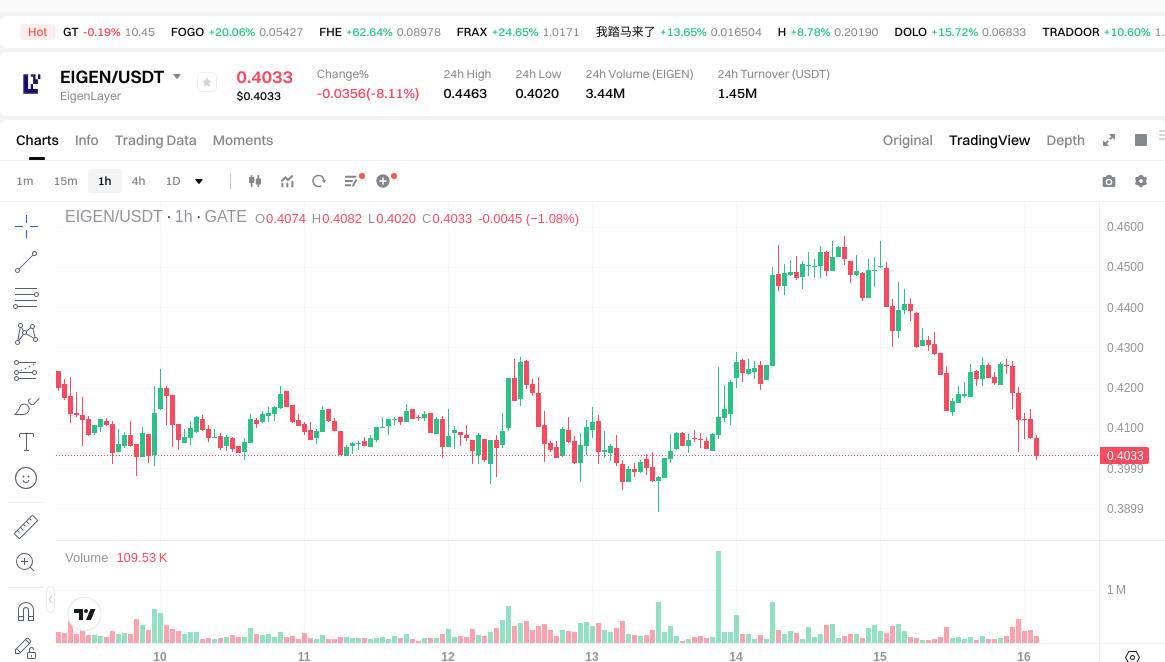
EIGEN is a notable asset in the cryptocurrency sector, having been introduced in 2024. As of January 16, 2026, EIGEN holds a market capitalization of approximately $219.45 million with a circulating supply of around 543.33 million tokens, and the current price stands at $0.4039. Positioned as a protocol that introduces restaking as a new primitive in cryptoeconomic security on Ethereum, EIGEN has gradually become a focal point for investors exploring opportunities in decentralized finance infrastructure. With its contract deployed on the Ethereum network and availability across 68 exchanges, the token serves approximately 224,633 holders. This article provides a comprehensive analysis of EIGEN's investment characteristics, historical price movements, future price projections, and associated risks to offer reference information for investors.
I. Eigenlayer (EIGEN) Price History Review and Current Investment Value
- 2024: EigenLayer officially launched, with price reaching $5.658 in December → Investors experienced significant early gains
- 2025: Market adjustment period → EIGEN price declined from $5.658 to $0.4947 in October
- Current Period (January 2026): Trading at $0.4039 → Price remains near lower range with 24-hour decline of 8.49%
Current EIGEN Investment Market Status (January 2026)
- EIGEN current price: $0.4039
- 24-hour price range: $0.4039 - $0.4463
- 24-hour trading volume: $1,480,370.63
- Market capitalization: $219,452,924.76
- Circulating supply: 543,334,797.62 EIGEN (32.46% of total supply)
- Total supply: 1,673,646,668.28 EIGEN
- Number of holders: 224,633
- Listed on 68 exchanges
Click to view real-time EIGEN market price
II. Core Factors Influencing Whether EIGEN is a Good Investment
Supply Mechanism and Scarcity (EIGEN Investment Scarcity)
- Supply Structure: EIGEN has a maximum supply of 1,673,646,668.28 tokens, with a current circulating supply of 543,334,797.62 tokens, representing a circulation ratio of approximately 32.46%. This controlled supply mechanism may influence price dynamics and investment value considerations.
- Historical Price Movement: EIGEN's price has experienced fluctuations since its launch in October 2024, with historical trading patterns showing movement between different price levels. Market participants monitor supply dynamics as part of their investment analysis.
- Investment Consideration: The relationship between circulating supply and maximum supply represents one factor that market participants consider when evaluating long-term investment characteristics.
Institutional Investment and Mainstream Adoption (Institutional Investment in EIGEN)
- Holder Distribution: EIGEN currently has 224,633 token holders, indicating a distributed ownership structure across the network. This holder base reflects the current level of adoption within the crypto asset community.
- Exchange Availability: EIGEN is listed on 68 exchanges, providing accessibility across multiple trading platforms. This multi-exchange presence facilitates trading activity and market participation.
- Ecosystem Development: EigenLayer's restaking protocol allows ETH stakers to extend cryptoeconomic security to additional applications on the network. The protocol's adoption within the Ethereum ecosystem represents one aspect of its technical integration.
Macroeconomic Environment's Impact on EIGEN Investment
- Market Context: Crypto asset valuations may be influenced by broader monetary policy conditions, interest rate environments, and macroeconomic trends. These factors can affect capital flows into digital asset markets.
- Risk Environment: Market participants may adjust their allocation strategies based on changing economic conditions and risk preferences across different asset classes.
- Market Dynamics: Shifts in global economic conditions and regulatory developments may influence investor sentiment toward crypto assets, including protocols operating within the Ethereum ecosystem.
Technology and Ecosystem Development (Technology & Ecosystem for EIGEN Investment)
- Restaking Mechanism: EigenLayer introduces restaking as a primitive in cryptoeconomic security, enabling ETH holders and liquid staking token (LST) users to opt-in to EigenLayer smart contracts. This mechanism allows participants to extend security to additional network applications while potentially earning additional rewards.
- Protocol Integration: The protocol operates on Ethereum using the ERC20 standard, with the contract address deployed at 0xec53bF9167f50cDEB3Ae105f56099aaaB9061F83. This technical infrastructure facilitates interaction with the broader Ethereum ecosystem.
- Ecosystem Expansion: EigenLayer's documentation and whitepaper outline its approach to extending cryptoeconomic security. The protocol's development roadmap includes services such as EigenCloud and restaking infrastructure, which may influence its long-term technical positioning within the decentralized finance landscape.
III. EIGEN Future Investment Prediction and Price Outlook (Is Eigenlayer(EIGEN) worth investing in 2026-2030)
Short-term Investment Prediction (2026, short-term EIGEN investment outlook)
- Conservative forecast: US$0.32248 - US$0.4031
- Neutral forecast: US$0.4031 - US$0.463565
- Optimistic forecast: US$0.463565 or above
Mid-term Investment Outlook (2027-2029, mid-term Eigenlayer(EIGEN) investment forecast)
- Market stage expectation: The mid-term period may witness gradual development with potential fluctuations as the project matures and market dynamics evolve
- Investment return prediction:
- 2027: US$0.32066605 - US$0.58066555
- 2028: US$0.3751792785 - US$0.5982588495
- 2029: US$0.2928933367425 - US$0.75157535466
- Key catalysts: Ecosystem development, technological advancement, and broader market sentiment
Long-term Investment Outlook (Is EIGEN a good long-term investment?)
- Base scenario: US$0.345874978214532 - US$0.71209554338286 (assuming steady ecosystem growth and stable market conditions)
- Optimistic scenario: US$0.6129760171977 - US$0.7042703176314 (assuming accelerated adoption and favorable market environment)
- Risk scenario: Below US$0.2928933367425 (under adverse market conditions or project setbacks)
Click to view EIGEN long-term investment and price prediction: Price Prediction
2026-01-16 - 2031 Long-term Outlook
- Base scenario: US$0.32248 - US$0.652102145955 (corresponding to steady progress and gradual mainstream application improvement)
- Optimistic scenario: US$0.6129760171977 - US$0.75157535466 (corresponding to large-scale adoption and favorable market environment)
- Transformational scenario: Above US$0.75157535466 (if ecosystem achieves breakthrough progress and mainstream popularization)
- 2031-12-31 predicted high: US$0.71209554338286 (based on optimistic development assumptions)
Disclaimer: The above predictions are for reference only and do not constitute investment advice. Cryptocurrency markets are highly volatile and subject to various risks. Please conduct thorough research and consider your risk tolerance before making any investment decisions.
| Year |
Predicted High Price |
Predicted Average Price |
Predicted Low Price |
Price Change |
| 2026 |
0.463565 |
0.4031 |
0.32248 |
0 |
| 2027 |
0.58066555 |
0.4333325 |
0.32066605 |
7 |
| 2028 |
0.5982588495 |
0.506999025 |
0.3751792785 |
25 |
| 2029 |
0.75157535466 |
0.55262893725 |
0.2928933367425 |
36 |
| 2030 |
0.7042703176314 |
0.652102145955 |
0.6129760171977 |
61 |
| 2031 |
0.71209554338286 |
0.6781862317932 |
0.345874978214532 |
67 |
IV. EIGEN Investment Strategy and Risk Management (How to invest in restaking protocols)
Investment Methodology (EIGEN investment strategy)
Long-term Holding (HODL EIGEN): This approach suits conservative investors who believe in the fundamental value proposition of restaking protocols. Given EIGEN's current circulating supply of approximately 543.33 million tokens (32.46% of max supply), early holders may benefit from potential appreciation as the protocol matures and adoption increases. Long-term investors typically focus on the project's technological development, ecosystem expansion, and overall market position rather than short-term price movements.
Active Trading: This strategy relies on technical analysis and swing trading opportunities. With EIGEN experiencing significant price fluctuations (24-hour range between $0.4039 and $0.4463), active traders may capitalize on volatility. Historical data shows substantial price movements, with the token trading between an all-time low of $0.3396 (December 31, 2025) and an all-time high of $5.658 (December 17, 2024). Traders employing this approach should monitor market sentiment, trading volume ($1.48 million in 24-hour volume), and technical indicators to identify entry and exit points.
Risk Management (Risk management for EIGEN investment)
Asset Allocation Ratios:
- Conservative investors: 1-3% of crypto portfolio allocation
- Aggressive investors: 5-10% of crypto portfolio allocation
- Professional investors: Up to 15% with active risk monitoring
Risk Hedging Solutions: Implement multi-asset portfolio strategies combining EIGEN with established cryptocurrencies and stablecoins. Consider diversification across different protocol categories to mitigate sector-specific risks. Dollar-cost averaging (DCA) can help reduce timing risk in volatile markets.
Secure Storage:
- Hot wallets: Suitable for active trading amounts only
- Cold wallets: Recommended for long-term holdings
- Hardware wallet options: Ledger, Trezor, or similar devices supporting ERC-20 tokens
- Important: EIGEN operates on the Ethereum blockchain (contract address: 0xec53bF9167f50cDEB3Ae105f56099aaaB9061F83), requiring compatible wallet solutions
V. EIGEN Investment Risks and Challenges (Risks of investing in restaking protocols)
Market Risks: EIGEN exhibits high volatility characteristics common to crypto assets. Recent performance shows an 8.49% decline over 24 hours and an 87.03% decrease over one year from its launch price of $3.70. The token's market capitalization stands at approximately $219.45 million with a fully diluted valuation of $675.99 million, indicating potential dilution risk as more tokens enter circulation. Price manipulation risks may exist given the relatively concentrated holder base of 224,633 addresses.
Regulatory Risks: Restaking protocols operate in an evolving regulatory landscape. Different jurisdictions maintain varying stances on staking derivatives and DeFi protocols. Policy uncertainty may impact protocol operations, token utility, or accessibility in certain markets. Investors should monitor regulatory developments in their respective jurisdictions and understand compliance requirements.
Technical Risks: As a protocol built on Ethereum, EIGEN faces network security considerations including smart contract vulnerabilities, potential bugs in restaking mechanisms, and integration risks with various applications. Protocol upgrades or modifications to the restaking framework could introduce unforeseen technical challenges. The dependency on Ethereum's consensus layer means any issues affecting Ethereum's security or performance may indirectly impact EigenLayer's operations.
VI. Conclusion: Is restaking protocol investment a Good Investment?
Investment Value Summary: EIGEN represents an innovative approach to cryptoeconomic security through restaking mechanisms, offering potential long-term value as the protocol develops. However, the token demonstrates significant short-term price volatility, with substantial declines from its initial listing price. The market cap to FDV ratio of 32.46% suggests considerable token unlock risk over time.
Investor Recommendations:
✅ Beginners: Implement dollar-cost averaging strategies with small, regular investments. Prioritize secure storage using hardware wallets or reputable custody solutions. Limit exposure to 1-3% of total investment portfolio.
✅ Experienced Investors: Consider swing trading opportunities based on technical analysis while maintaining a core long-term position. Implement portfolio diversification across multiple protocol categories and risk tiers.
✅ Institutional Investors: Evaluate strategic long-term allocation potential while conducting thorough due diligence on protocol fundamentals, tokenomics, and competitive positioning within the restaking ecosystem.
⚠️ Disclaimer: Cryptocurrency investments carry substantial risk due to market volatility, regulatory uncertainty, and technological factors. This content serves informational purposes only and does not constitute financial, investment, or trading advice. Conduct independent research and consult qualified financial advisors before making investment decisions.
VII. FAQ
Q1: What is EIGEN and how does it differ from standard staking?
EIGEN is the native token of EigenLayer, a protocol that introduces "restaking" as a new primitive in cryptoeconomic security on Ethereum. Unlike standard staking where ETH is locked to secure only the Ethereum network, restaking allows stakers to extend their staked ETH or liquid staking tokens (LSTs) to secure additional applications and protocols built on EigenLayer. This mechanism enables stakers to potentially earn additional rewards while providing cryptoeconomic security to multiple services simultaneously, creating a more capital-efficient ecosystem.
Q2: Why has EIGEN's price declined significantly since its launch?
EIGEN's price has experienced an 87.03% decline from its initial launch price of $3.70 (December 2024) to $0.4039 (January 2026), primarily due to several factors. The token launched during a period that preceded market adjustment in 2025, combined with the relatively low circulating supply ratio (32.46% of maximum supply), which creates potential dilution pressure as more tokens enter circulation. Additionally, the broader cryptocurrency market experienced volatility during this period, and the project is still in its early development phase with the ecosystem continuing to mature.
Q3: Is EIGEN suitable for long-term investment or short-term trading?
EIGEN can serve both investment strategies depending on investor profile and risk tolerance. For long-term investment, the protocol's innovative restaking mechanism and integration within the Ethereum ecosystem offer potential value as adoption grows, making it suitable for investors who believe in the fundamental technology with 1-3% portfolio allocation for conservative investors. For short-term trading, EIGEN exhibits significant volatility (24-hour range of $0.4039-$0.4463) providing opportunities for active traders who employ technical analysis. However, both approaches require careful risk management and understanding of the associated volatility.
Q4: What are the main risks associated with investing in EIGEN?
EIGEN investment carries multiple risk categories: Market risks include high volatility with recent 8.49% daily decline and potential dilution as circulating supply increases from current 32.46% to maximum supply. Regulatory risks stem from evolving DeFi and staking derivative policies across jurisdictions. Technical risks involve smart contract vulnerabilities, restaking mechanism bugs, and dependency on Ethereum's infrastructure performance. Additionally, the relatively concentrated holder base of 224,633 addresses presents potential liquidity and manipulation concerns. Investors should limit exposure based on their risk profile and maintain secure storage practices.
Q5: How should investors store EIGEN tokens securely?
EIGEN operates as an ERC-20 token on Ethereum (contract address: 0xec53bF9167f50cDEB3Ae105f56099aaaB9061F83), requiring compatible wallet solutions. For optimal security, investors should use hot wallets only for active trading amounts, while cold storage solutions such as hardware wallets (Ledger, Trezor) are recommended for long-term holdings. These devices provide offline storage protecting against online hacking attempts. Never share private keys, enable two-factor authentication where available, and verify contract addresses before transactions to prevent phishing attacks or fund loss.
Q6: What determines EIGEN's future price potential?
EIGEN's price trajectory depends on several interconnected factors: Protocol adoption rates and the growth of applications utilizing EigenLayer's restaking security, technological development milestones including ecosystem expansion through services like EigenCloud, broader Ethereum network performance and gas fee dynamics, macroeconomic conditions affecting cryptocurrency markets, regulatory clarity around staking and DeFi protocols, and competitive positioning within the restaking ecosystem. Short-term predictions range from $0.32248-$0.463565 (2026), while long-term scenarios extend to $0.345-$0.712 (2031) under base assumptions, though actual outcomes may vary significantly based on market conditions.
Q7: What percentage of portfolio should be allocated to EIGEN?
Portfolio allocation to EIGEN should align with individual risk tolerance and investment experience. Conservative investors should limit exposure to 1-3% of their cryptocurrency portfolio, focusing on long-term holding strategies and dollar-cost averaging to mitigate timing risk. Aggressive investors with higher risk tolerance may allocate 5-10% while implementing active trading strategies. Professional investors with comprehensive risk management systems might consider up to 15% allocation with continuous monitoring. All investors should implement diversification across multiple asset categories and maintain emergency reserves outside cryptocurrency investments to manage volatility exposure effectively.
Q8: How does EigenLayer's restaking mechanism create value?
EigenLayer's restaking mechanism generates value through capital efficiency and expanded utility. Traditional staking locks ETH solely for Ethereum network security, while restaking allows the same capital to secure multiple protocols simultaneously through opt-in smart contracts. This creates additional revenue streams for stakers who earn rewards from both Ethereum validation and EigenLayer-secured applications. For the broader ecosystem, restaking reduces the capital requirements for new protocols to establish cryptoeconomic security, lowering barriers to entry and potentially accelerating innovation. However, this mechanism also introduces additional technical complexity and requires careful assessment of risk-reward profiles across secured applications.
* The information is not intended to be and does not constitute financial advice or any other recommendation of any sort offered or endorsed by Gate.