This comprehensive guide analyzes whether Enjin Coin (ENJ) represents a viable investment opportunity for 2024 and beyond. ENJ, an ERC-20 token launched in 2017, currently trades at approximately $0.03285 with a market capitalization of $63.2 million, establishing itself as a mid-cap asset in blockchain gaming and digital collectibles. The article examines ENJ's investment potential through multiple dimensions: historical price performance from 2017 to 2026, core technological infrastructure supporting gaming ecosystems, and realistic price projections across conservative, neutral, and optimistic scenarios. Critical investment factors analyzed include supply mechanics influencing scarcity, institutional adoption metrics, macroeconomic positioning, and ecosystem development status. The guide addresses suitable investment strategies for different investor profiles—from conservative dollar-cost averaging approaches to active technical trading—while emphasizing robust risk management through asset allocation, por
Introduction: Enjin Coin (ENJ) Investment Position and Market Outlook
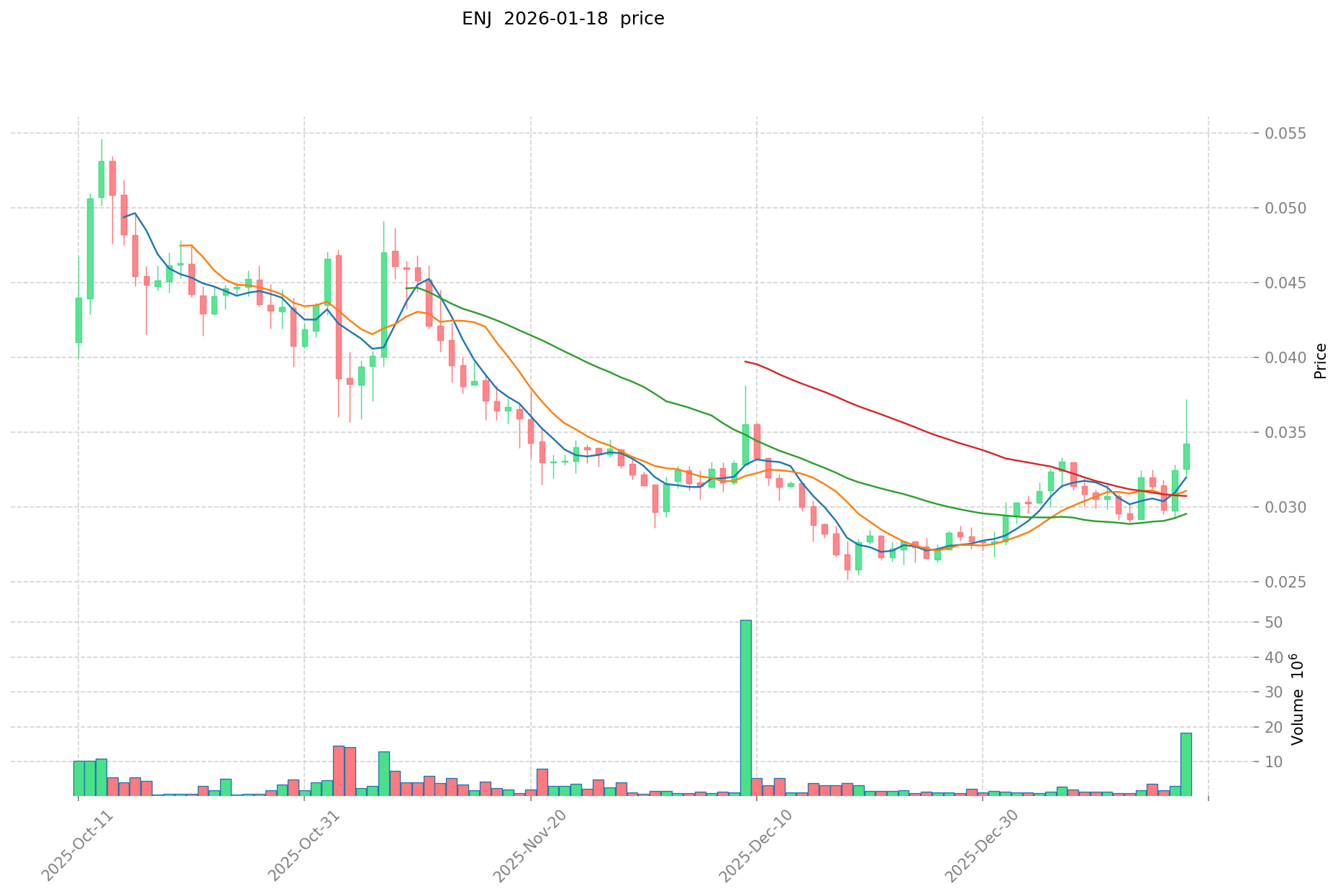
Enjin Coin (ENJ) is a notable asset in the cryptocurrency space, having been launched in 2017. It has achieved significant presence in the blockchain gaming and digital collectibles sector. As of January 18, 2026, ENJ has a market capitalization of approximately $63.20 million, with a circulating supply of around 1.92 billion tokens, and the current price is maintained at approximately $0.03285. With its positioning as a pioneer in integrating blockchain technology with gaming communities, ENJ has gradually become a focal point for investors discussing "Is Enjin Coin (ENJ) a good investment?" This article will comprehensively analyze ENJ's investment value, historical trends, future price predictions, and investment risks to provide reference for investors.
I. Enjin Coin (ENJ) Price History Review and Current Investment Value
- 2017: Project launch and Initial Coin Offering (ICO) raised approximately $18.9 million → Early investors gained exposure to blockchain gaming infrastructure
- 2018: Enjin network officially launched following successful ICO → ENJ began trading publicly, establishing initial market presence
- 2021: NFT market expansion and metaverse narrative growth → Price experienced significant appreciation during the broader crypto bull market cycle
- 2022-2023: Market correction phase → Price declined alongside broader digital asset market downturn
- 2025-2026: Ongoing market dynamics → ENJ trading within established range as blockchain gaming sector evolves
Current ENJ Investment Market Status (January 2026)
- ENJ current price: $0.03285
- 24-hour trading volume: approximately $579,996.56
- Market capitalization: approximately $63.20 million
- Circulating supply: approximately 1.92 billion ENJ tokens
- Token holder count: approximately 153,530 addresses
Click to view real-time ENJ market price
II. Core Factors Influencing Whether ENJ is a Good Investment
Supply Mechanism and Scarcity (ENJ Investment Scarcity)
- Supply Structure → Influences price and investment value
- ENJ's total supply stands at 1,812,211,928 tokens, with a circulating supply of approximately 1.92 billion tokens, representing a circulation ratio of over 100%. The maximum supply is listed as infinite, indicating potential for ongoing token issuance.
- Investment Significance: Understanding the supply dynamics is relevant for assessing long-term investment considerations. The relationship between circulating supply and market capitalization may impact price behavior over time.
Institutional Investment and Mainstream Adoption (Institutional Investment in ENJ)
- Market Data: As of January 18, 2026, ENJ maintains listings on 37 exchanges and has approximately 153,530 holders, indicating a level of distribution across the market.
- Platform Integration: Enjin operates as an online gaming community creation platform with reported connections to numerous gaming communities, e-sports teams, and content creators. The platform's reported user base includes millions of registered players, though the extent of active ENJ token utilization varies.
- Ecosystem Applications: The project focuses on integrating blockchain technology into gaming through virtual goods and community value mechanisms, representing one approach to gaming-blockchain convergence.
Macroeconomic Environment's Impact on ENJ Investment
- Market Positioning: ENJ operates within the gaming and NFT sectors of the cryptocurrency market, with its market capitalization of approximately $63.2 million representing 0.0017% of the total crypto market as of January 18, 2026.
- Price Performance Context: The token has experienced considerable price fluctuation, with 1-year performance showing a decline of 84.87%. Recent shorter-term performance includes a 30-day increase of 22.46% and a 7-day gain of 8.64%, reflecting varying market conditions.
- Market Sentiment: Current market sentiment indicators suggest a bearish outlook, with technical analysis showing 4 bullish signals versus 22 bearish signals as of mid-January 2026.
Technology and Ecosystem Development (Technology & Ecosystem for ENJ Investment)
- Sentosa Upgrade: The Sentosa mainnet upgrade was scheduled for implementation, which aimed to introduce Coretime support, a Hyperbridge module, and an on-chain asset conversion (DEX) pallet to the Enjin Blockchain. This upgrade represented an attempt to enhance network functionality.
- Technical Foundation: Enjin has developed infrastructure including content management systems and forum creation tools designed for gaming communities. The platform's architecture supports virtual goods integration across gaming environments.
- Application Scope: The ecosystem encompasses various gaming-related use cases, including virtual item creation, trading mechanisms, and community monetization features. The extent of adoption and utilization varies across different gaming communities and platforms.
III. ENJ Future Investment Prediction and Price Outlook (Is Enjin Coin(ENJ) worth investing in 2026-2031)
Short-term Investment Prediction (2026, short-term ENJ investment outlook)
According to available market analysis, ENJ may experience moderate volatility in 2026:
- Conservative prediction: $0.0301 - $0.0313
- Neutral prediction: $0.0313 - $0.0345
- Optimistic prediction: $0.0345 - $0.0388
The short-term outlook suggests ENJ may fluctuate within a relatively narrow range, with potential for modest gains depending on broader crypto market conditions and gaming sector developments.
Mid-term Investment Outlook (2027-2028, mid-term Enjin Coin(ENJ) investment forecast)
-
Market stage expectation: ENJ is anticipated to enter a consolidation and potential recovery phase during 2027-2028, with price movements influenced by gaming industry adoption trends and blockchain gaming ecosystem maturation.
-
Investment return prediction:
- 2027: $0.0316 - $0.0457
- 2028: $0.0286 - $0.0551
-
Key catalysts: Expansion of blockchain gaming adoption, NFT marketplace growth, regulatory clarity in digital asset gaming applications, and technological improvements in the Enjin platform.
Long-term Investment Outlook (Is ENJ a good long-term investment?)
- Base scenario: $0.0377 - $0.0639 (assuming steady ecosystem development and moderate market conditions through 2031)
- Optimistic scenario: $0.0551 - $0.0771 (assuming accelerated gaming industry blockchain integration and favorable market environment)
- Risk scenario: $0.0286 - $0.0316 (under prolonged market downturns or significant competitive pressures)
Click to view ENJ long-term investment and price prediction: Price Prediction
2026-01-18 - 2031 Long-term Outlook
- Base scenario: $0.0316 - $0.0571 USD (corresponding to steady progress and mainstream application development)
- Optimistic scenario: $0.0551 - $0.0771 USD (corresponding to large-scale adoption and favorable market environment)
- Transformative scenario: Above $0.0771 USD (if the ecosystem achieves breakthrough developments and mainstream popularization)
- 2031-12-31 predicted high: $0.0771 USD (based on optimistic development assumptions)
Disclaimer: The predictions presented are based on current market data and analytical models. Cryptocurrency investments involve substantial risks, including price volatility and potential loss of capital. These forecasts should not be considered as financial advice or guarantees of future performance. Market conditions, regulatory changes, technological developments, and competitive dynamics may significantly impact actual outcomes. Investors should conduct independent research and consider their risk tolerance before making investment decisions.
| Year |
Predicted High Price |
Predicted Average Price |
Predicted Low Price |
Price Change |
| 2026 |
0.0387621 |
0.03313 |
0.0301483 |
0 |
| 2027 |
0.0456514835 |
0.03594605 |
0.031632524 |
9 |
| 2028 |
0.0550783351125 |
0.04079876675 |
0.028559136725 |
24 |
| 2029 |
0.052732406024375 |
0.04793855093125 |
0.046021008894 |
45 |
| 2030 |
0.063926057666821 |
0.050335478477812 |
0.043791866275696 |
53 |
| 2031 |
0.077126536897628 |
0.057130768072317 |
0.037134999247006 |
73 |
IV. ENJ Investment Strategy and Risk Management (How to invest in Gaming Tokens)
Investment Methodology (ENJ investment strategy)
Long-term Holding (HODL ENJ): Suitable for Conservative Investors
For investors seeking exposure to the blockchain gaming sector, a long-term holding strategy may be considered for ENJ tokens. This approach involves acquiring tokens during favorable market conditions and maintaining positions through market cycles. Given Enjin's established position in the gaming community platform space since 2009 and its integration of blockchain technology, patient investors may view ENJ as a play on the convergence of gaming and digital asset ownership.
Long-term holders should monitor key developments such as platform adoption rates, partnership announcements with game developers, and the evolution of the NFT gaming ecosystem. The token's utility within the Enjin ecosystem—enabling players, content creators, and game publishers to add virtual goods and provide value to games and communities—represents a fundamental use case that may support sustained demand over time.
Active Trading: Relying on Technical Analysis and Swing Trading
Active traders may approach ENJ through technical analysis and swing trading strategies, capitalizing on the token's price volatility. Recent performance data shows mixed momentum across different timeframes: a 0.3% gain over 1 hour, a decline of 3.11% over 24 hours, gains of 8.64% over 7 days, and 22.46% over 30 days, while facing an 84.87% decline over the past year.
Traders should pay attention to key support and resistance levels, with recent 24-hour trading ranges between $0.03273 and $0.03723. Volume analysis is essential, as the 24-hour trading volume of approximately $580,000 provides liquidity for entry and exit positions. Technical indicators such as moving averages, relative strength index (RSI), and volume-weighted average price (VWAP) may assist in identifying potential entry and exit points.
Risk Management (Risk management for ENJ investment)
Asset Allocation Ratios: Conservative / Aggressive / Professional Investors
Conservative Investors: May consider allocating 1-3% of their cryptocurrency portfolio to ENJ, recognizing its position as a mid-cap gaming token. This allocation should be viewed as a speculative component within a broader diversified investment strategy that includes traditional assets and larger-cap cryptocurrencies.
Aggressive Investors: Those with higher risk tolerance and conviction in the blockchain gaming sector might allocate 5-10% of their cryptocurrency portfolio to ENJ. This strategy assumes active monitoring of market conditions and readiness to adjust positions based on sector developments and token performance.
Professional Investors: Institutional or experienced investors may incorporate ENJ as part of a thematic gaming and metaverse portfolio, with allocation determined by comprehensive due diligence, sector analysis, and correlation studies with other gaming tokens. Position sizing should account for liquidity constraints and market depth.
Diversification remains a fundamental risk management principle when investing in ENJ. Investors may consider:
- Portfolio Diversification: Combining ENJ with other gaming tokens, larger-cap cryptocurrencies (such as Bitcoin and Ethereum), and traditional assets to reduce concentration risk.
- Correlation Analysis: Understanding how ENJ correlates with broader crypto markets and gaming sector tokens to optimize portfolio construction.
- Position Sizing: Limiting exposure to any single token to prevent outsized losses from adverse price movements.
- Stop-Loss Mechanisms: Implementing predetermined exit points to limit downside risk, particularly important given the token's historical volatility.
Secure Storage: Hot and Cold Wallets + Hardware Wallet Recommendations
Secure storage of ENJ tokens is critical to protecting investment capital. Investors should consider a multi-layered storage approach:
Cold Storage Solutions:
- Hardware Wallets: Devices such as Ledger Nano X, Ledger Nano S Plus, and Trezor Model T provide offline storage with strong security features. Hardware wallets are recommended for long-term holdings and larger amounts.
- Multi-signature Wallets: For institutional investors or those holding substantial amounts, multi-signature solutions add an additional security layer by requiring multiple approvals for transactions.
Hot Wallets:
- For active traders requiring frequent access, reputable software wallets with strong security features may be used for smaller, operational amounts.
- Exchange wallets should only hold amounts intended for immediate trading, as they present higher security risks compared to self-custody solutions.
Security Best Practices:
- Never share private keys or seed phrases
- Enable two-factor authentication (2FA) on all accounts
- Verify wallet addresses carefully before transactions
- Keep wallet firmware and software updated
- Consider using separate wallets for long-term holdings and active trading
V. ENJ Investment Risks and Challenges (Risks of investing in Gaming Tokens)
Market Risk: High Volatility and Price Manipulation
ENJ exhibits significant price volatility characteristic of mid-cap cryptocurrency assets. The token's performance over the past year, with an 84.87% decline, illustrates the substantial downside risk inherent in gaming token investments. The 24-hour price range between $0.03273 and $0.03723 represents approximately 13.7% volatility within a single day.
The relatively modest 24-hour trading volume of approximately $580,000 suggests that large orders may impact price significantly, potentially exposing investors to slippage and market manipulation risks. The token's market capitalization of approximately $63.2 million places it in a category where price movements can be influenced by concentrated holdings or coordinated trading activity.
Historical price data shows ENJ reached a peak of $4.82 in November 2021, compared to the current price of approximately $0.03285, representing a substantial decline from previous levels. Investors should recognize that past performance does not guarantee future results and that recovery to previous price levels is not assured.
Regulatory Risk: Policy Uncertainty Across Different Countries
The regulatory landscape for gaming tokens and NFT-related assets remains fluid across jurisdictions. ENJ's integration of blockchain technology with gaming communities positions it at the intersection of multiple regulatory considerations:
Securities Regulation: Depending on jurisdiction, gaming tokens may face scrutiny under securities laws, particularly regarding their distribution, marketing, and utility claims.
Gaming Regulation: The convergence of blockchain technology with gaming may attract attention from gaming regulators, particularly concerning virtual goods, in-game economies, and potential gambling-related concerns.
Cross-border Compliance: With Enjin headquartered in Singapore and operating globally, the project must navigate multiple regulatory frameworks, including those in the United States, European Union, and Asian markets.
Tax Treatment: The tax treatment of gaming tokens varies significantly across jurisdictions, affecting both the project's operations and investor returns. Investors should consult tax professionals regarding reporting requirements and potential liabilities.
Regulatory developments can materially impact token valuations, exchange listings, and project operations, introducing uncertainty that investors must consider in their risk assessments.
Technical Risk: Network Security Vulnerabilities and Upgrade Failures
As a blockchain-based platform, ENJ faces several categories of technical risk:
Smart Contract Vulnerabilities: The Enjin platform's smart contracts, including the ERC-1155 standard developed by the project, must maintain security against potential exploits. While the codebase is available on GitHub for community review, undiscovered vulnerabilities could lead to loss of funds or platform disruptions.
Network Dependencies: ENJ operates within the broader blockchain ecosystem, and its security and functionality depend on the underlying infrastructure. Network congestion, upgrade issues, or security incidents affecting connected blockchains could impact ENJ functionality and value.
Platform Upgrades: The project's evolution requires ongoing technical development and upgrades. Failed upgrades, delayed implementations, or technical issues during transitions could disrupt services and negatively impact token value.
Integration Risks: Enjin's value proposition relies on integration with games and gaming platforms. Technical challenges in these integrations, compatibility issues, or platform changes by gaming partners could affect adoption and utility.
Competitive Technology: The blockchain gaming sector continues to evolve rapidly, with new technical solutions and standards emerging. ENJ faces the risk that competing technologies may offer superior functionality or gain greater adoption, potentially diminishing its market position.
Investors should monitor the project's GitHub activity, security audits, and technical roadmap to assess ongoing technical development and potential risks.
VI. Conclusion: Is Gaming Token a Good Investment?
Investment Value Summary
ENJ represents an established project in the blockchain gaming sector with a long operational history dating back to 2009. The platform's existing user base of 18.7 million registered players and monthly traffic from approximately 60 million global gamers provides a foundation for blockchain technology adoption. The token's utility in enabling virtual goods and value creation for games and communities addresses real use cases in the gaming industry.
However, the token's recent performance, including an 84.87% decline over the past year and significant distance from its historical peak of $4.82, reflects substantial market challenges. The relatively modest market capitalization of approximately $63.2 million and trading volume suggest limited liquidity compared to larger cryptocurrency projects.
Long-term investment potential depends on several factors: continued adoption of blockchain gaming, successful integration of ENJ within gaming ecosystems, competitive positioning against emerging projects, and the broader acceptance of NFTs and virtual asset ownership. Short-term price movements remain subject to high volatility, market sentiment, and broader cryptocurrency market conditions.
Investor Recommendations
✅ Beginners: Consider dollar-cost averaging strategies to build positions gradually while minimizing timing risk. Prioritize secure storage using hardware wallets and limit exposure to amounts within risk tolerance. Focus on understanding the gaming token sector before committing significant capital.
✅ Experienced Investors: May employ swing trading strategies based on technical analysis while maintaining core positions for longer-term exposure. Consider ENJ as part of a diversified gaming token portfolio rather than concentrated investment. Monitor sector developments and adjust positions based on market conditions and project milestones.
✅ Institutional Investors: Can evaluate ENJ for strategic long-term allocation within thematic gaming and metaverse portfolios. Conduct thorough due diligence on technology, team, competitive positioning, and regulatory considerations. Implement robust risk management frameworks and position sizing appropriate to overall portfolio strategy.
⚠️ Disclaimer: Cryptocurrency investments carry substantial risk, including the potential loss of invested capital. The gaming token sector is particularly volatile and subject to rapid technological and market changes. This analysis is provided for informational purposes only and does not constitute investment advice, financial advice, trading advice, or recommendations. Investors should conduct independent research, consider their individual circumstances, risk tolerance, and investment objectives, and consult with qualified financial advisors before making investment decisions. Past performance does not guarantee future results.
VII. FAQ
Q1: What is Enjin Coin (ENJ) and how does it work in the gaming ecosystem?
Enjin Coin (ENJ) is an ERC-20 cryptocurrency token designed to facilitate blockchain integration within gaming communities and virtual goods ecosystems. The platform enables game developers, content creators, and players to create, manage, and trade blockchain-based virtual assets using the ERC-1155 token standard developed by Enjin. ENJ tokens serve as backing value for in-game items and NFTs, allowing virtual goods to possess real-world value that can be transferred across different games and platforms. The Enjin ecosystem includes software development kits (SDKs), marketplace infrastructure, and wallet solutions that connect approximately 18.7 million registered users with blockchain-enabled gaming experiences.
Q2: Is ENJ a good investment for 2026 and beyond?
ENJ's investment suitability depends on individual risk tolerance and portfolio strategy. The token currently trades at approximately $0.03285 with a market capitalization of $63.2 million, representing an 84.87% decline from its 2021 peak. Short-term predictions for 2026 suggest prices ranging between $0.0301 and $0.0388, while long-term projections through 2031 estimate potential values between $0.0316 and $0.0771 under various scenarios. Conservative investors might allocate 1-3% of their cryptocurrency portfolio to ENJ as speculative exposure to blockchain gaming, while aggressive investors with higher risk tolerance might consider 5-10% allocation. The investment thesis relies on continued blockchain gaming adoption, successful platform development, and favorable market conditions, though substantial volatility and regulatory uncertainty remain significant risk factors.
Q3: What are the main risks associated with investing in ENJ?
ENJ investments face multiple risk categories. Market risk includes high price volatility, with historical fluctuations demonstrating substantial downside potential and relatively modest trading volume of approximately $580,000 daily, which may expose investors to slippage and manipulation. Regulatory risk stems from evolving policies across jurisdictions regarding gaming tokens, NFTs, securities classification, and cross-border compliance requirements. Technical risks encompass smart contract vulnerabilities, network dependencies, upgrade failures, and integration challenges with gaming platforms. Additionally, competitive risk exists as the blockchain gaming sector evolves rapidly with emerging technologies potentially offering superior functionality. The token's distance from its historical peak of $4.82 and sustained decline illustrate realized downside risk that investors should carefully consider.
Q4: How should I store ENJ tokens securely?
Secure ENJ storage requires a multi-layered approach based on investment size and trading frequency. For long-term holdings and larger amounts, hardware wallets such as Ledger Nano X, Ledger Nano S Plus, or Trezor Model T provide optimal security through offline storage with robust encryption. Institutional investors or those holding substantial amounts should consider multi-signature wallet solutions requiring multiple approvals for transactions. Active traders may use reputable software wallets for smaller operational amounts requiring frequent access, though exchange wallets should only hold funds intended for immediate trading due to elevated security risks. Best practices include never sharing private keys or seed phrases, enabling two-factor authentication (2FA) on all accounts, verifying wallet addresses carefully before transactions, maintaining updated wallet firmware, and separating long-term holdings from active trading positions.
Q5: What factors could drive ENJ's price higher in the future?
Several catalysts could positively influence ENJ's price trajectory. Expansion of blockchain gaming adoption by major game developers and publishers would increase demand for ENJ-backed virtual assets and platform services. Growth in NFT marketplace activity, particularly for gaming-related digital collectibles, could drive token utility and value. Successful implementation of the Sentosa mainnet upgrade and other technical improvements may enhance platform functionality and competitive positioning. Regulatory clarity providing favorable frameworks for gaming tokens and virtual asset ownership could reduce uncertainty and attract institutional investment. Strategic partnerships with established gaming companies, integration with popular gaming titles, and mainstream acceptance of blockchain-based virtual goods represent additional potential drivers. Broader cryptocurrency market bull cycles and increased capital flows into gaming and metaverse sectors could provide tailwinds for ENJ appreciation.
Q6: How does ENJ compare to other gaming and NFT tokens?
ENJ distinguishes itself through its established operational history since 2009, proprietary ERC-1155 token standard, and existing user base of 18.7 million registered players. However, with a market capitalization of approximately $63.2 million representing 0.0017% of the total cryptocurrency market, ENJ occupies a mid-tier position among gaming tokens. Comparative analysis should consider factors including platform adoption rates, developer ecosystem activity, technological innovation, liquidity profiles, and market performance metrics. Investors evaluating ENJ against alternative gaming tokens should assess relative strengths in areas such as game integration partnerships, marketplace functionality, cross-platform compatibility, and community engagement. The competitive landscape continues evolving with new projects offering different approaches to blockchain gaming integration, requiring ongoing monitoring of relative positioning and value propositions.
Q7: What investment strategy works best for ENJ?
Optimal ENJ investment strategies vary by investor profile and objectives. Conservative long-term holding (HODL) approaches suit investors seeking passive exposure to blockchain gaming sector growth, with dollar-cost averaging helping mitigate timing risk and volatility. This strategy involves acquiring tokens during favorable conditions and maintaining positions through market cycles while monitoring platform development milestones. Active trading strategies based on technical analysis and swing trading may benefit experienced traders capable of navigating ENJ's volatility, utilizing indicators such as moving averages, RSI, and volume analysis to identify entry and exit points. The token's recent performance showing gains of 8.64% over 7 days and 22.46% over 30 days alongside an 84.87% annual decline illustrates the mixed momentum requiring adaptive strategy. Regardless of approach, robust risk management including position sizing, stop-loss mechanisms, portfolio diversification, and secure storage remains essential for protecting investment capital.
Q8: What is the circulating supply situation and tokenomics of ENJ?
ENJ's total supply stands at approximately 1.81 billion tokens, with a circulating supply of approximately 1.92 billion tokens, representing a circulation ratio exceeding 100%. This unusual metric indicates that some tokens may have been burned or removed from the total supply through various mechanisms. The maximum supply is listed as infinite, suggesting potential for ongoing token issuance, though specific emission schedules and inflation rates should be verified through official project documentation. The tokenomics model relates to ENJ's utility as backing value for virtual goods, with tokens being locked when minting blockchain assets and released when those assets are melted. Approximately 153,530 addresses currently hold ENJ tokens, indicating distribution across the market. Understanding these supply dynamics is relevant for assessing scarcity, inflation considerations, and long-term value propositions as the token's utility within the gaming ecosystem evolves.
* The information is not intended to be and does not constitute financial advice or any other recommendation of any sort offered or endorsed by Gate.