This comprehensive analysis examines whether ENS (Ethereum Name Service) represents a sound investment opportunity in 2024-2031. With a current market cap of $419.23 million and price of $10.98, ENS provides exposure to Web3 infrastructure through governance participation and protocol utility. The article evaluates key investment factors including fixed token supply (38.19% circulating), institutional adoption (66,947 holders), ecosystem development, and price forecasts ranging from $17.94-$28.30 (base scenario) to $28.30-$41.31 (optimistic scenario) by 2031. Investment strategies span long-term holding for conservative investors to active trading approaches, with risk management guidelines allocating 1-15% portfolio exposure based on risk tolerance. Critical considerations include market volatility (-64.42% annual decline), regulatory uncertainty, technical dependencies, and proper custody solutions. Ultimately, ENS suitability depends on individual risk tolerance and investment objectives within the volatil
Introduction: Ethereum Name Service (ENS) Investment Position and Market Prospects
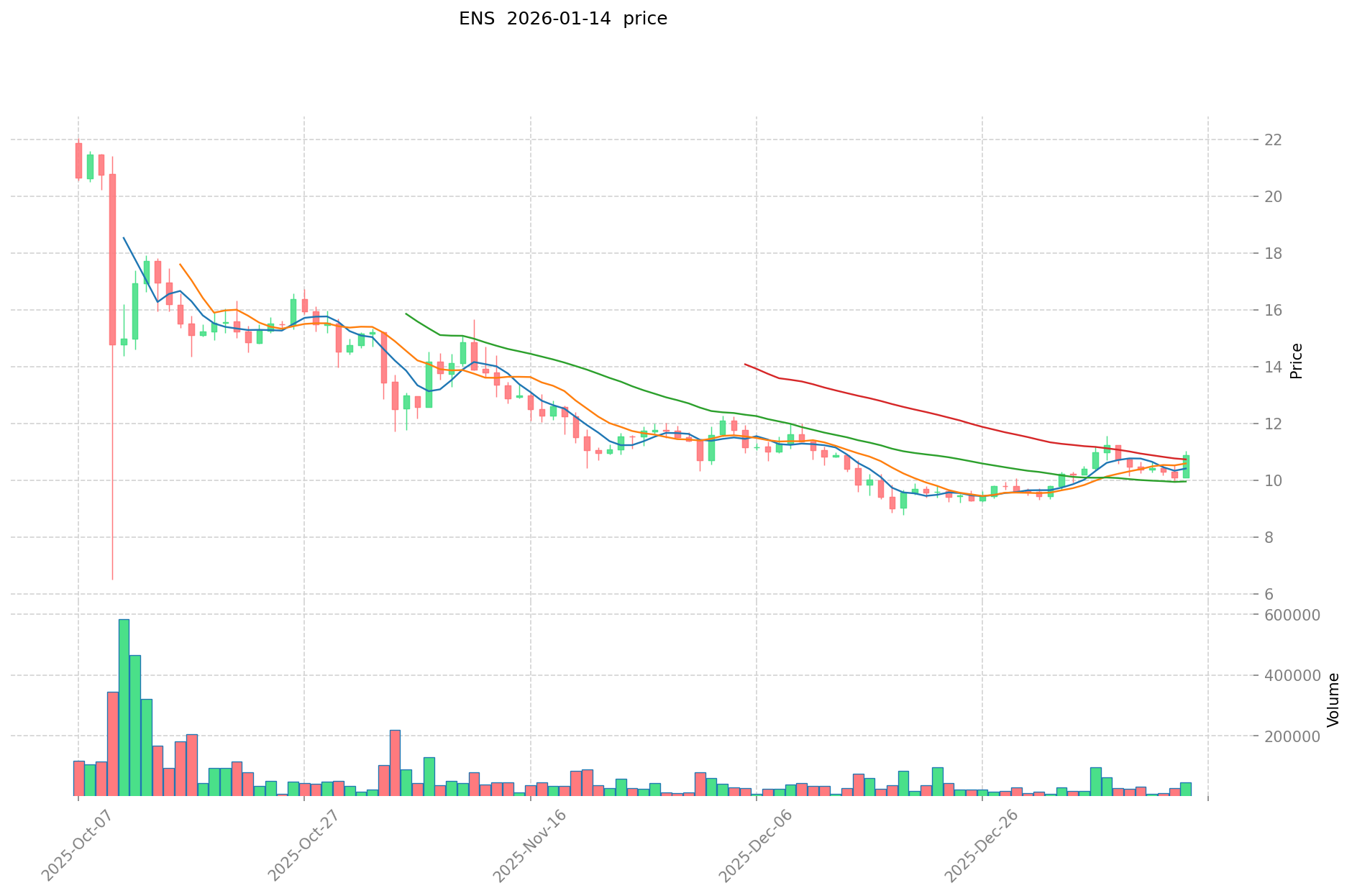
ENS is a significant asset in the cryptocurrency sector. Since its launch in 2021, it has achieved notable development in decentralized naming systems. As of January 15, 2026, ENS has a market capitalization of approximately $419.23 million, with a circulating supply of about 38.19 million tokens, and the current price is around $10.98. Positioned as a distributed and extensible naming protocol, ENS has gradually become a focal point for investors when discussing "Is ENS a good investment?" This article will comprehensively analyze ENS's investment value, historical trends, future price forecasts, and investment risks to provide reference for investors.
I. ENS Price History Review and Investment Value Status
- 2021: ENS token launched at initial price of $42.49, followed by early market enthusiasm → Early participants experienced notable returns
- 2021: Token reached peak valuation of $83.40 during market expansion phase → ENS demonstrated strong volatility characteristics typical of emerging blockchain assets
- 2023: Market experienced correction period → Price adjusted from previous highs to lower levels, with trading activity indicating market consolidation
- 2025: Current price level reflects maturation phase → ENS trading at approximately $10.98, showing stabilization after previous market cycles
Current ENS Investment Market Status (January 2026)
- ENS current price: $10.976
- Market sentiment: Market emotion indicator shows 1 (suggesting neutral to cautious sentiment)
- 24-hour trading volume: $753,403.08
- Circulating supply: 38,194,934.79 ENS tokens (representing 38.19% of total supply)
- Market capitalization: Approximately $419.23 million
- Fully diluted valuation: $1.098 billion
- Exchange availability: Listed on 54 exchanges
- Holder base: 66,947 addresses
Click to view real-time ENS market price
II. Core Factors Influencing Whether ENS is a Good Investment
Supply Mechanism and Scarcity (ENS Investment Scarcity)
- Fixed Maximum Supply: ENS has a maximum supply of 100,000,000 tokens with approximately 38,194,934.79 tokens currently in circulation (38.19% of total supply). This fixed supply cap creates a deflationary characteristic that may support long-term value appreciation as demand increases.
- Limited Circulating Supply: With only about 38% of tokens currently circulating, the controlled release mechanism may help maintain price stability while avoiding excessive market dilution.
- Investment Significance: The scarcity model, combined with ENS's utility as Ethereum's primary naming service, positions the token as infrastructure with inherent value tied to Ethereum ecosystem growth.
Institutional Investment and Mainstream Adoption (Institutional Investment in ENS)
- Holder Base Growth: ENS currently has 66,947 token holders, indicating a growing user and investor community.
- Infrastructure Positioning: ENS serves as critical infrastructure for Web3, with monthly registrations and renewals reaching 437,000 addresses, demonstrating strong organic adoption.
- Ecosystem Integration: As the dominant blockchain naming standard, ENS benefits from first-mover advantage in the decentralized identity space, with adoption spanning DeFi, NFT platforms, and institutional crypto infrastructure.
Macroeconomic Environment Impact on ENS Investment
- Ethereum Correlation: ENS's value is closely tied to Ethereum's performance and broader market sentiment, making it susceptible to macroeconomic factors affecting the cryptocurrency sector.
- Market Volatility: As a mid-cap crypto asset, ENS exhibits higher volatility compared to established cryptocurrencies, with price movements influenced by overall risk appetite in digital asset markets.
- Web3 Growth Narrative: The expansion of decentralized technologies and increasing demand for human-readable blockchain addresses position ENS to benefit from the broader Web3 adoption trend.
Technology and Ecosystem Development (Technology & Ecosystem for ENS Investment)
- Core Utility Expansion: ENS maps human-readable names (e.g., "alice.eth") to machine-readable identifiers including Ethereum addresses, other cryptocurrency addresses, content hashes, and metadata, with potential for expanded use cases in decentralized identity solutions.
- Governance Mechanism: The ENS token serves governance functions, allowing holders to participate in protocol decisions and vote on treasury grant allocations, creating utility beyond speculative value.
- Multi-Chain Potential: While currently focused on Ethereum, ENS's positioning as Web3's primary naming standard provides opportunities for expansion into multi-chain interoperability as the blockchain ecosystem evolves.
- DeFi and NFT Integration: Growing adoption across decentralized finance applications and NFT platforms strengthens ENS's role as foundational infrastructure, potentially supporting long-term investment value.
III. ENS Future Investment Forecast and Price Outlook (Is ENS(ENS) worth investing in 2026-2031)
Short-term Investment Forecast (2026, short-term ENS investment outlook)
- Conservative Forecast: $9.76 - $10.96
- Neutral Forecast: $10.96 - $13.10
- Optimistic Forecast: $13.10 - $15.24
Mid-term Investment Outlook (2027-2029, mid-term ENS(ENS) investment forecast)
- Market Stage Expectation: Based on available projections, ENS may experience gradual growth during the mid-term period, with price ranges expanding as the market matures and adoption potentially increases.
- Investment Return Forecast:
- 2027: $11.00 - $18.47
- 2028: $15.00 - $23.21
- 2029: $15.01 - $26.51
- Key Catalysts: Factors that may influence ENS performance include broader Ethereum ecosystem developments, domain name service adoption trends, and overall cryptocurrency market sentiment.
Long-term Investment Outlook (Is ENS a good long-term investment?)
- Base Scenario: $17.94 - $28.30 (assuming steady ecosystem development and moderate market conditions)
- Optimistic Scenario: $28.30 - $41.31 (assuming accelerated adoption and favorable market environment)
- Risk Scenario: Below $17.94 (under adverse market conditions or significant competitive pressure)
Click to view ENS long-term investment and price forecast: Price Prediction
2026-01-15 - 2031 Long-term Outlook
- Base Scenario: $17.94 - $28.30 (corresponding to steady progress and gradual mainstream application improvement)
- Optimistic Scenario: $28.30 - $41.31 (corresponding to large-scale adoption and favorable market environment)
- Transformative Scenario: Above $41.31 (if ecosystem achieves breakthrough progress and mainstream popularization)
- 2031-12-31 Forecast High: $41.31 (based on optimistic development assumptions)
Disclaimer: The forecasts presented are based on historical data and market analysis available as of January 15, 2026. Cryptocurrency markets are highly volatile and subject to various risks. These projections should not be construed as investment advice, and actual performance may differ materially from forecasts. Investors should conduct their own research and consult with financial advisors before making investment decisions.
| Year |
Predicted High Price |
Predicted Average Price |
Predicted Low Price |
Price Change |
| 2026 |
15.23857 |
10.963 |
9.75707 |
0 |
| 2027 |
18.47210685 |
13.100785 |
11.0046594 |
19 |
| 2028 |
23.20607550975 |
15.786445925 |
14.99712362875 |
43 |
| 2029 |
26.51491457563 |
19.496260717375 |
15.01212075237875 |
77 |
| 2030 |
33.58815796389365 |
23.0055876465025 |
17.94435836427195 |
109 |
| 2031 |
41.313434295589189 |
28.296872805198075 |
23.769373156366383 |
157 |
IV. ENS Investment Strategy and Risk Management (How to invest in ENS)
Investment Strategy (ENS investment strategy)
Long-term Holding (HODL ENS)
For conservative investors seeking exposure to Ethereum's decentralized infrastructure, long-term holding of ENS tokens may align with a strategy focused on the protocol's governance role and potential ecosystem growth. This approach typically involves:
- Accumulating tokens during market corrections
- Participating in governance proposals and DAO voting
- Monitoring protocol development and adoption metrics
- Maintaining holdings through market cycles
Active Trading
Traders may employ technical analysis and momentum strategies given ENS's price volatility. Based on recent data showing 24-hour price movements between $10.783 and $11.188, active trading approaches might include:
- Technical analysis using support/resistance levels
- Monitoring trading volume fluctuations (current 24h volume: $753,403)
- Swing trading during periods of elevated volatility
- Setting predefined entry and exit points
Risk Management (Risk management for ENS investment)
Asset Allocation Guidelines
- Conservative investors: Consider allocating 1-3% of crypto portfolio to ENS
- Moderate investors: May allocate 3-7% based on risk tolerance
- Experienced investors: Could allocate 7-15% with active monitoring
Risk Mitigation Strategies
- Portfolio diversification: Combine ENS with other crypto assets and traditional investments
- Position sizing: Avoid over-concentration in a single asset
- Stop-loss orders: Consider implementing protective stops during active trading
- Regular rebalancing: Adjust positions based on market conditions and portfolio performance
Secure Storage Solutions
- Hot wallets: For active trading and frequent transactions (exchanges, mobile wallets)
- Cold storage: For long-term holdings (hardware wallets recommended)
- Hardware wallet options: Consider reputable providers for ENS (ERC-20 token on Ethereum)
- Multi-signature solutions: For larger holdings requiring enhanced security
- Key management: Maintain secure backup of seed phrases and private keys
V. ENS Investment Risks and Challenges (Risks of investing in ENS)
Market Risks
- High volatility: ENS has experienced significant price fluctuations, with 1-year performance showing -64.42% change
- Price range volatility: Historical data shows movements between a low of $6.69 and previous levels near $83.4
- Liquidity considerations: Trading volume of $753,403 in 24 hours may impact execution for larger orders
- Market sentiment shifts: Crypto markets can experience rapid sentiment changes affecting prices
Regulatory Risks
- Jurisdictional uncertainty: Different countries maintain varying regulatory frameworks for crypto assets
- Governance token classification: Potential regulatory treatment of ENS as a governance token remains evolving
- Compliance requirements: Changing regulations may impact trading, taxation, and holding practices
- Cross-border considerations: International investors face multiple regulatory jurisdictions
Technical Risks
- Smart contract vulnerabilities: As an Ethereum-based protocol, ENS relies on smart contract security
- Network dependencies: Performance tied to Ethereum network's functionality and gas fees
- Protocol upgrade risks: Changes to ENS protocol may introduce technical challenges
- Integration risks: Dependencies on Ethereum infrastructure and third-party integrations
- Wallet security: Users must secure private keys and manage token custody properly
VI. Conclusion: Is ENS a Good Investment?
Investment Value Summary
ENS represents exposure to Ethereum's decentralized naming infrastructure, with the token serving governance and DAO participation functions. The asset has demonstrated substantial price volatility, with current circulating supply at 38.19% of maximum supply (38,194,934 tokens circulating out of 100,000,000 maximum). Market performance shows mixed signals, with recent gains of 12.2% over 30 days but a significant decline of -64.42% over one year.
Investor Recommendations
✅ New Investors:
- Consider dollar-cost averaging (DCA) strategy to mitigate timing risk
- Prioritize secure storage using hardware wallets
- Start with smaller position sizes to understand market dynamics
- Research ENS governance mechanisms and protocol fundamentals
✅ Experienced Investors:
- Implement active trading strategies with defined risk parameters
- Diversify holdings across multiple crypto assets
- Monitor governance proposals and protocol developments
- Consider technical analysis for entry and exit timing
✅ Institutional Investors:
- Evaluate ENS within broader crypto infrastructure thesis
- Assess governance participation opportunities
- Implement professional custody solutions
- Consider correlation with Ethereum ecosystem performance
⚠️ Important Notice: Cryptocurrency investments carry substantial risk due to market volatility, regulatory uncertainty, and technical factors. This content is provided for informational purposes only and does not constitute financial advice, investment recommendations, or an offer to buy or sell securities. Investors should conduct thorough due diligence, assess their risk tolerance, and consult with qualified financial advisors before making investment decisions. Past performance does not guarantee future results.
VII. FAQ
Q1: Is ENS a good investment in 2026?
ENS presents both opportunities and risks as an investment. With a current market cap of approximately $419.23 million and serving as Ethereum's primary naming service, ENS offers exposure to Web3 infrastructure development. However, investment suitability depends on individual risk tolerance, as ENS has shown significant volatility (-64.42% over one year, +12.2% over 30 days). Conservative investors should consider allocating 1-3% of their crypto portfolio, while experienced investors might allocate 3-15% with active monitoring. The asset's governance utility and fixed maximum supply of 100 million tokens provide fundamental value, but investors should implement proper risk management strategies and conduct thorough research before investing.
Q2: What factors most significantly influence ENS's investment value?
Four primary factors drive ENS's investment value: (1) Ethereum ecosystem adoption, as ENS functionality is directly tied to Ethereum's growth and network activity; (2) Web3 infrastructure demand, with ENS serving 437,000 monthly registrations and renewals; (3) Token scarcity, with only 38.19% of maximum supply currently circulating; and (4) governance participation, as ENS tokens enable holders to vote on protocol decisions and treasury allocations. Additionally, broader cryptocurrency market sentiment, regulatory developments, and technical protocol upgrades significantly impact ENS's price performance and long-term investment outlook.
Q3: What are the main risks of investing in ENS?
ENS investment involves three critical risk categories: (1) Market risks—substantial price volatility with historical fluctuations between $6.69 and $83.40, moderate trading volume of $753,403 potentially affecting large order execution, and correlation with overall cryptocurrency market sentiment; (2) Regulatory risks—evolving classification of governance tokens, varying jurisdictional frameworks, and potential compliance requirement changes; (3) Technical risks—smart contract vulnerabilities, dependency on Ethereum network performance and gas fees, protocol upgrade challenges, and wallet security responsibilities. Investors should implement diversification strategies, secure storage solutions, and regular portfolio rebalancing to mitigate these risks.
Q4: What is ENS's long-term price forecast through 2031?
Based on available market analysis as of January 15, 2026, ENS long-term forecasts present three scenarios: Base scenario projects $17.94-$28.30 by 2031, assuming steady ecosystem development and moderate market conditions; Optimistic scenario suggests $28.30-$41.31, contingent on accelerated adoption and favorable market environment (predicted high of $41.31 by December 31, 2031); Risk scenario indicates potential decline below $17.94 under adverse conditions. Mid-term forecasts show gradual progression: 2027 ($11.00-$18.47), 2028 ($15.00-$23.21), and 2029 ($15.01-$26.51). These projections should not be interpreted as guaranteed returns, as cryptocurrency markets remain highly volatile and subject to numerous unpredictable factors.
Q5: How should investors approach ENS storage and security?
Secure ENS token storage requires a strategy matching your investment approach and holdings size: (1) Active traders should utilize hot wallets (exchange wallets, mobile wallets) for frequent transactions while keeping only necessary amounts on exchanges; (2) Long-term holders should prioritize cold storage using hardware wallets from reputable providers, as ENS operates as an ERC-20 token on Ethereum; (3) Larger holdings warrant multi-signature solutions providing enhanced security through distributed access requirements; (4) All investors must maintain secure backups of seed phrases and private keys in physically secure, offline locations. Hardware wallet options such as Ledger or Trezor devices provide robust security for ENS holdings, protecting against online threats while enabling governance participation when needed.
Q6: What investment strategy works best for ENS tokens?
Optimal ENS investment strategy depends on investor profile and objectives: (1) Long-term holders (HODL strategy) should focus on accumulating during market corrections, participating in governance voting, monitoring protocol adoption metrics (currently 66,947 holders), and maintaining positions through market cycles—suitable for conservative investors seeking Ethereum infrastructure exposure; (2) Active traders can leverage ENS's volatility (recent 24-hour range: $10.783-$11.188) through technical analysis, monitoring volume fluctuations ($753,403 current 24h volume), swing trading strategies, and defined entry/exit points; (3) Dollar-cost averaging (DCA) provides new investors systematic exposure while mitigating timing risk. Regardless of strategy, investors should implement appropriate position sizing (1-15% of crypto portfolio based on risk tolerance) and maintain diversification across multiple assets.
* The information is not intended to be and does not constitute financial advice or any other recommendation of any sort offered or endorsed by Gate.