Ether.fi (ETHFI) is an Ethereum liquid staking governance token with a current market cap of $528.85 million and price of $0.8077 as of January 2026. This comprehensive analysis evaluates whether ETHFI represents a sound investment by examining its price history, protocol fundamentals, and market potential. The article reviews ETHFI's core value drivers, including native Eigenlayer restaking integration, eETH liquid staking mechanics, and expanding product ecosystem, while analyzing competitive positioning within the staking sector. Price forecasts range from $0.59-$1.18 for 2026, with long-term projections reaching $1.53-$2.33 by 2031 under optimistic scenarios. The guide provides tailored investment strategies for beginners, experienced traders, and institutions, emphasizing risk management through diversification and secure storage via Gate exchange and hardware wallets. Key considerations include high volatility, regulatory uncertainty, and technical dependencies on external protocols.
Introduction: Ether.fi (ETHFI) Investment Position and Market Outlook
ETHFI is an important asset in the cryptocurrency field. As a staking protocol for Ethereum, it has achieved notable development since its launch in 2024. As of January 15, 2026, Ether.fi has a market capitalization of approximately $528.85 million, with a circulating supply of around 654.76 million tokens, and the current price is maintained at approximately $0.8077. With its positioning as an Ethereum staking protocol integrated with Eigenlayer restaking mechanism, ETHFI has gradually become a focal point for investors discussing "Is Ether.fi (ETHFI) a good investment?" This article will comprehensively analyze the investment value, historical trends, future price predictions, and investment risks of ETHFI to provide reference for investors.
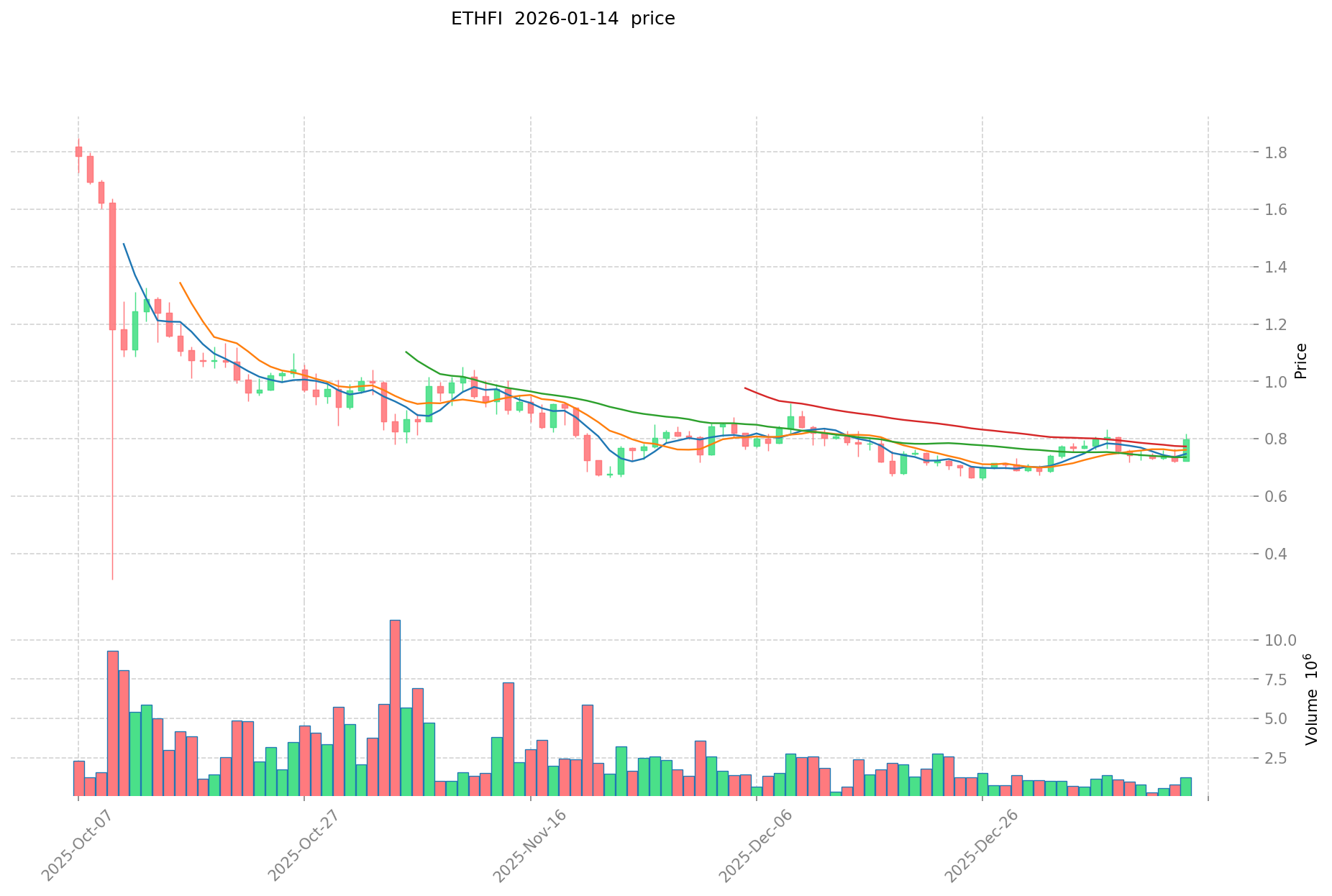
I. Ether.fi (ETHFI) Price History Review and Investment Value Status
- 2024: Token launched in March with initial trading activity → ETHFI experienced significant price volatility during its early market phase
- 2024: Reached a notable price level of $8.658 in March → Market participants observed substantial short-term fluctuations
- 2025: Market correction phase → Price adjusted from higher levels to $0.3086 in October
Current ETHFI Investment Market Status (January 2026)
- ETHFI current price: $0.8077
- 24-hour trading volume: $1,133,086.91
- Market capitalization: $528,851,551.71
- Circulating supply: 654,762,352 ETHFI (65.48% of total supply)
- Price changes: +4.96% (24h), +7.06% (7d), +4.31% (30d)
- Listed on 49 exchanges with 107,748 holders
Click to view real-time ETHFI market price
II. Core Factors Influencing Whether ETHFI is a Good Investment
Supply Mechanism and Scarcity (ETHFI investment scarcity)
- Supply Structure: ETHFI has a maximum supply of 1,000,000,000 tokens, with a current circulating supply of 654,762,352 tokens (approximately 65.48% of total supply). The fixed supply cap creates a deflationary pressure mechanism that may support long-term value appreciation.
- Market Cap to FDV Ratio: The current market cap to fully diluted valuation ratio stands at 65.48%, indicating that a substantial portion of tokens remain unlocked. Future token releases could influence supply-side dynamics.
- Investment Significance: The predetermined supply ceiling establishes a scarcity framework that may serve as a foundational element for long-term investment consideration, though the impact of remaining token unlocks warrants attention.
Institutional Investment and Mainstream Adoption (Institutional investment in ETHFI)
- Holder Base Growth: ETHFI currently has 107,748 token holders, reflecting a growing community of participants across the ecosystem.
- Protocol Integration: Ether.fi's integration with EigenLayer for native restaking and its expanding product ecosystem (including Liquid and Cash offerings) demonstrate increasing institutional and DeFi protocol adoption. The protocol's Total Value Locked (TVL) growth trajectory has been identified as a key metric for platform expansion.
- Exchange Listings: ETHFI is listed on 49 exchanges, providing broad market access and liquidity channels for institutional and retail participants.
- Investment Value Enhancement: The protocol's non-custodial architecture and governance rights through ETHFI tokens may attract long-term institutional interest seeking exposure to Ethereum's liquid staking economy.
Macroeconomic Environment's Impact on ETHFI Investment
- Crypto Market Correlation: As an Ethereum-based liquid staking protocol token, ETHFI's performance is influenced by broader cryptocurrency market conditions, Ethereum network adoption, and DeFi sector growth trends.
- Yield Generation Context: In varying interest rate environments, ETHFI's value proposition as a yield-generating asset through ETH staking rewards plus additional ETHFI token distributions may shift in relative attractiveness compared to traditional fixed-income alternatives.
- Regulatory Landscape: Evolving regulatory frameworks for staking protocols and DeFi services across jurisdictions may impact ETHFI's operational environment and investment risk profile.
Technology and Ecosystem Development (Technology & Ecosystem for ETHFI investment)
- EigenLayer Restaking Integration: Ether.fi's native integration with EigenLayer enables depositors to participate in restaking mechanisms, which repurpose staked ETH to support external systems such as rollups and oracles. This technical architecture creates additional yield opportunities beyond standard ETH staking, potentially enhancing the protocol's value proposition.
- Liquid Staking Token (eETH): Users receive eETH, a rebasing ERC-20 liquid staking token that maintains usability across DeFi protocols while accruing staking rewards. This liquidity preservation feature addresses a key limitation of traditional staking mechanisms.
- Product Ecosystem Expansion: The protocol has developed an expanding suite of services including vaults, loyalty rewards programs, and crypto-native spending options such as the Ether.Fi Cash Card. The roadmap includes planned integrations for decentralized node operators, ETH-denominated bonds, and yield-on-yield tokenization.
- Governance and Utility: ETHFI serves as both a governance token for the ether.fi DAO and a utility token within the protocol ecosystem, providing holders with decision-making rights over protocol parameters and access to platform features.
- Long-term Value Support: The protocol's focus on non-custodial operations (users retain control of private keys), DeFi strategy optimization, and ecosystem breadth may provide structural support for long-term investment considerations, contingent on successful execution of technical roadmap initiatives.
III. ETHFI Future Investment Forecast and Price Outlook (Is Ether.fi(ETHFI) worth investing in 2026-2031)
Short-term Investment Forecast (2026, short-term ETHFI investment outlook)
Based on multiple price prediction models, ETHFI presents varied scenarios for 2026. Conservative estimates suggest a trading range between $0.59 and $0.74, reflecting cautious market sentiment. Neutral forecasts position the average price around $0.81, while optimistic projections indicate potential highs reaching $1.18. These estimates incorporate factors such as protocol adoption rates, staking demand trends, and broader DeFi market conditions.
Mid-term Investment Outlook (2027-2029, mid-term Ether.fi(ETHFI) investment forecast)
-
Market Stage Expectation: The protocol may enter a maturation phase characterized by expanding total value locked (TVL) and strengthened partnerships within the Ethereum staking ecosystem. Integration with additional DeFi protocols and potential enhancements to the liquid staking mechanism could support sustained interest.
-
Investment Return Forecast:
- 2027: $0.77 - $1.32 (projected growth rate approximately 23% year-over-year)
- 2028: $0.86 - $1.38 (projected growth rate approximately 43% cumulative)
- 2029: $0.91 - $1.56 (projected growth rate approximately 56% cumulative)
-
Key Catalysts: Factors that may influence mid-term performance include Ethereum network upgrades, competitive positioning among liquid staking solutions, governance developments via ETHFI token utility, and evolving regulatory frameworks for staking protocols.
Long-term Investment Outlook (Is ETHFI a good long-term investment?)
- Baseline Scenario: $0.92 - $1.41 by 2030 (assuming steady protocol growth and moderate market expansion)
- Optimistic Scenario: $1.53 - $2.06 by 2030 (assuming accelerated DeFi adoption and favorable market dynamics)
- Risk Scenario: Below $0.70 (under conditions of intensified competition, regulatory headwinds, or significant market downturns)
Click to view ETHFI long-term investment and price predictions: Price Prediction
2026-2031 Long-term Outlook
- Base Scenario: $0.92 - $1.74 (corresponding to steady progress and gradual mainstream application improvement)
- Optimistic Scenario: $1.53 - $2.33 (corresponding to large-scale adoption and favorable market environment)
- Transformative Scenario: Above $2.33 (conditional on breakthrough ecosystem developments and mainstream adoption)
- Projected High by December 31, 2031: $2.33 (based on optimistic development assumptions)
Disclaimer: These projections are derived from analytical models and market data available as of January 15, 2026. Cryptocurrency markets remain highly volatile and subject to regulatory, technological, and macroeconomic uncertainties. Past performance does not guarantee future results. This content is for informational purposes only and does not constitute investment advice. Investors should conduct independent research and consult financial professionals before making investment decisions.
| Year |
Predicted High Price |
Predicted Average Price |
Predicted Low Price |
Price Change |
| 2026 |
1.184352 |
0.8112 |
0.592176 |
0 |
| 2027 |
1.31706432 |
0.997776 |
0.76828752 |
23 |
| 2028 |
1.3773299904 |
1.15742016 |
0.8564909184 |
43 |
| 2029 |
1.558871342496 |
1.2673750752 |
0.912510054144 |
56 |
| 2030 |
2.06315988491808 |
1.413123208848 |
0.9185300857512 |
74 |
| 2031 |
2.329109672823273 |
1.73814154688304 |
1.529564561257075 |
115 |
IV. ETHFI Investment Strategy and Risk Management (How to invest in ETHFI)
Investment Methodology (ETHFI investment strategy)
Long-term Holding (HODL ETHFI): Suitable for Conservative Investors
For investors seeking steady exposure to Ethereum staking protocols, a long-term holding strategy may be considered. This approach involves acquiring ETHFI tokens and maintaining positions through market cycles, focusing on the project's fundamental value proposition as a governance token for the Ether.Fi staking protocol. Given the protocol's integration with Eigenlayer for native restaking capabilities, long-term holders may benefit from the evolving Ethereum staking ecosystem. However, investors should be aware that ETHFI has experienced significant price volatility, with the current price at $0.8077 representing a substantial decline from its previous levels.
Active Trading: Technical Analysis and Swing Operations
Active traders may approach ETHFI through technical analysis and swing trading strategies. The token has demonstrated considerable price movements, with a 24-hour change of 4.96% and a 7-day change of 7.06%. The 24-hour price range between $0.7687 and $0.8168 provides potential opportunities for short-term trading. Traders utilizing this strategy should monitor key support and resistance levels, trading volume patterns (current 24h volume: $1,133,086.91), and broader market sentiment affecting DeFi and liquid staking protocols.
Risk Management (Risk management for ETHFI investment)
Asset Allocation Ratio: Conservative / Aggressive / Professional Investors
- Conservative Investors: May consider allocating 1-3% of their crypto portfolio to ETHFI, treating it as a speculative position within a broader diversified strategy
- Aggressive Investors: Could allocate 5-10% to ETHFI, accepting higher volatility in exchange for potential upside exposure to the liquid staking sector
- Professional Investors: May implement dynamic allocation strategies based on market conditions, protocol developments, and risk-adjusted return metrics
Investors can implement several risk management approaches:
- Diversification across different crypto categories (not concentrating solely in staking protocols)
- Correlation analysis with ETH price movements, as Ether.Fi's value proposition is closely tied to Ethereum staking
- Position sizing based on volatility metrics and personal risk tolerance
- Potential hedging through derivatives or correlated assets when available
Secure Storage: Hot and Cold Wallets + Hardware Wallet Recommendations
ETHFI is an ERC20 token deployed on Ethereum (contract address: 0xfe0c30065b384f05761f15d0cc899d4f9f9cc0eb). Storage options include:
- Hardware Wallets: Ledger and Trezor devices support ERC20 tokens and provide enhanced security for long-term storage
- Software Wallets: MetaMask, Trust Wallet, and other Ethereum-compatible wallets for active trading needs
- Cold Storage: For significant holdings, hardware wallets kept offline provide optimal security
- Hot Wallets: Convenient for frequent trading but should only hold amounts intended for active use
Investors should verify contract addresses through official channels before any transactions.
V. ETHFI Investment Risks and Challenges (Risks of investing in ETHFI)
Market Risk: High Volatility and Price Manipulation
ETHFI exhibits substantial price volatility characteristics. The token's current price of $0.8077 reflects significant fluctuation from various price levels throughout its trading history. The market capitalization of approximately $528.85 million and relatively modest 24-hour trading volume of $1.13 million suggest potential liquidity constraints during periods of market stress. With a circulating supply of 654,762,352 tokens representing 65.48% of the maximum supply of 1 billion tokens, future token unlocks could potentially impact price dynamics.
Regulatory Risk: Policy Uncertainty Across Different Countries
As a governance token for a liquid staking protocol, ETHFI faces regulatory considerations across multiple jurisdictions:
- Evolving regulatory frameworks for staking services and liquid staking derivatives in various countries
- Potential classification questions regarding the token's status under securities laws in different regions
- Ongoing regulatory developments affecting DeFi protocols and governance tokens globally
- Compliance requirements that may affect protocol operations or token utility in certain jurisdictions
Investors should monitor regulatory developments in their respective jurisdictions and assess how changes might impact the Ether.Fi protocol and ETHFI token utility.
Technical Risk: Network Security Vulnerabilities and Upgrade Failures
Technical risks associated with ETHFI include:
- Smart Contract Risk: As an ERC20 token and governance mechanism for a staking protocol, vulnerabilities in smart contract code could potentially affect token holders
- Protocol Integration Risk: Ether.Fi's integration with Eigenlayer for restaking functionality creates dependencies on external protocol security and performance
- Ethereum Network Risk: As an Ethereum-based protocol, Ether.Fi is subject to the security and performance characteristics of the Ethereum network
- Upgrade Risk: Protocol upgrades or changes to staking mechanisms could introduce unforeseen technical issues
The protocol's interaction with complex DeFi infrastructure and restaking mechanisms introduces technical complexity that warrants careful consideration.
VI. Conclusion: Is ETHFI a Good Investment?
Investment Value Summary
ETHFI represents exposure to the Ethereum liquid staking sector through the Ether.Fi protocol's governance token. The protocol's integration with Eigenlayer for native restaking offers a differentiated approach within the liquid staking landscape. However, the token has experienced considerable price volatility, and the liquid staking sector faces competitive dynamics with multiple established protocols. The project's value proposition centers on governance participation and potential alignment with protocol growth, but investors should carefully evaluate the risk-reward profile given market conditions and sector competition.
Investor Recommendations
✅ Beginners: Consider starting with small allocations through dollar-cost averaging strategies. Prioritize secure storage using hardware wallets and thoroughly research the Ether.Fi protocol mechanics before investing. Avoid concentration risk by maintaining diversification across different crypto categories.
✅ Experienced Investors: May implement swing trading strategies based on technical analysis while maintaining core positions for longer-term exposure. Consider portfolio allocation as part of a broader DeFi or Ethereum ecosystem strategy, with appropriate risk management through position sizing and stop-loss disciplines.
✅ Institutional Investors: Could evaluate ETHFI within strategic allocations to liquid staking infrastructure, considering liquidity profiles, correlation dynamics, and protocol fundamentals. Due diligence should encompass smart contract audits, tokenomics analysis, and competitive positioning within the staking sector.
⚠️ Disclaimer: Cryptocurrency investments carry substantial risk, including potential loss of principal. This content is for informational purposes only and does not constitute investment advice. Investors should conduct independent research and consult with qualified financial advisors before making investment decisions.
VII. FAQ
Q1: Is Ether.fi (ETHFI) a good investment for beginners in 2026?
ETHFI may be suitable for beginners as a small, diversified portfolio allocation (1-3%), but it carries substantial risks due to high volatility and requires careful consideration. As a governance token for an Ethereum liquid staking protocol, ETHFI offers exposure to the growing staking ecosystem. However, beginners should note that the token has experienced significant price fluctuations, with the current price of $0.8077 representing considerable decline from previous levels. New investors should start with minimal allocations, use dollar-cost averaging strategies, prioritize secure storage through hardware wallets, and thoroughly research the Ether.Fi protocol mechanics before investing. Understanding the technical aspects of liquid staking and restaking mechanisms is essential for informed decision-making.
Q2: What are the main risks of investing in ETHFI?
The primary risks include extreme price volatility, regulatory uncertainty, and technical vulnerabilities. ETHFI has demonstrated substantial price swings with modest trading volume ($1.13 million daily), which may result in liquidity constraints during market stress. Regulatory frameworks for staking protocols and governance tokens remain evolving across jurisdictions, potentially affecting protocol operations and token utility. Technical risks encompass smart contract vulnerabilities, dependencies on external protocols like Eigenlayer, Ethereum network security, and potential issues during protocol upgrades. Additionally, the liquid staking sector faces intense competition from established protocols, and future token unlocks (approximately 35% of total supply remains locked) could impact price dynamics. Investors should implement appropriate risk management strategies including diversification and position sizing.
Q3: How does ETHFI generate value for investors?
ETHFI generates value through governance rights, protocol participation, and alignment with Ether.Fi ecosystem growth. As the governance token for the Ether.Fi DAO, ETHFI holders can influence protocol parameters and strategic decisions. The protocol's integration with Eigenlayer enables native restaking functionality, offering depositors additional yield opportunities beyond standard ETH staking rewards through eETH liquid staking tokens. The expanding product ecosystem includes vaults, loyalty rewards programs, and DeFi integrations that enhance utility. With a fixed maximum supply of 1 billion tokens creating scarcity dynamics, long-term value appreciation potential exists if protocol adoption increases. However, value realization depends on successful execution of technical roadmap initiatives, growing Total Value Locked (TVL), and competitive positioning within the liquid staking sector.
Q4: What is the price outlook for ETHFI through 2030?
Price projections suggest varied scenarios based on market conditions and protocol adoption. For 2026, conservative estimates range from $0.59 to $0.74, neutral forecasts average $0.81, while optimistic projections reach $1.18. Mid-term outlook (2027-2029) indicates potential growth with 2029 estimates ranging from $0.91 to $1.56, representing approximately 56% cumulative growth under favorable conditions. Long-term projections for 2030 span from $0.92 to $2.06 depending on adoption scenarios, with transformative scenarios potentially exceeding $2.33 by 2031. These forecasts incorporate factors including protocol TVL growth, Ethereum network upgrades, DeFi sector expansion, and competitive dynamics. However, investors should recognize that cryptocurrency markets remain highly volatile and subject to regulatory, technological, and macroeconomic uncertainties that may significantly impact actual outcomes.
Q5: How should investors store ETHFI tokens securely?
ETHFI tokens should be stored using appropriate security measures based on holding duration and usage patterns. For long-term holdings, hardware wallets such as Ledger or Trezor provide optimal security by keeping private keys offline and supporting ERC20 tokens on Ethereum. Software wallets like MetaMask or Trust Wallet offer convenience for active trading but should only contain amounts intended for frequent use. Investors should verify the official ETHFI contract address (0xfe0c30065b384f05761f15d0cc899d4f9f9cc0eb) through official channels before any transactions to avoid scams. Cold storage solutions are recommended for significant holdings, while hot wallets serve operational needs. Best practices include enabling two-factor authentication, using strong unique passwords, regularly updating wallet software, and never sharing private keys or seed phrases with anyone.
Q6: What makes Ether.Fi different from other liquid staking protocols?
Ether.Fi distinguishes itself through native Eigenlayer restaking integration, non-custodial architecture, and expanding product ecosystem. Unlike standard liquid staking solutions, Ether.Fi enables depositors to participate in restaking mechanisms that repurpose staked ETH to support external systems such as rollups and oracles, creating additional yield opportunities. The protocol maintains a non-custodial approach where users retain control of private keys, addressing security concerns present in custodial alternatives. Users receive eETH, a rebasing ERC-20 liquid staking token that preserves liquidity across DeFi protocols while accruing staking rewards. Beyond core staking functionality, the protocol has developed an expanding suite of services including vaults, loyalty rewards programs, and crypto-native spending options like the Ether.Fi Cash Card. The roadmap includes planned integrations for decentralized node operators, ETH-denominated bonds, and yield-on-yield tokenization, positioning the protocol for broader ecosystem participation.
Q7: What investment strategy works best for ETHFI?
Optimal strategies depend on investor risk tolerance, time horizon, and market experience. Conservative long-term investors may adopt a HODL strategy with 1-3% portfolio allocation, focusing on the protocol's fundamental value proposition within Ethereum's staking ecosystem and holding through market cycles. Aggressive investors might allocate 5-10% and implement dollar-cost averaging to mitigate volatility impact while maintaining exposure to potential upside. Active traders can utilize technical analysis and swing trading approaches, capitalizing on ETHFI's price movements (recent 7-day change of 7.06%) by monitoring support/resistance levels and volume patterns. Professional investors may implement dynamic allocation strategies based on protocol developments, TVL growth metrics, and risk-adjusted return analysis. All strategies should incorporate diversification across crypto categories, appropriate position sizing based on volatility tolerance, and potential hedging through correlated assets when available.
Q8: How does the macroeconomic environment affect ETHFI investment prospects?
Macroeconomic conditions significantly influence ETHFI through multiple transmission channels. As an Ethereum-based liquid staking protocol token, ETHFI's performance correlates with broader cryptocurrency market conditions, Ethereum network adoption rates, and DeFi sector growth trajectories. In varying interest rate environments, ETHFI's value proposition as a yield-generating asset through ETH staking rewards plus ETHFI token distributions shifts in relative attractiveness compared to traditional fixed-income alternatives. During periods of monetary tightening and risk-off sentiment, speculative crypto assets typically face headwinds, while accommodative policies may support risk asset appreciation. Global economic uncertainty, inflation dynamics, and central bank policies impact investor appetite for crypto exposure. Additionally, regulatory developments across jurisdictions affect operational frameworks for staking protocols and DeFi services, potentially constraining or enabling growth depending on policy direction. Investors should monitor these macro factors alongside protocol-specific fundamentals when evaluating ETHFI investment timing and sizing.
* The information is not intended to be and does not constitute financial advice or any other recommendation of any sort offered or endorsed by Gate.