This comprehensive guide examines whether Ethereum (ETH) represents a sound investment opportunity by analyzing market fundamentals, historical performance, and future prospects. With a market capitalization of $374.5 billion and strong institutional backing—including BlackRock's ETHA fund holding $9 billion in ETH and cumulative spot ETF inflows exceeding $125 billion—Ethereum demonstrates significant investor confidence. The article evaluates critical investment factors including supply mechanisms, institutional adoption, macroeconomic conditions, and technological ecosystem development. Short-term predictions suggest consolidation between $2,484-$3,727, while long-term forecasts (2026-2031) range from $3,100-$6,400 depending on adoption scenarios. Investment strategies accommodate various risk profiles through dollar-cost averaging, active trading, and secure storage solutions. Risk management frameworks address market volatility, regulatory uncertainty, and technical vulnerabilities. Suitable for beginner
Introduction: Ethereum (ETH)'s Investment Position and Market Prospects
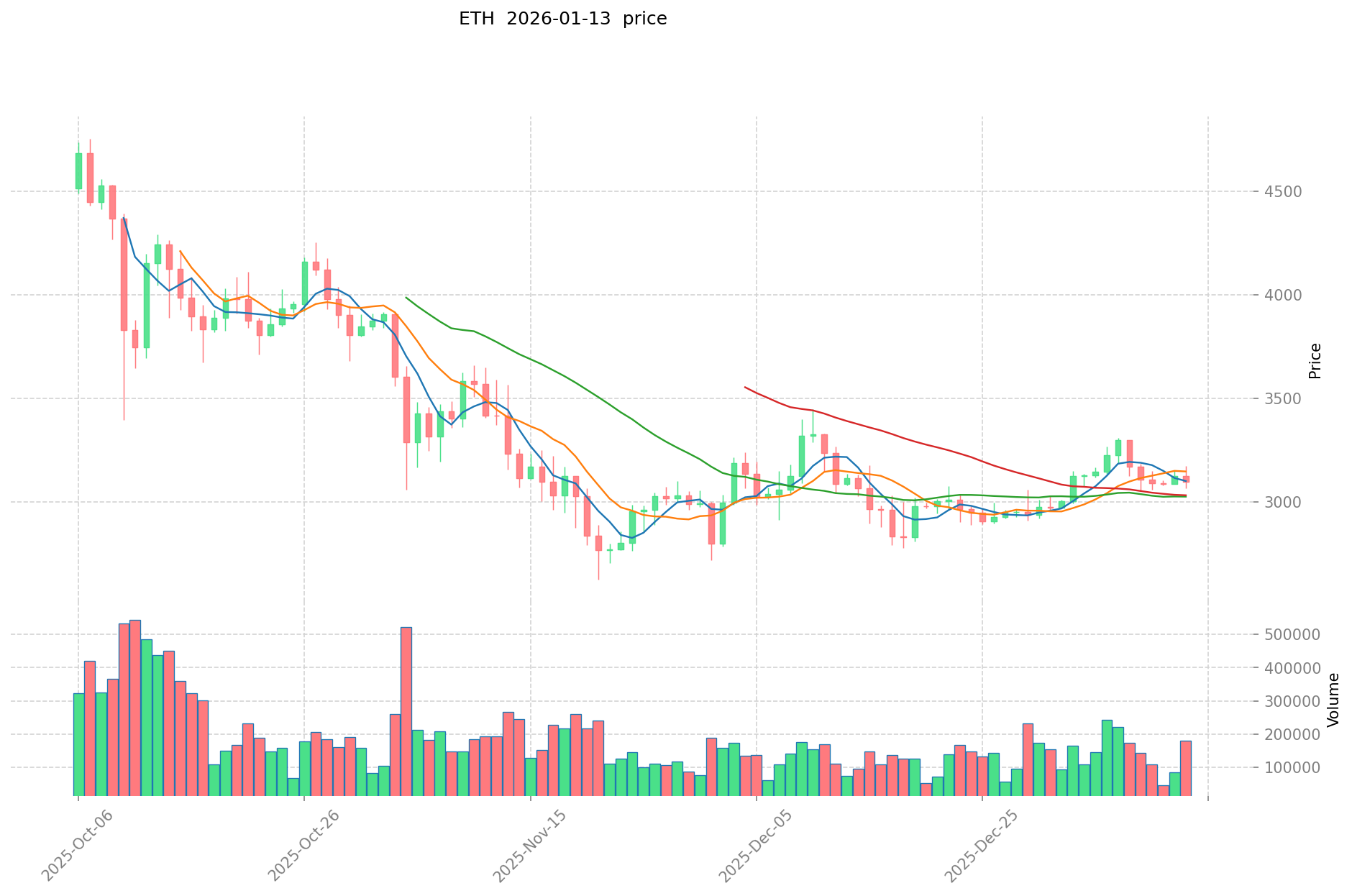
ETH is a significant asset in the cryptocurrency sector. Since its launch in 2015, it has achieved notable developments in smart contracts and decentralized applications (DApps). As of 2026, Ethereum's market capitalization reaches approximately $374.5 billion, with a circulating supply of around 120.69 million coins, and its current price maintains at approximately $3,102.83. With its positioning as a decentralized, open-source blockchain platform, Ethereum has gradually become a focal point for investors discussing "Is Ethereum (ETH) a good investment?" This article will comprehensively analyze ETH's investment value, historical trends, future price predictions, and investment risks to provide reference for investors.
I. Ethereum (ETH) Price History Review and Current Investment Value
- 2015: ETH launched at $0.31 → Early investors gained significant returns
- 2017: First major bull market → ETH price rose to $1,432.88
- 2018-2020: Crypto winter period → Price declined from previous peaks to approximately $100
- 2021: New bull cycle → ETH reached $4,946.05
- 2022-2023: Market correction phase → Price dropped to around $1,000 before recovering
- 2025: Price volatility continued → ETH reached $4,955.3 in August 2025
Current ETH Investment Market Status (January 2026)
- ETH Current Price: $3,102.83
- Market Sentiment (Fear & Greed Index): Data not provided in reference materials
- 24-Hour Trading Volume: $519,639,557.37
- Institutional Investor Holdings: BlackRock's ETHA fund holds approximately 3 million ETH, valued at nearly $9 billion; cumulative ETH spot ETF inflows exceeded $9.6 billion in 2025, with historical total inflows surpassing $125 billion; single-day net inflows reached $1.74 billion in early 2026
Click to view real-time ETH market price
II. Core Factors Influencing Whether ETH is a Good Investment
Supply Mechanism and Scarcity
- Ethereum's supply dynamics directly influence its price behavior and investment appeal. Following the transition to proof-of-stake and the implementation of EIP-1559, ETH has experienced periods of net deflationary issuance, where tokens burned exceed those newly issued, potentially enhancing scarcity over time.
- Historical patterns suggest that supply constraints have contributed to notable price appreciation phases. The shift toward a more limited supply model has attracted investor attention as a fundamental value driver.
- Investment significance: the evolving scarcity profile serves as a structural support for long-term investment theses, distinguishing ETH from assets with uncapped or rapidly expanding supply schedules.
Institutional Investment and Mainstream Adoption
- Institutional interest in Ethereum has grown substantially. The launch of spot Ethereum ETFs in multiple jurisdictions has facilitated regulated exposure, drawing capital from traditional financial firms and enhancing market liquidity.
- Major financial institutions and corporations have integrated Ethereum-based solutions—ranging from tokenized assets to decentralized finance infrastructure—thereby reinforcing its role in the evolving digital economy.
- Regulatory developments, particularly regarding staking frameworks and classification of ETH, remain pivotal. Favorable regulatory clarity in key markets could bolster institutional confidence, while restrictive measures or ambiguity may temper investment flows.
Macroeconomic Environment and Investment Appeal
- Monetary policy shifts, including interest rate adjustments, influence the relative attractiveness of risk assets such as ETH. Lower rates tend to support higher valuations for growth-oriented digital assets, whereas tightening cycles may dampen speculative demand.
- In periods of elevated inflation, some investors view Ethereum as a potential hedge, drawing parallels to "digital gold" narratives, though this perception remains subject to ongoing debate and empirical validation.
- Geopolitical uncertainties and macroeconomic volatility can drive demand for decentralized assets, as investors seek alternatives to traditional financial systems. However, such demand may fluctuate with broader market sentiment and risk appetite.
Technology and Ecosystem Development
- Layer-2 scaling solutions, including rollups, have significantly enhanced Ethereum's transaction throughput and reduced costs. These improvements address longstanding scalability concerns, making the network more competitive and attractive for developers and users.
- Ongoing protocol upgrades, such as enhancements to the consensus mechanism and data availability layers, aim to further strengthen network security and efficiency. These technical advancements underpin the long-term value proposition for investors.
- The expansion of decentralized finance (DeFi), non-fungible tokens (NFTs), and stablecoin infrastructure on Ethereum contributes to sustained network activity and fee generation. A robust and diverse ecosystem supports the investment case by demonstrating tangible utility and real-world adoption beyond speculative trading.
III. ETH Future Investment Prediction and Price Outlook (Is Ethereum (ETH) worth investing in 2026-2031)
Short-term Investment Prediction (2026, short-term ETH investment outlook)
Based on available market data, Ethereum's short-term price trajectory in 2026 suggests a consolidation phase with gradual upward potential.
- Conservative prediction: $2,484.73 - $3,105.91
- Neutral prediction: $3,000 - $3,300
- Optimistic prediction: $3,500 - $3,727.09
Technical analysis indicates ETH is trading within a $2,800-$3,300 range, with support holding around the $3,000 level and resistance concentrated near $3,300. The 34-day exponential moving average continues to provide dynamic support, suggesting consolidation within an established trading structure rather than directional momentum.
Mid-term Investment Outlook (2027-2029, mid-term Ethereum (ETH) investment forecast)
- Market stage expectation: Ethereum is anticipated to enter a gradual appreciation phase contingent on volume expansion and broader market participation
- Investment return prediction:
- 2027: $3,416.50 (average), ranging from $1,947.41 to $4,168.13
- 2028: $3,792.32 (average), ranging from $3,109.70 to $4,550.78
- 2029: $4,171.55 (average), ranging from $2,127.49 to $4,338.41
- Key catalysts: Sustained institutional accumulation, staking strategies, ecosystem expansion, and macroeconomic conditions including regulatory clarity and ETF demand trends
Mid-term projections reflect a cautiously bullish outlook, with price appreciation dependent on technical breakouts above key resistance levels and increased trading volume. Market sentiment analysis suggests that positive developments regarding Ethereum upgrades or institutional participation could support rallies toward resistance zones, while regulatory uncertainty may push ETH back to stronger support levels.
Long-term Investment Outlook (Is ETH a good long-term investment?)
Long-term forecasts for Ethereum vary significantly based on adoption trajectories and market conditions:
- Baseline scenario: $3,800 - $5,200 (assumes steady growth in decentralized applications and continued network development)
- Optimistic scenario: $5,500 - $6,700 (assumes accelerated institutional adoption, favorable regulatory environment, and expanding DeFi ecosystem)
- Risk scenario: $2,400 - $3,000 (under adverse macroeconomic or geopolitical conditions leading to risk-aversion behavior)
For more details on ETH long-term investment and price prediction: Price Prediction
2026-2031 Long-term Outlook
- Base scenario: $3,100 - $4,450 (corresponding to steady progress and gradual mainstream application enhancement)
- Optimistic scenario: $4,600 - $5,200 (corresponding to large-scale adoption and favorable market environment)
- Transformative scenario: Above $6,400 (if ecosystem achieves breakthrough progress and mainstream popularization)
- 2031-12-31 predicted high: $5,202.35 (based on optimistic development assumptions)
Disclaimer: Cryptocurrency markets involve high volatility and risk. Price predictions are based on historical data, technical analysis, and current market trends but do not guarantee future performance. Multiple factors including supply-demand dynamics, market sentiment, regulatory developments, institutional adoption, and macroeconomic trends influence ETH price movements. Investors should conduct independent research and understand the nature of digital assets before making investment decisions.
| Year |
Predicted High Price |
Predicted Average Price |
Predicted Low Price |
Price Change |
| 2026 |
3727.092 |
3105.91 |
2484.728 |
0 |
| 2027 |
4168.13122 |
3416.501 |
1947.40557 |
9 |
| 2028 |
4550.779332 |
3792.31611 |
3109.6992102 |
22 |
| 2029 |
4338.40962984 |
4171.547721 |
2127.48933771 |
34 |
| 2030 |
4637.9267562078 |
4254.97867542 |
2808.2859257772 |
36 |
| 2031 |
5202.349677502263 |
4446.4527158139 |
2401.084466539506 |
43 |
IV. Ethereum Investment Strategy and Risk Management (How to invest in Ethereum)
Investment Methodology (Ethereum investment strategy)
Investors can approach Ethereum through various strategies tailored to their risk tolerance and investment goals:
-
Long-term Holding (HODL Ethereum): This approach suits conservative investors who believe in Ethereum's long-term fundamentals as a decentralized blockchain platform supporting smart contracts and DApps. Given Ethereum's established position with a market capitalization of approximately $374.50 billion and ranking as the second-largest cryptocurrency, long-term holders may benefit from potential value appreciation over extended periods.
-
Active Trading: More experienced investors may employ technical analysis and swing trading strategies to capitalize on Ethereum's price movements. With a 24-hour trading volume exceeding $519.64 million and recent price fluctuations (24H: -1.01%, 7D: -3.55%), active traders can identify entry and exit points based on market momentum and technical indicators.
Risk Management (Risk management for Ethereum investment)
Effective risk management remains essential for Ethereum investment:
With over 264 million holders and availability on 84 exchanges, Ethereum offers liquidity and accessibility, though security practices remain paramount.
V. Ethereum Investment Risks and Challenges (Risks of investing in Ethereum)
Investors should carefully evaluate multiple risk factors before committing capital to Ethereum:
-
Market Risk: Ethereum demonstrates significant price volatility, with recent data showing fluctuations ranging from $3,065.96 to $3,171.41 within 24 hours. The 1-year price change of -4.97% illustrates medium-term volatility. Market manipulation risks exist in cryptocurrency markets, potentially affecting price discovery and investor returns.
-
Regulatory Risk: Policy uncertainty varies across jurisdictions, with different countries implementing diverse regulatory frameworks for cryptocurrencies. Regulatory changes could impact Ethereum's adoption, trading accessibility, and overall market dynamics.
-
Technical Risk: As a blockchain platform supporting smart contracts and decentralized applications, Ethereum faces potential network security vulnerabilities and upgrade implementation challenges. Technical failures or security breaches could affect network functionality and user confidence.
VI. Conclusion: Is Ethereum a Good Investment?
Investment Value Summary
Ethereum presents notable characteristics as an investment opportunity. As a decentralized, open-source blockchain platform supporting smart contracts and DApps, it maintains a significant market position with an 11.51% market dominance. The platform's 100% circulating supply ratio and established infrastructure with 84 exchange listings provide liquidity advantages. However, investors should acknowledge recent price volatility, with declines observed across multiple timeframes (7D: -3.55%, 30D: -0.5%, 1Y: -4.97%).
Investor Recommendations
✅ Beginners: Consider dollar-cost averaging (DCA) strategies combined with secure wallet storage. Start with smaller allocations to understand market dynamics before increasing exposure.
✅ Experienced Investors: Implement swing trading strategies based on technical analysis while maintaining diversified portfolio allocation. Monitor key support and resistance levels for optimal entry and exit timing.
✅ Institutional Investors: Evaluate Ethereum for strategic long-term allocation within diversified cryptocurrency portfolios, considering its established market position and technological infrastructure.
⚠️ Disclaimer: Cryptocurrency investments carry substantial risk due to market volatility and various external factors. This content serves informational purposes only and does not constitute investment advice. Investors should conduct thorough research and consider their financial situation before making investment decisions.
VII. FAQ
Q1: Is Ethereum (ETH) a good investment in 2026?
Ethereum presents a compelling investment case in 2026, though it carries inherent volatility and risks. With a market capitalization of approximately $374.5 billion and strong institutional support—including BlackRock's ETHA fund holding nearly $9 billion worth of ETH and cumulative spot ETF inflows exceeding $125 billion historically—the platform demonstrates significant investor confidence. Short-term predictions suggest consolidation within the $2,800-$3,300 range, with potential appreciation to $3,500-$3,727 under favorable conditions. However, investors should consider recent price declines (7D: -3.55%, 1Y: -4.97%) and implement appropriate risk management strategies based on their investment goals and risk tolerance.
Q2: What makes Ethereum different from other cryptocurrencies as an investment?
Ethereum distinguishes itself through its foundational role as a decentralized platform for smart contracts and decentralized applications (DApps), rather than functioning solely as a digital currency. Since transitioning to proof-of-stake and implementing EIP-1559, ETH has exhibited periods of deflationary supply dynamics, where token burns exceed new issuance—a characteristic that enhances scarcity and differentiates it from assets with unlimited supply. The platform's robust ecosystem supporting DeFi, NFTs, and stablecoin infrastructure generates sustained network activity and fee revenue, demonstrating tangible utility beyond speculative trading. With 264 million holders and availability on 84 exchanges, Ethereum offers established liquidity and market depth that newer cryptocurrencies lack.
Q3: How should beginners start investing in Ethereum?
Beginners should adopt a dollar-cost averaging (DCA) strategy, investing fixed amounts at regular intervals rather than attempting to time the market. Start with conservative portfolio allocations of 5-10% in ETH to limit exposure while learning market dynamics. Prioritize secure storage solutions, beginning with reputable hot wallets for smaller trading amounts and transitioning to hardware or cold wallets for long-term holdings. Given Ethereum's recent volatility (24H fluctuations between $3,065.96 and $3,171.41), avoid investing capital needed for immediate expenses. Conduct thorough research on blockchain fundamentals, understand how Ethereum's proof-of-stake mechanism works, and familiarize yourself with the platform's ecosystem before increasing investment exposure.
Q4: What are the main risks of investing in Ethereum?
Ethereum investment carries three primary risk categories. Market risk manifests through significant price volatility, with recent data showing short-term fluctuations and medium-term declines (30D: -0.5%, 1Y: -4.97%), alongside potential market manipulation in cryptocurrency markets. Regulatory risk stems from policy uncertainty across jurisdictions, where changing legal frameworks could impact adoption, trading accessibility, and overall market dynamics—particularly regarding staking regulations and ETH classification. Technical risk involves potential network security vulnerabilities, smart contract exploits, and challenges during protocol upgrades that could affect network functionality. Investors should implement diversification strategies, secure storage practices, and maintain awareness of regulatory developments to mitigate these risks.
Q5: What is the long-term price prediction for Ethereum through 2031?
Long-term forecasts for Ethereum through 2031 vary based on adoption scenarios and market conditions. The baseline scenario projects gradual appreciation to $3,100-$4,450 by 2031, assuming steady ecosystem development and mainstream application enhancement. The optimistic scenario anticipates $4,600-$5,200, driven by accelerated institutional adoption, favorable regulatory frameworks, and expanding DeFi infrastructure—with predictions suggesting a high of $5,202.35 by December 2031. A transformative scenario exceeding $6,400 remains possible if breakthrough developments and mainstream popularization occur. However, adverse macroeconomic conditions or regulatory restrictions could push prices to $2,400-$3,000 in a risk scenario. These predictions assume continued technological advancement, increasing Layer-2 adoption, and sustained network utility, though actual outcomes depend on multiple unpredictable factors.
Q6: How do institutional investments affect Ethereum's value?
Institutional participation significantly influences Ethereum's market dynamics and investment appeal. BlackRock's ETHA fund holding approximately 3 million ETH (valued near $9 billion) and cumulative ETH spot ETF inflows exceeding $125 billion historically demonstrate substantial institutional confidence. Single-day net inflows reaching $1.74 billion in early 2026 indicate sustained institutional demand. These investments enhance market liquidity, reduce volatility through longer holding periods, and provide validation of Ethereum's fundamental value proposition. Institutional adoption of Ethereum-based solutions—from tokenized assets to DeFi infrastructure—reinforces its role in the evolving digital economy. Favorable regulatory clarity regarding staking frameworks and ETH classification could further bolster institutional confidence, creating positive feedback loops that support price appreciation and network development.
Q7: What role does Ethereum's supply mechanism play in its investment value?
Ethereum's supply dynamics serve as a fundamental value driver distinguishing it from traditional cryptocurrencies. Following the transition to proof-of-stake and implementation of EIP-1559, ETH experiences periods of net deflationary issuance where tokens burned through transaction fees exceed newly issued tokens. This scarcity mechanism, combined with the 100% circulating supply ratio, creates potential supply constraints that historically correlate with price appreciation phases. Unlike Bitcoin's fixed supply cap, Ethereum's dynamic supply model responds to network activity—higher usage increases burn rates, enhancing scarcity during periods of elevated transaction volume. This evolving scarcity profile provides structural support for long-term investment theses, particularly as staking locks additional supply and Layer-2 solutions drive increased mainnet activity for settlement and security purposes.
Q8: Should investors choose active trading or long-term holding strategies for Ethereum?
The optimal strategy depends on investor experience, risk tolerance, and time commitment. Long-term holding (HODL) suits conservative investors who believe in Ethereum's fundamental value as a decentralized platform supporting smart contracts and DApps. With an established market capitalization of $374.50 billion and ranking as the second-largest cryptocurrency, long-term holders may benefit from compound appreciation despite short-term volatility. This approach requires minimal time commitment and reduces exposure to trading risks and tax implications. Active trading appeals to experienced investors who can leverage technical analysis and market momentum, particularly given Ethereum's 24-hour trading volume exceeding $519.64 million and observable price patterns. However, active trading demands constant market monitoring, technical expertise, and tolerance for potential losses. Many investors adopt hybrid approaches, maintaining core long-term positions while allocating smaller portions for tactical trading opportunities.
* The information is not intended to be and does not constitute financial advice or any other recommendation of any sort offered or endorsed by Gate.