This comprehensive analysis examines EthereumPoW (ETHW) as an investment opportunity in 2026, evaluating its market viability, risks, and return potential. Trading at $0.56 with a $59.99 million market cap, ETHW represents a Proof-of-Work fork maintaining Ethereum's pre-Merge consensus mechanism. The article reviews ETHW's price history from its $130 peak in 2022 to current lows, analyzes core investment factors including unlimited supply and limited institutional adoption, and presents price forecasts ranging from $0.45-$1.29 through 2031. Key discussions cover market volatility, regulatory uncertainties, technical challenges, and investment strategies suitable for different investor profiles, while emphasizing substantial risks and the importance of independent research before committing capital.
Introduction: EthereumPoW (ETHW) Investment Position and Market Prospects
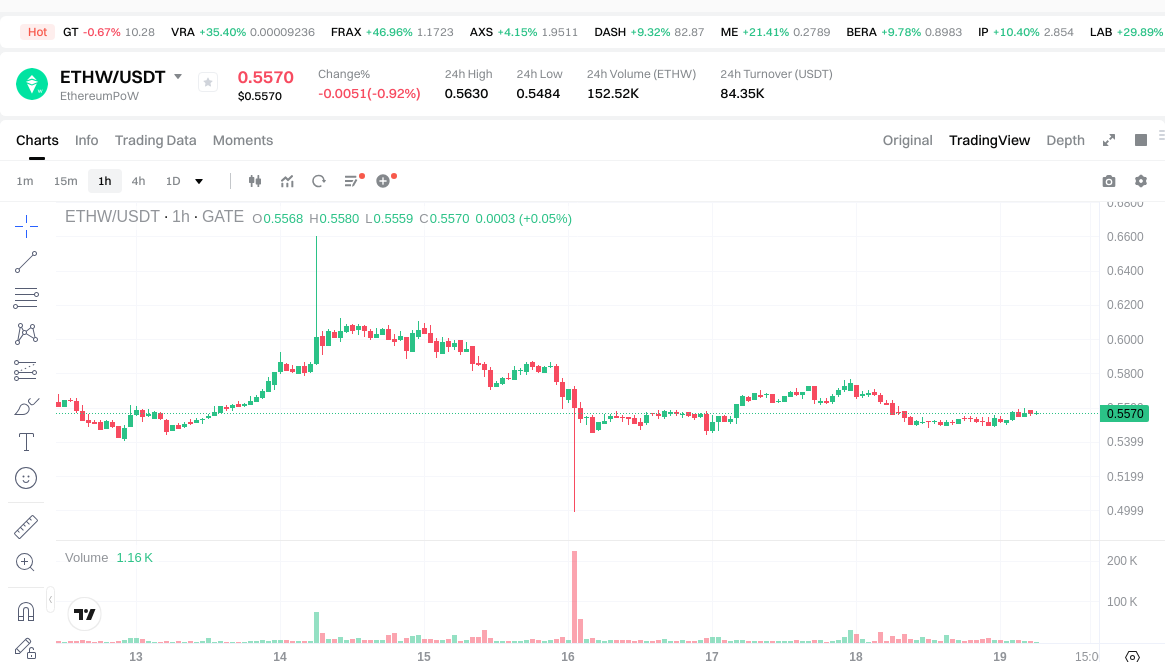
EthereumPoW (ETHW) emerged as a significant fork in the cryptocurrency ecosystem, originating from Ethereum's transition away from Proof-of-Work consensus. As a digital currency and payment technology that maintains the PoW mining mechanism, ETHW has established its position in the crypto market. As of January 19, 2026, ETHW holds a market capitalization of approximately $59.99 million with a circulating supply of about 107.82 million tokens, trading at around $0.5564. Currently ranked #490 by market cap with a 0.0017% market dominance, the token is listed on 17 exchanges. The project has developed a digital economy framework aimed at providing creators with monetization opportunities. Recent price movements show a 0.05% increase over 1 hour, a 0.94% decrease over 24 hours, and a 0.02% change over 7 days, while experiencing an 83.28% decline over the past year. With its focus on maintaining PoW-based infrastructure, ETHW has become a subject of discussion among investors exploring "Is EthereumPoW (ETHW) a good investment?" This article provides a comprehensive analysis of ETHW's investment characteristics, historical performance, future price considerations, and associated risks to serve as a reference for potential investors.
I. EthereumPoW (ETHW) Price History Review and Current Investment Status
- 2022: Following Ethereum's transition to Proof of Stake in September 2022, ETHW tokens were distributed at a 1:1 ratio to ETH holders. Initial trading saw the token price reach approximately $130 before experiencing notable volatility. The token subsequently declined to approximately $5 as many investors who were skeptical of the forked network sold their holdings.
- Recent Period: ETHW has been listed on over 50 centralized exchanges according to CoinMarketCap data. The token price showed recovery movement, rising from approximately $5 to around $12 during certain trading periods.
- 2025-2026: Price activity has shown continued fluctuation. In December 2025, trading occurred within a range of approximately $0.48 to $0.55. By mid-January 2026, prices ranged between approximately $0.55 and $0.61.
Current ETHW Investment Market Status (January 2026)
- ETHW current price: Approximately $0.56
- 24-hour trading volume: $86,213.11
- Market capitalization: Approximately $59.99 million
- Circulating supply: 107,818,717.05 ETHW
- Total supply: 107,818,717.05 ETHW (100% circulation ratio)
- Fully diluted market cap: $59,990,334.17
- Price changes: +0.05% (1H), -0.94% (24H), +0.02% (7D), +1.16% (30D), -83.28% (1Y)
Click to view real-time ETHW market price
II. Core Factors Affecting Whether ETHW Is a Good Investment
Supply Mechanism and Scarcity (ETHW investment scarcity)
- Total supply: 107,818,717.04993 ETHW with unlimited maximum supply (∞)
- Current circulating supply equals total supply (100% circulation ratio)
- Historical price movements: ETHW traded at $58.54 on September 3, 2022, while the recorded low was $0.477377 on December 16, 2025
- Investment consideration: The unlimited supply model may present challenges for long-term scarcity-driven value appreciation
Institutional Investment and Mainstream Adoption (Institutional investment in ETHW)
- Exchange accessibility: ETHW is listed on 17 exchanges, though OKX announced delisting on December 29, 2025, which may reduce liquidity
- ETF activity: Bitwise's ETHW ETF recorded $23 million in inflows on January 14, though outflows of $11 million occurred days earlier, indicating volatile institutional interest
- Institutional stance: Major players like Grayscale have publicly stepped away from post-Merge PoW forked tokens after assessing limited liquidity and custody support
- Developer support: ETHW lacks strong developer community backing, DeFi integrations, and staking infrastructure compared to established networks
Macroeconomic Environment Impact on ETHW Investment
- Market positioning: As a Proof-of-Work continuation of pre-Merge Ethereum, ETHW occupies a niche position among few remaining major PoW chains
- Market sentiment: The Fear & Greed Index reading of 48 (Neutral) reflects moderate market conditions as of the data point
- Regulatory considerations: ETHW may face scrutiny due to its fork status and governance structure, with some exchanges adjusting policies around forked assets
Technology and Ecosystem Development (Technology & Ecosystem for ETHW investment)
- Technical foundation: EthereumPoW maintains the pre-Merge Ethereum PoW consensus mechanism that continued after Ethereum's transition to Proof-of-Stake in September 2022
- Ecosystem constraints: Limited oracle support, reduced developer migration, and concentrated liquidity present structural challenges for ecosystem expansion
- GitHub activity: Developer activity on the ETHW repository remains minimal according to available analytics
- Application scope: The network faces constraints in DeFi integrations and lacks the staking infrastructure present in PoS networks
III. ETHW Future Investment Forecast & Price Outlook (Is EthereumPoW(ETHW) worth investing in 2026-2031)
Short-term Investment Outlook (2026, short-term ETHW investment outlook)
- Conservative forecast: $0.45 - $0.55
- Neutral forecast: $0.55 - $0.60
- Optimistic forecast: $0.60 - $0.64
Mid-term Investment Outlook (2027-2029, mid-term EthereumPoW(ETHW) investment forecast)
- Market phase expectation: ETHW may experience gradual development during this period, with potential fluctuations influenced by broader market conditions and the PoW ecosystem's evolution.
- Investment return forecast:
- 2027: $0.44 - $0.64
- 2028: $0.56 - $0.83
- 2029: $0.38 - $0.93
- Key catalysts: Mining ecosystem stability, broader acceptance of PoW mechanisms, and potential technical developments within the EthereumPoW network.
Long-term Investment Outlook (Is ETHW a good long-term investment?)
- Base scenario: $0.70 - $1.13 (assuming steady network development and sustained community support through 2030-2031)
- Optimistic scenario: $0.98 - $1.29 (contingent upon enhanced adoption, technological improvements, and favorable market dynamics)
- Risk scenario: $0.38 - $0.80 (under conditions of market downturn, regulatory challenges, or declining interest in PoW consensus mechanisms)
View ETHW long-term investment & price prediction: Price Prediction
2026-01-19 - 2031 Long-term Outlook
- Base scenario: $0.45 - $1.13 (corresponding to stable progress and steady mainstream application growth)
- Optimistic scenario: $0.98 - $1.29 (corresponding to large-scale adoption and favorable market environment)
- Transformative scenario: Above $1.29 (if the ecosystem achieves breakthrough progress and mainstream popularization)
- 2031-12-31 predicted high: $1.29 (based on optimistic development assumptions)
Disclaimer: The above price forecasts are based on statistical models and historical patterns for reference purposes only. Cryptocurrency markets are highly volatile and unpredictable. Past performance does not guarantee future results. These projections should not be construed as financial advice or investment recommendations. Investors should conduct independent research, assess their risk tolerance, and consult qualified financial advisors before making any investment decisions.
| Year |
Predicted High Price |
Predicted Average Price |
Predicted Low Price |
Price Change |
| 2026 |
0.6021 |
0.5575 |
0.451575 |
0 |
| 2027 |
0.643578 |
0.5798 |
0.440648 |
4 |
| 2028 |
0.83189704 |
0.611689 |
0.55663699 |
9 |
| 2029 |
0.9311129958 |
0.72179302 |
0.3825503006 |
29 |
| 2030 |
1.132240620823 |
0.8264530079 |
0.801659417663 |
48 |
| 2031 |
1.29273779495718 |
0.9793468143615 |
0.70512970634028 |
76 |
IV. ETHW Investment Strategy and Risk Management (How to invest in EthereumPoW)
Investment Methodology (ETHW investment strategy)
Long-term Holding (HODL ETHW)
For conservative investors seeking a passive approach, long-term holding may be considered. This strategy involves acquiring ETHW and maintaining positions through market cycles, potentially benefiting from broader ecosystem developments. Investors following this approach typically focus on fundamental developments rather than short-term price movements.
Active Trading
Active trading strategies rely on technical analysis and swing trading techniques. Traders may monitor key price levels, with recent data showing 24-hour trading ranges between $0.5484 and $0.5631. This approach requires continuous market monitoring and understanding of price volatility patterns, which have shown a 24-hour change of -0.94%.
Risk Management (Risk management for ETHW investment)
Asset Allocation Ratios
- Conservative Investors: May limit exposure to 1-3% of total portfolio, prioritizing capital preservation
- Aggressive Investors: Could allocate 5-10% while maintaining diversification across multiple assets
- Professional Investors: May employ dynamic allocation strategies based on market conditions and risk tolerance
Risk Hedging Solutions
A diversified portfolio approach combining multiple crypto assets with traditional hedging instruments may help mitigate concentration risk. Portfolio construction should consider correlation patterns and market dynamics across different asset classes.
Secure Storage
- Cold Wallets: Offline storage solutions for long-term holdings, reducing exposure to online security threats
- Hot Wallets: Convenient for active trading but require enhanced security protocols
- Hardware Wallet Recommendations: Physical devices offering enhanced security features for private key management
V. ETHW Investment Risks and Challenges (Risks of investing in EthereumPoW)
Market Risk
ETHW exhibits significant price volatility, with historical data showing a price range from an all-time high of $58.54 (September 2022) to an all-time low of $0.477377 (December 2025). The current 1-year performance indicates a decline of -83.28%, reflecting substantial market fluctuations. With a 24-hour trading volume of approximately $86,213 and a market capitalization of around $59.99 million, the asset demonstrates characteristics common to mid-cap cryptocurrencies, including potential liquidity constraints and price sensitivity.
Regulatory Risk
Cryptocurrency regulatory frameworks vary substantially across jurisdictions, creating uncertainty for investors. Policy changes, taxation rules, and compliance requirements may impact ETHW's accessibility and operational environment. Different countries maintain divergent approaches to digital asset regulation, potentially affecting cross-border transactions and exchange availability.
Technical Risk
As a blockchain network originally derived from Ethereum's Proof-of-Work mechanism, ETHW faces various technical considerations:
- Network Security: Potential vulnerabilities in smart contract implementations or consensus mechanisms
- Upgrade Execution: Risks associated with protocol updates and network maintenance
- Infrastructure Dependencies: Reliance on node operators, mining participants, and supporting infrastructure
With ETHW listed on 17 exchanges, platform-specific risks including security breaches, operational disruptions, or delisting decisions should be considered.
VI. Conclusion: Is EthereumPoW a Good Investment?
Investment Value Summary
ETHW presents characteristics typical of alternative proof-of-work blockchain projects, with both potential opportunities and considerable challenges. The token's significant price correction over the past year (-83.28%) and current market capitalization of approximately $59.99 million indicate a relatively small market presence. The fully diluted valuation equals current market cap (100% circulating supply of 107,818,717 ETHW), suggesting complete token distribution.
Investor Recommendations
✅ Beginners: Consider dollar-cost averaging strategies combined with secure wallet storage practices. Prioritize education on blockchain fundamentals and risk management principles before committing capital.
✅ Experienced Investors: May explore swing trading opportunities while maintaining diversified portfolio positions. Technical analysis skills and understanding of market dynamics become essential for this approach.
✅ Institutional Investors: Should conduct comprehensive due diligence including technical audits, regulatory compliance assessments, and liquidity analysis before strategic allocation decisions.
⚠️ Notice: Cryptocurrency investments carry substantial risk, including potential loss of capital. This content serves informational purposes only and does not constitute investment advice. Market conditions, regulatory environments, and technical factors may change rapidly. Investors should conduct independent research and consider consulting financial professionals before making investment decisions.
VII. FAQ
Q1: What is the primary difference between ETHW and Ethereum (ETH)?
ETHW maintains the original Proof-of-Work consensus mechanism that Ethereum used before its transition to Proof-of-Stake in September 2022, while ETH now operates on PoS. Following the Merge, ETHW was distributed at a 1:1 ratio to ETH holders who held tokens before the fork. The key distinction lies in their consensus mechanisms: ETHW continues to rely on energy-intensive mining operations, whereas Ethereum transitioned to a validator-based staking system for network security and transaction processing.
Q2: How has ETHW performed since its launch in 2022?
ETHW has experienced substantial price volatility since inception. The token initially traded around $130 following the September 2022 fork, then declined sharply to approximately $5 as skeptical investors liquidated positions. As of January 19, 2026, ETHW trades at approximately $0.56, representing an 83.28% decline over the past year. The all-time high of $58.54 was recorded on September 3, 2022, while the all-time low of $0.477377 occurred on December 16, 2025.
Q3: What are the main risks associated with investing in ETHW?
Key investment risks include significant market volatility, limited ecosystem development, regulatory uncertainty, and declining institutional support. Recent exchange delistings (such as OKX's announcement on December 29, 2025) reduce liquidity and accessibility. The token's 24-hour trading volume of approximately $86,213 indicates relatively thin market depth, which can amplify price swings. Additionally, ETHW faces technical challenges including minimal developer activity, limited DeFi integrations, and reduced infrastructure support compared to established blockchain networks.
Q4: What is the circulating supply structure of ETHW?
ETHW has a current circulating supply of 107,818,717.05 tokens, which equals the total supply, resulting in a 100% circulation ratio. Unlike many cryptocurrencies with capped supplies, ETHW operates with an unlimited maximum supply (∞), which may present challenges for scarcity-driven value appreciation. The fully diluted market capitalization equals the current market cap at approximately $59.99 million, as all tokens are already in circulation.
Q5: Where can investors trade ETHW tokens?
As of January 2026, ETHW is listed on 17 exchanges, though this number has decreased following some delistings. The token maintains trading pairs on various platforms, with centralized exchanges offering the primary liquidity venues. However, investors should note that exchange availability may continue to fluctuate based on platform policies and regulatory considerations. Potential delisting announcements can impact accessibility and liquidity.
Q6: What investment strategies are appropriate for ETHW?
Conservative investors may consider limiting ETHW exposure to 1-3% of total portfolio through a long-term holding approach focused on fundamental developments. Active traders could explore swing trading strategies using technical analysis, monitoring key price levels and the token's historical volatility patterns. More aggressive investors might allocate 5-10% while maintaining portfolio diversification. Regardless of strategy, secure storage solutions including hardware wallets for long-term holdings and enhanced security protocols for hot wallets used in active trading are essential risk management components.
Q7: What is the long-term price outlook for ETHW through 2031?
Price projections suggest potential ranges depending on market conditions and adoption scenarios. Base case forecasts indicate prices between $0.45-$1.13 through 2031, assuming steady network development. Optimistic scenarios project $0.98-$1.29 contingent upon enhanced adoption and favorable market dynamics. Risk scenarios suggest $0.38-$0.80 under conditions of market downturns or declining interest in PoW mechanisms. However, these projections carry substantial uncertainty given cryptocurrency market volatility and should not be construed as investment guarantees.
Q8: How does institutional interest impact ETHW's investment potential?
Institutional participation remains limited and volatile. While Bitwise's ETHW ETF recorded $23 million in inflows on January 14, 2026, outflows of $11 million occurred days earlier, indicating unstable institutional sentiment. Major players like Grayscale have publicly distanced themselves from post-Merge PoW forked tokens after assessing limited liquidity and custody support. The lack of strong institutional backing, combined with minimal developer community support and limited DeFi integrations, presents structural challenges for ETHW's ecosystem expansion and long-term value proposition.
* The information is not intended to be and does not constitute financial advice or any other recommendation of any sort offered or endorsed by Gate.