This comprehensive guide analyzes whether EthereumPoW (ETHW) represents a viable investment opportunity in 2026 and beyond. ETHW, trading at $0.5559 with a $59.94 million market capitalization, offers exposure to proof-of-work blockchain technology but faces significant challenges including an 83.3% annual price decline and unlimited supply structure. The article examines ETHW's price history, evaluates core investment factors including institutional adoption and technical development, provides price forecasts through 2031 ranging from $0.482 to $1.366, and outlines investment strategies for different investor profiles. Risk management approaches and potential regulatory, market, and technical risks are thoroughly addressed to help investors make informed decisions on Gate and other platforms where ETHW trades.
Introduction: EthereumPoW (ETHW) Investment Position and Market Outlook
EthereumPoW (ETHW) represents a digital currency and global payment technology originally derived from the Proof-of-Work based Ethereum network. As of January 19, 2026, ETHW maintains a market capitalization of approximately $59.94 million with a circulating supply of 107.82 million tokens, trading at around $0.5559. Positioned as a continuation of the PoW mining mechanism following Ethereum's transition to Proof-of-Stake, ETHW has established itself within the digital economy ecosystem. With a market ranking of 490 and trading availability across 17 exchanges, the token has experienced notable price fluctuations since its inception in September 2022, ranging from $0.477377 to $58.54. This article examines ETHW's investment characteristics, historical price movements, future projections, and associated risks to provide analytical insights for those considering exposure to this asset.
I. EthereumPoW (ETHW) Price History Review and Current Investment Status
- 2022: Initial exchange listing following Ethereum's PoS transition → ETHW experienced significant volatility, with price fluctuations from approximately $130 at launch declining to around $5
- 2022-2023: Post-launch consolidation period → ETHW price showed recovery signals, with values ranging between $5 and $12 as community discussion increased
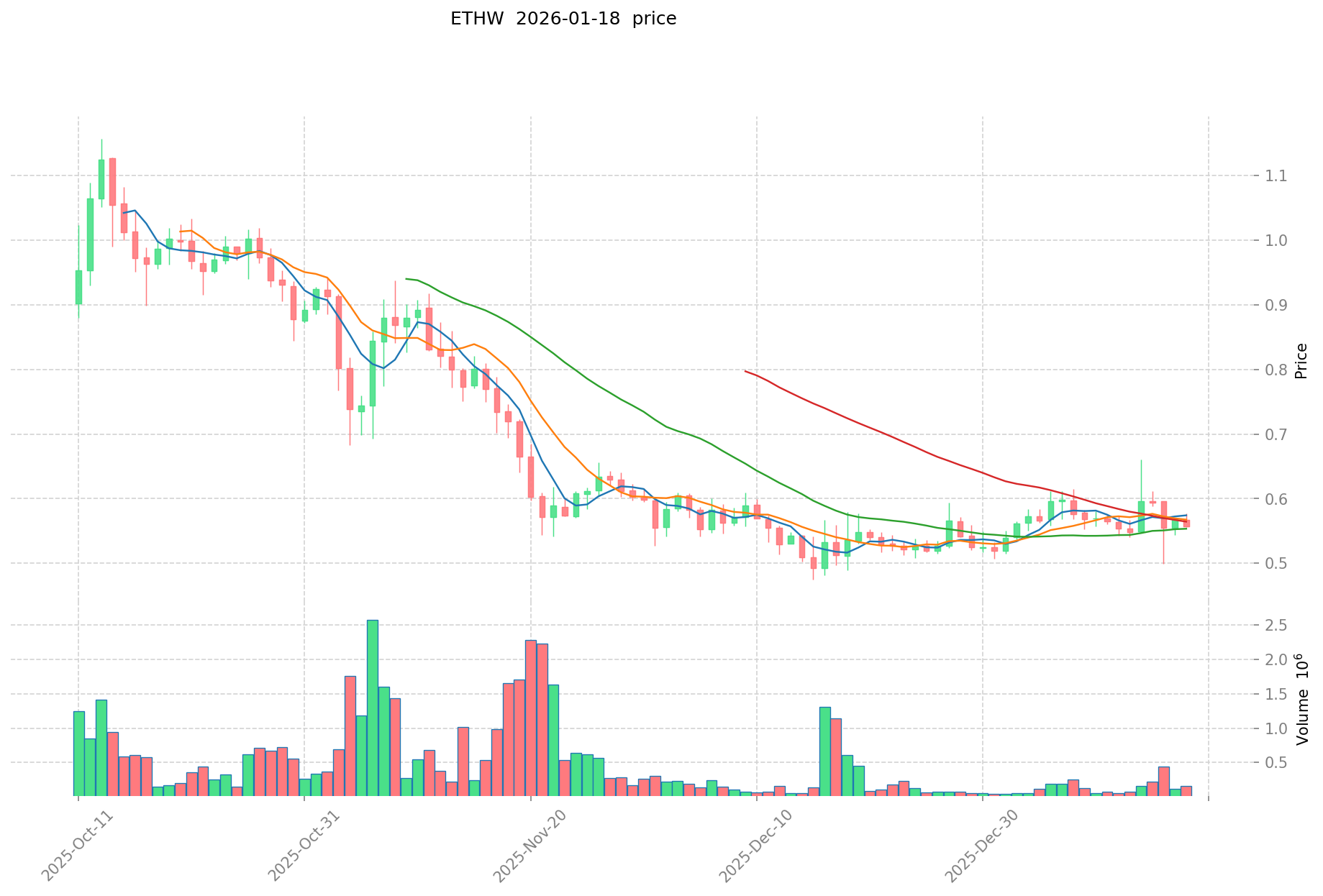
- 2025-2026: Recent market cycle → Price movement from $0.48 to approximately $0.61 observed in December 2025 through January 2026
Current ETHW Investment Market Status (January 2026)
- ETHW current price: $0.5559 (as of January 19, 2026)
- 24-hour trading volume: $103,374.84
- Market capitalization: $59,936,424.81
- Circulating supply: 107,818,717.05 ETHW (100% of total supply)
- Recent price performance: -1.71% (24h), -1.069% (7d), +0.09% (30d), -83.3% (1y)
- Trading range (24h): $0.5484 - $0.5674
- Listed on 17 exchanges
Click to view real-time ETHW market price
II. Core Factors Influencing Whether ETHW is a Good Investment
Supply Mechanism and Scarcity (ETHW Investment Scarcity)
- ETHW has a circulating supply of 107,818,717 tokens with a maximum supply listed as infinite (∞), indicating no hard cap on total issuance. This unlimited supply structure differs from scarcity-driven assets and may influence long-term price dynamics.
- The current circulating supply represents 100% of the total supply, suggesting full circulation without locked reserves. However, the absence of a supply cap removes the scarcity mechanism that typically supports sustained price appreciation in digital assets.
- Investment consideration: Without supply constraints, ETHW's value proposition relies more heavily on network adoption and utility rather than scarcity-driven demand, which presents different risk-reward characteristics for investors.
Institutional Investment and Mainstream Adoption (Institutional Investment in ETHW)
- Available data indicates limited institutional engagement with ETHW. The token emerged from a mining-community-led fork following Ethereum's transition to Proof-of-Stake in September 2022.
- ETHW has been listed on 17 exchanges, suggesting some level of market infrastructure support. However, the 24-hour trading volume of approximately $103,375 reflects relatively modest liquidity compared to mainstream digital assets.
- Market positioning: ETHW maintains a market capitalization of approximately $59.94 million with a market dominance of 0.0017%, indicating niche positioning rather than broad institutional adoption. The project's development following the Ethereum merge has focused on maintaining the Proof-of-Work consensus mechanism.
Macroeconomic Environment's Impact on ETHW Investment
- Price performance data shows ETHW trading at $0.5559 as of the latest update, representing an 83.3% decline over a one-year period. This performance trend reflects both asset-specific factors and broader market conditions affecting digital assets.
- The token's 24-hour price range of $0.5484 to $0.5674 and recent percentage changes (-1.71% over 24 hours, -1.069% over 7 days, +0.09% over 30 days) suggest price volatility within a range-bound trading pattern.
- Market context: ETHW experienced price levels near $58.54 in September 2022 following the fork, with subsequent decline to a recorded low of $0.477377 in December 2025. These fluctuations reflect both the project's adoption trajectory and shifting sentiment in the digital asset ecosystem.
Technology and Ecosystem Development (Technology & Ecosystem for ETHW Investment)
- ETHW continues to operate using the Proof-of-Work consensus mechanism, maintaining the pre-merge Ethereum protocol structure. This technical approach serves mining communities seeking PoW-based networks.
- The project maintains technical infrastructure including block explorers (mainnet.ethwscan.com), development repositories on GitHub, and community channels. Active development activity and ecosystem expansion indicators were not detailed in available materials.
- Network positioning: ETHW provides an alternative for participants preferring Proof-of-Work validation rather than Proof-of-Stake mechanisms. The extent of decentralized application integration, DeFi protocols, or NFT ecosystem development on the ETHW chain was not specified in the reference materials.
III. ETHW Future Investment Forecast and Price Outlook (Is EthereumPoW (ETHW) worth investing in 2026-2031)
Short-term Investment Forecast (2026, short-term ETHW investment outlook)
- Conservative forecast: $0.497 - $0.559
- Neutral forecast: $0.559 - $0.598
- Optimistic forecast: $0.598 - $0.620
Mid-term Investment Outlook (2027-2029, mid-term EthereumPoW (ETHW) investment forecast)
- Market stage expectations: ETHW may experience moderate growth during the mid-term period, with price fluctuations influenced by overall market conditions and the PoW ecosystem development.
- Investment return forecast:
- 2027: $0.460 - $0.873
- 2028: $0.614 - $0.885
- 2029: $0.565 - $1.082
- Key catalysts: Mining ecosystem stability, community engagement levels, and broader cryptocurrency market sentiment may serve as primary drivers for mid-term price movements.
Long-term Investment Outlook (Is ETHW a good long-term investment?)
- Base scenario: $0.482 - $1.049 (assuming steady development and moderate adoption within the PoW blockchain sector)
- Optimistic scenario: $0.927 - $1.366 (contingent upon enhanced ecosystem growth and favorable market conditions)
- Risk scenario: Below $0.482 (under conditions of declining mining participation or adverse regulatory developments)
View ETHW long-term investment and price forecast: Price Prediction
2026-01-19 - 2031 Long-term Outlook
- Base scenario: $0.482 - $1.049 (corresponding to steady progress and gradual mainstream application advancement)
- Optimistic scenario: $0.927 - $1.366 (corresponding to large-scale adoption and favorable market environment)
- Transformative scenario: Above $1.366 (in the event of breakthrough ecosystem developments and mainstream popularization)
- 2031-12-31 forecast high: $1.366 (based on optimistic development assumptions)
Disclaimer: Cryptocurrency markets remain highly volatile and unpredictable. The forecasts presented herein are derived from third-party analytical models and historical data patterns, and should not be construed as financial advice or investment recommendations. Past performance does not guarantee future results. Investors should conduct thorough research, assess their risk tolerance, and consult with qualified financial advisors before making any investment decisions.
| Year |
Predicted High Price |
Predicted Average Price |
Predicted Low Price |
Price Change |
| 2026 |
0.620268 |
0.5588 |
0.497332 |
0 |
| 2027 |
0.87251032 |
0.589534 |
0.45983652 |
6 |
| 2028 |
0.8845368136 |
0.73102216 |
0.6140586144 |
31 |
| 2029 |
1.082424512312 |
0.8077794868 |
0.56544564076 |
45 |
| 2030 |
1.04906321950716 |
0.945101999556 |
0.48200201977356 |
70 |
| 2031 |
1.366003175058264 |
0.99708260953158 |
0.927286826864369 |
79 |
IV. ETHW Investment Strategy and Risk Management (How to invest in EthereumPoW)
Investment Methodology (ETHW investment strategy)
Long-term Holding (HODL ETHW)
Long-term holding represents a strategy suitable for conservative investors who believe in the fundamental value proposition of EthereumPoW. This approach involves acquiring ETHW tokens and maintaining positions through market cycles, focusing on the project's long-term development rather than short-term price fluctuations. Investors adopting this strategy typically evaluate the project's technological foundation, community engagement, and ecosystem development trajectory.
Active Trading
Active trading strategies for ETHW rely on technical analysis and swing trading techniques. Traders employing this approach monitor price patterns, trading volumes, and market sentiment indicators to identify entry and exit points. Given ETHW's price movements, with recent data showing fluctuations between $0.5484 and $0.5674 within 24 hours, active traders may find opportunities in these price variations. Technical analysis tools such as moving averages, relative strength index (RSI), and volume analysis can support trading decisions.
Risk Management (Risk management for ETHW investment)
Asset Allocation Ratios
Conservative Investors: May consider allocating 1-3% of their cryptocurrency portfolio to ETHW, maintaining majority positions in more established digital assets.
Aggressive Investors: Could allocate 5-10% to ETHW, accepting higher volatility in exchange for potential growth opportunities.
Professional Investors: May employ dynamic allocation strategies, adjusting ETHW positions based on market conditions, technical indicators, and fundamental developments, potentially ranging from 3-15% of their cryptocurrency holdings.
Risk Hedging Strategies
Multi-asset portfolio construction serves as a primary risk management approach. Investors may combine ETHW holdings with other cryptocurrency assets that demonstrate lower correlation, potentially including established proof-of-work cryptocurrencies or proof-of-stake alternatives. Additionally, some investors may utilize derivatives or stablecoin positions to hedge against adverse price movements during periods of heightened volatility.
Secure Storage Solutions
Cold Wallet Storage: For long-term holdings, cold storage solutions provide enhanced security by keeping private keys offline. Hardware wallets such as Ledger or Trezor devices offer robust protection against online threats.
Hot Wallet Solutions: For active trading or frequent transactions, hot wallets provide convenience while maintaining reasonable security standards. Investors should select reputable wallet providers with strong security track records.
Best Practices: Implementing a hybrid approach, where the majority of ETHW holdings remain in cold storage while maintaining smaller amounts in hot wallets for trading purposes, offers a balanced security strategy.
V. ETHW Investment Risks and Challenges (Risks of investing in EthereumPoW)
Market Risks
High Volatility: ETHW demonstrates significant price volatility, as evidenced by its trading history. The token has experienced substantial price movements, with 24-hour changes reaching -1.71% and annual changes showing -83.3%. This volatility creates both opportunities and risks for investors.
Price Manipulation Concerns: With a market capitalization of approximately $59.94 million and 24-hour trading volume of $103,374.84, the relatively smaller market size compared to major cryptocurrencies may create susceptibility to price manipulation by large holders or coordinated trading activities.
Regulatory Risks
Policy Uncertainty Across Jurisdictions: Different countries maintain varying regulatory stances toward cryptocurrencies and proof-of-work networks. Regulatory developments in major markets may impact ETHW's accessibility, trading availability, and overall market sentiment. Investors should monitor regulatory announcements in their respective jurisdictions and major cryptocurrency markets.
Compliance Requirements: Evolving compliance standards for cryptocurrency exchanges and service providers may affect ETHW's listing status on trading platforms. Currently, ETHW is available on 17 exchanges, but regulatory changes could impact this availability.
Technical Risks
Network Security Vulnerabilities: As a proof-of-work network, EthereumPoW faces ongoing security considerations related to hash rate distribution, potential 51% attacks, and network consensus mechanisms. Investors should monitor network health metrics and security developments.
Upgrade Implementation Challenges: Technical upgrades or protocol changes carry inherent risks of implementation issues, consensus disputes, or unexpected network behavior. While EthereumPoW originated from Ethereum's PoW foundation, ongoing development and maintenance require continuous community support and technical expertise.
VI. Conclusion: Is EthereumPoW a Good Investment?
Investment Value Summary
EthereumPoW presents a complex investment proposition characterized by both opportunities and significant challenges. The project maintains operational status with presence on 17 exchanges and a circulating supply of 107,818,717.04993 ETHW tokens. However, the substantial price decline of -83.3% over the past year and current market capitalization of approximately $59.94 million reflect considerable market headwinds. The fully diluted market cap matches the current market cap at 100%, indicating all tokens are in circulation, which eliminates future supply inflation concerns but also removes potential scarcity-driven value appreciation from supply schedules.
Investor Recommendations
✅ Beginners:
- Consider dollar-cost averaging (DCA) approaches to mitigate timing risk
- Prioritize secure wallet storage using reputable cold storage solutions
- Limit exposure to a small percentage of overall portfolio
- Conduct thorough research before any investment decision
✅ Experienced Investors:
- Employ swing trading strategies during volatility periods
- Integrate ETHW within diversified cryptocurrency portfolio
- Monitor technical indicators and market sentiment metrics
- Maintain strict risk management protocols
✅ Institutional Investors:
- Evaluate strategic allocation as part of broader proof-of-work exposure
- Conduct comprehensive due diligence on network security and development activity
- Assess liquidity requirements against current trading volumes
- Consider market position within proof-of-work cryptocurrency landscape
⚠️ Disclaimer: Cryptocurrency investments involve substantial risk and high volatility. ETHW has demonstrated significant price fluctuations and market challenges. This content serves informational purposes only and does not constitute financial advice, investment recommendations, or solicitation to buy or sell any asset. Investors should conduct independent research, assess their risk tolerance, and consult qualified financial advisors before making investment decisions. Past performance does not indicate future results.
VII. FAQ
Q1: What is EthereumPoW (ETHW) and how does it differ from Ethereum?
EthereumPoW is a cryptocurrency that continues the original Proof-of-Work consensus mechanism after Ethereum transitioned to Proof-of-Stake in September 2022. Unlike Ethereum's current PoS model, ETHW maintains the mining-based validation system, serving communities that prefer traditional proof-of-work blockchain architecture. The token currently trades at approximately $0.5559 with a market capitalization of $59.94 million and is available on 17 exchanges.
Q2: Is ETHW a good investment for beginners in 2026?
For beginners, ETHW presents considerable risks due to its high volatility and 83.3% price decline over the past year. Conservative allocation of 1-3% of a cryptocurrency portfolio is recommended, utilizing dollar-cost averaging (DCA) strategies to mitigate timing risks. Beginners should prioritize secure cold wallet storage, conduct thorough research, and understand that ETHW's smaller market size and limited institutional adoption create additional risk factors compared to established cryptocurrencies.
Q3: What is the long-term price forecast for ETHW through 2031?
Price projections for ETHW through 2031 range from $0.482 to $1.366 under various scenarios. The base scenario estimates $0.482 - $1.049 assuming steady development, while optimistic forecasts reach $0.927 - $1.366 with enhanced ecosystem growth. Short-term 2026 forecasts range from $0.497 - $0.620, with mid-term projections for 2029 at $0.565 - $1.082. These forecasts remain highly speculative given cryptocurrency market volatility and ETHW's current challenges.
Q4: What are the main risks of investing in EthereumPoW?
Primary risks include extreme price volatility (demonstrated by 83.3% annual decline), potential market manipulation due to relatively small market capitalization ($59.94 million), regulatory uncertainty across jurisdictions, and technical vulnerabilities related to network security and hash rate distribution. The unlimited supply structure (infinite maximum supply) removes scarcity-driven value appreciation, and the 24-hour trading volume of approximately $103,375 indicates limited liquidity compared to major cryptocurrencies.
Q5: How should I securely store ETHW tokens?
A hybrid storage approach is recommended: use cold wallet solutions (hardware wallets like Ledger or Trezor) for long-term holdings to protect against online threats, and maintain smaller amounts in reputable hot wallets for active trading purposes. Cold storage keeps private keys offline, providing enhanced security for the majority of holdings, while hot wallets offer convenience for frequent transactions. Always select wallet providers with strong security track records and implement best practices for private key management.
Q6: What trading strategies work best for ETHW?
Two primary strategies suit different investor profiles: long-term holding (HODL) for conservative investors who believe in the project's fundamental value proposition, focusing on multi-year development rather than short-term fluctuations; and active trading for those comfortable with technical analysis, monitoring price patterns between support and resistance levels (recent 24-hour range: $0.5484 - $0.5674). Active traders should employ technical indicators including moving averages, RSI, and volume analysis, while maintaining strict risk management protocols.
Q7: Does ETHW have institutional investment support?
Available data indicates limited institutional engagement with ETHW. The project maintains a market dominance of only 0.0017% and originated from a mining-community-led fork rather than institutional backing. While listed on 17 exchanges suggesting basic infrastructure support, the modest 24-hour trading volume ($103,374.84) and lack of documented institutional partnerships reflect niche positioning rather than broad mainstream adoption. Investment consideration should account for this limited institutional presence.
Q8: What factors could drive ETHW's future price performance?
Key catalysts include mining ecosystem stability, community engagement levels, broader cryptocurrency market sentiment, and proof-of-work blockchain sector development. Price appreciation depends on network adoption and utility rather than scarcity mechanisms due to unlimited supply structure. Technical developments, regulatory clarity in major markets, and the overall health of the proof-of-work cryptocurrency landscape will influence ETHW's trajectory. However, the 100% circulating supply and absence of locked reserves eliminate future token unlock events as price drivers.
* The information is not intended to be and does not constitute financial advice or any other recommendation of any sort offered or endorsed by Gate.