This comprehensive analysis evaluates EVAA Protocol (EVAA) as a DeFi investment opportunity through 2031. Trading at $0.842 with a $5.57 million market cap, EVAA offers lending and yield generation on BSC and TON networks. The article examines historical price volatility ranging from $0.6063 to $13.7054, current market status with 22,621 holders across 9 exchanges, and core investment factors including tokenomics, technology infrastructure, and ecosystem development. It presents tiered price scenarios for 2026-2031, ranging from conservative to optimistic outlooks, alongside detailed investment strategies for conservative, aggressive, and professional investors. Risk management guidance covers market volatility, regulatory uncertainty, and technical vulnerabilities. The analysis concludes that EVAA presents potential within TON DeFi but requires careful portfolio allocation (1-15% depending on risk tolerance), secure storage practices, and ongoing protocol monitoring. Comprehensive FAQ addresses beginner suit
Introduction: EVAA Protocol (EVAA) Investment Position and Market Outlook
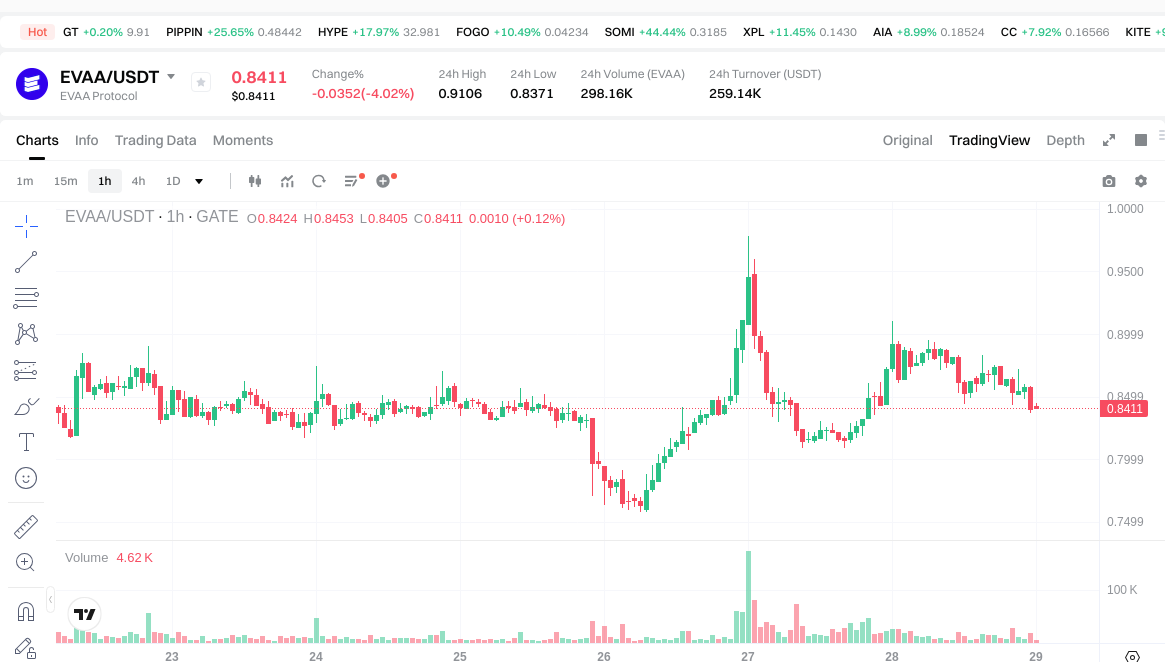
EVAA Protocol (EVAA) is a DeFi-focused cryptocurrency asset that supports lending, yield generation, and governance functionalities. As of January 29, 2026, EVAA holds a market ranking of #1479 with a market capitalization of approximately $5.57 million and a circulating supply of 6.62 million tokens out of a maximum supply of 50 million tokens. The current price stands at $0.842, with a 24-hour trading volume of around $258,508.
Since its launch, EVAA has experienced notable price fluctuations, ranging from a recorded low of $0.6063 in December 2025 to a peak of $13.7054 in October 2025. The token operates across multiple blockchain networks, including BSC and TON, utilizing open-source smart contracts and Pyth Oracle integrations. With a circulating supply ratio of 13.24% and a fully diluted market cap of $42.1 million, EVAA employs a gradual token release schedule designed to support long-term protocol sustainability.
The protocol's roadmap focuses on enhancing liquidity within the TON DeFi ecosystem and increasing community participation through various liquidity initiatives. With approximately 22,621 holders and availability on 9 exchanges, EVAA has developed a growing user base. This article examines EVAA's investment characteristics, historical price movements, future price considerations, and associated risks to provide information for those evaluating "Is EVAA Protocol (EVAA) a good investment?"
I. EVAA Protocol (EVAA) Price History Review and Current Investment Status
- 2025 October: Price reached $8.97 with market capitalization rising to approximately $181.4 million, representing significant growth momentum during this period.
- 2025 October 27: EVAA recorded a notable price level of $13.7054, marking a peak in its trading history.
- 2025 December 18: Price experienced substantial correction, declining to $0.6063, reflecting broader market volatility and adjustment phase.
- 2026 January: Price stabilized around $0.842, with trading volume of approximately $258,507.93 over 24 hours.
Current EVAA Investment Market Status (January 2026)
- Current EVAA Price: $0.842
- 24-hour Trading Volume: $258,507.93
- Circulating Supply: 6,617,972.4 EVAA (13.24% of total supply)
- Current Market Capitalization: $5,572,332.76
- Fully Diluted Market Cap: $42,100,000
- Total Holders: 22,621 addresses
- Exchange Listings: Available on 9 exchanges
- Recent Price Performance:
- 1-hour change: -1.23%
- 24-hour change: -3.9%
- 7-day change: -0.38%
- 30-day change: -8.33%
Check real-time EVAA market price
II. Core Factors Influencing Whether EVAA is a Good Investment (Is EVAA Protocol(EVAA) a Good Investment)
Supply Mechanism and Scarcity (EVAA investment scarcity)
- Supply mechanism → Impacts price and investment value
- EVAA Protocol features a fixed maximum supply of 50,000,000 tokens with a circulating supply of 6,617,972.4 tokens as of January 29, 2026, representing approximately 13.24% of total supply.
- The gradual release schedule aims to support sustainable growth by managing token availability over time.
- Investment significance: Controlled token release mechanisms may influence long-term investment considerations by affecting supply dynamics.
Institutional Investment and Mainstream Adoption (Institutional investment in EVAA)
- Token holder commitment trends: Analysis of on-chain data shows that major EVAA token holders have maintained substantial positions throughout 2025 and into 2026, demonstrating commitment to the protocol during market volatility periods.
- The holder base includes 22,621 addresses, indicating a distributed ownership structure.
- The stability of large EVAA positions may reduce downward selling pressure and support price discovery mechanisms.
Macroeconomic Environment's Impact on EVAA Investment
- Monetary policy and interest rate changes → Influence investment attractiveness across crypto assets
- Market participants may consider macroeconomic indicators when evaluating crypto investments, including protocols in the DeFi lending sector.
- Broader market conditions affect liquidity and valuation dynamics for tokens like EVAA.
Technology and Ecosystem Development (Technology & Ecosystem for EVAA investment)
- Protocol features: EVAA Protocol supports lending and yield generation with open-source smart contracts.
- Oracle integration: The protocol incorporates Pyth Oracle integrations to support its operational framework.
- Roadmap initiatives: Development plans include liquidity initiatives designed to strengthen TON DeFi liquidity and increase community participation.
- Multi-chain presence: Token contracts are deployed on BSC and TON networks, potentially expanding accessibility.
III. EVAA Future Investment Prediction and Price Outlook (Is EVAA Protocol(EVAA) worth investing in 2026-2031)
Short-term Investment Prediction (2026, short-term EVAA investment outlook)
- Conservative prediction: $0.757 - $0.841
- Neutral prediction: $0.841 - $0.874
- Optimistic prediction: $0.874 - $0.908
Mid-term Investment Outlook (2027-2029, mid-term EVAA Protocol(EVAA) investment forecast)
- Market stage expectation: The protocol may experience gradual ecosystem development as it strengthens its position within the TON DeFi landscape and expands its lending and yield features.
- Investment return prediction:
- 2027: $0.700 - $0.988
- 2028: $0.494 - $1.239
- 2029: $0.792 - $1.606
- Key catalysts: Liquidity initiatives, community participation growth, potential integration of NFT-based ecosystem elements, and continued development of open-source smart contracts with Pyth Oracle integrations.
Long-term Investment Outlook (Is EVAA a good long-term investment?)
- Base scenario: $0.915 - $1.582 (assuming steady protocol adoption and maintained fundamentals)
- Optimistic scenario: $1.606 - $1.816 (assuming strengthened TON DeFi liquidity and increased user adoption)
- Risk scenario: Below $0.700 (under conditions of reduced liquidity or competitive pressure)
For more EVAA long-term investment and price predictions: Price Prediction
2026-01-29 - 2031 Long-term Outlook
- Base scenario: $0.915 - $1.582 (corresponding to steady progress and gradual mainstream application growth)
- Optimistic scenario: $1.606 - $1.816 (corresponding to large-scale adoption and favorable market environment)
- Transformational scenario: Above $1.816 (if ecosystem achieves breakthrough development and mainstream penetration)
- 2031-12-31 predicted high: $1.816 (based on optimistic development assumptions)
Disclaimer: The above predictions are based on available data and market analysis models. Cryptocurrency markets are highly volatile and subject to various risk factors. These projections should not be considered as investment advice, and investors should conduct their own research and risk assessment before making any investment decisions.
| Year |
Predicted High Price |
Predicted Average Price |
Predicted Low Price |
Price Change |
| 2026 |
0.908388 |
0.8411 |
0.75699 |
0 |
| 2027 |
0.98846072 |
0.874744 |
0.6997952 |
3 |
| 2028 |
1.2390311388 |
0.93160236 |
0.4937492508 |
10 |
| 2029 |
1.606268789112 |
1.0853167494 |
0.792281227062 |
28 |
| 2030 |
1.8168202384956 |
1.345792769256 |
0.91513908309408 |
59 |
| 2031 |
1.73943715426338 |
1.5813065038758 |
1.217606007984366 |
87 |
IV. EVAA Protocol Investment Strategy and Risk Management (How to invest in DeFi Protocols)
Investment Methodology (EVAA Protocol investment strategy)
-
Long-term Holding (HODL EVAA Protocol): Suitable for conservative investors
Investors who believe in the long-term development potential of EVAA Protocol and the TON DeFi ecosystem may consider holding EVAA tokens for an extended period. This strategy requires patience to weather short-term market fluctuations and focuses on the protocol's fundamental value growth, including the expansion of lending services, ecosystem development, and governance participation benefits.
-
Active Trading: Relies on technical analysis and swing operations
Given EVAA Protocol's relatively high price volatility (24-hour fluctuation range between $0.8371 and $0.9106), active traders may utilize technical indicators and market sentiment analysis to capture short-term price movements. Traders should pay attention to trading volume changes, support and resistance levels, and broader crypto market trends to optimize entry and exit timing.
Risk Management (Risk management for EVAA Protocol investment)
-
Asset Allocation Ratio: Conservative / Aggressive / Professional investors
- Conservative investors: Allocate 1-3% of total crypto portfolio to EVAA Protocol, primarily for diversification purposes within the DeFi sector.
- Aggressive investors: May allocate 5-10% of portfolio to EVAA and similar emerging DeFi protocols, accepting higher risk for potentially greater returns.
- Professional investors: Could allocate up to 15% with comprehensive due diligence, active monitoring of protocol developments, and utilization of advanced risk management tools.
-
Risk Hedging Solutions: Multi-asset portfolio + hedging instruments
Investors should consider diversifying across multiple DeFi protocols and blockchain ecosystems rather than concentrating solely on EVAA Protocol. Hedging strategies may include holding stablecoins for liquidity, pairing with established cryptocurrencies, or utilizing derivatives (where available) to limit downside exposure.
-
Secure Storage: Hot and cold wallets + hardware wallet recommendations
Given that EVAA Protocol tokens exist on both BSC and TON networks, investors should use appropriate wallets for each chain. Hardware wallets such as Ledger or Trezor are recommended for long-term storage of significant holdings. For active trading, reputable exchange wallets or software wallets with strong security features may be used, though only for amounts needed for immediate trading purposes.
V. EVAA Protocol Investment Risks and Challenges (Risks of investing in DeFi Protocols)
-
Market Risk: High volatility and price manipulation potential
EVAA Protocol exhibits substantial price volatility, with a recorded range from $0.6063 to $13.7054. The relatively modest market capitalization of approximately $5.57 million and 24-hour trading volume of around $258,508 indicate lower liquidity, which may amplify price swings and increase susceptibility to large order impacts or potential manipulation.
-
Regulatory Risk: Policy uncertainty across different jurisdictions
DeFi protocols like EVAA operate in an evolving regulatory landscape. Different countries maintain varying approaches to cryptocurrency regulation, and future policy changes could impact the protocol's operations, token accessibility, or legal status. Investors should stay informed about regulatory developments in their jurisdictions and internationally.
-
Technical Risk: Network security vulnerabilities and upgrade failures
As with any DeFi protocol, EVAA Protocol faces technical risks including potential smart contract vulnerabilities, oracle failures (despite Pyth Oracle integration), or issues arising from protocol upgrades. The protocol's relatively early stage (launched in October 2025) means it has limited operational history. While open-source smart contracts allow for community auditing, the complexity of DeFi systems creates inherent technical risks.
VI. Conclusion: Is DeFi Protocols a Good Investment?
-
Investment Value Summary: EVAA Protocol demonstrates potential within the TON DeFi ecosystem, offering lending and yield generation services with governance features. However, the token exhibits considerable short-term price volatility, having experienced an approximately 8.33% decline over the past 30 days and currently trading significantly below its recorded peak.
-
Investor Recommendations:
✅ Beginners: Consider dollar-cost averaging (DCA) combined with secure wallet storage. Start with small allocations to understand the protocol and DeFi mechanics before increasing exposure.
✅ Experienced Investors: May employ swing trading strategies while maintaining a diversified portfolio allocation. Monitor protocol developments, TVL growth, and community engagement metrics.
✅ Institutional Investors: Could consider strategic long-term allocation as part of broader DeFi exposure, conducting thorough due diligence on protocol security, team credentials, and competitive positioning within the TON ecosystem.
⚠️ Disclaimer: Cryptocurrency investments carry substantial risk. This content is for informational purposes only and does not constitute investment advice. Investors should conduct independent research and consider their financial situation before making investment decisions.
VII. FAQ
Q1: Is EVAA Protocol (EVAA) a good investment for beginners in 2026?
EVAA Protocol may be suitable for beginners as a small portfolio allocation (1-3%), but requires caution due to high volatility and relatively low liquidity. As of January 29, 2026, EVAA trades at $0.842 with a modest market cap of $5.57 million and 24-hour trading volume of approximately $258,508. The token has demonstrated substantial price swings, ranging from $0.6063 to $13.7054 since launch. Beginners should consider dollar-cost averaging (DCA) strategies, allocate only funds they can afford to lose, and prioritize secure wallet storage across both BSC and TON networks where EVAA operates.
Q2: What are the main risks associated with investing in EVAA Protocol?
The primary risks include extreme price volatility, limited liquidity, technical vulnerabilities, and regulatory uncertainty. EVAA's 30-day price decline of 8.33% and significant deviation from its peak illustrate market risk exposure. With only 22,621 holders and $258,508 in daily trading volume, the token faces liquidity constraints that may amplify price movements. Technical risks stem from potential smart contract vulnerabilities despite Pyth Oracle integration, while the evolving DeFi regulatory landscape across jurisdictions creates policy uncertainty. The protocol's relatively recent launch in October 2025 means limited operational track record for assessing long-term stability.
Q3: How does EVAA's tokenomics affect its investment potential?
EVAA's tokenomics feature a controlled supply mechanism with 50 million maximum tokens and only 6.62 million (13.24%) currently circulating, creating a fully diluted market cap of $42.1 million. The gradual token release schedule aims to support long-term sustainability by managing supply dynamics and potentially reducing immediate selling pressure. This low circulation percentage suggests significant future token unlocks that could impact price discovery. The 22,621 holder distribution indicates relatively decentralized ownership, though concentration among major holders may influence price movements during market volatility periods.
Q4: What price predictions exist for EVAA Protocol through 2031?
Short-term 2026 predictions range from $0.757 (conservative) to $0.908 (optimistic). Mid-term forecasts suggest potential ranges of $0.700-$0.988 for 2027, $0.494-$1.239 for 2028, and $0.792-$1.606 for 2029, depending on ecosystem development and adoption rates. Long-term 2031 projections estimate prices between $0.915-$1.582 (base scenario) and $1.606-$1.816 (optimistic scenario), assuming successful liquidity initiatives and TON DeFi ecosystem growth. However, these predictions carry substantial uncertainty given cryptocurrency market volatility, competitive dynamics, and the protocol's early stage of development.
Q5: What investment strategies work best for EVAA Protocol?
Long-term holding (HODL) suits conservative investors believing in TON DeFi ecosystem growth potential, requiring patience through short-term volatility. Active trading strategies may capitalize on EVAA's price fluctuations (24-hour range $0.8371-$0.9106) using technical analysis and market sentiment indicators. Portfolio allocation recommendations vary: 1-3% for conservative investors seeking diversification, 5-10% for aggressive investors accepting higher risk, and up to 15% for professional investors with comprehensive due diligence capabilities. Risk management should include multi-asset diversification across DeFi protocols, maintaining stablecoin liquidity reserves, and utilizing hardware wallets for secure storage of significant holdings.
Q6: How does EVAA Protocol compare to other DeFi lending platforms?
EVAA Protocol differentiates itself through multi-chain deployment on BSC and TON networks, open-source smart contracts, and Pyth Oracle integrations for price feeds. The protocol focuses specifically on strengthening TON DeFi liquidity through planned liquidity initiatives and community participation programs. However, its relatively small market cap ($5.57 million) and limited operational history since October 2025 position it as an emerging player compared to established DeFi lending protocols. The 9 exchange listings and 22,621 holder base suggest growing adoption, though significantly lower than major competitors in the lending space.
Q7: What factors could drive EVAA's price growth in the future?
Key catalysts include successful execution of liquidity initiatives within the TON DeFi ecosystem, increased community participation and governance engagement, potential integration of NFT-based ecosystem elements, and expanded utility of lending and yield generation features. Broader adoption of TON network applications could drive demand for EVAA's services. Technical developments such as protocol upgrades, enhanced security audits, and improved oracle integrations may strengthen investor confidence. Macroeconomic factors including cryptocurrency market sentiment, institutional DeFi adoption trends, and regulatory clarity could also positively influence EVAA's valuation trajectory.
Q8: Should institutional investors consider EVAA Protocol for portfolio allocation?
Institutional investors may consider EVAA as part of strategic DeFi exposure with appropriate risk management, though thorough due diligence is essential. The protocol's early stage, modest market cap, and limited liquidity present higher risk compared to established DeFi platforms. Institutions should evaluate protocol security through independent smart contract audits, assess team credentials and development roadmap execution, and analyze competitive positioning within the TON ecosystem. Potential allocation should remain proportional to risk tolerance, potentially forming part of a broader emerging DeFi protocol investment thesis rather than core holdings. Monitoring metrics such as TVL growth, active user numbers, and protocol revenue generation is crucial for ongoing assessment.
* The information is not intended to be and does not constitute financial advice or any other recommendation of any sort offered or endorsed by Gate.