This comprehensive analysis examines First Digital USD (FDUSD), a fiat-backed stablecoin maintaining a 1:1 USD peg with a $1.45 billion market cap as of January 2026. The article evaluates FDUSD's investment characteristics, price history, and market potential across institutional adoption and cross-border payment applications. It addresses core investment factors including supply mechanisms, multi-chain deployment on Ethereum, BSC, Solana, and TON, plus regulatory considerations. The guide presents short-term, mid-term, and long-term price forecasts alongside detailed investment strategies for conservative, aggressive, and institutional investors. Critical risk analysis covers depeg events, regulatory uncertainty, and technical vulnerabilities. Perfect for investors on Gate seeking stable value preservation tools and understanding stablecoin market dynamics.
Introduction: First Digital USD (FDUSD) Investment Position and Market Outlook
First Digital USD (FDUSD) represents a notable asset within the cryptocurrency sector, having been launched in July 2023. As a fiat-backed stablecoin, FDUSD is designed to maintain a 1:1 peg with the U.S. dollar, serving as a tool for enhancing efficiency in financial transactions, reducing costs, and facilitating cross-border payments. As of January 14, 2026, FDUSD holds a market capitalization of approximately $1.45 billion, with a circulating supply of around 1.45 billion tokens and a current price of $1.0013. With its deployment across multiple blockchain networks including Ethereum, BSC, and Solana, FDUSD has gained attention among market participants examining stablecoin options. This article provides an analysis of FDUSD's investment characteristics, historical price patterns, future price considerations, and associated risks to serve as a reference for investors evaluating digital asset opportunities.
I. First Digital USD (FDUSD) Price History Review and Current Investment Value
- 2023: FDUSD launched in July 2023 with an initial price of $1.00, maintaining its peg to the US dollar through reserve backing. Early adopters experienced stable value preservation with minimal volatility.
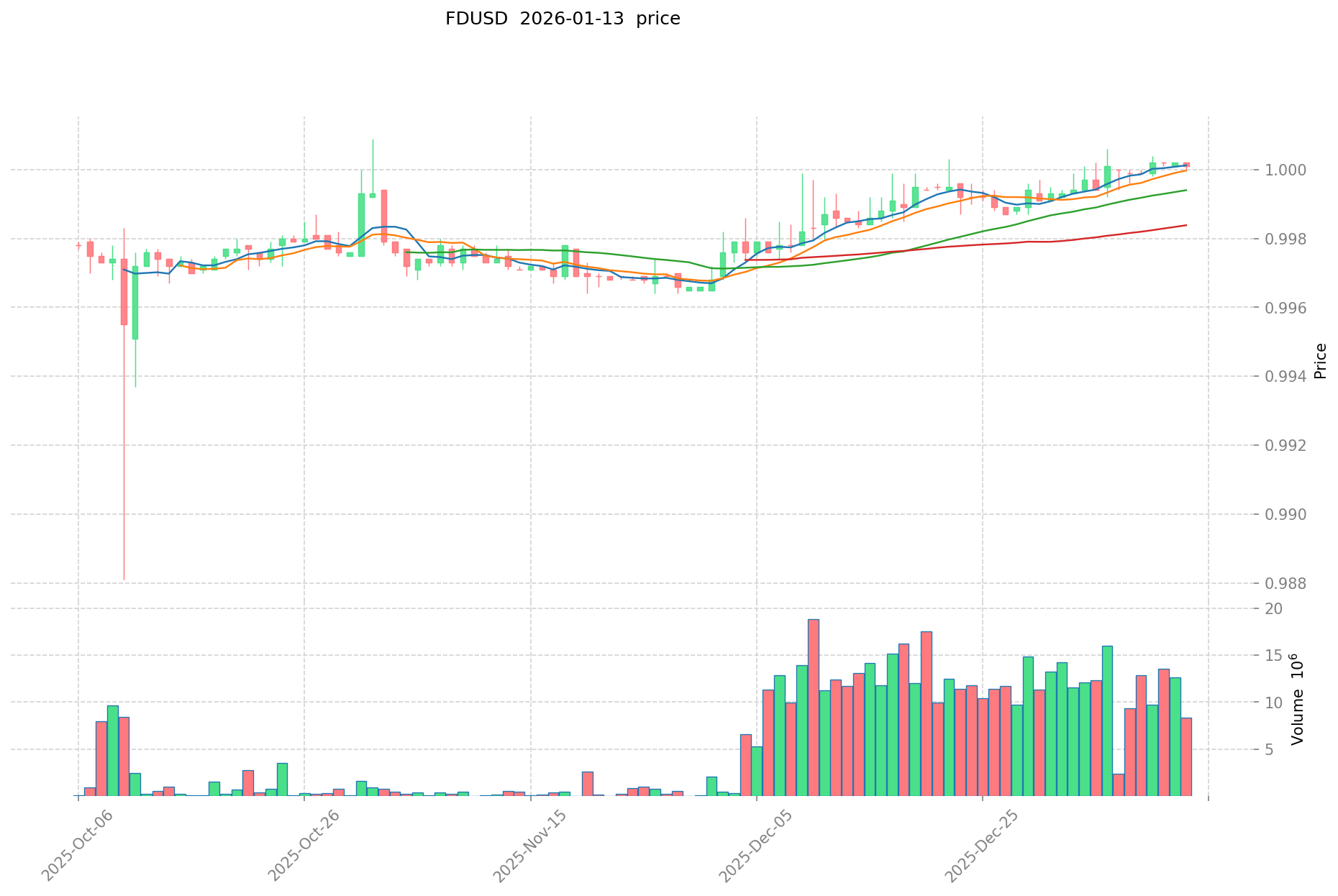
- 2024: The stablecoin maintained its 1:1 USD peg throughout most of the year, though briefly experienced a significant de-pegging event in April 2025 (noted in reference materials) which raised concerns about reserve transparency and regulatory oversight.
- 2025: Following the de-pegging incident, FDUSD has since recovered to trade around $1.0013 as of January 2026, demonstrating resilience but highlighting ongoing challenges in the stablecoin sector regarding trust and operational transparency.
Current FDUSD Investment Market Status (January 2026)
- FDUSD current price: $1.0013
- Market sentiment: The broader stablecoin market continues to face regulatory scrutiny following various incidents, though FDUSD has maintained relative stability in recent months.
- 24-hour trading volume: $10.75 million
- Market capitalization: Approximately $1.45 billion, with circulating supply of 1.45 billion tokens
Click to view real-time FDUSD market price
Note: As a fiat-backed stablecoin designed to maintain a 1:1 peg with the US dollar, FDUSD functions primarily as a medium of exchange and store of value rather than a speculative investment asset. The stablecoin operates under custodial arrangements and aims to provide transaction efficiency while reducing costs compared to traditional payment methods. However, recent market events have highlighted the importance of conducting thorough due diligence regarding reserve transparency and regulatory compliance when utilizing any stablecoin.
II. Core Factors Influencing Whether FDUSD is a Good Investment
Supply Mechanism and Scarcity (FDUSD Investment Scarcity)
- Fiat-backed stability mechanism → influences price stability and investment characteristics
- FDUSD maintains a 1:1 peg with USD through reserve asset backing, with circulating supply of approximately 1.45 billion tokens as of December 2025
- Investment significance: the stablecoin's pegging mechanism differs from traditional scarcity-driven cryptocurrencies, focusing on stability rather than appreciation potential
Institutional Investment and Mainstream Adoption (Institutional Investment in FDUSD)
- Exchange integration trend: FDUSD is listed on 16 exchanges and has gained traction in cross-border payment solutions
- Multi-chain deployment across ETH, BSC, and SOL ecosystems enhances accessibility for institutional users
- Expansion to TON blockchain in July 2025 enabled low-cost transfers for Telegram's user base, broadening adoption channels
Macroeconomic Environment's Impact on FDUSD Investment
- Stablecoin positioning → serves as a bridge asset during volatile market conditions rather than an inflation hedge
- Market capitalization of approximately $1.45 billion USD reflects sustained demand for USD-pegged digital assets
- Regulatory developments surrounding stablecoins may influence long-term viability and adoption rates
Technology and Ecosystem Development (Technology & Ecosystem for FDUSD Investment)
- Multi-chain deployment strategy: operational on ETH, BSC, SOL, and TON blockchains enhances utility across diverse ecosystems
- Integration with centralized exchanges facilitates trading efficiency and reduces transaction costs for cross-border payments
- Custodial arrangements under rigorous frameworks provide operational security, though specific technical upgrade roadmaps are not detailed in available materials
III. FDUSD Future Investment Forecast and Price Outlook (Is First Digital USD(FDUSD) worth investing in 2026-2031)
Short-term Investment Forecast (2026, short-term FDUSD investment outlook)
- Conservative forecast: $0.83 - $0.90
- Neutral forecast: $0.95 - $1.05
- Optimistic forecast: $1.10 - $1.28
Mid-term Investment Outlook (2027-2029, mid-term First Digital USD(FDUSD) investment forecast)
- Market Stage Expectations: FDUSD may maintain its stablecoin positioning with gradual expansion in cross-border payment scenarios and reserve asset backing mechanisms.
- Investment Return Forecast:
- 2027: $0.75 - $1.22
- 2028: $0.90 - $1.23
- 2029: $0.83 - $1.46
- Key Catalysts: Expansion of custodial arrangements, enhanced reserve transparency, increased adoption in cross-border transactions, and potential regulatory clarity for fiat-backed stablecoins.
Long-term Investment Outlook (Is FDUSD a good long-term investment?)
- Baseline Scenario: $1.08 - $1.64 (assuming steady reserve management and moderate market adoption)
- Optimistic Scenario: $1.33 - $2.05 (assuming enhanced institutional adoption and favorable regulatory developments)
- Risk Scenario: $0.75 - $1.00 (under conditions of reduced market confidence or reserve management challenges)
Click to view FDUSD long-term investment and price prediction: Price Prediction
2026-01-14 to 2031 Long-term Outlook
- Baseline Scenario: $1.08 - $1.64 (corresponding to stable progress and steady mainstream application growth)
- Optimistic Scenario: $1.33 - $2.05 (corresponding to large-scale adoption and favorable market conditions)
- Transformative Scenario: Above $2.05 (in case of breakthrough ecosystem developments and mainstream popularization)
- 2031-12-31 Predicted High: $2.05 (based on optimistic development assumptions)
Disclaimer: These forecasts are based on available market data and analytical models. Cryptocurrency markets involve substantial risks, and past performance does not guarantee future results. Price predictions should not be considered as investment advice.
| Year |
Predicted High Price |
Predicted Average Price |
Predicted Low Price |
Price Change |
| 2026 |
1.281536 |
1.0012 |
0.830996 |
0 |
| 2027 |
1.22126376 |
1.141368 |
0.75330288 |
13 |
| 2028 |
1.2285685152 |
1.18131588 |
0.8978000688 |
17 |
| 2029 |
1.457980059096 |
1.2049421976 |
0.831410116344 |
20 |
| 2030 |
1.94393324738808 |
1.331461128348 |
1.14505657037928 |
32 |
| 2031 |
2.04712148483505 |
1.63769718786804 |
1.080880143992906 |
63 |
IV. FDUSD Investment Strategy and Risk Management (How to invest in stablecoins)
Investment Methodology (FDUSD investment strategy)
-
Long-term Holding (HODL FDUSD): Suitable for conservative investors seeking stability
As a fiat-backed stablecoin maintaining a 1:1 peg with the US dollar, FDUSD serves primarily as a value preservation tool rather than a speculative asset. Long-term holders typically use FDUSD to preserve capital during market volatility, facilitate cross-border transactions, or maintain liquidity for future investment opportunities. The token operates under rigorous custodial arrangements with reserve assets matching or exceeding the total quantity of outstanding stablecoins.
-
Active Trading: Relies on technical analysis and swing operations
Active traders may utilize FDUSD as a base currency for trading pairs or as a temporary parking position between trades. Given its price stability around $1.0013 (as of January 14, 2026), trading strategies focus on arbitrage opportunities across different exchanges or exploiting minimal price deviations from the peg. Technical analysis for FDUSD centers on monitoring its ability to maintain the dollar peg rather than traditional price movement patterns.
Risk Management (Risk management for FDUSD investment)
-
Asset Allocation Ratio: Conservative / Aggressive / Professional investors
- Conservative investors: Allocate 10-30% of portfolio in stablecoins like FDUSD for capital preservation and liquidity
- Aggressive investors: Use 5-15% allocation as a strategic reserve for opportunistic market entry
- Professional investors: Maintain flexible allocations (20-40%) for risk management and tactical rebalancing
-
Risk Hedging Solutions: Multi-asset portfolio + hedging tools
Diversification across multiple stablecoins (USDT, USDC, FDUSD) reduces single-issuer risk. Combining FDUSD holdings with crypto assets and traditional investments creates a balanced portfolio. Utilizing FDUSD's cross-border transaction capabilities helps reduce fees and processing times associated with traditional methods.
-
Secure Storage: Hot/cold wallets + hardware wallet recommendations
FDUSD tokens are available on ETH, BSC, and SOL chains. For enhanced security:
- Cold storage: Hardware wallets (Ledger, Trezor) for long-term holdings
- Hot wallets: Trusted software wallets for active trading and daily transactions
- Multi-signature wallets: For institutional-grade security
- Regular audits: Verify contract addresses (ETH: 0xc5f0f7b66764f6ec8c8dff7ba683102295e16409, BSC: 0xc5f0f7b66764f6ec8c8dff7ba683102295e16409, SOL: 9zNQRsGLjNKwCUU5Gq5LR8beUCPzQMVMqKAi3SSZh54u)
V. FDUSD Investment Risks and Challenges (Risks of investing in stablecoins)
-
Market Risk: High volatility and price manipulation
While FDUSD maintains relative price stability (24H range: $0.9999-$1.0016), stablecoins face depeg risks during extreme market conditions. The token has shown a historical price range between $0.8799 and $1.0093, indicating potential volatility during market stress. With a 24-hour trading volume of $10.75 million and market capitalization of $1.45 billion, liquidity risks exist during high-demand periods.
-
Regulatory Risk: Policy uncertainty across different countries
Stablecoin regulations vary significantly by jurisdiction. Regulatory scrutiny continues to intensify globally, with potential impacts on issuance, redemption, and trading activities. Changes in compliance requirements for reserve asset management and custodial arrangements could affect FDUSD's operational framework. Cross-border transaction benefits may be impacted by evolving payment regulations.
-
Technical Risk: Network security vulnerabilities and upgrade failures
Smart contract vulnerabilities across ETH, BSC, and SOL chains pose security risks. Network congestion or technical failures on underlying blockchains could temporarily affect FDUSD transfers. Reserve asset management systems require robust security protocols to prevent unauthorized access. The reliance on custodial arrangements introduces counterparty risk.
VI. Conclusion: Is stablecoin a Good Investment?
-
Investment Value Summary: FDUSD serves as a stable value preservation tool with practical utility in reducing transaction costs and improving cross-border payment efficiency. Its 1:1 dollar peg and rigorous custodial arrangements provide relative stability, though it lacks the growth potential of volatile crypto assets.
-
Investor Recommendations:
✅ Beginners: Use FDUSD for dollar-cost averaging strategies and secure storage in hardware wallets. Ideal for maintaining purchasing power while learning crypto markets.
✅ Experienced Investors: Employ FDUSD for swing trading operations, portfolio rebalancing, and as a strategic liquidity reserve. Leverage cross-border transaction benefits for international diversification.
✅ Institutional Investors: Strategic allocation for treasury management, cross-border settlements, and as collateral for DeFi protocols. Consider multi-chain deployment options for operational flexibility.
⚠️ Disclaimer: Cryptocurrency investment carries significant risks. This article is for reference purposes only and does not constitute investment advice.
VII. FAQ
Q1: What makes FDUSD different from other stablecoins like USDT or USDC?
FDUSD maintains a 1:1 peg with the US dollar through fiat-backed reserves and operates under rigorous custodial arrangements similar to other major stablecoins. The key differentiators include its multi-chain deployment across Ethereum, BSC, Solana, and TON blockchains, providing greater flexibility for users across different ecosystems. Additionally, FDUSD emphasizes cross-border payment efficiency and reduced transaction costs, particularly benefiting from its integration with Telegram's user base through TON blockchain deployment since July 2025. While it shares the fundamental stability mechanism with USDT and USDC, FDUSD's relatively smaller market capitalization of $1.45 billion (compared to larger competitors) means investors should consider liquidity factors when choosing between stablecoin options.
Q2: Can FDUSD generate investment returns like other cryptocurrencies?
No, FDUSD is not designed as a speculative investment asset for generating returns through price appreciation. As a fiat-backed stablecoin pegged 1:1 to the US dollar, FDUSD's primary function is value preservation, transaction facilitation, and serving as a stable medium of exchange. Unlike volatile cryptocurrencies such as Bitcoin or Ethereum, FDUSD maintains a stable price around $1.00, with historical ranges between $0.8799 and $1.0093 representing temporary deviations rather than investment opportunities. Investors seeking returns should view FDUSD as a cash-equivalent tool for portfolio stability, trading liquidity, or earning yield through DeFi protocols rather than a growth asset.
Q3: How secure is storing FDUSD, and what are the best practices?
FDUSD security depends on proper storage methods and awareness of both technical and counterparty risks. For optimal security, long-term holders should use hardware wallets like Ledger or Trezor to store FDUSD in cold storage, protecting against online threats. Active traders can use trusted software wallets for daily transactions while maintaining the majority of holdings offline. Always verify the correct contract addresses when transacting: ETH (0xc5f0f7b66764f6ec8c8dff7ba683102295e16409), BSC (0xc5f0f7b66764f6ec8c8dff7ba683102295e16409), and SOL (9zNQRsGLjNKwCUU5Gq5LR8beUCPzQMVMqKAi3SSZh54u). Additionally, understand that smart contract vulnerabilities, network security issues, and custodial arrangement risks exist across all chains where FDUSD operates.
Q4: What are the main risks associated with investing in FDUSD?
The primary risks include depeg events, regulatory uncertainty, technical vulnerabilities, and liquidity constraints. FDUSD experienced a significant depegging incident in April 2025, demonstrating that even fiat-backed stablecoins can lose their peg during market stress or operational challenges. Regulatory risks vary by jurisdiction, with evolving compliance requirements potentially affecting issuance, redemption, and trading activities. Technical risks involve smart contract vulnerabilities across multiple blockchains and potential network congestion issues. With a 24-hour trading volume of $10.75 million against a $1.45 billion market cap, liquidity risks exist during high-demand periods. Investors should also consider counterparty risk associated with custodial arrangements and reserve asset management.
Q5: Is FDUSD suitable for beginners in cryptocurrency?
Yes, FDUSD can be an appropriate starting point for beginners due to its price stability and straightforward use case. Newcomers can use FDUSD to preserve capital while learning about cryptocurrency markets without exposure to extreme volatility. It serves well for dollar-cost averaging strategies, allowing beginners to gradually build positions in other assets while maintaining a stable base. The stablecoin's presence on multiple exchanges and blockchains provides accessibility, and its cross-border payment benefits offer practical utility. However, beginners should understand that FDUSD requires secure storage practices, awareness of potential depeg risks, and recognition that it functions as a cash equivalent rather than a growth investment.
Q6: How does FDUSD perform during market downturns compared to volatile cryptocurrencies?
FDUSD maintains relative stability during market downturns, serving as a safe-haven asset within cryptocurrency portfolios. While volatile cryptocurrencies like Bitcoin or Ethereum can experience significant price declines during bear markets, FDUSD aims to preserve its $1.00 value through reserve backing. With a current price of $1.0013 and 24-hour range of $0.9999-$1.0016, it demonstrates minimal volatility compared to traditional crypto assets. This stability makes FDUSD valuable for risk management, allowing investors to quickly exit volatile positions and preserve capital during market stress. However, historical data shows FDUSD is not immune to temporary deviations from its peg, and extreme market conditions or operational issues can lead to depegging events that temporarily undermine its stability advantage.
Q7: What allocation percentage of FDUSD is recommended for different investor types?
Conservative investors should allocate 10-30% of their portfolio to stablecoins like FDUSD for capital preservation and maintaining liquidity for opportunistic investments. This higher allocation reflects a risk-averse approach prioritizing stability over growth. Aggressive investors might maintain a 5-15% allocation, using FDUSD primarily as a tactical reserve for quick market entry when opportunities arise, while focusing the majority of holdings on higher-risk, higher-reward assets. Professional investors typically maintain flexible allocations between 20-40% depending on market conditions, using FDUSD for strategic rebalancing, treasury management, and as collateral for DeFi protocols. These recommendations assume FDUSD represents part of the stablecoin allocation rather than the entire portfolio, with percentages adjusted based on individual risk tolerance, investment goals, and market outlook.
Q8: What future developments could impact FDUSD's utility and adoption?
Several key developments could significantly affect FDUSD's position in the stablecoin market. Enhanced reserve transparency and regular auditing procedures would strengthen trust and potentially drive institutional adoption. Regulatory clarity regarding fiat-backed stablecoins across major jurisdictions could either facilitate broader adoption or impose operational constraints. Expansion to additional blockchain networks beyond ETH, BSC, SOL, and TON would increase accessibility and use cases. Integration with more DeFi protocols and traditional financial services could enhance utility for both retail and institutional users. The token's price forecasts suggest potential ranges from $1.08-$1.64 (baseline scenario) to $1.33-$2.05 (optimistic scenario) by 2031, reflecting expectations of steady mainstream adoption growth, though these projections should be viewed with caution given the inherent stability mechanism designed to maintain the $1.00 peg.
* The information is not intended to be and does not constitute financial advice or any other recommendation of any sort offered or endorsed by Gate.