This comprehensive guide analyzes whether Flamingo Finance (FLM) represents a viable investment opportunity, examining the Neo-based DeFi protocol token currently trading at $0.004903 with a $2.78 million market capitalization. The analysis covers FLM's price history, ecosystem fundamentals, and multi-component architecture including cross-chain interoperability, liquidity provision, synthetic stablecoins, and perpetual contracts. Price forecasts range from conservative ($0.0026-$0.0065) to optimistic scenarios ($0.0078-$0.0095) through 2031, with detailed investment strategies for different investor profiles. The guide addresses critical risk factors including 90.72% annual decline, market volatility, regulatory uncertainty, and technical vulnerabilities across six protocol components. Suitable for beginners considering dollar-cost averaging and experienced traders on Gate, this resource provides actionable risk management frameworks, storage recommendations, governance insights, and realistic expectations f
Introduction: Flamingo Finance (FLM) Investment Position and Market Outlook
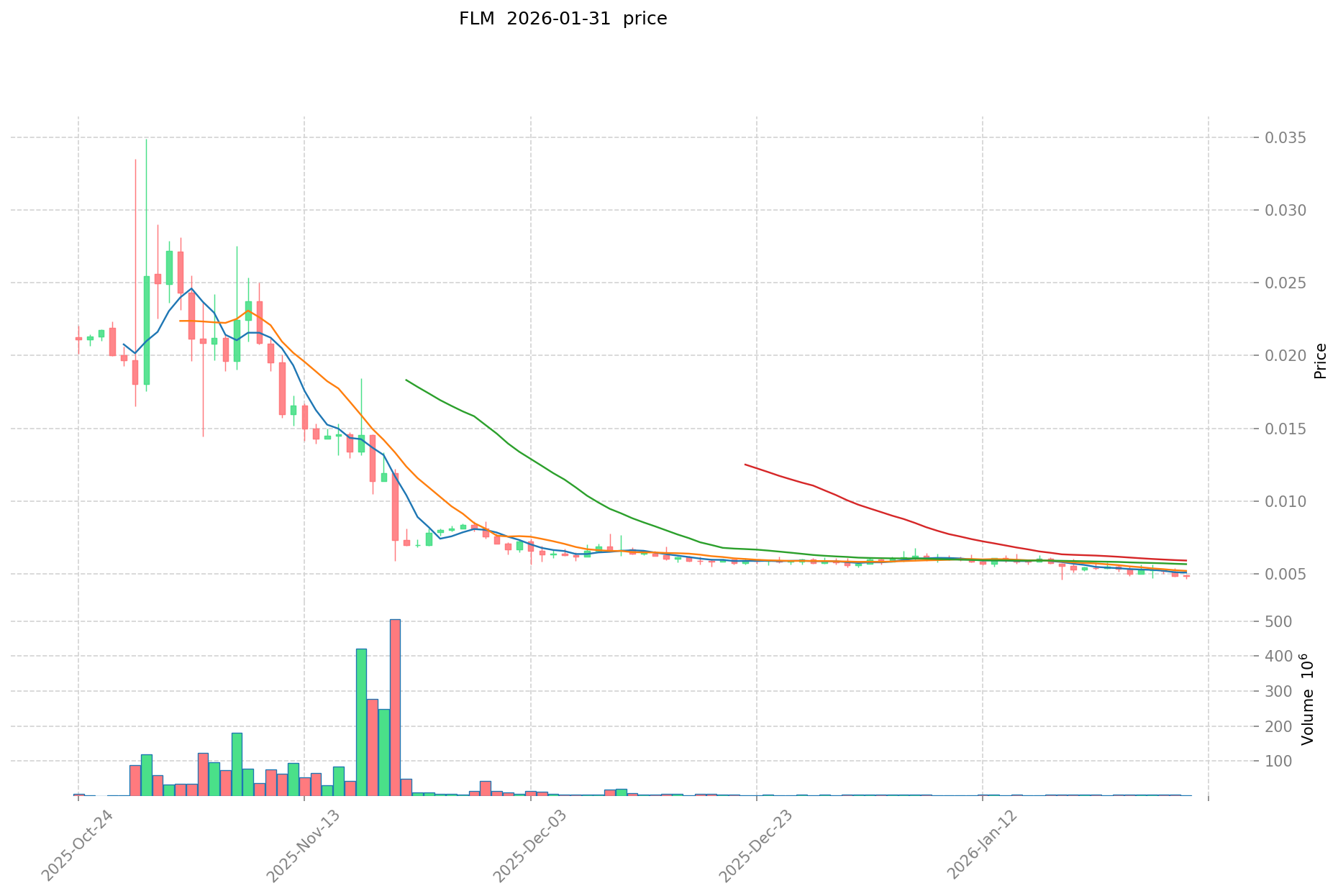
FLM is a significant asset in the cryptocurrency sector. Since its launch in September 2020, it has been establishing its presence in the DeFi interoperability domain. As of January 2026, Flamingo Finance holds a market capitalization of approximately $2.78 million, with a circulating supply of around 566.45 million tokens, and the current price is maintained at approximately $0.004903. Positioned as a Neo-based interoperability full-stack DeFi protocol, FLM has gradually become a focal point for investors discussing "Is Flamingo Finance (FLM) a good investment?" This article will comprehensively analyze the investment value, historical trends, future price forecasts, and investment risks of FLM to provide reference for investors.
I. Flamingo Finance (FLM) Price History Review and Current Investment Status
- 2020: Flamingo Finance launched on the Neo blockchain in September 2020, with an initial price of approximately $0.2814. The token experienced notable volatility during its early trading period, with price movements influenced by the emerging DeFi sector dynamics on Neo.
- 2020-2021: During the broader cryptocurrency market expansion, FLM participated in the growth cycle alongside other DeFi protocols, though specific peak levels varied across different trading periods.
- 2022-2025: Market conditions shifted significantly, with FLM experiencing price adjustments that reflected broader sector trends. By 2025, the token stabilized at levels reflecting its current market positioning and ecosystem development stage.
Current FLM Investment Market Status (January 2026)
- Current FLM Price: $0.004903
- Market Capitalization: $2,777,322.37
- 24-Hour Trading Volume: $13,355.06
- Circulating Supply: 566,453,674.96 FLM (approximately 56.65% of maximum supply)
- Market Dominance: 0.000093%
Click to view real-time FLM market price
II. Core Factors Affecting Whether FLM is a Good Investment (Is Flamingo Finance(FLM) a Good Investment)
Supply Mechanism and Scarcity (FLM investment scarcity)
- FLM has a maximum supply of 1,000,000,000 tokens with current circulating supply of 566,453,674.96 tokens (approximately 56.65% of max supply) → affects price dynamics and investment valuation
- The circulating supply represents over half of the maximum supply, indicating a moderate scarcity level that may influence token economics
- Investment significance: Token distribution mechanisms, including allocation to cross-chain asset collateral, liquidity provider (LP) token staking, FUSD generation, perpetual contract margin, and DAO governance participation, create utility-driven demand that supports long-term investment considerations
Institutional Investment and Mainstream Adoption (Institutional investment in FLM)
- FLM is listed on 5 exchanges as of January 31, 2026, providing accessibility for institutional and retail participants
- Flamingo Finance operates as a full-stack DeFi protocol on Neo, comprising six components: Wrapper (cross-chain asset gateway), Swap (on-chain liquidity provider), Vault (one-click asset management), FUSD (synthetic stablecoin), Perp (perpetual contract trading platform using AMM mechanism), and DAO (decentralized governance organization)
- The protocol's design to facilitate low-friction bidirectional asset flow across multiple chains (including Neo, Ethereum, Ontology, and Cosmos SDK-based blockchains) positions it within the broader DeFi ecosystem, though specific institutional adoption data was not available in the reference materials
Macroeconomic Environment Impact on FLM Investment
- As a governance token within the DeFi sector, FLM's investment attractiveness may be influenced by broader cryptocurrency market conditions and regulatory developments affecting decentralized finance protocols
- Market conditions as of January 31, 2026 show FLM trading at $0.004903 with a market capitalization of approximately $2.78 million and market dominance of 0.000093%
- The token experienced significant price volatility, with a 1-year decline of 90.72%, reflecting broader market dynamics and sector-specific challenges that investors should consider
Technology and Ecosystem Development (Technology & Ecosystem for FLM investment)
- Flamingo Finance's multi-component architecture provides diversified functionality: cross-chain interoperability through Wrapper, liquidity provision via Swap, automated asset management through Vault, stablecoin generation with FUSD, and derivatives trading on Perp
- The governance model allows FLM holders to vote on platform parameter changes and token issuance decisions, creating stakeholder alignment and decentralized decision-making mechanisms
- The protocol's integration with Neo blockchain and planned interoperability with Ethereum, Ontology, and Cosmos SDK-based chains demonstrates technical infrastructure designed to capture value across multiple blockchain ecosystems, though specific recent development updates were not provided in the reference materials
III. FLM Future Investment Prediction and Price Outlook (Is Flamingo Finance(FLM) worth investing in 2026-2031)
Short-term Investment Prediction (2026, short-term FLM investment outlook)
- Conservative prediction: $0.0026379 - $0.004885
- Neutral prediction: $0.004885
- Optimistic prediction: $0.004885 - $0.0063505
Mid-term Investment Outlook (2027-2029, mid-term Flamingo Finance(FLM) investment forecast)
- Market stage expectation: The token may experience moderate growth as the DeFi ecosystem continues to evolve, with potential fluctuations influenced by broader market conditions and adoption trends.
- Investment return prediction:
- 2027: $0.0045503775 - $0.0065727675
- 2028: $0.0035962026625 - $0.006460974275
- 2029: $0.0037668699075 - $0.008349894961625
- Key catalysts: Multi-chain interoperability developments, liquidity provision incentives, governance participation, and overall DeFi market momentum.
Long-term Investment Outlook (Is FLM a good long-term investment?)
- Base scenario: $0.004388403442237 - $0.007314005737062 (assuming steady protocol development and moderate market conditions)
- Optimistic scenario: $0.007804044121445 - $0.009493579446707 (assuming increased adoption, enhanced cross-chain functionality, and favorable market environment)
- Risk scenario: Below $0.004388403442237 (under conditions of reduced DeFi activity or significant market downturn)
Click to view FLM long-term investment and price prediction: Price Prediction
2026-01-31 - 2031 Long-term Outlook
- Base scenario: $0.004388403442237 - $0.007314005737062 (corresponding to steady progress and gradual mainstream application growth)
- Optimistic scenario: $0.007804044121445 - $0.009493579446707 (corresponding to large-scale adoption and favorable market environment)
- Transformative scenario: Above $0.009493579446707 (in case of breakthrough ecosystem developments and mainstream popularization)
- 2031-12-31 predicted high: $0.009493579446707 (based on optimistic development assumptions)
Disclaimer: Price predictions are subject to market volatility and uncertainty. This analysis does not constitute investment advice.
| Year |
Predicted High Price |
Predicted Average Price |
Predicted Low Price |
Price Change |
| 2026 |
0.0063505 |
0.004885 |
0.0026379 |
0 |
| 2027 |
0.0065727675 |
0.00561775 |
0.0045503775 |
14 |
| 2028 |
0.006460974275 |
0.00609525875 |
0.0035962026625 |
24 |
| 2029 |
0.008349894961625 |
0.0062781165125 |
0.0037668699075 |
28 |
| 2030 |
0.008776806884475 |
0.007314005737062 |
0.004388403442237 |
49 |
| 2031 |
0.009493579446707 |
0.008045406310768 |
0.007804044121445 |
64 |
IV. FLM Investment Strategy and Risk Management (How to invest in DeFi tokens)
Investment Methodology (FLM investment strategy)
-
Long-term Holding (HODL FLM): Suitable for conservative investors
Long-term holding involves purchasing FLM tokens and maintaining positions over extended periods, focusing on the fundamental development of the Flamingo Finance ecosystem. This approach requires patience and belief in the protocol's long-term value proposition within the Neo blockchain DeFi landscape.
-
Active Trading: Relies on technical analysis and swing trading
Active trading strategies involve utilizing technical indicators, chart patterns, and market sentiment analysis to identify entry and exit points. Given FLM's price movements, traders may employ strategies such as support and resistance level trading, momentum-based approaches, or mean reversion techniques.
Risk Management (Risk management for FLM investment)
-
Asset Allocation Ratio: Conservative / Aggressive / Professional investors
- Conservative investors: Allocate 1-3% of crypto portfolio to FLM
- Aggressive investors: May allocate 5-10% with higher risk tolerance
- Professional investors: Dynamic allocation based on market conditions and risk models
-
Risk Hedging Solutions: Multi-asset portfolio + hedging tools
Diversification across different blockchain ecosystems, combining FLM with established cryptocurrencies and stablecoins can reduce overall portfolio volatility. Investors may consider hedging strategies such as holding stablecoins for liquidity or using derivative instruments where available.
-
Secure Storage: Hot/cold wallets + hardware wallet recommendations
For FLM tokens on Neo N3, investors should utilize:
- Cold storage solutions for long-term holdings
- Hardware wallets compatible with Neo N3 network
- Hot wallets only for active trading amounts
- Multi-signature wallets for institutional holdings
V. FLM Investment Risks and Challenges (Risks of investing in DeFi tokens)
-
Market Risk: High volatility, price manipulation
FLM exhibits considerable price fluctuations, with recent data showing movements ranging from -90.72% over one year to shorter-term variations. The relatively limited trading volume and market capitalization may increase susceptibility to larger price swings and potential market manipulation scenarios.
-
Regulatory Risk: Policy uncertainty across different jurisdictions
DeFi protocols face evolving regulatory frameworks globally. Changes in cryptocurrency regulations, DeFi-specific compliance requirements, or cross-chain protocol oversight could impact Flamingo Finance operations and FLM token utility. Different jurisdictions maintain varying approaches to DeFi governance tokens, creating uncertainty for international investors.
-
Technical Risk: Network security vulnerabilities, upgrade failures
As a multi-component DeFi protocol built on Neo, Flamingo Finance faces technical risks including:
- Smart contract vulnerabilities in Wrapper, Swap, Vault, FUSD, Perp, or DAO components
- Cross-chain bridge security concerns
- Neo network dependencies and potential upgrade complications
- Integration risks with Ethereum, Ontology, and Cosmos SDK-based blockchains
VI. Conclusion: Is DeFi tokens a Good Investment?
-
Investment Value Summary: FLM represents a governance token within a comprehensive DeFi ecosystem on Neo, offering exposure to cross-chain functionality and multiple DeFi services. However, recent performance indicators and market position suggest significant challenges.
-
Investor Recommendations:
✅ Beginners: Consider dollar-cost averaging with small allocations + secure wallet storage practices
✅ Experienced Investors: Employ swing trading strategies + diversified portfolio allocation with risk-appropriate position sizing
✅ Institutional Investors: Conduct thorough due diligence on protocol fundamentals, assess strategic fit within broader DeFi exposure, and implement comprehensive risk management frameworks
⚠️ Disclaimer: Cryptocurrency investments carry substantial risk. This content is for informational purposes only and does not constitute investment advice. Investors should conduct independent research and consult financial professionals before making investment decisions.
VII. FAQ
Q1: What is the maximum supply of FLM tokens and how does it affect investment potential?
FLM has a maximum supply of 1,000,000,000 tokens, with approximately 566,453,674.96 tokens currently in circulation (56.65% of max supply). This moderate scarcity level creates a balanced token economic model where additional supply can still enter the market, potentially diluting existing holdings. However, the controlled distribution mechanism through cross-chain asset collateral, LP token staking, FUSD generation, perpetual contract margins, and DAO governance creates utility-driven demand that may support long-term value appreciation as the ecosystem develops.
Q2: How does FLM differ from other DeFi governance tokens?
FLM serves as the governance token for Flamingo Finance, a full-stack DeFi protocol on Neo that comprises six integrated components: Wrapper (cross-chain gateway), Swap (liquidity provider), Vault (asset management), FUSD (synthetic stablecoin), Perp (perpetual contracts), and DAO (governance). Unlike single-function DeFi tokens, FLM holders can participate in decisions affecting multiple protocol aspects while benefiting from cross-chain interoperability with Ethereum, Ontology, and Cosmos SDK-based blockchains, positioning it as a comprehensive DeFi ecosystem token rather than a specialized utility token.
Q3: What are the main risks associated with investing in FLM?
FLM investment carries several significant risks: First, market risk evidenced by high volatility with a 90.72% decline over one year and limited trading volume ($13,355.06 in 24 hours) that may increase price manipulation susceptibility. Second, regulatory uncertainty surrounding DeFi protocols and cross-chain operations across multiple jurisdictions. Third, technical risks including smart contract vulnerabilities across six protocol components, cross-chain bridge security concerns, and dependencies on Neo network stability and upgrades. Investors should only allocate capital they can afford to lose completely.
Q4: Is FLM suitable for long-term holding or short-term trading?
The suitability depends on investor profile and risk tolerance. Long-term holding may appeal to those believing in Neo's DeFi ecosystem growth and Flamingo Finance's multi-component protocol development, with predictions ranging from $0.004388 to $0.009494 by 2031 under optimistic scenarios. Short-term trading may suit experienced traders who can navigate high volatility and utilize technical analysis, though limited liquidity presents challenges. Conservative investors should limit FLM to 1-3% of crypto portfolios, while aggressive investors might allocate 5-10% with appropriate risk management and hedging strategies in place.
Q5: How can investors securely store FLM tokens?
FLM tokens operate on the Neo N3 network and require compatible storage solutions. For long-term holdings, investors should utilize cold storage solutions and hardware wallets that support Neo N3, keeping private keys completely offline. Hot wallets should only contain amounts needed for active trading to minimize security exposure. Institutional investors may implement multi-signature wallet configurations for enhanced security. Always verify wallet compatibility with Neo N3 before transferring tokens, and never share private keys or seed phrases with any third party.
Q6: What factors could drive FLM price appreciation in 2026-2027?
Several catalysts could influence FLM's short-to-mid-term performance: increased adoption of Flamingo Finance's cross-chain functionality across Neo, Ethereum, Ontology, and Cosmos ecosystems; growing liquidity provision activity generating trading fees and staking rewards; expanded use of FUSD stablecoin and Perp perpetual contracts; successful implementation of DAO governance proposals enhancing protocol efficiency; and broader DeFi market momentum benefiting Neo-based projects. However, these positive scenarios must be weighed against current market conditions showing $2.78 million market capitalization and 0.000093% market dominance, indicating significant growth requirements.
Q7: How does FLM's governance model work for token holders?
FLM holders participate in Flamingo Finance's decentralized governance through the DAO component, which allows voting on platform parameter changes and token issuance decisions. This governance structure creates stakeholder alignment where token holders directly influence protocol direction, fee structures, liquidity incentives, and strategic developments across all six ecosystem components (Wrapper, Swap, Vault, FUSD, Perp, and DAO). The weight of voting power typically correlates with token holdings, though investors should verify specific governance mechanics and participation requirements through official Flamingo Finance documentation before engaging in governance activities.
Q8: What is the realistic price target for FLM by 2030-2031?
Based on multiple projection scenarios, FLM's 2031 price targets range considerably: the base scenario suggests $0.004388 to $0.007314 assuming steady protocol development and moderate market conditions; the optimistic scenario projects $0.007804 to $0.009494 under increased adoption and favorable market environments; while risk scenarios could see prices below $0.004388 if DeFi activity contracts or significant market downturns occur. The predicted high of approximately $0.009494 by December 2031 represents potential 64% growth from 2026 levels, though investors must recognize these projections carry substantial uncertainty and do not constitute investment advice or guarantees of future performance.
* The information is not intended to be and does not constitute financial advice or any other recommendation of any sort offered or endorsed by Gate.