This comprehensive analysis evaluates whether Flamingo Finance (FLM) represents a viable investment opportunity. FLM serves as the governance token for a Neo-based DeFi protocol featuring six key components: cross-chain asset gateway (Wrapper), liquidity provision (Swap), asset management (Vault), synthetic stablecoin (FUSD), perpetual trading (Perp), and DAO governance. As of January 2026, FLM trades at $0.004808 with a $2.72 million market cap and 566.45 million circulating tokens. The article examines FLM's historical price volatility—including a 90.85% one-year decline—current market positioning, and multiple investment scenarios through 2031. It presents three strategic approaches: conservative long-term holding for 1-3% portfolio allocation, active swing trading leveraging technical analysis, and institutional strategic positioning. Risk analysis covers market volatility, regulatory uncertainty across jurisdictions, and technical vulnerabilities in the protocol's six-component architecture. Investor rec
Introduction: Flamingo Finance (FLM) Investment Position and Market Outlook
FLM is a governance token in the cryptocurrency space, launched in September 2020 as part of the Flamingo Finance platform. The project operates as a Neo-based interoperability full-stack DeFi protocol, focusing on cross-chain asset flow and decentralized finance services. As of January 31, 2026, FLM has a market capitalization of approximately $2.72 million, with a circulating supply of around 566.45 million tokens, and the current price is approximately $0.004808. With its positioning as a governance token for a multi-functional DeFi ecosystem comprising cross-chain gateways, liquidity provision, asset management, synthetic stablecoins, perpetual contract trading, and DAO governance, FLM has attracted attention from participants interested in Neo ecosystem DeFi solutions. Currently ranked #1886 by market capitalization with a market dominance of 0.000092%, the token represents a relatively small-cap digital asset. This article will comprehensively analyze FLM's investment characteristics, historical price trends, future price outlook, and associated investment risks to provide reference information for those considering "Is Flamingo Finance (FLM) a good investment?"
I. Flamingo Finance (FLM) Price History Review and Current Investment Value
- 2020: Project launched in September with initial price around $0.2814, marking entry into Neo-based DeFi ecosystem
- 2020: FLM experienced notable price movements during early adoption phase, reaching levels near $1.59 in late September
- 2025: Market conditions led to price adjustments, with FLM trading around $0.00699, representing a decline from previous periods
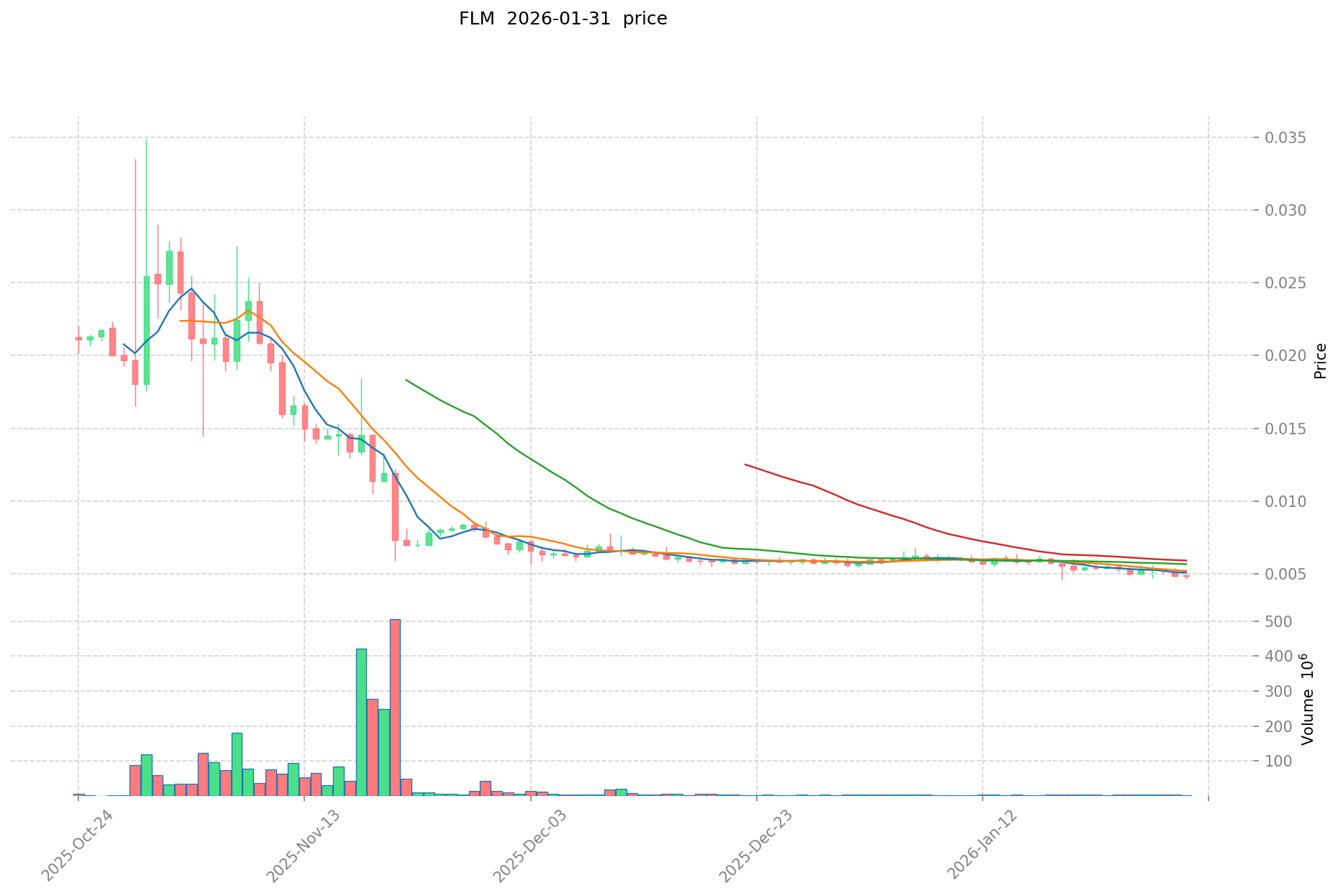
Current FLM Investment Market Status (January 2026)
- FLM current price: $0.004808
- Market sentiment (Fear & Greed Index): Data not available in provided materials
- 24-hour trading volume: $14,168.19
- Institutional investor holdings: Data not available in provided materials
Click to view real-time FLM market price
II. Core Factors Influencing Whether FLM is a Good Investment
Supply Mechanism and Scarcity (FLM Investment Scarcity)
- Supply Structure → Impacts price and investment value
- FLM has a maximum supply of 1,000,000,000 tokens, with a circulating supply of 566,453,674.96 tokens (approximately 56.65% of max supply). The controlled release mechanism may influence price dynamics over time.
- Investment Implication: Token scarcity relative to total supply could provide structural support for long-term investment considerations, though market conditions remain a significant factor.
Institutional Investment and Mainstream Adoption (Institutional Investment in FLM)
- The reference materials do not provide specific data on institutional holdings or major enterprise adoption of FLM.
- As a governance token for the Flamingo Finance platform, FLM's adoption is tied to the platform's DeFi ecosystem usage, including cross-chain asset wrapping, liquidity provision, and synthetic stablecoin generation.
Macroeconomic Environment's Impact on FLM Investment
- Monetary Policy and Interest Rate Changes → May alter investment attractiveness across crypto assets
- Inflation Environment: DeFi tokens like FLM may serve as alternative investment vehicles during inflationary periods, though they carry distinct risk profiles compared to traditional hedges.
- Geopolitical Uncertainty → Could influence demand for decentralized finance platforms and their associated governance tokens.
Technology and Ecosystem Development (Technology & Ecosystem for FLM Investment)
- Cross-Chain Interoperability: Flamingo Finance operates as a full-stack DeFi protocol on Neo, featuring a cross-chain asset gateway (Wrapper) that facilitates asset flow between Neo, Ethereum, Ontology, and Cosmos SDK-based blockchains. This multi-chain capability may enhance platform utility and investment appeal.
- DeFi Ecosystem Components: The platform comprises six key components: Wrapper (cross-chain gateway), Swap (liquidity provision), Vault (asset management), FUSD (synthetic stablecoin), Perp (perpetual contract trading), and DAO (governance). These diverse applications may provide structural support for long-term value.
- Governance Functionality: FLM holders can participate in platform governance, including voting on parameter changes and token issuance decisions, which may contribute to token utility and investment considerations.
III. FLM Future Investment Forecast and Price Outlook (Is Flamingo Finance(FLM) worth investing in 2026-2031)
Short-term Investment Forecast (2026, short-term FLM investment outlook)
- Conservative forecast: $0.00393372 - $0.004683
- Neutral forecast: $0.004683 - $0.00557277
- Optimistic forecast: $0.00557277 and above
Mid-term Investment Outlook (2027-2029, mid-term Flamingo Finance(FLM) investment forecast)
- Market phase expectation: The asset may experience moderate volatility as the Neo-based DeFi ecosystem continues to evolve, with potential fluctuations influenced by broader market sentiment and platform development progress.
- Investment return forecast:
- 2027: $0.00446125995 - $0.00610218315
- 2028: $0.00454817760075 - $0.0081979497495
- 2029: $0.00663023223576 - $0.007251816507862
- Key catalysts: Platform governance enhancements, liquidity provision expansion, cross-chain asset integration developments, and participation growth in DAO governance mechanisms.
Long-term Investment Outlook (Is FLM a good long-term investment?)
- Base scenario: $0.006512821873251 - $0.007079154210056 (assuming steady ecosystem development and maintained platform functionality)
- Optimistic scenario: $0.007669909628885 - $0.009415275099374 (assuming enhanced cross-chain interoperability and increased adoption of DeFi components including Wrapper, Swap, Vault, FUSD, and Perp)
- Risk scenario: Below $0.00393372 (under conditions of significant market downturns or reduced platform activity)
View FLM long-term investment and price forecast: Price Prediction
2026-01-31 - 2031 Long-term Outlook
- Base scenario: $0.006512821873251 - $0.007079154210056 (corresponding to steady progress and gradual mainstream application enhancement)
- Optimistic scenario: $0.007669909628885 - $0.009415275099374 (corresponding to large-scale adoption and favorable market conditions)
- Transformative scenario: Above $0.009415275099374 (if ecosystem achieves breakthrough developments and mainstream popularization)
- 2031-12-31 projected high: $0.009415275099374 (based on optimistic development assumptions)
Disclaimer: The forecasts provided are based on historical data and market analysis models. Cryptocurrency investments involve substantial risk, and actual prices may differ significantly from projections due to market volatility, regulatory changes, technological developments, and other unpredictable factors. These projections should not be considered as investment advice, and investors should conduct their own research and consult with financial professionals before making investment decisions.
| Year |
Predicted High Price |
Predicted Average Price |
Predicted Low Price |
Price Change |
| 2026 |
0.00557277 |
0.004683 |
0.00393372 |
-2 |
| 2027 |
0.00610218315 |
0.005127885 |
0.00446125995 |
6 |
| 2028 |
0.0081979497495 |
0.005615034075 |
0.00454817760075 |
16 |
| 2029 |
0.007251816507862 |
0.00690649191225 |
0.00663023223576 |
43 |
| 2030 |
0.009415275099374 |
0.007079154210056 |
0.006512821873251 |
47 |
| 2031 |
0.008494631094357 |
0.008247214654715 |
0.007669909628885 |
71 |
IV. FLM Investment Strategy and Risk Management (How to invest in Flamingo Finance)
Investment Methodology (FLM investment strategy)
Long-term Holding (HODL FLM): Suitable for Conservative Investors
For investors seeking a conservative approach, long-term holding of FLM tokens may be considered as part of a broader DeFi portfolio strategy. This approach involves acquiring FLM and retaining it over an extended period, potentially participating in platform governance and staking opportunities. Given that FLM serves as the governance token for the Flamingo platform, long-term holders may benefit from protocol participation rights, including voting on platform parameter changes and decisions regarding token issuance.
The token distribution model allocates FLM to various use cases within the ecosystem, including cross-chain asset collateral, liquidity provider (LP) token staking, FUSD generation, perpetual contract margin, and DAO governance participation. Investors adopting a long-term strategy should evaluate these utility mechanisms and their potential impact on token value over time.
Active Trading: Technical Analysis and Swing Trading
Active traders may approach FLM through technical analysis and swing trading strategies, capitalizing on price movements within the cryptocurrency market. As of January 31, 2026, FLM is trading at $0.004808, with a 24-hour price range between $0.004682 and $0.00493. Recent price trends show a 1.88% increase over 24 hours, but a decline of 9.44% over 7 days and 14.63% over 30 days.
Traders employing technical analysis should monitor key support and resistance levels, volume patterns, and broader market sentiment. The token's price volatility, as evidenced by its performance metrics, presents both opportunities and risks for swing trading strategies. Active traders should implement strict entry and exit protocols, utilizing stop-loss orders and position sizing to manage exposure.
Risk Management (Risk management for FLM investment)
Asset Allocation Ratio: Conservative / Aggressive / Professional Investors
Conservative Investors: A conservative approach might allocate 1-3% of total crypto portfolio to FLM, recognizing its position as a smaller market cap DeFi token with a market capitalization of approximately $2.72 million and a ranking of 1886.
Aggressive Investors: More aggressive strategies might allocate 5-10% to FLM, seeking higher potential returns while accepting increased volatility and risk associated with lower-cap DeFi tokens.
Professional Investors: Institutional or professional investors may consider strategic allocations based on comprehensive due diligence, portfolio diversification requirements, and risk tolerance thresholds, potentially incorporating FLM as part of a broader Neo ecosystem or DeFi sector exposure.
Investors can implement risk hedging strategies through:
- Portfolio Diversification: Combining FLM with other assets across different blockchain ecosystems, including established cryptocurrencies, stablecoins, and tokens from various DeFi protocols
- Correlation Analysis: Monitoring FLM's price correlation with Neo ecosystem tokens and broader DeFi market movements
- Stablecoin Allocation: Maintaining a portion of holdings in stablecoins to provide liquidity and reduce overall portfolio volatility
- Derivatives and Hedging Instruments: Utilizing available hedging tools where applicable to manage downside risk
Secure Storage: Hot/Cold Wallets + Hardware Wallet Recommendations
Secure storage of FLM tokens requires appropriate wallet infrastructure:
- Cold Storage: For long-term holdings, cold storage solutions provide enhanced security by keeping private keys offline, reducing exposure to online threats
- Hot Wallets: For active trading and platform participation, hot wallets offer convenience but require strong security practices, including two-factor authentication and regular security updates
- Hardware Wallets: Hardware wallet solutions compatible with Neo-based tokens provide a balance between security and accessibility
- Multi-signature Solutions: For larger holdings, multi-signature wallet configurations add an additional security layer
Investors should implement backup procedures for recovery phrases and maintain multiple secure storage locations for backup information.
V. FLM Investment Risks and Challenges (Risks of investing in Flamingo Finance)
Market Risk: High Volatility and Price Manipulation
FLM exhibits significant price volatility, as demonstrated by its historical price movements. The token has experienced a one-year decline of 90.85%, with its current price of $0.004808 substantially below its previous levels. The 24-hour trading volume of approximately $14,168 indicates relatively limited liquidity, which can amplify price movements and potentially increase susceptibility to market manipulation.
The market capitalization of approximately $2.72 million and ranking of 1886 among cryptocurrencies suggest that FLM operates in a segment of the market characterized by higher volatility and potentially lower liquidity compared to larger market cap assets. The 24-hour price range variation of approximately 5.3% reflects the ongoing price fluctuations that investors should anticipate.
Regulatory Risk: Policy Uncertainty Across Different Countries
Regulatory considerations for FLM investment include:
- DeFi Protocol Regulation: Evolving regulatory frameworks for decentralized finance protocols across different jurisdictions may impact Flamingo's operations and token utility
- Cross-chain Asset Regulations: The Wrapper component's cross-chain asset gateway functionality involves assets from multiple blockchain ecosystems (Neo, Ethereum, Ontology, and Cosmos SDK-based blockchains), each potentially subject to different regulatory treatments
- Governance Token Classification: Regulatory treatment of governance tokens varies by jurisdiction, potentially affecting FLM's legal status and holder rights
- Stablecoin Oversight: The FUSD synthetic stablecoin component may face specific regulatory scrutiny as authorities worldwide develop frameworks for algorithmic and synthetic stablecoins
Technical Risk: Network Security Vulnerabilities and Upgrade Failures
Technical risks associated with FLM investment include:
- Smart Contract Vulnerabilities: The six-component architecture (Wrapper, Swap, Vault, FUSD, Perp, and DAO) involves multiple smart contracts, each representing potential attack surfaces
- Cross-chain Bridge Security: The Wrapper's cross-chain asset gateway functionality introduces specific security considerations related to asset transfers between different blockchain networks
- Protocol Upgrade Risks: Changes to platform parameters and protocol upgrades, while governed by FLM token holders, carry implementation risks
- Dependency on Neo Ecosystem: As a Neo-based protocol, Flamingo's functionality depends on the security and performance of the underlying Neo blockchain infrastructure
- Oracle and Price Feed Risks: The perpetual contract platform (Perp) and synthetic stablecoin (FUSD) components likely rely on price oracles, which can introduce additional technical vulnerabilities
VI. Conclusion: Is Flamingo Finance a Good Investment?
Investment Value Summary
FLM presents a complex investment profile characterized by both opportunities and significant risks. As the governance token for a multi-component DeFi protocol built on Neo, FLM offers exposure to an interoperability-focused ecosystem encompassing cross-chain asset transfers, liquidity provision, asset management, synthetic stablecoins, perpetual contracts, and decentralized governance.
The token's utility within the Flamingo ecosystem provides multiple use cases, including cross-chain asset collateral, LP token staking, FUSD generation, perpetual contract margin, and DAO participation. However, the current market position—with a market cap of approximately $2.72 million, ranking of 1886, and a one-year price decline of 90.85%—reflects significant market challenges and investor risk considerations.
The circulating supply of approximately 566.45 million tokens represents 56.65% of the maximum supply of 1 billion tokens, with the market cap to fully diluted valuation ratio at 56.65%. Trading across 5 exchanges with relatively modest daily volume suggests limited liquidity compared to larger DeFi tokens.
Investor Recommendations
✅ Beginners: New investors considering FLM should approach with caution, implementing dollar-cost averaging strategies with small position sizes, and prioritizing secure wallet storage solutions compatible with Neo-based tokens. Understanding the six-component Flamingo protocol architecture and its associated risks is essential before allocation.
✅ Experienced Investors: Those with experience in DeFi and smaller market cap tokens may consider FLM as part of a diversified crypto portfolio, utilizing swing trading strategies to capitalize on price volatility while maintaining strict risk management protocols. Position sizing should reflect the token's volatility profile and liquidity constraints.
✅ Institutional Investors: Institutional participants evaluating FLM should conduct comprehensive due diligence on the Flamingo protocol's technical architecture, governance mechanisms, and Neo ecosystem dynamics. Strategic allocation decisions should account for liquidity limitations, regulatory considerations, and the evolving DeFi competitive landscape.
⚠️ Disclaimer: Cryptocurrency investment carries substantial risk, including potential loss of principal. This analysis is provided for informational purposes only and does not constitute investment advice. Investors should conduct independent research, assess their risk tolerance, and consult qualified financial advisors before making investment decisions.
VII. FAQ
Q1: What is Flamingo Finance (FLM) and what makes it unique as an investment?
FLM is the governance token for Flamingo Finance, a Neo-based interoperability full-stack DeFi protocol launched in September 2020. What distinguishes FLM as an investment is its multi-functional ecosystem comprising six core components: Wrapper (cross-chain asset gateway connecting Neo, Ethereum, Ontology, and Cosmos SDK-based blockchains), Swap (liquidity provision), Vault (asset management), FUSD (synthetic stablecoin), Perp (perpetual contract trading), and DAO (governance). Token holders can participate in platform governance, including voting on parameter changes and token issuance decisions, while the token serves multiple utility functions including cross-chain asset collateral, LP token staking, FUSD generation, and perpetual contract margin.
Q2: What is the current market position and price performance of FLM?
As of January 31, 2026, FLM trades at approximately $0.004808 with a market capitalization of $2.72 million, ranking 1886th among cryptocurrencies with a market dominance of 0.000092%. The token has experienced significant price volatility, with a one-year decline of 90.85%, a 30-day decrease of 14.63%, and a 7-day drop of 9.44%, though showing a 24-hour increase of 1.88%. The circulating supply stands at approximately 566.45 million tokens (56.65% of the maximum supply of 1 billion tokens), with a 24-hour trading volume of $14,168.19 across 5 exchanges, indicating relatively limited liquidity compared to larger market cap assets.
Q3: What are the price forecasts for FLM from 2026 to 2031?
Short-term forecasts for 2026 range from a conservative $0.00393372-$0.004683 to an optimistic $0.00557277 and above. Mid-term projections show potential growth: 2027 ($0.00446-$0.00610), 2028 ($0.00455-$0.00820), and 2029 ($0.00663-$0.00725). Long-term outlook through 2031 presents three scenarios: base case ($0.00651-$0.00708), optimistic ($0.00767-$0.00942), and transformative (above $0.00942). The 2031 projected high reaches $0.00942 under optimistic development assumptions. These forecasts assume steady ecosystem development, enhanced cross-chain interoperability, and increased adoption of DeFi components, though actual prices may differ significantly due to market volatility, regulatory changes, and technological developments.
Q4: What investment strategies are suitable for different types of FLM investors?
Conservative investors may consider allocating 1-3% of their crypto portfolio to FLM through long-term holding (HODL) strategies, participating in platform governance and staking opportunities. Aggressive investors might allocate 5-10% to capitalize on higher potential returns while accepting increased volatility. Active traders can employ technical analysis and swing trading strategies, monitoring the 24-hour price range and volume patterns. Professional investors should conduct comprehensive due diligence on the protocol's technical architecture and governance mechanisms. Risk management should include portfolio diversification across different blockchain ecosystems, maintaining stablecoin allocations for liquidity, utilizing hedging instruments where applicable, and implementing secure storage solutions including cold wallets and hardware wallets compatible with Neo-based tokens.
Q5: What are the primary risks associated with investing in FLM?
FLM investment carries multiple risk categories: (I) Market risks include high volatility demonstrated by a 90.85% one-year decline, limited liquidity with $14,168 daily volume, and potential price manipulation due to the relatively small market cap of $2.72 million. (II) Regulatory risks encompass uncertain DeFi protocol regulations across jurisdictions, cross-chain asset regulatory treatment affecting the Wrapper component, governance token classification variations, and potential stablecoin oversight affecting FUSD. (III) Technical risks involve smart contract vulnerabilities across the six-component architecture, cross-chain bridge security concerns in the Wrapper gateway, protocol upgrade implementation risks, dependency on Neo blockchain infrastructure, and oracle/price feed vulnerabilities for Perp and FUSD components. Investors should implement strict risk management protocols and maintain awareness of these multifaceted risk exposures.
Q6: How does FLM's token supply mechanism affect its investment value?
FLM has a maximum supply of 1,000,000,000 tokens with a current circulating supply of 566,453,674.96 tokens, representing approximately 56.65% of total supply. This controlled release mechanism creates a supply structure where 43.35% of tokens remain to be distributed, potentially influencing future price dynamics. The market cap to fully diluted valuation ratio of 56.65% suggests significant future dilution potential. The token distribution model allocates FLM across various ecosystem use cases including cross-chain asset collateral, liquidity provider token staking, FUSD generation, perpetual contract margin, and DAO governance participation. This scarcity relative to total supply could provide structural support for long-term investment considerations, though the gradual release of remaining tokens may create selling pressure that impacts price trajectories over time.
Q7: What are the key technological features that could impact FLM's long-term investment value?
The Flamingo Finance platform's technological foundation presents several features relevant to investment evaluation: (I) Cross-chain interoperability through the Wrapper component enables asset flow between Neo, Ethereum, Ontology, and Cosmos SDK-based blockchains, potentially enhancing platform utility and adoption. (II) The six-component DeFi ecosystem (Wrapper, Swap, Vault, FUSD, Perp, DAO) provides diverse applications that may contribute to sustained platform usage and token utility. (III) Governance functionality allows FLM holders to participate in platform decisions, including parameter changes and token issuance votes, creating ongoing utility beyond speculative trading. (IV) Integration with Neo blockchain infrastructure provides the technical foundation for protocol operations, though it also creates dependency on Neo ecosystem development and security. These technological characteristics represent potential sources of long-term value, though they also introduce technical risks and competitive challenges within the evolving DeFi landscape.
Q8: Should beginners invest in FLM, and what precautions should they take?
Beginners considering FLM should approach with significant caution due to the token's high volatility, limited liquidity, and complex technical architecture. New investors should implement dollar-cost averaging strategies with very small position sizes (suggesting no more than 1-2% of a diversified crypto portfolio), prioritizing risk capital that they can afford to lose entirely. Essential precautions include: (I) Understanding the six-component Flamingo protocol architecture and its associated risks before allocation. (II) Utilizing secure wallet storage solutions compatible with Neo-based tokens, preferably cold storage or hardware wallets for holdings not actively traded. (III) Conducting independent research beyond this analysis, including review of platform documentation, community discussions, and ongoing development updates. (IV) Starting with minimal exposure while gaining familiarity with DeFi concepts, governance participation, and Neo ecosystem dynamics. (V) Avoiding investment based solely on price predictions or past performance. Given the substantial one-year decline of 90.85% and significant ongoing volatility, beginners should prioritize education and risk management over aggressive position sizing.
* The information is not intended to be and does not constitute financial advice or any other recommendation of any sort offered or endorsed by Gate.