This comprehensive analysis examines whether Flare Network (FLR) represents a sound investment opportunity in 2024-2026. FLR, the native token of an EVM-based Layer 1 blockchain, provides decentralized access to cross-chain data through its State Connector protocol and Time Series Oracle infrastructure. Currently trading at $0.01169 with a market capitalization of $967.39 million, FLR has experienced significant volatility, declining 50.01% annually while trading 28 exchanges including Gate. The article evaluates historical price trends, tokenomics featuring 82.75 billion circulating tokens, institutional adoption metrics, and technical fundamentals driving ecosystem development. Investment recommendations span conservative dollar-cost averaging strategies for beginners to active trading approaches for experienced investors, with asset allocation guidance ranging from 1-15% portfolio exposure based on risk tolerance. Critical risk factors include market volatility, regulatory uncertainty, technical vulnerabil
Introduction: Flare Network (FLR)'s Investment Position and Market Prospects
FLR is a significant asset in the cryptocurrency sector, serving as the native token of Flare Network, an EVM-based Layer 1 blockchain designed to enable developers to build applications utilizing data from other chains and the internet. As of January 14, 2026, FLR holds a market capitalization of approximately $967.39 million, with a circulating supply of about 82.75 billion tokens and a current price around $0.01169. The token ranks 90th by market capitalization, accounting for 0.036% of the total crypto market share. With its positioning as a blockchain providing decentralized access to high-integrity data through state connector protocols and time series oracles, FLR has become a point of discussion among investors examining "Is Flare Network (FLR) a good investment?" This article provides a comprehensive analysis of FLR's investment value, historical price trends, future price predictions, and associated investment risks to serve as a reference for investors.
I. Flare Network (FLR) Price History Review and Current Investment Value
- 2023: FLR experienced notable price volatility following its token distribution event, with the price reaching elevated levels in January before entering a correction phase throughout the year.
- Historical price range: The token has traded between $0.00827405 and $0.150073 since its market debut, reflecting significant price discovery activity in the evolving Layer 1 blockchain sector.
- 2024-2025: Market cycles brought continued price adjustments, with FLR demonstrating resilience amid broader cryptocurrency market fluctuations and ongoing ecosystem development.
Current FLR Investment Market Status (January 2026)
- Current FLR price: $0.01169
- 24-hour trading volume: $236.16 million
- Market capitalization: $967.39 million
- Circulating supply: 82.75 billion FLR (representing 80.86% of total supply)
- Price performance: +3.35% (24H), -5.5% (7D), -3.63% (30D)
Click to view real-time FLR market price
Flare Network maintains its position as an EVM-compatible Layer 1 blockchain focused on providing decentralized data access through its State Connector protocol and Time Series Oracle. The project's market presence reflects ongoing development in cross-chain interoperability and decentralized data infrastructure. Trading activity across 28 exchanges indicates sustained market interest, while the circulating supply ratio suggests a substantial portion of tokens remains in active circulation. The token's price movements align with broader market trends affecting Layer 1 blockchain platforms, with technical fundamentals tied to ecosystem adoption and data oracle utilization.
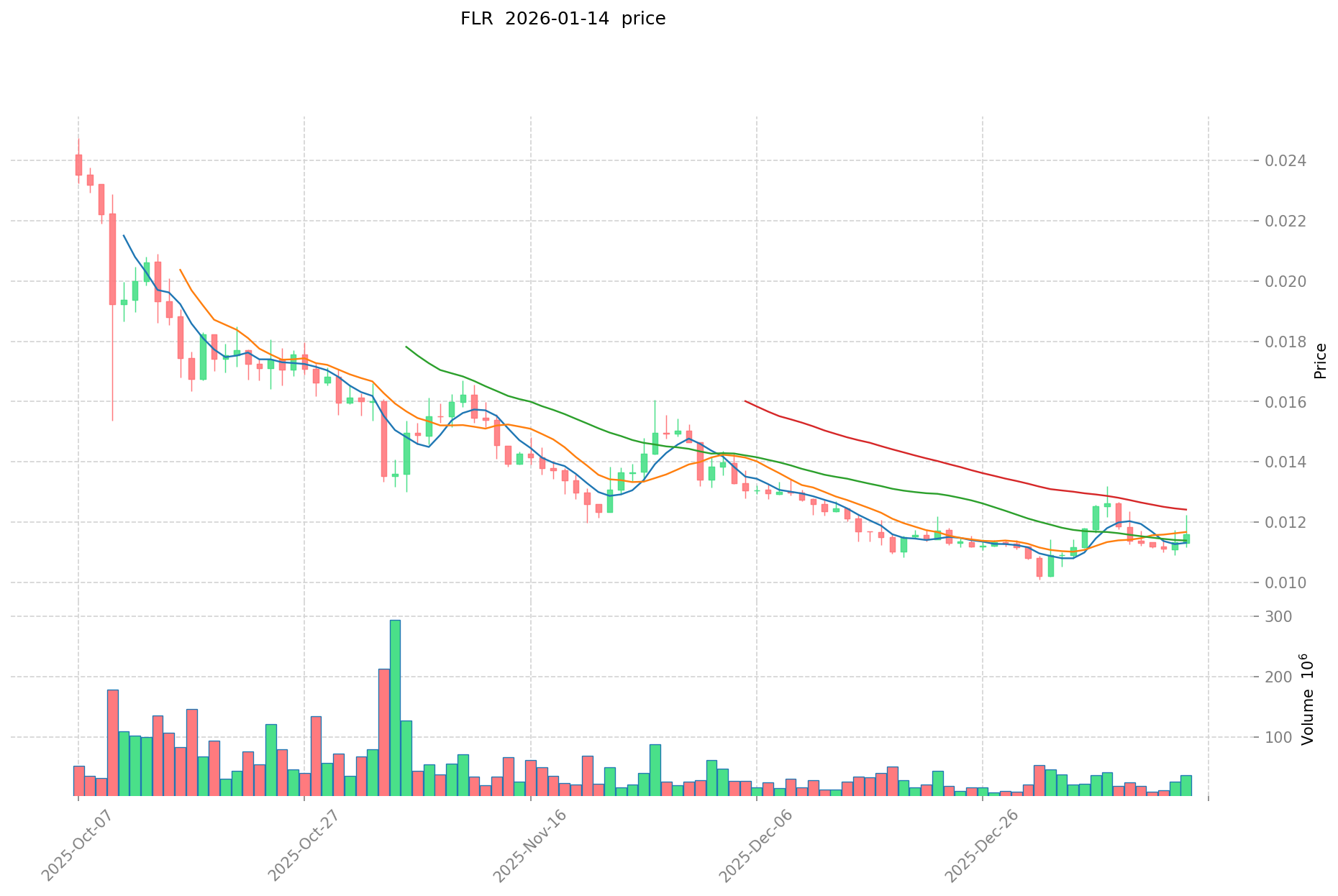
II. Core Factors Influencing Whether FLR is a Good Investment
Supply Mechanism and Scarcity (FLR Investment Scarcity)
- Supply dynamics → Influence price and investment value
- Historical pattern: Supply changes have contributed to FLR price movements, with the token reaching notable price levels of $0.150073 in January 2023
- Investment significance: Scarcity fundamentals support long-term investment considerations, with current circulating supply at 82.75 billion FLR (approximately 80.86% of maximum supply)
Institutional Investment and Mainstream Adoption (Institutional Investment in FLR)
- Market presence: FLR is listed on 28 exchanges, indicating broad market accessibility
- Adoption metrics: The network maintains 143 holder addresses, reflecting current user base
- Ecosystem positioning: As an EVM-based Layer 1 blockchain, Flare's infrastructure enables developers to build applications utilizing data from multiple chains and internet sources
Macroeconomic Environment's Impact on FLR Investment
- Market volatility: FLR demonstrates price fluctuations influenced by broader crypto market conditions, with 24-hour volatility ranging from $0.01119 to $0.01174
- Performance trends: The token shows mixed performance across timeframes, with 24-hour gains of 3.35% contrasted against 7-day decline of 5.5% and annual decline of 50.01%
- Market positioning: FLR holds 0.036% market dominance with a market capitalization of approximately $967.39 million
Technology and Ecosystem Development (Technology & Ecosystem for FLR Investment)
- State Connector Protocol: Enables secure, scalable, and trustless information flow from other blockchains and the internet through smart contracts on Flare
- Flare Time Series Oracle: Provides decentralized price and data feeds for dapps without reliance on centralized providers
- Cross-chain data accessibility: The platform supports developers in building applications that leverage high-integrity data from multiple ecosystems, expanding potential use cases and monetization models
- DeFi and multi-ecosystem applications: Flare's architecture enables building decentralized applications that can serve multiple blockchain ecosystems simultaneously
III. FLR Future Investment Forecast and Price Outlook (Is Flare Network(FLR) worth investing in 2026-2031)
Short-term Investment Outlook (2026, short-term FLR investment outlook)
- Conservative forecast: $0.0081 - $0.0095
- Neutral forecast: $0.0105 - $0.0117
- Optimistic forecast: $0.0118 - $0.0121
Mid-term Investment Outlook (2027-2029, mid-term Flare Network(FLR) investment forecast)
- Market phase expectation: Anticipated gradual growth phase with moderate volatility as the ecosystem continues developing its State Connector and Time Series Oracle infrastructure.
- Investment return forecast:
- 2027: $0.0107 - $0.0142
- 2028: $0.0124 - $0.0193
- 2029: $0.0087 - $0.0218
- Key catalysts: Potential expansion of cross-chain data integrations, advancement in decentralized oracle services, and broader adoption of Flare's interoperability protocols.
Long-term Investment Outlook (Is Flare Network a good long-term investment?)
- Base scenario: $0.0133 - $0.0207 (assuming steady ecosystem development and sustained community engagement through 2030-2031)
- Optimistic scenario: $0.0227 - $0.0281 (contingent upon significant protocol upgrades and increased institutional integration)
- Risk scenario: Below $0.0087 (under conditions of prolonged market downturn or competitive displacement)
Click to view FLR long-term investment and price forecast: Price Prediction
2026-01-14 - 2031 Long-term Outlook
- Base scenario: $0.0133 - $0.0207 (corresponding to steady progress and incremental mainstream adoption)
- Optimistic scenario: $0.0227 - $0.0281 (corresponding to large-scale adoption and favorable market conditions)
- Transformative scenario: Above $0.0281 (contingent upon breakthrough ecosystem achievements and mainstream penetration)
- 2031-12-31 forecast high: $0.0281 (based on optimistic development assumptions)
Disclaimer: Cryptocurrency markets are highly volatile and unpredictable. These forecasts are derived from available analytical data and should not be construed as financial advice. Investors should conduct independent research and consider their own risk tolerance before making investment decisions.
| Year |
Predicted High Price |
Predicted Average Price |
Predicted Low Price |
Price Change |
| 2026 |
0.0120819 |
0.01173 |
0.0080937 |
0 |
| 2027 |
0.0141680805 |
0.01190595 |
0.010715355 |
1 |
| 2028 |
0.01929478257 |
0.01303701525 |
0.0123851644875 |
11 |
| 2029 |
0.0218239635285 |
0.01616589891 |
0.0087295854114 |
38 |
| 2030 |
0.026402954394757 |
0.01899493121925 |
0.013296451853475 |
62 |
| 2031 |
0.028146689080684 |
0.022698942807003 |
0.020656037954373 |
94 |
IV. Flare Network Investment Strategy and Risk Management (How to invest in Layer 1 blockchain)
Investment Methodology (Flare Network investment strategy)
Long-term Holding (HODL FLR)
For conservative investors seeking stable exposure to the decentralized data infrastructure sector, a long-term holding strategy may be appropriate. This approach involves acquiring FLR tokens and maintaining positions through market cycles, based on the belief in Flare Network's technological fundamentals and ecosystem development potential. Investors adopting this strategy typically focus on the protocol's State Connector capabilities and Time Series Oracle infrastructure rather than short-term price movements.
Active Trading
Active trading strategies rely on technical analysis and swing trading techniques. Given FLR's 24-hour price volatility of 3.35% and 7-day fluctuation of -5.5%, traders may identify opportunities through chart patterns, volume analysis, and support/resistance levels. The token's daily trading range between $0.01119 and $0.01174 provides potential entry and exit points for experienced traders. However, such approaches require constant market monitoring and technical expertise.
Risk Management (Risk management for Flare Network investment)
Asset Allocation Ratios
- Conservative Investors: 1-3% of total portfolio allocated to FLR, prioritizing capital preservation while gaining limited exposure to Layer 1 blockchain infrastructure.
- Aggressive Investors: 5-10% allocation for those with higher risk tolerance and conviction in Flare's cross-chain data solutions.
- Professional Investors: 10-15% strategic allocation as part of a diversified blockchain infrastructure portfolio, with ongoing position monitoring and rebalancing.
Risk Hedging Solutions
Implementing multi-asset portfolio construction can help mitigate concentration risk. Combining FLR holdings with other Layer 1 protocols, stablecoins, and traditional hedging instruments may reduce overall portfolio volatility. Dollar-cost averaging (DCA) strategies can also smooth out entry points given the token's price fluctuations.
Secure Storage
- Hot Wallets: Suitable for active traders requiring frequent access, though carrying higher security risks.
- Cold Wallets: Recommended for long-term holders to minimize exposure to online threats.
- Hardware Wallets: Devices such as Ledger and Trezor provide enhanced security for substantial FLR holdings through offline private key storage.
V. Flare Network Investment Risks and Challenges (Risks of investing in Layer 1 blockchain)
Market Risks
FLR exhibits significant price volatility, with a 1-year decline of -50.01% from previous levels. The token's current price of $0.01169 remains substantially below its recorded high of $0.150073 on January 10, 2023. Such volatility presents risks for investors unprepared for sharp price movements. The cryptocurrency market's susceptibility to manipulation, particularly in lower-liquidity periods, represents an additional concern for position holders.
Regulatory Risks
The evolving regulatory landscape across different jurisdictions creates uncertainty for blockchain infrastructure projects. Changes in securities laws, data privacy regulations, or cross-border transaction policies could impact Flare Network's operational model and token utility. Investors should monitor regulatory developments in key markets where the protocol operates.
Technical Risks
As an EVM-based Layer 1 blockchain providing cross-chain data connectivity, Flare Network faces technical challenges inherent to complex protocol designs. Potential vulnerabilities in the State Connector protocol or Time Series Oracle system could compromise data integrity or network security. Protocol upgrades, while necessary for advancement, carry implementation risks that may temporarily affect network stability or token functionality.
VI. Conclusion: Is Layer 1 Blockchain Infrastructure a Good Investment?
Investment Value Summary
Flare Network presents a specialized investment thesis centered on decentralized data infrastructure for blockchain applications. While the protocol's technical approach to cross-chain data connectivity addresses real ecosystem needs, FLR has experienced substantial price volatility, with significant declines over the past year. The token's current market capitalization of approximately $967 million and circulating supply representing 80.86% of maximum supply indicate moderate maturity. However, short-term price movements remain unpredictable and subject to broader market sentiment.
Investor Recommendations
✅ Beginners: Consider dollar-cost averaging with small position sizes (1-2% of portfolio) and prioritize secure wallet storage solutions such as hardware wallets. Focus on understanding the protocol's fundamentals rather than timing market entries.
✅ Experienced Investors: Employ swing trading strategies within defined risk parameters while maintaining a core long-term position. Diversify across multiple Layer 1 protocols to reduce concentration risk and consider technical analysis for tactical allocation adjustments.
✅ Institutional Investors: Evaluate Flare Network as part of a strategic blockchain infrastructure allocation, conducting thorough due diligence on technical architecture, development progress, and ecosystem adoption metrics. Implement position limits and regular portfolio rebalancing protocols.
⚠️ Disclaimer: Cryptocurrency investments carry substantial risk due to price volatility, regulatory uncertainty, and technical complexities. This analysis is provided for informational purposes only and does not constitute financial advice. Investors should conduct independent research and consult qualified financial advisors before making investment decisions.
VII. FAQ
Q1: What is Flare Network (FLR) and what makes it unique compared to other Layer 1 blockchains?
Flare Network is an EVM-based Layer 1 blockchain designed to provide decentralized access to high-integrity data from other chains and the internet. What distinguishes Flare from other Layer 1 platforms is its State Connector protocol and Time Series Oracle system, which enable developers to build applications that can securely utilize cross-chain data without relying on centralized providers. This infrastructure allows for the creation of decentralized applications that serve multiple blockchain ecosystems simultaneously, addressing interoperability challenges in the broader crypto space.
Q2: Is FLR a good investment for beginners in 2026?
For beginners, FLR represents a high-risk, speculative investment that requires caution. The token has experienced significant volatility, declining approximately 50.01% over the past year from previous levels. Beginners should consider allocating only 1-2% of their portfolio to FLR, implement dollar-cost averaging strategies to mitigate entry timing risks, and prioritize secure storage through hardware wallets. Understanding the protocol's technical fundamentals and cross-chain data infrastructure is essential before making any investment commitment.
Q3: What are the main risks associated with investing in Flare Network?
The primary risks include: (1) Market volatility - FLR has shown substantial price fluctuations, currently trading 92.21% below its all-time high of $0.150073; (2) Regulatory uncertainty - evolving regulations concerning blockchain data infrastructure and cross-border transactions could impact operations; (3) Technical risks - potential vulnerabilities in the State Connector protocol or Time Series Oracle system; (4) Competition - other Layer 1 platforms and oracle solutions competing for market share; and (5) Liquidity concerns - with limited holder addresses (143), trading depth may be insufficient during market stress periods.
Q4: What is the realistic price prediction for FLR by the end of 2026?
Based on current market analysis, FLR's price forecast for 2026 presents three scenarios: Conservative ($0.0081 - $0.0095), Neutral ($0.0105 - $0.0117), and Optimistic ($0.0118 - $0.0121). The predicted high for year-end 2026 is approximately $0.0121, representing modest potential appreciation from current levels around $0.01169. These projections assume continued ecosystem development and stable market conditions. However, cryptocurrency markets remain highly unpredictable, and actual outcomes may vary significantly based on adoption rates, technological advancement, and overall market sentiment.
Q5: How does Flare Network's tokenomics affect its long-term investment potential?
Flare Network's tokenomics show that approximately 80.86% of the maximum supply (82.75 billion FLR) is already in circulation, suggesting limited additional dilution pressure compared to projects with low initial circulation. The relatively high circulating supply ratio provides transparency regarding future token release schedules. However, the large total supply may create challenges for substantial price appreciation without corresponding ecosystem growth. Long-term investment potential depends significantly on increasing utility through State Connector adoption, Time Series Oracle integration, and expanding cross-chain data applications that drive genuine demand for FLR tokens.
Q6: What investment strategy is most suitable for FLR holders?
The optimal strategy depends on investor profile and risk tolerance: Long-term holders (HODL strategy) should focus on accumulating FLR during market corrections with a 3-5 year horizon, emphasizing the protocol's fundamental development over short-term price action. Active traders can capitalize on FLR's volatility (24-hour fluctuations of 3-5%) through swing trading techniques, utilizing technical analysis and defined stop-loss parameters. Diversified approach combining both strategies—maintaining a core long-term position (60-70%) while actively trading a smaller allocation (30-40%)—may balance growth potential with risk management. All strategies should incorporate secure storage solutions and position sizing appropriate to individual risk tolerance.
Q7: Can institutional investors consider FLR as part of their blockchain infrastructure portfolio?
Institutional investors may evaluate FLR as a specialized allocation within broader blockchain infrastructure strategies, though with significant caveats. The protocol's focus on decentralized data infrastructure addresses legitimate ecosystem needs for cross-chain interoperability. However, institutional consideration requires: (1) thorough technical due diligence on State Connector security and scalability; (2) assessment of competitive positioning against established oracle solutions; (3) evaluation of development team execution capabilities; (4) analysis of ecosystem adoption metrics and partnership agreements; and (5) implementation of strict position limits (typically 1-3% of total blockchain allocation). The current market capitalization of $967 million and relatively limited holder base suggest FLR remains in early development stages requiring heightened risk monitoring.
Q8: What are the key milestones that could significantly impact FLR's price in 2026-2027?
Critical catalysts for FLR price movement include: (1) Protocol upgrades - enhancements to State Connector efficiency and Time Series Oracle accuracy; (2) Integration partnerships - major DeFi protocols or enterprise clients adopting Flare's data infrastructure; (3) Cross-chain expansion - increasing the number of supported blockchains for data connectivity; (4) Regulatory clarity - positive developments in blockchain data infrastructure regulations; (5) Exchange listings - addition to major centralized exchanges beyond the current 28 platforms; and (6) Ecosystem growth - measurable increases in developer activity, deployed applications, and network transaction volumes. Monitoring these developments provides insight into whether the project is achieving meaningful adoption versus remaining primarily speculative.
* The information is not intended to be and does not constitute financial advice or any other recommendation of any sort offered or endorsed by Gate.