This comprehensive investment analysis examines Flow (FLOW), the native token of a blockchain platform designed for next-generation games and digital assets. As of January 16, 2026, Flow trades at $0.1014 with a market capitalization of $165.86 million across 32 exchanges including Gate. The guide covers critical investment aspects including price performance history from launch to current levels, core factors influencing investment decisions such as technology and ecosystem development, and detailed price forecasts through 2031 ranging from conservative to optimistic scenarios. Investors receive actionable strategies for long-term holding and active trading, alongside essential risk management techniques including asset allocation guidelines and secure storage recommendations. The analysis addresses major challenges including market volatility, regulatory uncertainty, and technical risks, while providing specific guidance for beginners, experienced traders, and institutional investors seeking to evaluate Flo
Introduction: Flow (FLOW) Investment Position and Market Prospects
FLOW is a significant asset in the cryptocurrency space, serving as the native token of the Flow blockchain platform designed for next-generation games, applications, and digital assets. As of January 16, 2026, Flow maintains a market capitalization of approximately $165.86 million with a circulating supply of around 1.64 billion tokens, trading at $0.1014. The platform positions itself as a blockchain network that integrates usability improvements into the protocol layer, attracting developers and brands building decentralized applications. With 794,846 holders and availability on 32 exchanges, Flow has established a presence in the blockchain gaming and application ecosystem. The token serves multiple functions within its network, including staking for transaction validation, paying transaction fees, and covering network storage costs. This article provides a comprehensive analysis of Flow's investment characteristics, historical price movements, future price considerations, and associated risks to serve as a reference for market participants.
I. Flow (FLOW) Price History Review and Current Investment Status
- 2020: Flow blockchain launched with initial token distribution at $0.1, establishing foundational infrastructure for NFT and gaming applications → Early investors gained entry at initial offering levels
- 2021: Major ecosystem expansion driven by NBA Top Shot and NFT marketplace growth → FLOW price reached $42.4 in April 2021, representing substantial appreciation from launch price
- 2022-2024: Market adjustment period amid broader crypto sector volatility → Price declined from peak levels to multi-year lows
- 2025: Recovery phase initiated with ecosystem restructuring → FLOW experienced continued market pressure, with price recording $0.07519 level in early January
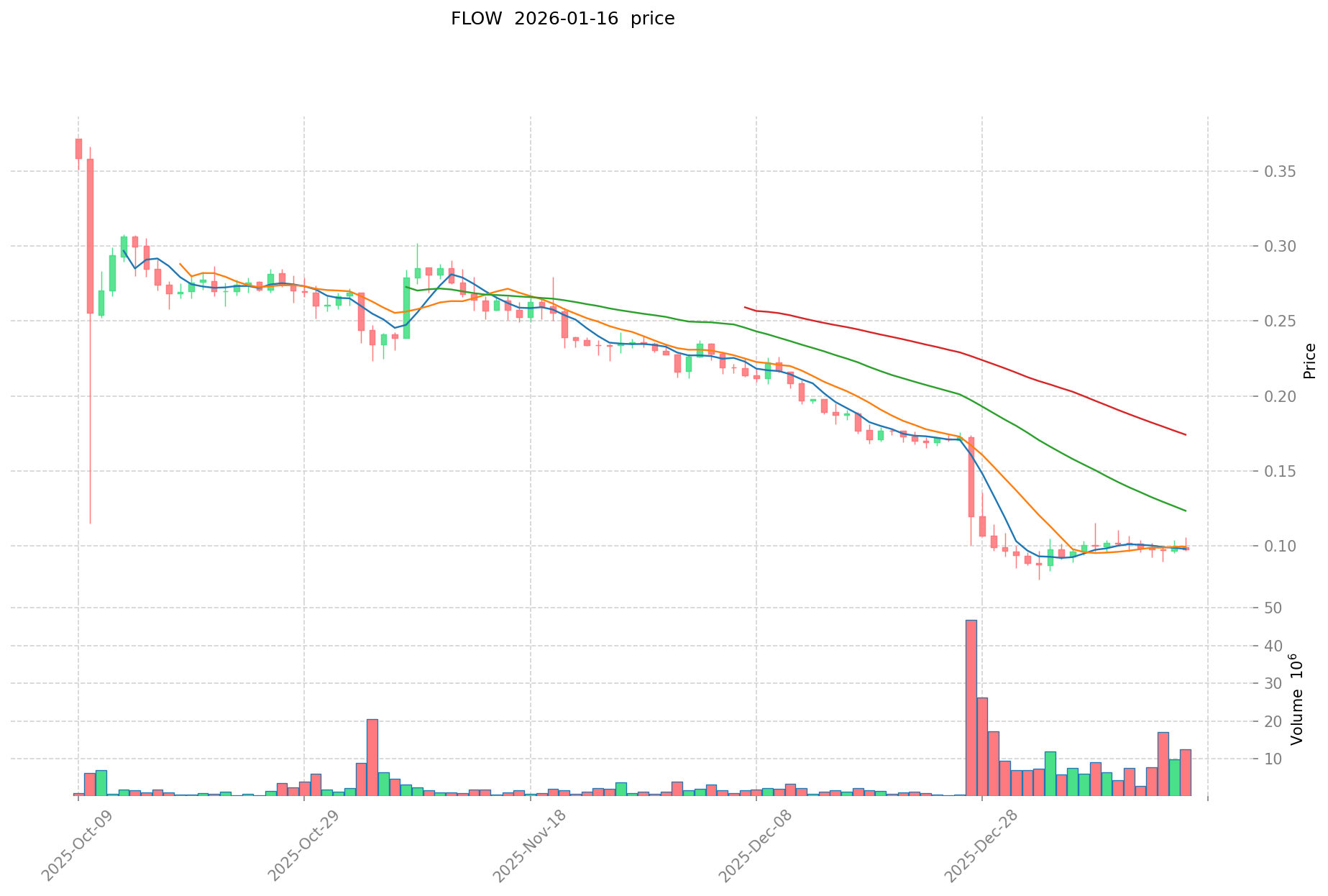
- 2026 (Current): Trading around $0.1014 as of January 16, 2026 → Price demonstrates modest stabilization with 1.88% increase over 24-hour period
Current FLOW Investment Market Status (January 2026)
- FLOW current price: $0.1014
- Market sentiment (Fear & Greed Index): Data not available in provided materials
- 24-hour trading volume: $1,257,289.34
- Circulating supply: 1,635,710,752 FLOW tokens
- Market capitalization: $165,861,070.26
- Total holder addresses: 794,846
- Exchange listings: Available on 32 cryptocurrency exchanges
- Recent price performance: +1.88% (24h), -0.54% (7d), -45.57% (30d), -87.18% (1y)
Click to view real-time FLOW market price
II. Core Factors Influencing Whether FLOW is a Good Investment
Supply Mechanism and Scarcity (FLOW Investment Scarcity)
- Total supply stands at 1,635,710,752 FLOW tokens with no maximum supply cap (indicated as ∞), while circulating supply represents approximately 100.37% of the total supply
- The token economic model includes staking requirements and transaction fee payments, which may influence circulating supply dynamics
- Investment consideration: The unlimited maximum supply structure differs from assets with fixed caps, which may affect long-term scarcity dynamics and investment value assessment
Institutional Investment and Mainstream Adoption (Institutional Investment in FLOW)
- Flow has attracted partnerships with major brands and top-tier developers building on the platform, as evidenced by its focus on mainstream consumer applications
- The network reports 794,846 holders as of January 2026, suggesting a broad user base distribution
- The platform's design prioritizes usability improvements at the protocol layer, which may support institutional and enterprise adoption for gaming and digital asset applications
Macroeconomic Environment Impact on FLOW Investment
- Recent price performance shows volatility with a 45.57% decline over 30 days and 87.18% decline over one year, reflecting sensitivity to broader market conditions
- The current trading price of $0.1014 (as of January 16, 2026) remains significantly below historical levels, which may present both risk and opportunity considerations
- Market capitalization stands at approximately $165.86 million with a 0.0048% market share, positioning FLOW as a mid-tier asset subject to broader cryptocurrency market dynamics
Technology and Ecosystem Development (Technology & Ecosystem for FLOW Investment)
- Multi-node architecture design: The platform employs a specialized blockchain structure aimed at improving security, speed, and efficiency for application development
- Consumer-focused UX optimization: Protocol-level usability improvements distinguish Flow from other blockchain networks, potentially supporting long-term developer retention
- NFT and gaming applications: The network serves as infrastructure for next-generation games and digital assets, with ongoing ecosystem development through developer events and on-chain upgrades
- DeFi integration potential: While the platform emphasizes consumer applications and NFT functionality, the broader Web3 ecosystem development may influence investment value over time
III. FLOW Future Investment Forecast and Price Outlook (Is Flow(FLOW) worth investing in 2026-2031)
Short-term Investment Forecast (2026, short-term FLOW investment outlook)
- Conservative Forecast: $0.058 - $0.100
- Neutral Forecast: $0.100 - $0.125
- Optimistic Forecast: $0.125 - $0.150
Mid-term Investment Outlook (2027-2028, mid-term Flow(FLOW) investment forecast)
- Market Stage Expectation: Based on statistical models and historical patterns, FLOW may experience gradual recovery during the mid-term period, supported by ongoing blockchain infrastructure developments and potential ecosystem expansion.
- Investment Return Forecast:
- 2027: $0.106 - $0.172
- 2028: $0.109 - $0.199
- Key Catalysts: Global digital currency regulatory dynamics, technological advancements in blockchain scalability solutions, and adoption by mainstream applications and developers.
Long-term Investment Outlook (Is FLOW a good long-term investment?)
- Base Scenario: $0.104 - $0.237 (assuming steady ecosystem development and stable market conditions through 2029)
- Optimistic Scenario: $0.160 - $0.313 (assuming accelerated adoption, favorable regulatory environment, and successful implementation of multi-node architecture benefits through 2031)
- Risk Scenario: Below $0.058 (in case of prolonged market downturn, regulatory challenges, or competitive pressure from alternative blockchain platforms)
For detailed FLOW long-term investment analysis and price predictions: Price Prediction
2026-2031 Long-term Outlook
- Base Scenario: $0.058 - $0.205 USD (corresponding to steady progress and gradual mainstream application growth)
- Optimistic Scenario: $0.160 - $0.313 USD (corresponding to large-scale adoption and favorable market environment)
- Transformative Scenario: Above $0.313 USD (in case of breakthrough ecosystem developments and mainstream popularization)
- 2031-12-31 Projected High: $0.313 USD (based on optimistic development assumptions)
Disclaimer: Price predictions are based on statistical models and historical data patterns. Cryptocurrency markets remain highly volatile and unpredictable. These forecasts should not be considered as investment advice, and actual future prices may differ significantly from projections due to market dynamics, regulatory changes, technological developments, and other unforeseen factors.
| Year |
Predicted High Price |
Predicted Average Price |
Predicted Low Price |
Price Change |
| 2026 |
0.149596 |
0.1004 |
0.058232 |
0 |
| 2027 |
0.17249724 |
0.124998 |
0.1062483 |
23 |
| 2028 |
0.1993218108 |
0.14874762 |
0.1085857626 |
46 |
| 2029 |
0.236687212944 |
0.1740347154 |
0.10442082924 |
71 |
| 2030 |
0.23205788951436 |
0.205360964172 |
0.17661042918792 |
102 |
| 2031 |
0.312754480385747 |
0.21870942684318 |
0.159657881595521 |
115 |
IV. Flow Investment Strategy and Risk Management (How to invest in Flow)
Investment Strategy (Flow investment strategy)
Long-term Holding (HODL Flow): Suitable for conservative investors
Flow, as a blockchain platform designed for next-generation games and applications, may appeal to investors seeking long-term exposure to the gaming and NFT sectors. A buy-and-hold strategy allows investors to potentially benefit from the platform's ecosystem growth as more developers and brands build on Flow. This approach requires patience and tolerance for short-term price fluctuations.
Active Trading: Relying on technical analysis and swing trading
For traders with experience in technical analysis, Flow's price movements may present opportunities for active trading strategies. Given the token's volatility (with 24-hour changes of 1.88% and 7-day changes of -0.54% as of January 16, 2026), swing traders may identify entry and exit points based on price patterns, volume trends, and market momentum indicators.
Risk Management (Risk management for Flow investment)
Asset Allocation Ratio: Conservative / Aggressive / Professional investors
- Conservative investors: Consider allocating 1-5% of crypto portfolio to Flow, maintaining majority exposure to established assets
- Aggressive investors: May allocate 10-20% of crypto portfolio to Flow, accepting higher volatility for potential growth
- Professional investors: Portfolio allocation based on comprehensive analysis of Flow's technical fundamentals, ecosystem development, and market conditions
Risk Hedging Solutions: Multi-asset portfolio + risk mitigation tools
Diversification remains essential when investing in Flow. Investors should consider:
- Maintaining exposure across different cryptocurrency categories (Layer 1 platforms, DeFi tokens, stablecoins)
- Utilizing stablecoins for portfolio rebalancing during periods of high volatility
- Monitoring correlation with broader crypto market movements
- Setting stop-loss orders to limit potential downside exposure
Secure Storage: Hot and cold wallets + hardware wallet recommendations
Proper storage of Flow tokens is critical for security:
- Cold Storage: Hardware wallets (such as Ledger or Trezor models supporting Flow) for long-term holdings
- Hot Wallets: Flow-compatible software wallets for active trading or staking participation
- Exchange Storage: Only for amounts actively traded; avoid storing significant holdings on exchanges long-term
- Backup Procedures: Maintain secure backups of private keys and recovery phrases in multiple physical locations
V. Flow Investment Risks and Challenges (Risks of investing in Flow)
Market Risk: High volatility and price manipulation concerns
Flow has demonstrated significant price volatility, with a 30-day decline of -45.57% and a 1-year decline of -87.18% as of January 16, 2026. The token's price of $0.1014 represents a substantial decrease from its all-time high of $42.4 reached on April 5, 2021. With a market capitalization of approximately $165.86 million and ranking at position 272, Flow's relatively smaller market presence compared to major cryptocurrencies may contribute to increased price volatility and potential susceptibility to large-order price impacts.
Regulatory Risk: Policy uncertainty across different jurisdictions
As a blockchain platform focused on gaming, applications, and digital assets, Flow may face evolving regulatory frameworks in various jurisdictions. Different countries maintain varying approaches to cryptocurrency regulation, which could impact:
- Platform operations and token utility
- Developer and brand partnerships on the network
- Token listing and trading availability on exchanges
- Tax treatment and reporting requirements for investors
Investors should monitor regulatory developments in their jurisdictions and major markets where Flow operates.
Technical Risk: Network security vulnerabilities and upgrade failures
As with any blockchain platform, Flow faces technical risks including:
- Potential smart contract vulnerabilities or network security issues
- Challenges in protocol upgrades or network maintenance
- Competition from other blockchain platforms targeting similar use cases
- Developer adoption and ecosystem growth uncertainties
The platform's ability to maintain network security, implement successful upgrades, and attract sustained developer interest will impact long-term viability.
VI. Conclusion: Is Flow a Good Investment?
Investment Value Summary: Flow presents potential opportunities in the blockchain gaming and application sector, but carries substantial short-term price volatility and long-term uncertainty.
As of January 16, 2026, Flow trades at $0.1014 with a circulating supply of approximately 1.64 billion tokens. The platform's focus on gaming and digital assets positions it within a growing sector, though significant price declines over recent periods (-45.57% over 30 days, -87.18% over 1 year) reflect market challenges. With 794,846 holders and availability on 32 exchanges, Flow maintains a community presence, though its market capitalization of $165.86 million represents a relatively modest position in the cryptocurrency market.
Investor Recommendations:
✅ Beginners: Consider dollar-cost averaging (DCA) strategies combined with secure wallet storage. Allocate only funds you can afford to lose, given Flow's volatility profile.
✅ Experienced Investors: May explore swing trading opportunities while maintaining core long-term positions. Diversify across multiple blockchain platforms and asset categories.
✅ Institutional Investors: Conduct comprehensive due diligence on Flow's technical architecture, ecosystem partnerships, and competitive positioning before considering strategic allocation.
⚠️ Disclaimer: Cryptocurrency investments carry substantial risk, including potential complete loss of capital. This content is for informational purposes only and does not constitute investment advice. Investors should conduct independent research and consult qualified financial advisors before making investment decisions.
VII. FAQ
Q1: Is Flow (FLOW) a good investment for beginners in 2026?
Flow may be suitable for beginners willing to accept high volatility and long-term uncertainty. As of January 16, 2026, FLOW trades at $0.1014, down 87.18% over the past year, indicating substantial price volatility. For beginners, a dollar-cost averaging (DCA) approach with conservative allocation (1-5% of crypto portfolio) is recommended. The platform's focus on blockchain gaming and NFT applications presents growth potential, but investors should only allocate funds they can afford to lose completely. Secure storage using hardware wallets and thorough understanding of the platform's use cases are essential before investing.
Q2: What are the main risks of investing in Flow (FLOW)?
The primary risks include extreme price volatility, regulatory uncertainty, and technical challenges. Flow has experienced a 45.57% decline over 30 days and 87.18% decline over one year, demonstrating significant market risk. With a relatively modest market capitalization of $165.86 million (ranking #272), FLOW faces potential price manipulation concerns and liquidity risks. Regulatory challenges may affect gaming and NFT-focused platforms across different jurisdictions. Technical risks include potential smart contract vulnerabilities, network security issues, and competition from other blockchain platforms targeting similar use cases. Investors should conduct comprehensive risk assessment before allocating capital.
Q3: How does Flow's unlimited supply affect its long-term investment value?
Flow's unlimited maximum supply (indicated as ∞) differs fundamentally from cryptocurrencies with fixed supply caps. With a circulating supply of 1,635,710,752 tokens representing approximately 100.37% of total supply, the absence of a supply ceiling may impact long-term scarcity dynamics. Unlike Bitcoin's fixed 21 million supply, Flow's token economics rely on staking requirements and transaction fee mechanisms rather than supply scarcity to drive value. This structure means investment value depends more on ecosystem growth, developer adoption, and network utility rather than supply-driven price appreciation. Investors should evaluate whether this economic model aligns with their investment thesis.
Q4: What is Flow's price prediction for 2027-2028?
Based on statistical models and historical data patterns, Flow's mid-term forecast for 2027 ranges from $0.106 to $0.172, while 2028 projections range from $0.109 to $0.199. These predictions assume gradual ecosystem recovery, continued blockchain infrastructure development, and potential expansion in gaming and NFT applications. Key catalysts include global cryptocurrency regulatory developments, technological advancements in blockchain scalability, and mainstream developer adoption. However, cryptocurrency markets remain highly unpredictable, and actual prices may differ significantly from these projections due to market dynamics, competitive pressures, and unforeseen factors. These forecasts should not be considered investment advice.
Q5: How should investors store Flow (FLOW) tokens securely?
Secure storage of Flow tokens requires a multi-layered approach based on investment timeframe and activity level. For long-term holdings, hardware wallets such as Ledger or Trezor models supporting Flow provide optimal security through cold storage. Active traders may use Flow-compatible software wallets for staking participation or frequent transactions, though hot wallets carry higher security risks. Investors should avoid storing significant holdings on exchanges long-term, using exchange storage only for actively traded amounts. Essential security practices include maintaining secure backups of private keys and recovery phrases in multiple physical locations, implementing two-factor authentication, and regularly updating wallet software.
Q6: What makes Flow different from other blockchain platforms for investment purposes?
Flow distinguishes itself through its multi-node architecture designed specifically for consumer applications, games, and digital assets. Unlike general-purpose blockchains, Flow integrates usability improvements at the protocol layer, potentially offering advantages for mainstream developer adoption. The platform gained initial recognition through NBA Top Shot and NFT marketplace growth in 2021. With 794,846 holders and availability on 32 exchanges, Flow maintains an established ecosystem presence. However, with a current market capitalization of $165.86 million and price 97.6% below its all-time high of $42.4, investors must weigh the platform's technical differentiation against significant market depreciation and competition from alternative Layer 1 solutions.
Q7: Is Flow suitable for long-term holding (HODL strategy)?
Flow may be suitable for long-term holding for investors with high risk tolerance and belief in the blockchain gaming and NFT sector's growth. The HODL strategy allows potential benefit from ecosystem expansion as developers and brands build on the platform. Long-term projections suggest a base scenario range of $0.058-$0.237 through 2029, with an optimistic scenario reaching $0.160-$0.313 by 2031. However, the 87.18% price decline over the past year and current trading level of $0.1014 indicate substantial patience is required for potential recovery. Conservative investors should allocate only 1-5% of their crypto portfolio to Flow, while more aggressive investors may consider 10-20% allocation based on comprehensive analysis of the platform's technical fundamentals and competitive positioning.
Q8: What are the key catalysts that could drive Flow's price higher?
Several potential catalysts could influence Flow's price trajectory positively: (1) Increased developer adoption and successful deployment of major gaming or NFT applications on the platform, (2) Strategic partnerships with mainstream brands and entertainment properties similar to the NBA Top Shot collaboration, (3) Favorable regulatory developments for blockchain gaming and digital asset platforms, (4) Successful implementation of protocol upgrades enhancing network performance and usability, (5) Growing institutional interest in blockchain gaming infrastructure, and (6) Broader cryptocurrency market recovery. However, investors should note that with a market share of only 0.0048% and ranking at position 272, Flow faces substantial competition and must demonstrate meaningful ecosystem growth and user adoption to achieve significant price appreciation.
* The information is not intended to be and does not constitute financial advice or any other recommendation of any sort offered or endorsed by Gate.