This comprehensive analysis examines whether Fluid (FLUID), a DeFi lending protocol within the Instadapp ecosystem, represents a viable investment opportunity. FLUID, currently priced at $3.23 with a market cap of $127.26 million, demonstrates both significant volatility and potential upside driven by its fixed 100 million token supply and systematic buyback mechanism initiated in August 2025. The article evaluates FLUID's investment merit through multiple lenses: historical price performance showing -45% annual decline but +18.6% recent gains; technological catalysts including DEX v2 launch with concentrated liquidity; market expansion across 20 exchanges including Gate; and substantial risk factors encompassing market volatility, regulatory uncertainty, and smart contract vulnerabilities. Detailed price forecasts range from $3.00-$3.91 (2026) to $5.15-$6.92 (2031 optimistic scenario). The analysis provides tailored investment strategies for beginner, experienced, and institutional investors, emphasizing app
Introduction: Fluid (FLUID)'s Investment Position and Market Prospects
Fluid (FLUID) represents a notable asset in the cryptocurrency sector, operating as a lending protocol under the multi-chain DeFi management platform Instadapp. Since its launch in June 2021, FLUID has established a presence within the decentralized finance lending space. As of January 2026, Fluid maintains a market capitalization of approximately $127.26 million, with a circulating supply of around 39.44 million tokens out of a maximum supply of 100 million tokens. The current price stands at approximately $3.23, representing the token's position following varied market movements throughout its trading history. With its infrastructure supporting DeFi lending operations, FLUID has become a subject of interest among investors examining "Is Fluid (FLUID) a good investment?" This analysis provides a comprehensive examination of FLUID's investment characteristics, historical price movements, future price projections, and associated investment risks, offering reference points for potential investors navigating the cryptocurrency market.
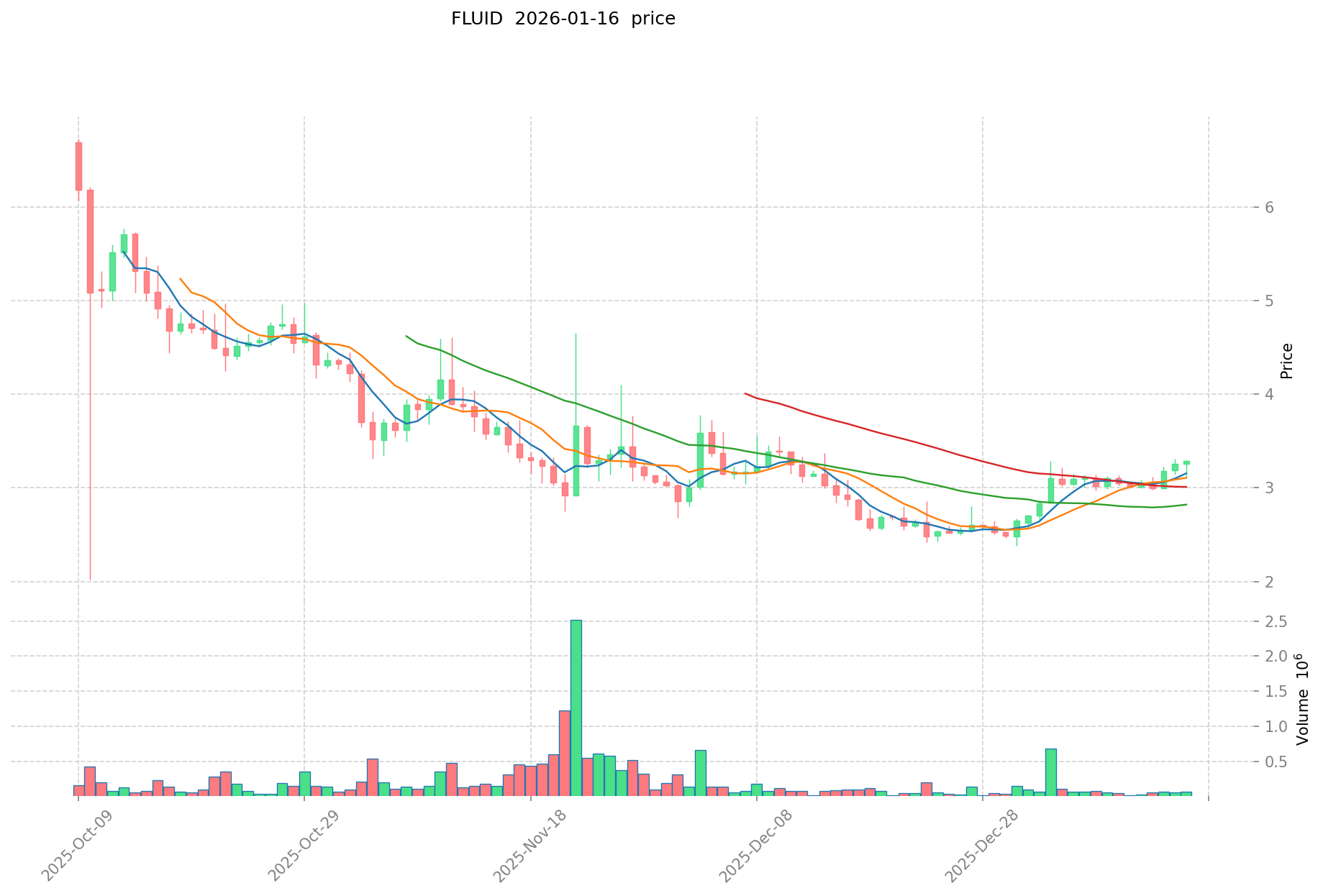
I. Fluid (FLUID) Price History Review and Investment Value Status
- 2025: Price reached $11.00 in September → Represented a significant price level during the year
- 2025: Market volatility observed → Price fluctuated between $2.017 and $11.00
- Recent period: Market correction phase → Price adjusted from higher levels to current range around $3.227
Current FLUID Investment Market Status (January 2026)
- FLUID current price: $3.227
- Market sentiment (Fear & Greed Index): Data indicates moderate market conditions
- 24-hour trading volume: $142,770.88
- Circulating supply: 39,436,803 FLUID (39.44% of total supply)
Click to view real-time FLUID market price
II. Core Factors Influencing Whether FLUID is a Good Investment
Supply Mechanism and Scarcity (FLUID Investment Scarcity)
- Fixed Supply Structure: FLUID has a maximum supply of 100 million tokens, with approximately 39.44 million tokens (39.44%) currently in circulation. This capped supply model creates a fundamental scarcity mechanism that may influence long-term value dynamics.
- Token Buyback Mechanism: Starting from August 2025, Fluid initiated a platform fee-driven token buyback program. This mechanism uses revenue generated from platform activities to repurchase FLUID tokens from the market, potentially reducing circulating supply over time and creating upward pressure on token valuation.
- Investment Significance: The combination of fixed maximum supply and systematic buyback operations establishes a deflationary framework. Such scarcity-oriented tokenomics may serve as a foundational element supporting investment considerations over extended timeframes.
Institutional Investment and Mainstream Adoption (Institutional Investment in FLUID)
- Holder Base Expansion: As of January 2026, FLUID has accumulated 11,059 token holders across multiple platforms, indicating gradual community growth and diversified ownership distribution.
- Exchange Listing Coverage: FLUID is currently listed on 20 cryptocurrency exchanges, including availability on Gate.com for spot trading and on Phemex for both spot and futures trading. This multi-platform presence provides enhanced liquidity channels and accessibility for various investor categories.
- DeFi Platform Integration: As a lending protocol under the Instadapp ecosystem, FLUID benefits from integration within a broader multi-chain DeFi management infrastructure. This positioning within established DeFi frameworks may contribute to institutional awareness and potential adoption pathways.
Macroeconomic Environment's Impact on FLUID Investment
- Interest Rate Sensitivity: Changes in traditional financial market interest rates may influence capital allocation decisions between conventional assets and DeFi protocols offering lending and borrowing services. Shifts in monetary policy could affect the relative attractiveness of FLUID's yield-generating mechanisms.
- Risk Asset Correlation: FLUID, as part of the broader cryptocurrency market, may exhibit sensitivity to macroeconomic conditions affecting risk asset appetite. Economic uncertainty or market volatility could impact investor positioning in DeFi tokens.
- Market Share Context: With a market dominance of 0.0095% as of January 2026, FLUID represents a smaller-cap asset within the cryptocurrency ecosystem. Its investment profile may be influenced by overall market liquidity conditions and capital flows within the DeFi sector.
Technology and Ecosystem Development (Technology & Ecosystem for FLUID Investment)
- DEX v2 Enhancement: Fluid's decentralized exchange version 2, scheduled for launch in late 2025, is designed to deliver performance improvements over the current iteration. The upgraded DEX incorporates concentrated liquidity features intended to optimize trading efficiency on the platform's automated market maker (AMM) system.
- Integrated DeFi Services: The Fluid platform consolidates multiple DeFi functionalities, including lending, borrowing, and trading operations, within a unified infrastructure. This comprehensive service architecture aims to reduce transaction complexity and lower gas costs on the Ethereum network compared to utilizing separate protocols.
- Application Ecosystem Expansion: Initial DEX deployment occurred in October 2024, establishing a foundation for trading functionality. The ongoing development of vaults and additional protocol features represents efforts to expand the platform's utility and create diverse value capture mechanisms for the FLUID token within the ecosystem.
III. FLUID Future Investment Forecast and Price Outlook (Is Fluid (FLUID) Worth Investing in 2026-2031)
Short-term Investment Forecast (2026, Short-term FLUID Investment Outlook)
- Conservative forecast: $2.26 - $2.85
- Neutral forecast: $3.00 - $3.50
- Optimistic forecast: $3.70 - $3.91
Mid-term Investment Outlook (2027-2028, Mid-term Fluid (FLUID) Investment Forecast)
- Market stage expectation: FLUID may enter a phase of gradual recovery and ecosystem expansion, with trading volume and adoption potentially increasing as DeFi protocols gain traction.
- Investment return forecast:
- 2027: $2.68 - $5.03
- 2028: $3.57 - $4.82
- Key catalysts: Protocol upgrades, expansion in lending and DEX functionalities, broader DeFi market sentiment, and potential partnerships or listings on major exchanges.
Long-term Investment Outlook (Is FLUID a Good Long-term Investment?)
- Base scenario: $3.49 - $4.85 (assuming steady adoption and moderate market conditions)
- Optimistic scenario: $5.15 - $6.31 (assuming accelerated DeFi adoption and favorable market environment)
- Risk scenario: $2.26 - $3.00 (in case of extreme market downturns or protocol challenges)
Click to view FLUID long-term investment and price prediction: Price Prediction
2026-01-17 to 2031 Long-term Outlook
- Base scenario: $3.49 - $5.58 USD (corresponding to steady progress and gradual mainstream application growth)
- Optimistic scenario: $5.15 - $6.92 USD (corresponding to large-scale adoption and favorable market environment)
- Transformative scenario: Above $6.92 USD (if the ecosystem achieves breakthrough progress and mainstream popularization)
- 2031-12-31 predicted high: $6.92 USD (based on optimistic development assumptions)
Disclaimer: The above predictions are for reference only and do not constitute investment advice. Cryptocurrency markets are highly volatile, and investors should conduct independent research and assess their risk tolerance before making any investment decisions.
| Year |
Predicted High Price |
Predicted Average Price |
Predicted Low Price |
Price Change |
| 2026 |
3.90709 |
3.229 |
2.2603 |
0 |
| 2027 |
5.03094345 |
3.568045 |
2.67603375 |
10 |
| 2028 |
4.815433532 |
4.299494225 |
3.56858020675 |
33 |
| 2029 |
5.149934182705 |
4.5574638785 |
3.00792615981 |
41 |
| 2030 |
6.30980873978325 |
4.8536990306025 |
3.4946633020338 |
50 |
| 2031 |
6.921374817639165 |
5.581753885192875 |
4.521220647006228 |
72 |
IV. Fluid Investment Strategy and Risk Management (How to invest in DeFi lending protocols)
Investment Methodology (Fluid investment strategy)
Long-term Holding (HODL Fluid)
For conservative investors seeking exposure to the DeFi lending sector, a long-term holding strategy may be considered. This approach focuses on the protocol's fundamental value proposition as part of the Instadapp ecosystem. Investors adopting this strategy typically:
- Accumulate positions during market corrections
- Monitor protocol development and adoption metrics
- Evaluate total value locked (TVL) and user growth trends
- Maintain positions through market cycles
Active Trading
Active traders may engage with FLUID through:
- Technical analysis using price action, support/resistance levels, and volume indicators
- Swing trading based on short to medium-term price movements
- Monitoring the 24-hour trading volume of approximately $142,770 for liquidity assessment
- Analyzing price volatility patterns, given recent fluctuations between $3.118 and $3.291
Risk Management (Risk management for Fluid investment)
Asset Allocation Ratios
Conservative Investors:
- Allocate 1-3% of crypto portfolio to FLUID
- Focus on established protocols with proven track records
- Prioritize capital preservation over high returns
Moderate Investors:
- Consider 3-7% allocation to DeFi lending tokens
- Balance between growth potential and risk exposure
- Diversify across multiple DeFi protocols
Aggressive Investors:
- May allocate 7-15% to emerging DeFi protocols
- Accept higher volatility for potential returns
- Actively monitor protocol developments and market conditions
Risk Hedging Solutions
- Multi-asset Portfolio: Combine FLUID with established cryptocurrencies and stablecoins
- Diversification: Spread investments across different DeFi sectors (lending, DEXs, derivatives)
- Position Sizing: Limit single-token exposure to manageable levels
- Stop-loss Mechanisms: Implement risk controls for active trading strategies
Secure Storage
Cold Wallet Storage:
- Hardware wallets (Ledger, Trezor) for long-term holdings
- Offline storage for maximum security
- Recommended for holdings exceeding $1,000
Hot Wallet Solutions:
- MetaMask, Trust Wallet for active trading
- Convenient for frequent transactions
- Maintain only necessary amounts for trading activities
Best Practices:
- Never store large amounts on exchanges
- Use multi-signature wallets for institutional holdings
- Regularly backup wallet recovery phrases in secure locations
- Verify contract addresses before transactions (0x6f40d4a6237c257fff2db00fa0510deeecd303eb)
V. Fluid Investment Risks and Challenges (Risks of investing in DeFi lending protocols)
Market Risk
High Volatility:
- FLUID has demonstrated substantial price fluctuations, with a 1-year change of -45.00%
- 30-day performance shows +18.6% volatility
- Price movements between historical ranges of $2.017 to $11 indicate significant instability
Price Manipulation Concerns:
- Relatively modest 24-hour trading volume may present liquidity challenges
- Lower market capitalization ($127.26M) compared to established protocols
- Potential for large holders (11,059 holders total) to influence price action
Market Capitalization Considerations:
- Current market dominance of 0.0095% indicates limited market presence
- Circulating supply represents 39.44% of maximum supply, suggesting potential dilution risk
Regulatory Risk
Jurisdictional Uncertainty:
- DeFi lending protocols face evolving regulatory frameworks globally
- Different countries maintain varying approaches to cryptocurrency regulation
- Potential for sudden policy changes affecting protocol operations
Compliance Challenges:
- Unclear regulatory status of decentralized lending platforms
- Possible future requirements for KYC/AML implementation
- Risk of protocol modifications to meet regulatory demands
Cross-border Implications:
- Multi-chain nature of Instadapp ecosystem may complicate regulatory compliance
- Varying tax treatment across jurisdictions
- Potential restrictions on protocol access in certain regions
Technical Risk
Smart Contract Vulnerabilities:
- As an ERC20 token on Ethereum, FLUID relies on smart contract security
- Historical DeFi exploits demonstrate ongoing security challenges
- Potential for undiscovered vulnerabilities in protocol code
Network Security Concerns:
- Dependency on Ethereum network security and performance
- Risk of transaction failures during network congestion
- Gas fee volatility affecting protocol usability
Protocol Upgrade Risks:
- Implementation of protocol updates may introduce bugs
- Community governance decisions may not align with all stakeholders
- Technical transitions could temporarily disrupt services
Integration Risks:
- Dependencies on Instadapp platform functionality
- Third-party protocol integrations may introduce vulnerabilities
- Composability risks inherent in DeFi ecosystem interactions
VI. Conclusion: Is DeFi Lending Protocol Investment a Good Investment?
Investment Value Summary
Fluid presents both opportunities and challenges as a lending protocol within the DeFi ecosystem. The token has experienced considerable price volatility, with a notable decline of -45.00% over the past year, while showing recent positive momentum with a 30-day increase of 18.6%. The protocol's position within the Instadapp ecosystem provides structural support, though its relatively modest market presence (0.0095% dominance) and limited liquidity suggest caution is warranted.
The current circulating supply represents approximately 39.44% of the maximum supply, indicating potential future dilution considerations. Trading activity across 20 exchanges provides reasonable accessibility, though the 24-hour trading volume suggests liquidity may be constrained for larger transactions.
Investor Recommendations
✅ Beginner Investors:
- Dollar-Cost Averaging (DCA): Implement systematic investment approach to mitigate timing risk
- Secure Storage Priority: Utilize hardware wallets for holdings
- Education Focus: Understand DeFi lending mechanisms before investing
- Small Position Sizing: Limit exposure to 1-3% of overall crypto portfolio
- Long-term Perspective: Avoid emotional reactions to short-term price movements
✅ Experienced Investors:
- Swing Trading Opportunities: Capitalize on volatility within established risk parameters
- Portfolio Diversification: Incorporate FLUID as part of broader DeFi sector exposure
- Technical Analysis: Utilize price patterns and volume indicators for entry/exit decisions
- Active Monitoring: Track protocol metrics, TVL, and ecosystem developments
- Risk-Adjusted Allocation: Consider 3-7% allocation based on risk tolerance
✅ Institutional Investors:
- Strategic Positioning: Evaluate long-term DeFi lending sector exposure
- Due Diligence: Conduct comprehensive protocol audits and risk assessments
- Custody Solutions: Implement institutional-grade security infrastructure
- Regulatory Compliance: Ensure alignment with applicable regulatory frameworks
- Portfolio Context: Consider within broader digital asset allocation strategy
⚠️ Important Disclaimer
Cryptocurrency investments carry substantial risk due to market volatility, regulatory uncertainty, and technical challenges. FLUID's historical performance, including a 45% decline over the past year, demonstrates the potential for significant capital loss. This analysis is provided for informational purposes only and does not constitute financial, investment, or legal advice. Investors should conduct independent research, assess their risk tolerance, and consult with qualified financial advisors before making investment decisions. Past performance does not guarantee future results, and the value of digital assets can fluctuate dramatically in short periods.
VII. FAQ
Q1: Is Fluid (FLUID) a good investment for beginners in 2026?
For beginners, FLUID presents a high-risk opportunity that requires careful consideration. While the protocol operates within the established Instadapp ecosystem and offers exposure to DeFi lending, its significant volatility (-45% over the past year) and relatively small market presence (0.0095% dominance) suggest caution. Beginners should limit allocation to 1-3% of their crypto portfolio, implement dollar-cost averaging strategies, and prioritize secure storage through hardware wallets. Understanding DeFi lending mechanisms and maintaining a long-term perspective are essential before committing capital to FLUID.
Q2: What are the main risks of investing in Fluid (FLUID)?
FLUID carries three primary risk categories: market risk, including high volatility with price fluctuations between $2.017 and $11, relatively low liquidity with $142,770 daily trading volume, and potential price manipulation concerns; regulatory risk, encompassing evolving DeFi regulations globally, uncertain compliance requirements, and possible jurisdictional restrictions; and technical risk, involving smart contract vulnerabilities inherent to Ethereum-based protocols, network security dependencies, and potential bugs during protocol upgrades. The combination of these factors makes FLUID suitable only for investors with appropriate risk tolerance.
Q3: How does Fluid's token buyback mechanism affect investment value?
Fluid's token buyback program, initiated in August 2025, creates a deflationary mechanism by using platform fees to repurchase FLUID tokens from the market. This systematic buyback reduces circulating supply over time, potentially generating upward pressure on token valuation. Combined with the fixed maximum supply of 100 million tokens (with only 39.44% currently circulating), this scarcity-oriented approach establishes a fundamental framework that may support long-term value appreciation, though effectiveness depends on sustained platform revenue generation and market conditions.
Q4: What price levels can FLUID realistically reach by 2028?
Based on current market analysis, FLUID price forecasts for 2028 range from $3.57 to $4.82 under neutral conditions, assuming steady protocol adoption and moderate market growth. Conservative scenarios suggest $2.68 minimum support levels, while optimistic projections anticipate potential highs approaching $5.03 if DeFi sector momentum accelerates. These projections depend on several factors including protocol upgrades, lending platform expansion, broader DeFi market sentiment, and successful integration of DEX v2 features. However, cryptocurrency markets remain inherently volatile, and actual performance may deviate substantially from predictions.
Q5: How should investors allocate FLUID within their portfolio?
Portfolio allocation for FLUID should align with individual risk profiles. Conservative investors should limit exposure to 1-3% of their crypto holdings, focusing on capital preservation while gaining DeFi lending sector exposure. Moderate investors may consider 3-7% allocation, balancing growth potential against volatility risks through diversification across multiple DeFi protocols. Aggressive investors accepting higher risk for potential returns might allocate 7-15%, though this requires active monitoring of protocol developments and market conditions. Regardless of allocation, investors should diversify across different DeFi sectors and implement appropriate stop-loss mechanisms.
Q6: What are the key developments expected to impact FLUID's value in 2026?
Several developments may influence FLUID's investment profile in 2026. The DEX v2 launch scheduled for late 2025/early 2026 introduces concentrated liquidity features designed to optimize trading efficiency and reduce Ethereum gas costs. Expansion of the platform's lending and borrowing functionalities may attract additional users and increase total value locked. The ongoing token buyback program using platform fees should continue reducing circulating supply. Additionally, potential listings on major exchanges beyond the current 20 platforms could enhance liquidity. Market reception of these developments, combined with overall DeFi sector momentum, will likely determine near-term price action.
Q7: How does Fluid compare to other DeFi lending protocols as an investment?
Fluid differentiates itself through integration within the Instadapp multi-chain DeFi management ecosystem, offering consolidated lending, borrowing, and trading services that reduce transaction complexity compared to using separate protocols. However, its relatively modest market capitalization ($127.26M) and market dominance (0.0095%) position it below established lending protocols. The 11,059 token holder base indicates growing but still limited adoption. While the fixed supply cap and buyback mechanism provide scarcity elements, investors should compare these features against more established protocols with proven track records, higher liquidity, and larger user bases when constructing DeFi lending exposure.
Q8: What security measures should investors implement when holding FLUID?
Implementing robust security practices is essential for FLUID holders. For long-term holdings exceeding $1,000, cold wallet storage through hardware devices like Ledger or Trezor provides maximum security through offline storage. Active traders may use hot wallets such as MetaMask or Trust Wallet for convenience, maintaining only necessary amounts for trading activities. Best practices include never storing large amounts on exchanges, using multi-signature wallets for institutional holdings, regularly backing up wallet recovery phrases in secure locations, and always verifying the contract address (0x6f40d4a6237c257fff2db00fa0510deeecd303eb) before executing transactions to prevent phishing attacks.
* The information is not intended to be and does not constitute financial advice or any other recommendation of any sort offered or endorsed by Gate.