Fogo (FOGO) is a Layer 1 blockchain designed for high-performance on-chain trading, currently trading at $0.04002 with a market cap of $145.11 million. This comprehensive analysis examines FOGO's investment viability through multiple dimensions: historical price performance showing 24.94% volatility over seven days, market fundamentals including unlimited token supply and low circulation ratio of 7.24%, and technology infrastructure built on Solana Virtual Machine for institutional-grade DeFi. The guide evaluates investment strategies ranging from long-term holding to active trading, outlines risk management approaches via portfolio diversification and secure storage via Gate and hardware wallets, and addresses critical challenges including market volatility, regulatory uncertainty, and technical security risks. Long-term price projections span $0.032-$0.081 through 2031 depending on adoption scenarios, applicable for beginners, experienced investors, and institutions conducting blockchain infrastructure asse
Introduction: Fogo (FOGO) Investment Position and Market Outlook
Fogo (FOGO) positions itself as a next-generation Layer 1 blockchain designed for the ultimate on-chain trading experience. As of January 16, 2026, FOGO is trading at approximately $0.04002, with a market capitalization of around $145.11 million and a circulating supply of 3.626 billion tokens. The asset is currently ranked 291st by market cap and is listed on 17 exchanges. With a 24-hour trading volume of approximately $28.93 million, FOGO has attracted attention from traders and researchers examining emerging Layer 1 blockchain infrastructures.
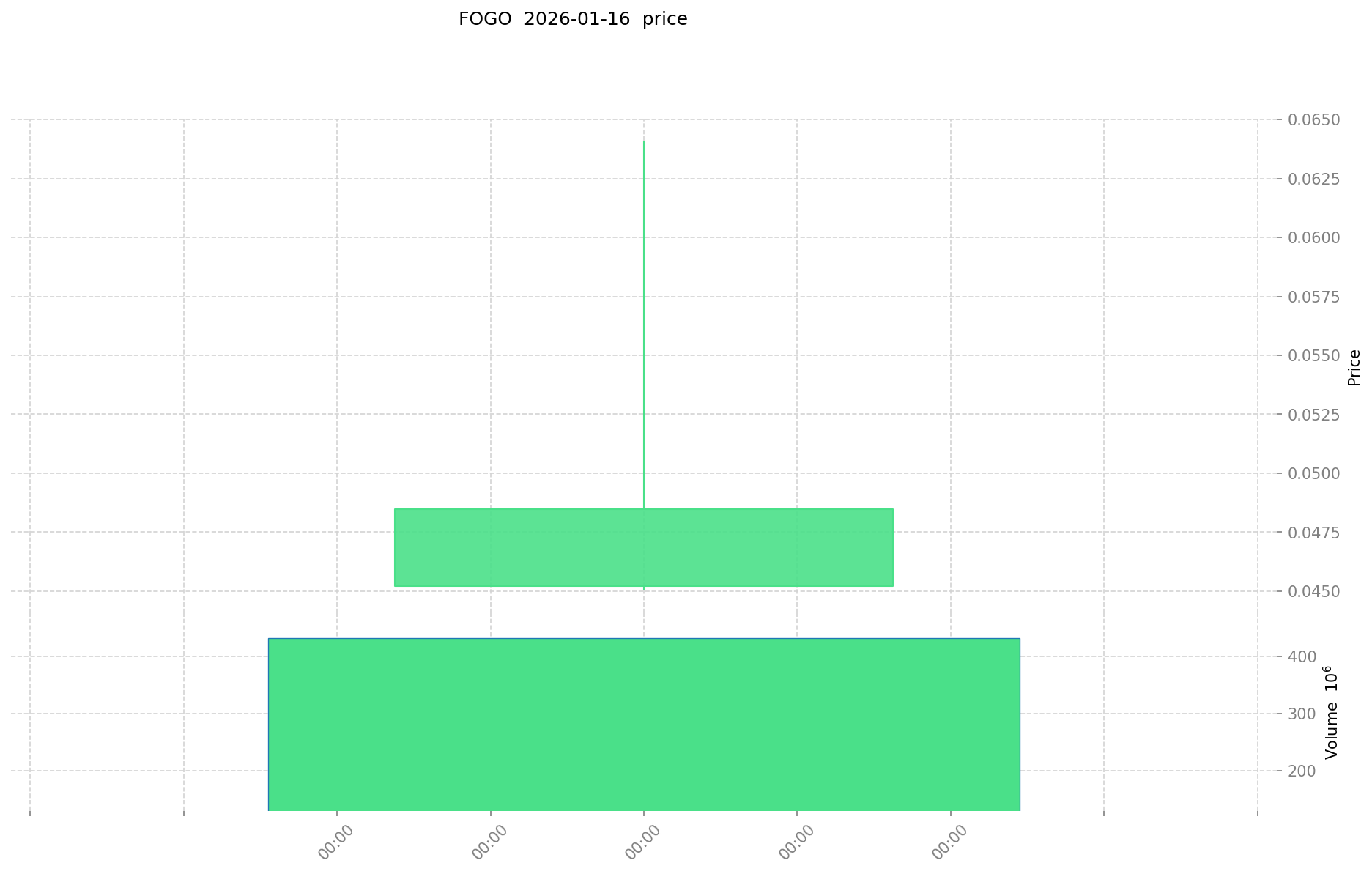
Recent price movements show fluctuations, with FOGO experiencing a decline of approximately 10.92% over 24 hours and 24.94% over the past 7 days. The token reached a price level of $0.06409 on January 15, 2026, and saw a lower point of $0.03875 on January 16, 2026. The circulating supply represents approximately 7.24% of the fully diluted market cap, indicating a relatively low circulation ratio at this stage.
As investors evaluate whether Fogo (FOGO) represents a suitable investment opportunity, understanding its technical foundation as a Layer 1 blockchain, its market performance metrics, and the associated risks becomes essential. This article provides a comprehensive analysis of FOGO's investment value, historical trends, future price considerations, and risk factors to assist investors in their research and decision-making processes.
I. Fogo (FOGO) Price Historical Review and Current Investment Value Status
- January 2026: Token circulation commenced on Binance on January 15, 2026 at 20:00 (UTC+8) → Initial trading phase with high volatility
- January 15, 2026: All-time high recorded at $0.06409 → Price reached peak during early circulation
- January 16, 2026: Market correction occurred → Price declined to $0.03875, representing a downward movement from initial levels
Current FOGO Investment Market Status (January 2026)
- FOGO current price: $0.04002
- Market sentiment (Fear & Greed Index): Data not available in provided materials
- 24-hour trading volume: $28,929,112.01
- Institutional investor holdings: Data not available in provided materials
Click to view real-time FOGO market price
II. Core Factors Affecting Whether FOGO is a Good Investment
Supply Mechanism and Scarcity (FOGO Investment Scarcity)
- Unlimited Max Supply → Potential inflationary pressure on long-term value retention
- Current Circulating Supply: 3.626 billion tokens (7.24% of total circulating ratio)
- Investment Implication: The unlimited supply model may pose challenges for long-term scarcity-based value appreciation
Institutional Investment and Mainstream Adoption (Institutional Investment in FOGO)
- Institutional-Grade Design: FOGO positions itself as a high-performance Layer 1 blockchain designed specifically for institutional-grade decentralized finance
- Trading Platform Support: Listed on 17 exchanges including major platforms, indicating market accessibility
- Mainnet Launch Timeline: Q2 2025 planned mainnet release with support for real-world applications and institutional adoption
Macroeconomic Environment's Impact on FOGO Investment
- Market Performance: 24-hour price change of -10.92%, 7-day change of -24.94%
- Trading Volume: $28.93 million in 24-hour trading volume, reflecting active market participation
- Market Context: Price range between $0.03875 (low) and $0.06409 (high) within 24 hours, indicating volatility
Technology and Ecosystem Development (Technology & Ecosystem for FOGO Investment)
- SVM Layer 1 Architecture: Built on Solana Virtual Machine (SVM), designed for ultra-low latency on-chain trading
- High-Frequency Trading Focus: Purpose-built infrastructure for institutional-grade DeFi and high-frequency trading applications
- Ecosystem Positioning: Targets decentralized finance applications with emphasis on trading performance and institutional use cases
III. FOGO Future Investment Forecast and Price Outlook (Is Fogo(FOGO) worth investing in 2026-2031)
Short-term Investment Forecast (2026, short-term FOGO investment outlook)
Based on available market data, FOGO's short-term outlook presents multiple scenarios:
- Conservative forecast: $0.038-$0.040
- Neutral forecast: $0.040-$0.042
- Optimistic forecast: $0.042-$0.044
The token launched on January 12, 2026, with initial volatility observed across major exchanges. Current trading patterns suggest consolidation around the $0.040 level, with technical indicators showing potential support at lower ranges.
Mid-term Investment Outlook (2027-2028, mid-term Fogo(FOGO) investment forecast)
- Market stage expectation: The project is expected to transition from early adoption to broader ecosystem development, with increasing focus on validator participation and DeFi protocol integration
- Investment return forecast:
- 2027: $0.038-$0.048
- 2028: $0.023-$0.060
- Key catalysts: Mainnet performance optimization, developer migration from Solana ecosystem, institutional adoption of high-frequency trading infrastructure, and community governance implementation
The mid-term outlook depends significantly on the network's ability to demonstrate sustained low-latency performance and attract meaningful liquidity providers.
Long-term Investment Outlook (Is FOGO a good long-term investment?)
- Base scenario: $0.032-$0.081 (assuming steady ecosystem growth and maintained technical advantages)
- Optimistic scenario: $0.050-$0.081 (assuming significant DeFi protocol adoption and expanded validator network)
- Risk scenario: $0.023-$0.040 (considering intensified Layer 1 competition and potential technical challenges)
Click to view FOGO long-term investment and price forecast: Price Prediction
2026-2031 Long-term Outlook
- Base scenario: $0.032 - $0.069 USD (corresponding to steady progress and gradual mainstream application improvement)
- Optimistic scenario: $0.050 - $0.081 USD (corresponding to large-scale adoption and favorable market environment)
- Transformative scenario: Above $0.081 USD (if ecosystem achieves breakthrough developments and mainstream popularization)
- 2031-12-31 predicted high: $0.080 USD (based on optimistic development assumptions)
Disclaimer: Price forecasts are inherently speculative and subject to significant uncertainty. The cryptocurrency market exhibits high volatility, and FOGO's performance will depend on multiple factors including network adoption, validator participation, developer activity, and broader market conditions. Historical performance does not guarantee future results. These projections should not be construed as financial advice, and potential investors should conduct thorough research and assess their risk tolerance before making investment decisions.
| Year |
Predicted High Price |
Predicted Average Price |
Predicted Low Price |
Price Change |
| 2026 |
0.0436218 |
0.04002 |
0.0384192 |
0 |
| 2027 |
0.048094035 |
0.0418209 |
0.038475228 |
4 |
| 2028 |
0.06024300645 |
0.0449574675 |
0.0233778831 |
12 |
| 2029 |
0.0641722891095 |
0.052600236975 |
0.0368201658825 |
31 |
| 2030 |
0.081156905628727 |
0.05838626304225 |
0.032112444673237 |
46 |
| 2031 |
0.080237321985812 |
0.069771584335488 |
0.050933256564906 |
74 |
IV. Fogo Investment Strategy and Risk Management (How to invest in Layer 1 blockchain)
Investment Methodology (Fogo investment strategy)
Long-term Holding (HODL Fogo): Suitable for conservative investors
For investors with a long-term perspective, holding FOGO may be considered as part of a diversified blockchain portfolio strategy. This approach typically involves:
- Evaluating the project's fundamental technical development and ecosystem growth
- Monitoring the progression of on-chain trading functionality and user adoption
- Assessing the competitive landscape within the Layer 1 blockchain sector
- Implementing periodic portfolio rebalancing based on market conditions
Active Trading: Relying on technical analysis and swing trading
Active traders may approach FOGO through:
- Technical chart analysis utilizing historical price data and trading volumes
- Identifying support and resistance levels based on the token's price range between $0.03875 and $0.06409
- Monitoring the 24-hour trading volume of approximately $28.93 million for liquidity assessment
- Implementing stop-loss mechanisms to manage downside exposure
Risk Management (Risk management for Fogo investment)
Asset Allocation Ratio: Conservative / Aggressive / Professional investors
- Conservative investors: May consider allocating 1-3% of their cryptocurrency portfolio to emerging Layer 1 projects like FOGO
- Aggressive investors: Could allocate 5-10% while maintaining diversification across multiple blockchain ecosystems
- Professional investors: May implement dynamic allocation strategies based on market cycles and technical indicators
Risk Hedging Solutions: Multi-asset portfolio + hedging tools
- Diversification across established Layer 1 blockchains and emerging projects
- Utilizing stablecoin positions to manage volatility exposure
- Implementing correlation analysis with major cryptocurrency assets
- Consider derivatives or hedging instruments where available
Secure Storage: Hot and cold wallets + hardware wallet recommendations
- Cold storage solutions for long-term holdings (hardware wallets such as Ledger or Trezor)
- Hot wallets for active trading with limited fund allocation
- Multi-signature wallet configurations for enhanced security
- Regular security audits and backup procedures for private keys
V. Fogo Investment Risks and Challenges (Risks of investing in Layer 1 blockchain)
Market Risks: High volatility and potential price manipulation
FOGO has demonstrated significant price volatility, with fluctuations ranging from $0.03875 to $0.06409 within a short timeframe. Key market risks include:
- The token has experienced a 24-hour price decline of 10.92% and a 7-day decline of 24.94%
- With a circulating supply of 3.626 billion tokens representing only 7.24% of the total supply, the unlimited maximum supply structure presents potential dilution concerns
- The relatively limited exchange availability across 17 platforms may impact liquidity during volatile market conditions
- Market capitalization of approximately $145 million positions FOGO as a mid-cap asset with corresponding volatility characteristics
Regulatory Risks: Policy uncertainty across different jurisdictions
- Evolving regulatory frameworks for Layer 1 blockchain networks across various jurisdictions
- Potential classification changes affecting trading, custody, and operational compliance
- Cross-border regulatory inconsistencies impacting global accessibility
- Compliance requirements that may affect the project's development roadmap or operational structure
Technical Risks: Network security vulnerabilities and upgrade failures
- Blockchain security considerations inherent to new Layer 1 networks
- Smart contract vulnerabilities that may affect on-chain trading functionality
- Network stability and scalability challenges during high-traffic periods
- Potential technical implementation risks associated with planned upgrades or features
- Competition from established Layer 1 ecosystems with proven track records
VI. Conclusion: Is Layer 1 blockchain a Good Investment?
Investment Value Summary: Fogo presents characteristics of an emerging Layer 1 blockchain project focused on on-chain trading experiences, with notable short-term price volatility.
The project operates within the competitive Layer 1 blockchain sector, with a current market position reflecting early-stage development. The significant price movements observed—including a 24.94% decline over seven days—underscore the volatile nature of investments in emerging blockchain infrastructure.
Key considerations include the unlimited token supply structure, the relatively low circulating supply ratio of 7.24%, and the project's positioning within the evolving on-chain trading landscape.
Investor Recommendations:
✅ Beginners: Consider dollar-cost averaging strategies combined with secure wallet storage solutions. Prioritize education on blockchain fundamentals and risk management before allocating capital.
✅ Experienced Investors: May explore swing trading opportunities while maintaining diversified portfolio allocations. Implement technical analysis frameworks and establish clear entry/exit criteria.
✅ Institutional Investors: Conduct comprehensive due diligence on technical infrastructure, team capabilities, and competitive positioning. Consider strategic allocation as part of broader blockchain infrastructure exposure.
⚠️ Disclaimer: Cryptocurrency investments carry substantial risk. This content is provided for informational purposes only and does not constitute investment advice. Conduct independent research and consult with qualified financial advisors before making investment decisions.
VII. FAQ
Q1: Is Fogo (FOGO) a good investment for beginners in 2026?
FOGO presents high-risk characteristics that may not be suitable for beginner investors without proper risk management strategies. The token has demonstrated significant volatility with a 24.94% decline over seven days and price fluctuations between $0.03875 and $0.06409 within 24 hours. Beginners considering FOGO should implement dollar-cost averaging strategies, allocate only 1-3% of their cryptocurrency portfolio, and prioritize secure wallet storage. Given the unlimited token supply and early-stage development status, beginners must understand blockchain fundamentals and establish clear risk tolerance levels before investing.
Q2: What makes Fogo different from other Layer 1 blockchains?
FOGO is purpose-built on Solana Virtual Machine (SVM) architecture specifically for institutional-grade decentralized finance and high-frequency trading applications. Unlike general-purpose Layer 1 blockchains, FOGO focuses on ultra-low latency on-chain trading experiences, targeting professional traders and institutional users. However, this specialized positioning also means FOGO faces intense competition from established Layer 1 ecosystems with proven track records. The project's mainnet launch planned for Q2 2025 and its emphasis on trading performance differentiate it within the Layer 1 landscape, though actual adoption and performance remain to be demonstrated.
Q3: What are the major risks associated with investing in FOGO?
FOGO carries three primary risk categories: market risks, technical risks, and regulatory risks. Market risks include extreme volatility (10.92% decline in 24 hours), unlimited token supply creating potential dilution concerns, and a low circulating supply ratio of 7.24% which may impact price stability. Technical risks encompass blockchain security vulnerabilities inherent to new Layer 1 networks, potential smart contract vulnerabilities, and network scalability challenges. Regulatory risks involve evolving policy frameworks across jurisdictions that may affect operations, trading accessibility, and compliance requirements. The combination of these factors necessitates comprehensive risk assessment before investment.
Q4: How should investors approach FOGO's price volatility?
Investors should implement structured approaches based on their risk profiles and investment objectives. Long-term holders may consider implementing dollar-cost averaging strategies to mitigate timing risks, while active traders should establish clear support and resistance levels (current range: $0.03875-$0.06409) and utilize stop-loss mechanisms. Conservative investors should limit FOGO allocation to 1-3% of their cryptocurrency portfolio, while aggressive investors may allocate 5-10% with proper diversification. Professional investors can implement dynamic allocation strategies based on technical indicators and market cycles. All approaches should include secure storage solutions combining cold wallets for long-term holdings and hot wallets for active trading.
Q5: What is FOGO's long-term investment outlook through 2031?
Long-term forecasts present multiple scenarios based on adoption levels and market conditions. The base scenario projects a range of $0.032-$0.069 USD through 2031, assuming steady ecosystem development and maintained technical advantages. The optimistic scenario forecasts $0.050-$0.081 USD, contingent on significant DeFi protocol adoption and expanded validator networks. However, the risk scenario projects $0.023-$0.040 USD considering intensified Layer 1 competition and potential technical challenges. These projections are highly speculative and dependent on mainnet performance, developer migration from Solana ecosystem, institutional adoption rates, and broader cryptocurrency market conditions. Investors must recognize that historical performance does not guarantee future results.
Q6: What security measures should FOGO investors implement?
FOGO investors should adopt multi-layered security protocols appropriate to their investment strategy. For long-term holdings, cold storage solutions such as Ledger or Trezor hardware wallets provide optimal security against online threats. Active traders should utilize hot wallets with limited fund allocation, keeping the majority of assets in cold storage. Advanced security measures include implementing multi-signature wallet configurations, establishing regular backup procedures for private keys, and conducting periodic security audits. Investors should verify wallet addresses carefully before transactions, enable two-factor authentication on exchange accounts, and maintain separate devices for cryptocurrency management. Given the early-stage nature of FOGO and limited exchange availability across 17 platforms, enhanced security vigilance is particularly important.
Q7: How does FOGO's unlimited supply affect its investment value?
FOGO's unlimited maximum supply structure presents significant implications for long-term value appreciation. Unlike cryptocurrencies with fixed supply caps that create scarcity-based value propositions, unlimited supply introduces potential inflationary pressure on token value. Currently, only 3.626 billion tokens are circulating, representing 7.24% of the fully diluted market cap, indicating substantial future supply could enter circulation. This supply dynamic may challenge traditional scarcity-driven appreciation models and requires investors to focus on network utility, adoption rates, and demand-side factors rather than supply constraints. The unlimited supply model necessitates sustained ecosystem growth and user adoption to maintain or increase token value over time, distinguishing FOGO's value proposition from fixed-supply Layer 1 alternatives.
Q8: What catalysts could drive FOGO's price performance in 2026-2028?
Several key catalysts may influence FOGO's mid-term price trajectory. Technical catalysts include the mainnet launch planned for Q2 2025, demonstrating sustained low-latency performance for high-frequency trading, and successful implementation of institutional-grade DeFi infrastructure. Ecosystem catalysts encompass developer migration from the Solana ecosystem, expansion of the validator network, integration with major DeFi protocols, and community governance implementation. Market catalysts involve increased exchange listings beyond the current 17 platforms, growing institutional adoption of on-chain trading infrastructure, and establishment of strategic partnerships with liquidity providers. The realization of these catalysts remains uncertain and dependent on execution capabilities, competitive dynamics, and broader cryptocurrency market conditions.
* The information is not intended to be and does not constitute financial advice or any other recommendation of any sort offered or endorsed by Gate.